BTC - Bitcoin
 USDTERC20 - USDT ERC20
 ETH - Ethereum
 BNB - Binance
 BCH - Bitcoin Cash
 DOGE - Dogecoin
 TRX - TRON
 USDTTRC20 - USD TRC20
 LTC - LiteCoin

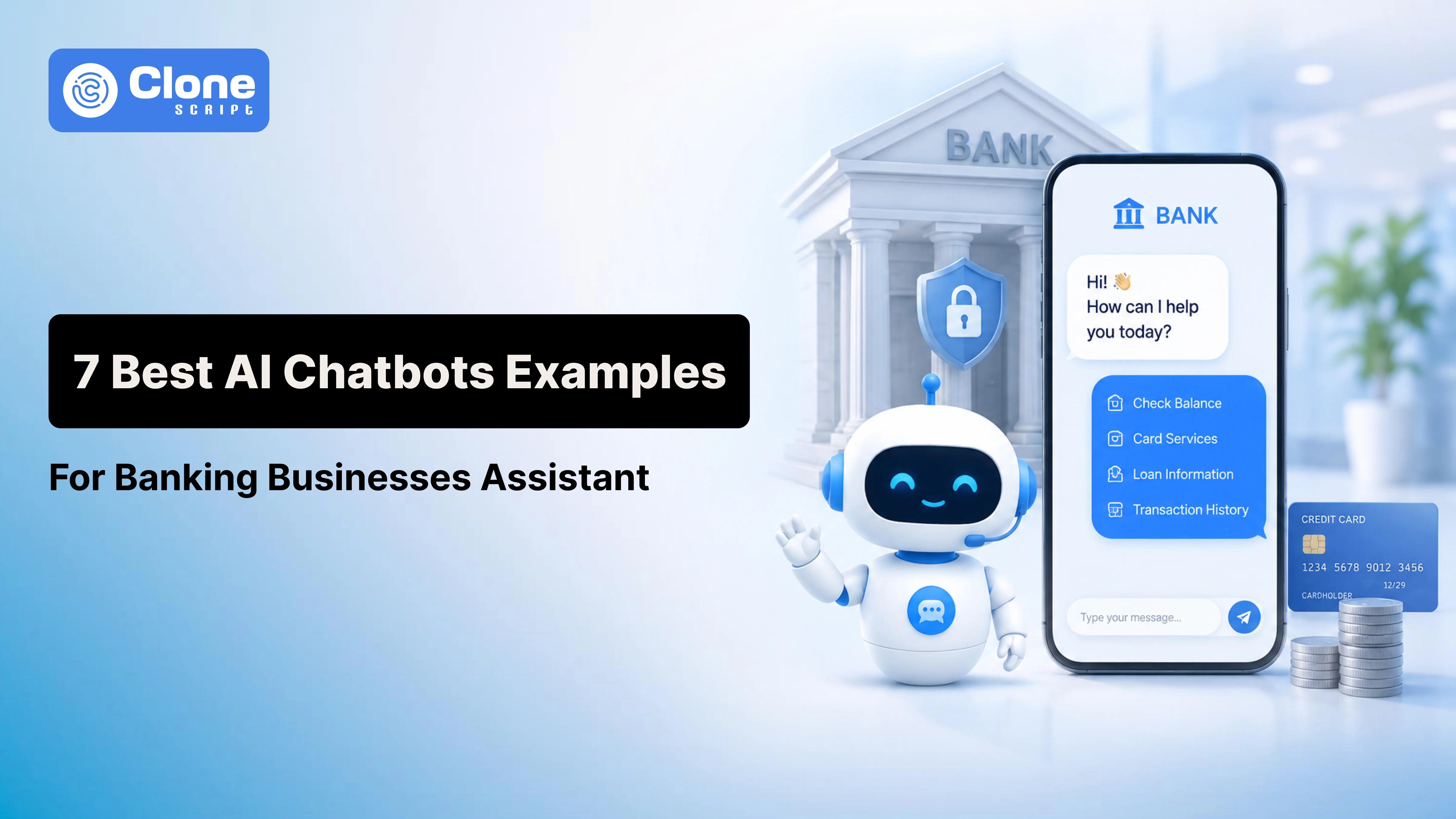
7 Best AI Chatbot Examples for Banking Businesses Assistant
Customer expectations in banking have changed significantly over the last few years. People now expect instant answers about account balances, loan eligibility, card services, and payment issues without waiting in long support queues. At the same time, banks are looking for ways to improve customer service while reducing operational costs.
This is where AI chatbots have become an important part of digital banking. Modern banking AI assistants can answer common questions, guide customers through financial services, detect potential fraud, assist employees internally, and provide personalized support around the clock.
In this guide, we'll explore seven of the best AI chatbot examples for banking businesses, compare their features, pricing, and ideal use cases, and help you decide whether an existing platform or a custom banking chatbot is the right investment for your organization.
What Is an AI Chatbot for Banking?
An AI chatbot for banking is a virtual assistant that uses artificial intelligence, natural language processing (NLP), and machine learning to communicate with customers through websites, mobile apps, messaging platforms, or voice channels. Unlike traditional rule-based bots, modern AI chatbots understand natural conversations and provide contextual responses.
These chatbots can securely help customers:
-
Check account information
-
Answer banking questions
-
Assist with loan applications
-
Schedule appointments
-
Locate nearby branches
-
Explain banking products
-
Escalate complex cases to human agents when necessary.
Many enterprise banking chatbots also integrate with core banking systems, CRM software, authentication services, payment gateways, and customer databases. This allows them to provide personalized assistance while maintaining security and regulatory compliance.
For banks, AI chatbots reduce repetitive workloads, improve customer satisfaction, and provide consistent support 24 hours a day without increasing staffing costs.
Benefits of AI Chatbots for Banking Businesses
AI chatbots provide value beyond answering customer questions. They improve operational efficiency and create better banking experiences across digital channels.
Some of the biggest benefits include:
-
Provide 24/7 customer support without increasing staffing costs.
-
Reduce average response and resolution times.
-
Handle thousands of customer conversations simultaneously.
-
Assist customers with loans, credit cards, and account services.
-
Guide users through KYC and onboarding processes.
-
Help detect and report suspicious account activities.
-
Personalize recommendations based on customer profiles.
-
Support bank employees with internal knowledge and documentation.
-
Improve customer satisfaction through faster service.
-
Reduce call center workload and operational expenses.
Banks of all sizes, from regional institutions to multinational financial organizations, are increasingly adopting AI-powered assistants to improve service quality and keep costs under control.
7 Best AI Chatbot Examples for Banking Businesses
Banks have different requirements depending on their size, customer base, and digital infrastructure. Some need a customer service chatbot that handles everyday banking queries; others require enterprise-grade AI assistants capable of integrating with core banking systems and automating complex workflows.
Below are seven trusted AI chatbot platforms that financial institutions use to improve customer support, streamline operations, and deliver personalized banking experiences.
1. IBM watsonx Assistant
Website: https://www.ibm.com/products/watsonx-data-integration
IBM watsonx Assistant is an enterprise AI chatbot platform designed for highly regulated industries, including banking and financial services. It combines conversational AI with automation to help banks resolve customer inquiries, reduce support costs, and deliver secure, personalized experiences across digital channels.
Best Features
-
Natural language understanding with generative AI capabilities.
-
Integrates with banking systems, CRM platforms, and customer databases.
-
Supports web, mobile apps, voice assistants, and messaging channels.
-
Enterprise-grade security and governance controls.
-
Workflow automation with human-agent handoff.
-
Advanced analytics for chatbot performance and customer insights.
Banking Use Cases
Banks use IBM watsonx Assistant to answer account-related questions, guide customers through loan applications, support credit card services, provide branch information, assist with fraud reporting, and automate internal employee support requests.
Pros
-
Built for enterprise-scale deployments.
-
Strong security and compliance features.
-
Extensive integration capabilities.
-
Supports complex customer conversations.
Limitations
-
Requires implementation planning and technical expertise.
-
Premium features may increase overall costs.
Pricing
Custom enterprise pricing based on business requirements.
2. Amelia (SoundHound AI)
Website: https://www.soundhound.com/voice-ai-solutions/financial-services/
Amelia is a conversational AI platform from SoundHound AI that specializes in customer service automation for financial institutions. It combines natural conversations with task automation, which means banks can resolve customer requests and reduce dependence on live support agents.
Best Features
-
Human-like conversational AI.
-
Omnichannel support across web, mobile, and voice.
-
Integration with CRM and banking applications.
-
Intelligent workflow automation.
-
Secure authentication capabilities.
-
AI-powered analytics and reporting.
Banking Use Cases
Banks deploy Amelia to assist customers with account inquiries, loan applications, payment support, card management, branch services, and frequently asked questions. It is also helping employees access internal knowledge faster.
Pros
-
Natural and engaging conversations.
-
Strong automation capabilities.
-
Suitable for enterprise banking environments.
-
Reduces customer support workload.
Limitations
-
Enterprise implementation can take time.
-
Pricing is not publicly available.
Pricing
Custom pricing available upon request.
3. Kore.ai
Website: https://www.kore.ai/ai-for-service/ai-for-banking
Kore.ai offers an enterprise conversational AI platform that helps banks automate customer service, employee support, and back-office operations. Its AI agents can understand complex financial conversations and integrate with existing banking systems for seamless customer experiences.
Best Features
-
Generative AI-powered virtual assistants.
-
Low-code chatbot development tools.
-
Omnichannel deployment.
-
Banking workflow automation.
-
Secure enterprise integrations.
-
Performance monitoring and analytics.
Banking Use Cases
Financial institutions use Kore.ai to automate customer support, process loan inquiries, guide users through digital onboarding, assist with credit card services, answer account-related questions, and improve employee productivity.
Pros
-
Highly customizable platform.
-
Strong enterprise integrations.
-
Supports both customer-facing and internal use cases.
-
Scalable for large organizations.
Limitations
-
Learning curve for advanced customization.
-
Better suited for medium to large enterprises.
Pricing
Custom pricing based on deployment requirements.
4. Yellow.ai
Website: https://yellow.ai/industries/bfsi/
Yellow.ai is an enterprise conversational AI platform that helps banks automate customer interactions across multiple digital channels. Its AI agents support customer service, sales, and engagement using generative AI to provide faster, more personalized banking experiences.
Best Features
-
Generative AI-powered customer support.
-
Omnichannel deployment across websites, mobile apps, WhatsApp, and social messaging platforms.
-
Low-code chatbot builder with workflow automation.
-
Multilingual support for global banking customers.
-
CRM and core banking integrations.
-
Real-time analytics and conversation insights.
Banking Use Cases
Banks use Yellow.ai to answer account-related questions, assist with loan applications, resolve debit and credit card issues, provide transaction support, automate customer onboarding, and send proactive alerts for payments, reminders, and account activities.
Pros
-
Supports multiple communication channels.
-
Easy to scale across different banking services.
-
Strong multilingual capabilities.
-
AI automation reduces customer support workload.
Limitations
-
Advanced implementations may require technical support.
-
Enterprise pricing isn't publicly disclosed.
Pricing
Free plan available. Custom pricing based on business requirements.
5. Microsoft Copilot Studio
Website: https://www.microsoft.com/en-us/microsoft-365-copilot/microsoft-copilot-studio
Microsoft Copilot Studio enables banks to build custom AI assistants using Microsoft's AI ecosystem. Organizations can create conversational agents that connect with Microsoft 365, Dynamics 365, Azure services, and third-party banking applications to automate customer support and internal operations.
Best Features
-
Low-code AI chatbot development platform.
-
Integration with Microsoft 365 and Dynamics 365.
-
Generative AI powered by Microsoft AI services.
-
Secure enterprise authentication and governance.
-
Custom workflows using Power Platform.
-
Extensive integration through APIs and connectors.
Banking Use Cases
Banks use Microsoft Copilot Studio to automate customer inquiries, support mortgage and loan applications, help employees retrieve internal policies, answer account service questions, and simplify repetitive administrative tasks.
Pros
-
Ideal for organizations using Microsoft's ecosystem.
-
Flexible customization with low-code development.
-
Enterprise-grade security and compliance.
-
Strong automation capabilities.
Limitations
-
Best suited for businesses already using Microsoft products.
-
Advanced integrations may require Power Platform expertise.
Pricing
Subscription-based pricing starting from $30/month with additional costs depending on AI usage and Microsoft services.
6. Salesforce Agentforce
Website: https://www.salesforce.com/in/financial-services/artificial-intelligence/
Salesforce Agentforce brings autonomous AI agents into the Salesforce ecosystem. From it, banks automate customer engagement, sales assistance, and service operations. It combines generative AI with customer data to deliver personalized conversations throughout the banking journey.
Best Features
-
AI agents built on Salesforce Data Cloud.
-
Personalized responses using customer relationship data.
-
Integration with Financial Services Cloud.
-
Automated workflows and task execution.
-
Omnichannel customer engagement.
-
Enterprise-grade security and governance.
Banking Use Cases
Banks use Salesforce Agentforce to assist customers with account management, recommend financial products, support loan servicing, automate case management, answer service requests, and help relationship managers respond more efficiently.
Pros
-
Excellent for Salesforce-based financial organizations.
-
Personalized customer experiences.
-
Strong workflow automation.
-
Scalable enterprise platform.
Limitations
-
Requires Salesforce products for maximum value.
-
Enterprise implementation can be resource-intensive.
Pricing
Custom enterprise pricing based on Salesforce products and business requirements starting from $325/month.
7. Tidio AI Chatbot
Website: https://www.tidio.com/industry/finance/
Tidio is an AI-powered customer service platform that combines live chat, chatbot automation, and AI assistance into a single solution. While it serves multiple industries, its finance-focused features help banks, credit unions, and fintech companies automate customer support, answer routine banking questions, and improve response times without requiring a large support team.
Best Features
-
AI chatbot powered by Lyro AI Agent.
-
Live chat and chatbot in one platform.
-
Omnichannel customer communication.
-
No-code chatbot builder with customizable workflows.
-
Integrates with CRM systems and popular business tools.
-
Human agent handoff for complex customer requests.
Banking Use Cases
Banks and financial service providers use Tidio to answer frequently asked questions, guide customers through account opening, explain loan and credit card options, schedule appointments with advisors, provide branch information, and manage general customer support inquiries. It is particularly suitable for smaller banks, digital-first financial institutions, and fintech startups looking for an affordable AI customer support solution.
Pros
-
Easy to deploy with minimal technical expertise.
-
Affordable pricing for small and medium-sized businesses.
-
Combines AI chatbot, live chat, and automation in one platform.
-
Simple interface with customizable workflows.
Limitations
-
Not as deeply integrated with enterprise core banking systems as specialized banking AI platforms.
-
Advanced AI automation features are available only in higher-tier plans.
Pricing
Offers a free plan with paid plans starting at approximately $24.17 per month (billed annually), while Lyro AI features are available through higher-tier subscriptions.
Should You Build a Custom Banking AI Chatbot?
Ready-made AI chatbot platforms are ideal for banks that need fast deployment, standard customer support, and basic automation. However, larger financial institutions often require more flexibility.
A custom banking AI chatbot is the better choice when you need core banking integration, custom internal workflows, regulatory compliance, proprietary AI models, multi-language support, or enterprise-wide automation.
These solutions are built around your existing systems, ensuring better security, scalability, and customer experiences. If your bank needs tailored AI capabilities, consider a professional AI chatbot development service to build a secure, business-specific banking assistant.
Conclusion
AI chatbots are helping banks deliver faster support, automate routine operations, and improve customer experiences. Whether you choose a ready-made platform or invest in a custom banking AI chatbot depends on your business needs, integration requirements, and growth plans. Selecting the right solution today can create long-term value for both your customers and employees for long-term success.