BTC - Bitcoin
 USDTERC20 - USDT ERC20
 ETH - Ethereum
 BNB - Binance
 BCH - Bitcoin Cash
 DOGE - Dogecoin
 TRX - TRON
 USDTTRC20 - USD TRC20
 LTC - LiteCoin

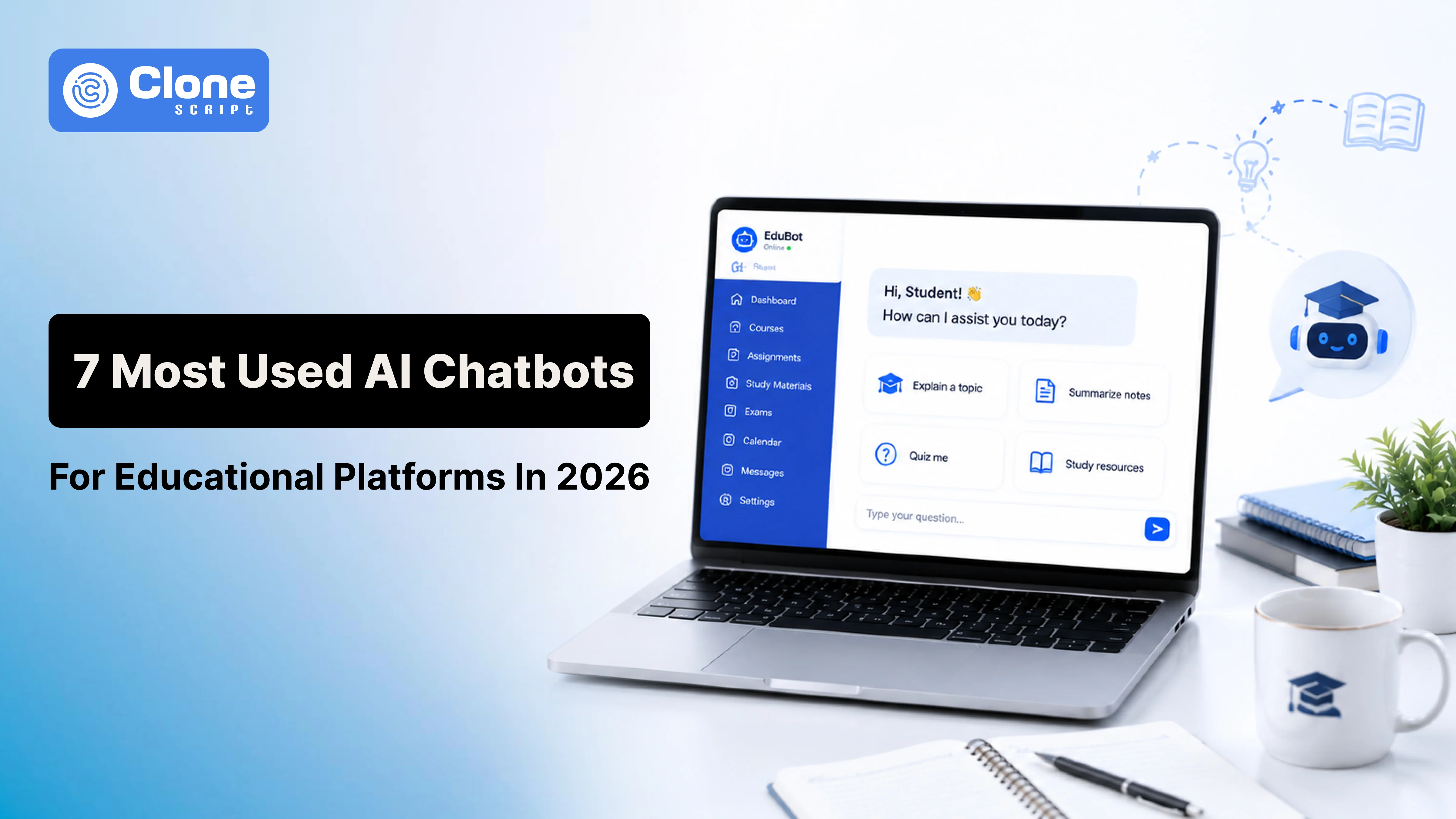
7 Most Used AI Chatbots for Educational Platforms Internationally
Choosing an educational platform is rarely a quick decision. Prospective students compare multiple institutions, explore course options, check admission requirements, and look for answers before they ever speak with a representative. When those answers aren't easy to find, many simply move on to another provider that responds faster.
This shift in student behavior has pushed schools, universities, and online learning platforms to rethink how they handle support and engagement. Depending on the admissions teams and support staff is not enough. Many institutions now use AI-powered chatbot assistants to answer questions instantly.
As a result, the most used AI chatbots for educational platforms are becoming an important part of the student experience. However, each solution serves a different purpose. Some focus on admissions, others on academic assistance or student retention. In this guide, we'll examine seven widely used options and where they fit best.
What Makes an AI Chatbot Good for Educational Platforms?
Here are those factors to consider:
-
Student Support Capabilities
Students often need quick answers about admissions, course requirements, schedules, fees, assignments, and campus services. An effective educational chatbot should be able to handle these inquiries accurately and consistently.
-
Learning Management System (LMS) Integration
The chatbot should integrate smoothly with platforms such as Moodle, Canvas, Blackboard, or custom learning systems. Strong integration allows students to access relevant information without switching between multiple tools.
-
Multilingual Communication
Many educational institutions serve students from different regions and backgrounds. Multilingual support helps provide a better experience for international students and improves accessibility.
-
Personalization and Learning Assistance
Advanced AI chatbots can provide personalized recommendations, learning guidance, and tailored responses based on a student's profile, course history, or learning objectives.
-
Analytics and Reporting
Educational institutions need visibility into student interactions. Reporting features help identify common questions, support gaps, and areas where students may need additional assistance.
-
Scalability and Ease of Management
As enrollment grows, the chatbot should continue handling increasing numbers of conversations without affecting response quality. Easy management and customization are equally important.
-
Data Privacy and Security
Educational organizations handle sensitive student information. A chatbot should offer strong security controls and comply with applicable privacy regulations to protect user data.
7 Most Used AI Chatbots for Educational Platforms Internationally
Here is the list of AI chatbots used in educational websites and apps.
1. ChatGPT Edu
Website: https://chatgpt.com/business/education/
Most educational chatbots are built to answer questions, but ChatGPT Edu is designed to support a much broader range of academic activities. Universities use it not only for student assistance but also for research support, content creation, curriculum planning, and administrative productivity. This wider scope has made it one of the most discussed AI solutions in higher education.
Why Institutions Use It
ChatGPT Edu can understand context, generate detailed explanations, summarize information, and assist with complex academic tasks. This makes it useful across multiple departments rather than a single support function.
Best For
-
Universities and colleges
-
Research institutions
-
Higher education organizations
-
Multi-campus educational systems
Key Features
-
Natural language conversations
-
Academic research assistance
-
Document summarization
-
Custom AI assistants for departments
-
Multilingual support
-
Enterprise-grade security controls
Strengths
One of the biggest advantages of ChatGPT Edu is flexibility. A university can use it to help prospective students explore programs, assist faculty with content development, and support learners who need additional explanations outside the classroom. Few educational AI solutions offer this level of versatility.
Limitations
Because it is a general-purpose AI platform, institutions often need clear usage policies and governance frameworks. It may also require additional customization for organizations seeking highly specialized admissions or student-retention workflows.
Pricing
Custom pricing based on institution size and deployment requirements.
2. Khanmigo
Website: https://www.khanmigo.ai/
While many educational AI tools focus on answering questions, Khanmigo was created with a different goal: helping students learn how to think through problems rather than simply providing answers. Developed by Khan Academy, it acts more like a learning companion than a traditional chatbot.
Why Institutions Use It
Teachers often face a common challenge: students need support outside classroom hours, but providing one-on-one guidance at scale is difficult. Khanmigo helps bridge this gap by offering guided assistance that encourages critical thinking and active learning.
Best For
-
K-12 schools
-
Tutoring businesses
-
Online learning platforms
-
Supplemental education programs
Key Features
-
AI-powered tutoring assistance
-
Guided problem-solving
-
Writing support and feedback
-
Lesson planning assistance
-
Student progress support
-
Classroom learning integration
Strengths
Khanmigo stands out because it avoids becoming an answer machine. Instead, it asks follow-up questions, provides hints, and helps students work toward solutions independently. This approach aligns more closely with educational objectives than many general-purpose AI tools.
Limitations
Its primary focus is teaching and learning support. Institutions seeking advanced admissions automation, enrollment management, or campus-wide student services may need additional solutions alongside Khanmigo.
Pricing
Pricing varies depending on educational plans and institutional requirements.
3. Mainstay
Website: https://mainstay.com/
Many students don't leave educational programs because they lack interest or ability. In many cases, they miss important deadlines, overlook critical information, or disengage due to a absence of communication. Mainstay was developed to help institutions address these challenges through proactive student engagement.
Why Institutions Use It
Educational institutions generate countless reminders throughout the year, from application deadlines and orientation schedules to financial aid requirements and course registration dates. Mainstay helps automate these interactions, ensuring students receive timely guidance without overwhelming support staff.
Best For
-
Higher education institutions
-
Student retention initiatives
-
Enrollment and admissions teams
-
Community colleges and universities
Key Features
-
AI-driven student messaging
-
Automated reminders and follow-ups
-
Enrollment support workflows
-
Student success campaigns
-
Two-way conversational engagement
-
Performance analytics
Strengths
Mainstay's biggest advantage is its focus on proactive communication. Rather than waiting for students to ask questions, the platform helps institutions reach out with relevant information at key moments. This can improve engagement and reduce the likelihood of students missing important milestones.
Limitations
Mainstay is primarily designed around communication and student success initiatives. Institutions looking for advanced tutoring capabilities or curriculum-focused AI assistance may need complementary solutions.
Pricing
Custom pricing based on institution size, student volume, and feature requirements.
4. LearnWise AI
Website: https://www.learnwise.ai/
As AI tools become more common in education, many institutions are asking a different question: How can students use AI responsibly without compromising learning outcomes? LearnWise AI was built around this challenge, combining academic support with safeguards designed specifically for educational environments.
Why Institutions Use It
General AI tools can be powerful, but they may lack visibility and control from an educator's perspective. LearnWise AI gives institutions a way to provide AI assistance and maintain alignment with teaching objectives, course materials, and academic policies.
Best For
-
Universities and colleges
-
Online learning platforms
-
Academic support centers
-
Institutions adopting AI-assisted learning
Key Features
-
Course-aware AI assistance
-
LMS integration capabilities
-
Academic support chatbot
-
Faculty oversight tools
-
Student learning guidance
-
Usage analytics and reporting
Strengths
One of LearnWise AI's biggest differentiators is its focus on education-first implementation. Rather than functioning as a standalone chatbot, it can work alongside existing learning environments to provide support that is more relevant to specific courses and learning objectives.
Limitations
Compared with broader AI platforms, LearnWise AI may offer less flexibility for non-academic use cases such as institution-wide administrative automation or research assistance.
Pricing
The starting cost is $2-20 per month. There is also an option for custom pricing based on academic organization size, integrations, and deployment needs.
5. Ivy.ai
Website: https://ivy.ai/
Educational institutions receive thousands of repetitive questions every year. Prospective students ask about admission requirements, parents want information about tuition, and current students need help finding campus resources. Responding to these inquiries manually can consume a significant amount of staff time. Ivy.ai was created to automate these interactions while maintaining a conversational experience.
Why Institutions Use It
Unlike many AI platforms that serve multiple industries, Ivy.ai has focused heavily on higher education. Its knowledge base can be trained using institutional content that allows students to receive answers that are specific to the school rather than generic responses pulled from the web.
Best For
-
Universities and colleges
-
Admissions offices
-
Student services departments
-
Institutional websites
Key Features
-
AI-powered student support
-
Admissions inquiry handling
-
Website chatbot deployment
-
Knowledge base integration
-
Multilingual communication
-
Conversation analytics
Strengths
Ivy.ai helps answer institution-specific questions. Whether students need information about deadlines, academic programs, campus facilities, or financial aid processes, the chatbot can deliver consistent responses without requiring staff intervention for every inquiry.
Limitations
Its primary strength lies in student services and information delivery. Organizations seeking advanced tutoring capabilities, research assistance, or classroom-focused AI support may find its scope more limited.
Pricing
Custom pricing based on institution size and implementation requirements.
6. Haptik
Website: https://www.haptik.ai/industry/education
Not every educational institution has the resources to build a custom AI assistant from scratch. Many need a solution that can handle admissions inquiries, lead qualification, student support, and communication across multiple channels without requiring a large technical team. This is where Haptik has found its place in the education sector.
Why Institutions Use It
The student journey often begins long before an application is submitted. Prospective students browse programs, compare tuition costs, explore scholarship opportunities, and seek answers about eligibility requirements. Haptik helps educational organizations engage these prospects early and guide them toward enrollment.
Best For
-
Universities and colleges
-
Online learning providers
-
EdTech businesses
-
Admissions and enrollment teams
Key Features
-
AI-powered conversational support
-
Admissions and lead qualification workflows
-
Omnichannel communication
-
WhatsApp integration
-
Automated student engagement
-
Analytics and performance tracking
Strengths
Haptik's major advantage is its ability to manage large volumes of conversations across multiple communication channels. Educational institutions can engage prospective students through their preferred platforms. It maintains a consistent support experience throughout the enrollment process.
Limitations
Although Haptik performs well for communication and enrollment workflows, it is not primarily designed as an academic tutoring or learning-assistance platform. Institutions focused on instructional support may require additional AI tools.
Pricing
Custom pricing based on conversation volume, integrations, and deployment requirements.
7. TutorAI
Website: https://tutorai.me/
Unlike admission-focused chatbots, TutorAI is designed to support the learning process itself. It acts as a virtual tutor that helps students understand concepts, find relevant learning resources, and receive guidance outside scheduled classroom hours. This makes it particularly perfect for online education platforms that need scalable learner support.
Why Institutions Use It
As course libraries grow, students often struggle to find the right content or understand complex topics independently. TutorAI provides instant assistance, helping learners stay engaged without requiring constant instructor intervention.
Best For
-
Online learning platforms
-
Course marketplaces
-
EdTech startups
-
Corporate training portals
Key Features
-
AI-powered tutoring assistance
-
Personalized learning recommendations
-
Course navigation support
-
Question-and-answer functionality
-
Learning progress guidance
-
Multi-language support
Strengths
TutorAI enhances the student experience by providing immediate academic support. Learners can ask questions, clarify concepts, and discover relevant resources without leaving the platform, helping improve engagement and course completion rates.
Limitations
The platform focuses primarily on learning assistance and may not provide advanced admissions, enrollment, or student retention capabilities found in higher education-focused solutions.
Pricing
The starting price is $13.33 per month. There are other paid plans to opt for.
How to Choose the Right AI Chatbot for Your Educational Platform?
Before making a decision, evaluate your institution's goals and operational requirements.
-
Define your primary objective: Determine whether you need support for admissions, student services, learning assistance, or enrollment management.
-
Check integration capabilities: Ensure the chatbot works with your LMS, CRM, student portal, and communication tools.
-
Evaluate student experience: Look for natural conversations, quick responses, and personalized interactions.
-
Consider multilingual support: This is especially important for institutions serving international students.
-
Review analytics and reporting: Data insights can help identify student needs and improve support processes.
-
Assess scalability: Choose a solution that can handle growing student numbers without affecting performance.
-
Compare pricing and implementation costs: Consider both short-term affordability and long-term value before making a final decision.
Selecting an AI chatbot can be challenging because each platform is designed for different educational needs. Some focus on student engagement, while others specialize in admissions, academic assistance, or retention.
Should You Build a Custom Educational AI Chatbot?
Choosing between a ready-made chatbot and a custom-built solution depends on how your educational platform operates today and how you plan to scale in the future. While many institutions can get started with an existing platform, others require features and workflows that off-the-shelf solutions cannot provide.
-
A ready-made chatbot is often enough.
For handling admissions inquiries, student FAQs, enrollment support, and basic engagement, a ready-made solution cannot be helpful. Custom development offers faster deployment, lower upfront costs, and minimal technical management.
-
Custom AI chatbot development makes sense.
When you need advanced LMS integration, personalized learning experiences, institution-specific workflows, or unique features tailored to students, faculty, and administrators, go with this solution.
-
Cost is a major consideration.
Subscription-based platforms usually have predictable monthly fees, while custom development requires investment in design, development, testing, deployment, and ongoing maintenance.
-
Scalability should be part of the decision.
As student numbers increase, your chatbot must handle more conversations, data, and integrations without affecting performance.
If your institution needs a tailored solution built around its specific educational goals, consider exploring professional AI chatbot development services from All Clone Script. A custom-built chatbot can provide greater flexibility, ownership, and long-term scalability compared to generic platforms.