BTC - Bitcoin
 USDTERC20 - USDT ERC20
 ETH - Ethereum
 BNB - Binance
 BCH - Bitcoin Cash
 DOGE - Dogecoin
 TRX - TRON
 USDTTRC20 - USD TRC20
 LTC - LiteCoin

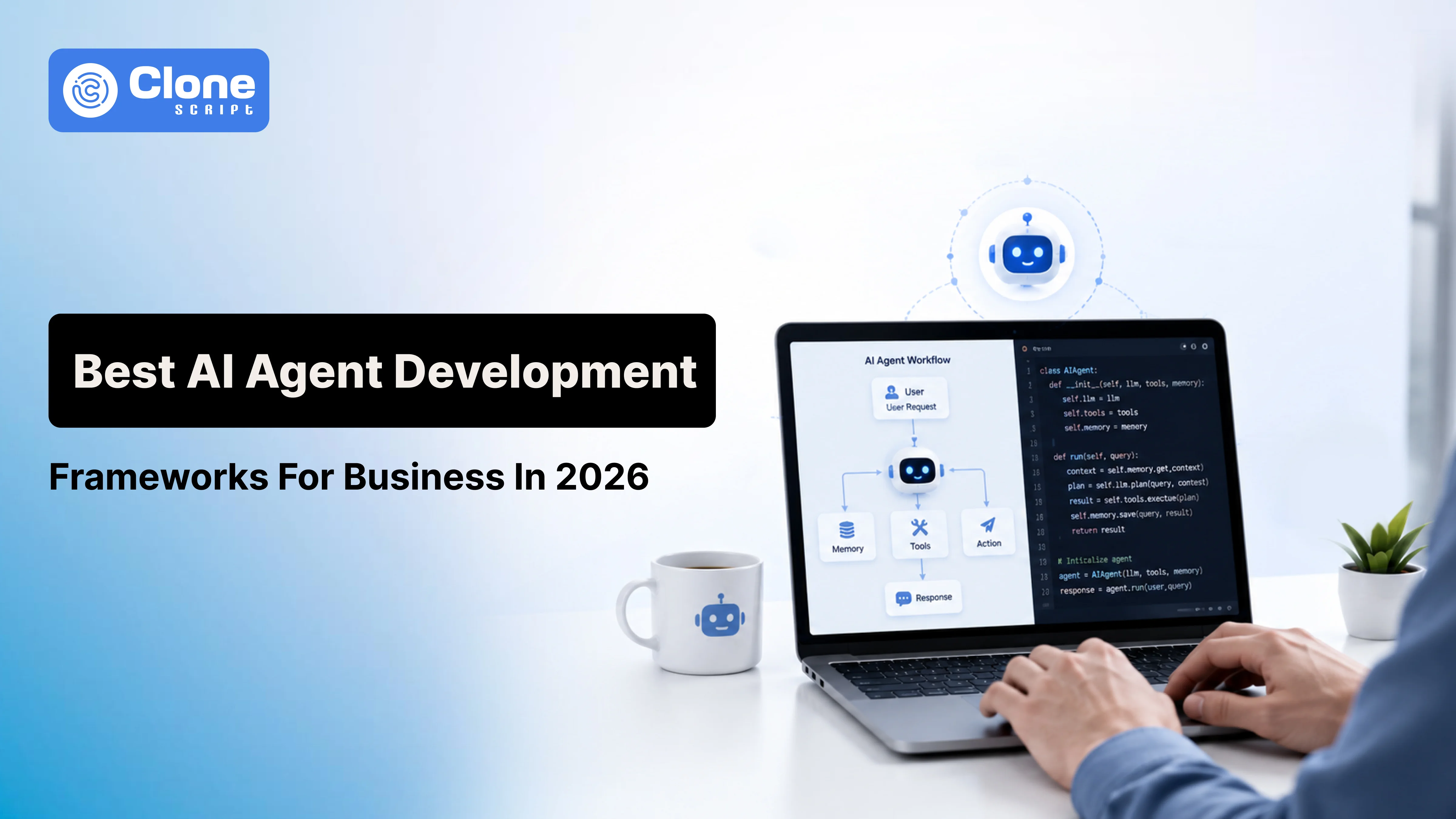
7 Best AI Agent Development Frameworks for Business Applications
Thinking that AI agent development is the biggest challenge for businesses? No.
The real challenge is choosing the framework that will support the agent as requirements grow.
But why?
A framework determines how an AI agent manages tasks, connects with tools, remembers information, and responds to changing situations.
Today, AI developers can choose from frameworks such as LangGraph, LangChain, CrewAI, AutoGen, Semantic Kernel, and others. Each is designed for different types of business applications, from customer support automation to multi-agent enterprise workflows.
Understanding these frameworks before starting development can save time and reduce costs. That prevent future scalability issues. In this guide, we compare the best AI agent development frameworks and explain where each one fits in a business environment.
What Is an AI Agent Development Framework?
An AI agent development framework is a set of tools, libraries, and components that helps developers build AI agents more efficiently. Rather than creating every function from the ground up, developers can use a framework to manage workflows, connect external tools, store information, and coordinate agent actions.
In simple terms, a framework acts as the foundation of an AI agent. It determines how the agent processes requests, retrieves data, makes decisions, and completes tasks. Without a framework, building these capabilities requires significant development effort and custom coding.
For example, an AI agent used in customer support might need to access order information, check shipping updates, generate responses, and update records in a business system. A development framework helps organize these actions into a structured workflow.
Modern frameworks go beyond basic automation.
Many support advanced features such as memory management, tool calling, multi-step reasoning, API integrations, and collaboration between multiple agents. These capabilities allow businesses to build AI solutions that can handle more complex and practical workflows.
As organizations expand their AI initiatives, development frameworks play an important role in reducing development time, improving maintainability, and creating scalable business applications.
Key Features to Look for in an AI Agent Development Framework
Some agents focus on workflow orchestration, while others specialize in multi-agent collaboration or enterprise integrations. Before selecting a framework, it is important to evaluate the features that directly affect development, performance, and long-term scalability.
-
Workflow Management
Business applications require AI agents to perform multiple actions in sequence. A good framework should make it easy to create, manage, and modify workflows without introducing unnecessary complexity.
-
Memory and Context Retention
Many business tasks depend on historical information and ongoing conversations. Frameworks with memory capabilities allow agents to retain context, leading to more accurate responses and better decision-making.
-
Tool and API Integration
AI agents rarely operate in isolation. They often need access to CRM platforms, databases, communication tools, and third-party applications. Strong integration support helps agents interact with existing business systems more effectively.
-
Multi-Agent Collaboration
Some projects require multiple AI agents to work together on a task. For example, one agent may conduct research while another analyzes data and a third prepares a response. Frameworks that support multi-agent collaboration can simplify these complex workflows.
-
Scalability and Performance
An AI solution that works for a small team today may need to serve thousands of users tomorrow. Choosing a framework with strong scalability features helps businesses avoid performance bottlenecks as adoption grows.
-
Monitoring and Control
Businesses need visibility into how AI agents operate. Monitoring tools help developers track agent behavior, identify workflow issues, and improve performance over time.
-
Security and Compliance
Organizations handling customer data or sensitive information should prioritize frameworks that support secure integrations, access controls, and compliance requirements. Security considerations become increasingly important as AI agents gain access to business systems and data sources.
7 Best AI Agent Development Frameworks for Business Applications
Choosing the right AI agent framework can significantly impact development speed, scalability, and long-term maintenance. Below are some of the most popular frameworks businesses use to build intelligent AI applications.
-
LangGraph
LangGraph is built for creating AI agents that follow structured and multi-step workflows. It gives developers greater control over how agents move through tasks and make decisions.
Key Highlights:
-
Stateful workflow management
-
Strong workflow orchestration
-
Supports complex business processes
-
Better control over agent behavior
-
Suitable for enterprise automation
Best For: Customer support systems, approval processes, and operational workflows.
-
LangChain
LangChain is one of the most widely adopted frameworks in the AI ecosystem. It provides tools for building agents that connect with APIs, databases, and external applications.
Key Highlights:
-
Large developer community
-
Extensive integration support
-
Flexible agent development
-
Rich documentation and resources
-
Strong ecosystem maturity
Best For: SaaS products, AI assistants, and business automation tools.
-
CrewAI
CrewAI focuses on multi-agent collaboration. Different agents can be assigned specialized roles and work together to complete larger tasks.
Key Highlights:
-
Role-based agent architecture
-
Multi-agent coordination
-
Easy workflow delegation
-
Supports collaborative task execution
-
Flexible agent management
Best For: Research projects, content workflows, and team-based automation systems.
-
AutoGen
AutoGen enables multiple AI agents to communicate and solve problems together. It is particularly useful for tasks that require planning, analysis, and iterative decision-making.
Key Highlights:
-
Agent-to-agent conversations
-
Advanced task planning
-
Supports autonomous workflows
-
Flexible customization
-
Strong problem-solving capabilities
Best For: Business analysis, research automation, and decision-support systems.
-
Semantic Kernel
Semantic Kernel is Microsoft's framework for integrating AI capabilities into enterprise applications. It combines traditional programming with AI-driven workflows.
Key Highlights:
-
Enterprise-focused architecture
-
Strong Microsoft ecosystem integration
-
Security and governance support
-
Plugin-based development
-
Scalable business applications
Best For: Large enterprises using Microsoft technologies and cloud services.
-
OpenAI Agents SDK
OpenAI Agents SDK simplifies the process of building AI agents that can use tools, perform actions, and manage workflows.
Key Highlights:
-
Native OpenAI integration
-
Tool calling capabilities
-
Simplified agent development
-
Supports workflow automation
-
Easy implementation for new projects
Best For: Businesses building AI-powered applications with OpenAI models.
-
LlamaIndex
LlamaIndex specializes in connecting AI agents with business data sources. It helps agents retrieve and use information from documents, databases, and knowledge repositories.
Key Highlights:
-
Strong data retrieval capabilities
-
Enterprise knowledge integration
-
Supports structured and unstructured data
-
Improves response accuracy
-
Efficient information management
Best For: Internal knowledge bases, enterprise search, and document-driven AI applications.
Which AI Agent Framework Is Best for Different Business Needs?
The best AI agent framework depends on the type of application you plan to build. A framework that works well for a startup may not be the best choice for a large enterprise handling complex workflows and large volumes of data.
-
For Startups
Startups need to build and launch products quickly while keeping development costs under control. Frameworks with strong documentation, active communities, and easy integrations are usually the best option.
Here are recommended frameworks: LangChain and OpenAI Agents SDK.
-
For SaaS Applications
SaaS platforms require AI features such as customer assistance, workflow automation, and data processing. Scalability and integration flexibility are important factors.
Here are recommended frameworks: LangChain and LangGraph.
-
For Customer Support Automation
Customer support agents need access to business data, conversation history, and workflow automation capabilities. Structured workflows help ensure accurate and consistent responses.
Here are recommended frameworks: LangGraph and OpenAI Agents SDK.
-
For Enterprise Operations
Large organizations typically need secure, scalable, and well-governed AI systems. Enterprise-grade integrations and workflow control become critical requirements.
Here are recommended frameworks: Semantic Kernel and LangGraph.
-
For Knowledge Management Systems
Companies with large document repositories need AI agents that can retrieve and summarize information efficiently. Data indexing and retrieval capabilities become essential.
Here are recommended frameworks: LlamaIndex and LangChain.
-
For Research and Analysis Workflows
Research projects often involve gathering information, evaluating sources, and producing insights. Multi-agent collaboration can improve efficiency for these tasks.
Here are recommended frameworks: CrewAI and AutoGen.
Before making a final decision, businesses should evaluate their workflow complexity, integration requirements, security expectations, and future scalability goals. Selecting a framework based on actual business needs usually produces better long-term results than choosing the most popular option in the market.
Common Challenges When Choosing an AI Agent Framework
Selecting an AI agent framework is not only about features and popularity. Businesses must also consider long-term maintenance, scalability, and integration requirements. Overlooking these factors can lead to higher costs and development challenges later.
-
Integration Complexity
Many businesses depend on multiple software platforms, including CRM systems, databases, communication tools, and cloud services. Not every framework integrates with these systems equally well.
Before choosing a framework, verify that it can connect with the tools your business already uses. This can reduce development effort and speed up deployment.
-
Scalability Limitations
A framework that performs well during testing may struggle as usage grows. Increasing user traffic, larger datasets, and more complex workflows can expose performance issues.
Businesses should evaluate how a framework handles growth before committing to a production deployment.
-
Security and Data Privacy
AI agents often access sensitive customer and business information. Weak security controls can create compliance risks and expose critical data.
Organizations operating in regulated industries should prioritize frameworks that support authentication, permissions management, and secure data handling.
-
Framework Maturity
New frameworks often introduce innovative features, but they may lack documentation, community support, or proven enterprise use cases.
More established frameworks typically offer better resources, stability, and long-term reliability, making them easier to maintain over time.
-
Vendor Dependency
Some frameworks work best within a specific ecosystem or cloud environment. While this can simplify development, it may also create dependency on a particular technology provider.
Businesses should assess how easily they can migrate or expand their AI systems in the future.
-
Development and Maintenance Costs
Building an AI agent is only the beginning. Ongoing maintenance, updates, monitoring, and infrastructure costs can have a significant impact on the total project budget.
Choosing a framework that aligns with your team's technical expertise can help reduce implementation and maintenance expenses.
Future Trends in AI Agent Development Frameworks
AI agent frameworks are changing rapidly as businesses look for more capable and reliable automation solutions. Future developments are expected to focus on improving collaboration, governance, and operational efficiency.
-
Multi-Agent Systems
Instead of relying on a single AI agent, businesses are increasingly adopting multiple specialized agents that work together. One agent may gather information, another may analyze data, and a third may execute actions. Frameworks that support this model are expected to see greater adoption.
-
Smarter Workflow Automation
Future AI agents will handle longer and more complex workflows with less human intervention. This will allow businesses to automate processes that currently require multiple software tools and manual oversight.
-
Improved Enterprise Governance
As AI agents gain access to business-critical systems, organizations will require stronger controls over how agents operate. Future frameworks are likely to offer enhanced monitoring, auditing, permissions management, and compliance features.
-
Better Tool Integration
Businesses use a wide range of software platforms, from CRM systems to project management tools. Future frameworks will simplify integrations and allow agents to interact more effectively across different applications.
-
Enhanced Memory Capabilities
Current AI agents struggle with maintaining long-term context. Future frameworks are expected to improve memory management, helping agents retain relevant information and deliver more personalized interactions.
-
Greater Transparency and Monitoring
Organizations want to understand how AI agents make decisions. Framework providers are investing in observability features that offer visibility into agent actions, workflow execution, and performance metrics.
As these advancements continue, AI agent frameworks will move beyond experimental projects and become a core component of business automation strategies.
How to Choose the Right AI Agent Framework for Your Organization
With multiple frameworks offering similar capabilities, selecting the right one can be challenging. The best approach is to evaluate frameworks based on your business goals, technical requirements, and future growth plans.
-
Define Your Business Objectives
Start by identifying the problem the AI agent will solve. Some businesses need customer support automation, while others focus on internal operations, research, or knowledge management. Clear objectives make framework selection easier.
-
Assess Workflow Complexity
Simple AI assistants may work well with lightweight frameworks, but complex workflows often require advanced orchestration capabilities. Understanding workflow requirements helps narrow down suitable options.
-
Review Integration Requirements
Most AI agents need access to existing business systems. Consider whether the framework can connect with your CRM, databases, communication platforms, and other software tools without extensive customization.
-
Evaluate Team Expertise
Some frameworks are easier to learn and implement than others. Choosing a framework that matches your team's technical skills can reduce development time and maintenance challenges.
-
Consider Scalability
Business requirements change over time. A framework should be able to support additional users, new integrations, and more advanced workflows as your AI initiatives expand.
-
Prioritize Security
If your AI agent will handle sensitive customer or company information, security should be a key consideration. Look for frameworks that support access controls, monitoring, and secure integrations.
-
Test Before Full Deployment
A pilot project can reveal potential limitations before a large-scale implementation. Testing allows organizations to evaluate performance, integration capabilities, and user experience under real-world conditions.
Selecting an AI agent framework is a long-term technology decision. Businesses that align framework capabilities with operational goals are more likely to build AI solutions that remain effective as requirements evolve.
Conclusion
AI agent frameworks provide the foundation for building intelligent systems that can automate tasks, connect with business tools, and support decision-making processes. Frameworks such as LangGraph, LangChain, CrewAI, AutoGen, Semantic Kernel, OpenAI Agents SDK, and LlamaIndex each offer unique strengths for different business applications. A well-chosen AI agent development framework can simplify implementation, improve maintainability, and create a stronger foundation for future AI initiatives.