BTC - Bitcoin
 USDTERC20 - USDT ERC20
 ETH - Ethereum
 BNB - Binance
 BCH - Bitcoin Cash
 DOGE - Dogecoin
 TRX - TRON
 USDTTRC20 - USD TRC20
 LTC - LiteCoin

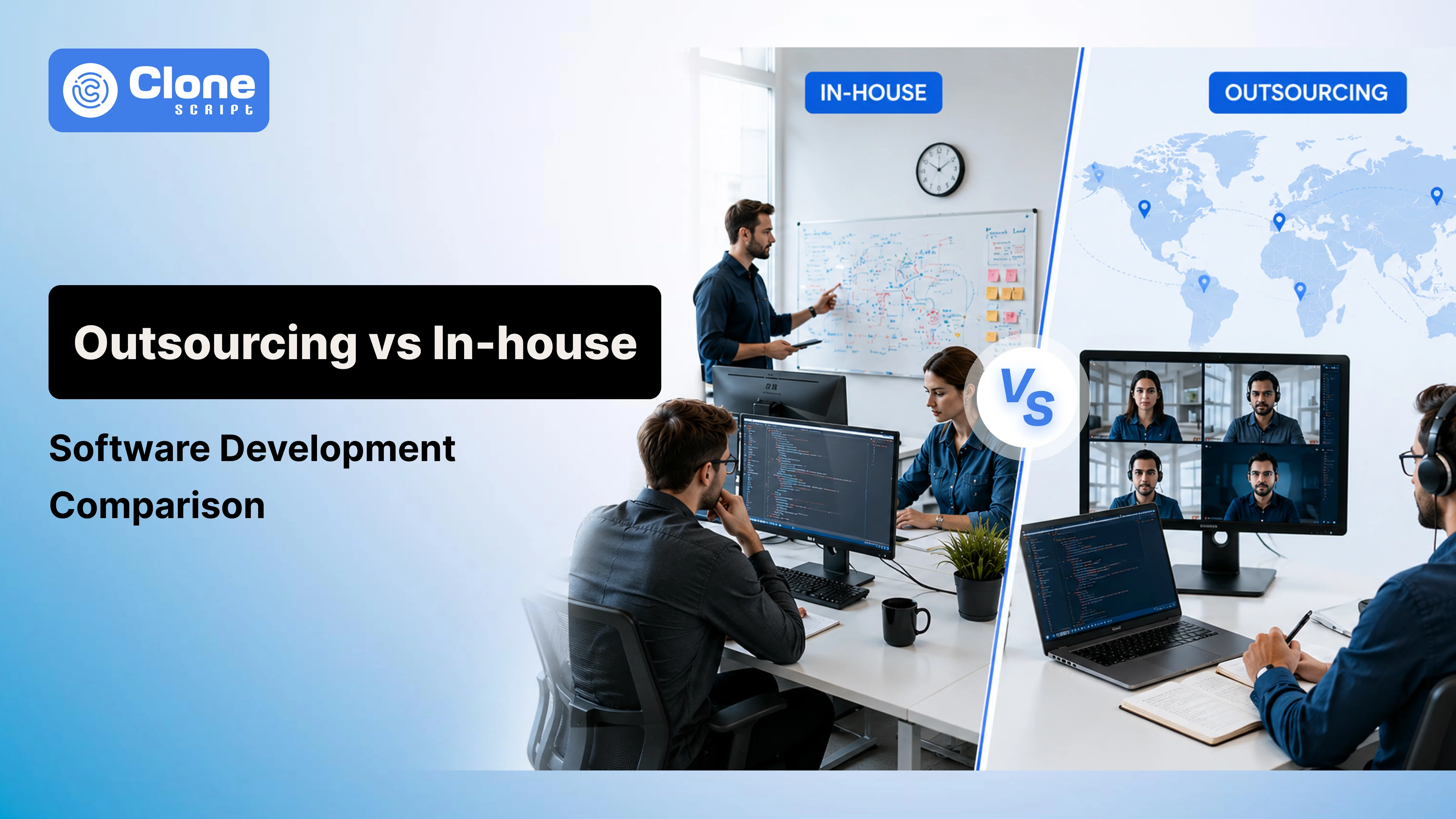
Outsourcing vs In-house Software Development Process Comparison
Building software is rarely the difficult part of micro SaaS app ideas. Deciding who should build it is.
Some businesses invest in in-house software development because they want a team that understands the product inside out. Others turn to software development outsourcing to move faster, fill skill gaps, or avoid the cost of hiring full-time engineers.
There is no fixed formula. A startup and an enterprise rarely need the same approach. This outsourcing vs in-house software development comparison explains where each model works, where it struggles, and how to choose the option that fits your business goals.
What Is In-house Software Development?
In-house software development means building software with employees who work directly for your company. The developers, designers, testers, and project managers become part of the business and work exclusively on its products.
How Does an In-house Development Team Work?
Take the example of Netflix. Here’s how it works:
Step 1: Build a Dedicated Team
Netflix hires its own developers, designers, QA engineers, and product managers who work exclusively on its streaming platform.
Step 2: Understand the Product
The team continuously analyzes user behavior, business goals, and technical requirements to improve content recommendations and overall user experience.
Step 3: Collaborate Across Teams
Engineers work closely with product managers and business teams to prioritize features such as downloads, personalized recommendations, and parental controls.
Step 4: Develop and Test Features
The team builds new features, performs A/B testing, fixes bugs, and releases updates to ensure the platform remains fast and reliable.
Step 5: Invest in Long-Term Growth
Netflix invests in skilled engineers, cloud infrastructure, security, and development tools to support continuous innovation.
Step 6: Scale the Platform
As Netflix expanded globally, its in-house team introduced multilingual support, localized recommendations, and streaming optimizations for millions of users worldwide.
What Is Software Development Outsourcing?
Software development outsourcing is the practice of hiring an external company or dedicated team to build, maintain, or scale a software product. Instead of recruiting full-time employees, businesses partner with specialists who already have the required technical skills and delivery processes in place.
How Does Software Development Outsourcing Work?
Slack manages the outsourcing correctly:
Step 1: Define Project Requirements
In its early days, Slack identified the need for a polished product interface and defined its goals, budget, and development priorities before seeking external expertise.
Step 2: Hire an Outsourcing Partner
Rather than building a large in-house team immediately, Slack outsourced parts of its product design and development to experienced specialists, enabling faster progress.
Step 3: Collaborate Throughout Development
The outsourced team worked closely with Slack's founders to refine the user interface, gather feedback, and align the product with business objectives.
Step 4: Develop and Launch the Product
The external team contributed to designing and developing the MVP, helping Slack launch a professional, user-friendly collaboration platform more quickly.
Step 5: Scale with Internal Growth
After validating the product and gaining users, Slack expanded its in-house engineering team for continuing to evolve the platform with full ownership and long-term development.
Outsourcing vs In-house Software Development Comparison
There are certain kinds of aspects to consider for outsourcing and in-house software development. The way they handle costs, hiring, scalability, and project management is entirely different.
| Factor | In-house Software Development | Software Development Outsourcing |
|---|---|---|
| Initial Cost | High recruitment and infrastructure costs | Lower upfront investment |
| Hiring Speed | Can take weeks or months | Team can be assembled quickly |
| Access to Talent | Limited by local hiring market | Access to global specialists |
| Project Control | Direct supervision and management | Shared control with external partner |
| Scalability | Slower team expansion | Easy to scale up or down |
| Communication | Immediate and direct | Depends on processes and time zones |
| Specialized Skills | May require additional hiring | Skills available on demand |
| Development Speed | Slower initial setup | Faster project kick-off |
| Security & Compliance | Greater internal oversight | Depends on vendor practices |
| Long-term Ownership | Strong product knowledge retention | Knowledge transfer may be required |
| Maintenance Costs | Higher ongoing expenses | Flexible engagement models |
| Best For | Long-term, core business products | MVPs, short-term projects, and niche expertise |
The right choice depends on what the company needs at a particular stage. A startup racing to launch its first product may prioritize speed and flexibility. An established enterprise managing sensitive data may place higher value on long-term knowledge retention and internal control.
Advantages of In-house Software Development
An internal team brings more than technical skills to a project. It develops a deep understanding of the product, the customers using it, and the business problems the software is meant to solve.
-
Better Product Ownership
Developers who work on the same product for years understand its architecture and history. They know why certain decisions were made and can improve the product without spending time rediscovering old requirements.
-
Faster Collaboration
Questions, feature discussions, and priority changes can be addressed quickly because developers and business teams work closely together. Direct communication reduces misunderstandings and shortens decision-making cycles.
-
Greater Control Over Development
Companies have full visibility into project timelines, coding standards, security practices, and resource allocation. This level of control becomes important when software directly impacts revenue or customer experience.
-
Stronger Security and Confidentiality
Businesses handling financial records, healthcare information, or proprietary technology prefer an internal team because sensitive data remains under direct organizational oversight. Access controls and compliance measures are also easier to enforce.
-
Alignment With Long-term Business Goals
An in-house team grows alongside the company. As products evolve, developers gain business knowledge that cannot be documented easily or transferred overnight. This accumulated experience helps organizations make faster decisions and build software that supports long-term strategic objectives.
Disadvantages of In-house Software Development
Building an internal engineering team offers control, but that control comes at a cost. For many companies, the biggest challenge is not developing the product itself. It is building and maintaining the team behind it.
-
High Hiring and Operational Costs
Developer salaries are only one expense. Recruitment fees, employee benefits, equipment, software licenses, office space, and training programs significantly increase the total cost of ownership.
-
Longer Recruitment Process
Hiring experienced developers can take months. Even after recruitment, new employees need time to understand the product, processes, and company culture before reaching full productivity.
-
Limited Access to Specialized Skills
A business may need expertise in artificial intelligence, blockchain, cloud architecture, or cybersecurity for only a few months. Hiring full-time specialists for short-term requirements becomes expensive and inefficient.
-
Difficulty Scaling Teams Quickly
Project requirements can change unexpectedly. Expanding an internal team requires new hiring, onboarding, and budget approvals. Downsizing is equally challenging because it can affect morale and result in additional costs.
-
Employee Turnover Risks
When senior developers leave, they take valuable product knowledge with them. Replacing experienced team members is rarely immediate, and project timelines suffer during the transition period.
For startups and businesses with uncertain product requirements, these challenges can make in-house software development slower and more expensive than initially expected.
Advantages of Software Development Outsourcing
For many businesses, the biggest advantage of outsourced software development is speed. An outsourcing partner can assemble a team in days, while building an internal team may take several months.
-
Lower Development Costs
Companies avoid expenses related to recruitment, employee benefits, office infrastructure, and long-term payroll commitments. This makes outsourcing a practical option for startups and businesses working with limited budgets.
-
Access to Global Talent
Outsourcing removes geographical limitations. A company can work with experienced developers, designers, and specialists from different parts of the world instead of relying solely on the local talent market.
-
Faster Time-to-Market
Established outsourcing teams already have development processes, project management frameworks, and technical expertise in place. Projects can begin almost immediately, helping businesses launch products and features more quickly.
-
Easy Team Scalability
Development requirements rarely remain constant. Outsourced teams can be expanded or reduced based on project demands without going through lengthy hiring or restructuring processes.
-
Access to Specialized Expertise
Many projects require niche skills that are difficult to hire internally. Outsourcing allows businesses to bring in experts in areas such as artificial intelligence, cloud computing, blockchain, or cybersecurity only when those skills are needed.
-
More Focus on Core Business Activities
By delegating development tasks to an external team, business leaders can spend more time on strategy, customer acquisition, and product growth instead of managing recruitment and day-to-day engineering operations.
Disadvantages of Software Development Outsourcing
While software development outsourcing can reduce costs and speed up delivery, it also introduces challenges that businesses should evaluate before choosing an external partner.
-
Less Direct Control
An outsourced team operates outside the company's day-to-day environment. Managers may not have the same level of visibility into development activities, technical decisions, or resource allocation as they would with an internal team.
-
Communication Challenges
Different working styles, language preferences, and documentation practices can lead to misunderstandings. Small communication gaps become expensive when project requirements are complex or change frequently.
-
Time Zone Differences
Working with offshore teams can make real-time collaboration difficult. Urgent issues may take longer to resolve when both teams have only a few overlapping working hours.
-
Security and Confidentiality Concerns
External teams may need access to sensitive business information, source code, or customer data. Without proper contracts, security standards, and access controls, the risk of data exposure increases.
-
Dependence on the Service Provider
A project can become heavily dependent on the outsourcing partner's processes and expertise. If the vendor changes priorities, increases costs, or ends the engagement, transferring knowledge to another team may require additional time and effort.
For this reason, outsourcing the software development works best when businesses choose experienced partners, define clear expectations, and establish strong communication and governance processes from the beginning.
Software Cost Comparison: Outsourcing vs In-house Development
Cost is the deciding factor in the outsourcing and in-house software development comparison, but the real expense goes far beyond salaries and hourly rates.
-
Estimated Cost of In-house Development
Building an internal team requires ongoing investment in multiple areas.
| Expense | Estimated Annual Cost (Per Developer) |
|---|---|
| Salary | $40,000 - $120,000+ |
| Recruitment & Hiring | $3,000 - $10,000 |
| Employee Benefits | $5,000 - $20,000 |
| Hardware & Equipment | $1,000 - $3,000 |
| Software Licenses & Tools | $500 - $2,500 |
| Training & Upskilling | $1,000 - $5,000 |
For example, a team of five mid-level developers can easily cost $250,000–$600,000+ per year, excluding office space and employee turnover expenses.
-
Estimated Cost of Software Development Outsourcing
Outsourcing costs depend largely on the region and expertise required.
| Region | Average Hourly Rate |
|---|---|
| North America | $80 - $200/hour |
| Western Europe | $50 - $150/hour |
| Eastern Europe | $30 - $80/hour |
| Asia | $20 - $60/hour |
| Latin America | $30 - $70/hour |
A typical MVP requiring around 1,000 development hours may cost:
| Team Location | Estimated Project Cost |
|---|---|
| North America | $80,000 - $200,000 |
| Western Europe | $50,000 - $150,000 |
| Eastern Europe | $30,000 - $80,000 |
| Asia | $20,000 - $60,000 |
Which Option Saves More Money?
For short-term projects, startups, and businesses testing new ideas, outsourcing provides better cost efficiency because companies avoid long-term hiring commitments.
For products that need continuous updates, dedicated resources, and years of development, in-house software teams may deliver stronger long-term value despite their higher initial investment.
The lowest price rarely produces the best outcome. The real objective is to choose a development model that matches the product's complexity, growth plans, and expected return on investment.
When Should You Choose In-house Development?
An internal team is not necessary for every project. However, there are situations where in-house software development creates a clear business advantage.
1. Software Is Your Core Product: Companies whose revenue depends directly on software usually benefit from keeping development in-house.
2. Your Project Handles Sensitive Data: Industries such as finance, healthcare, and insurance deal with confidential information and strict compliance requirements.
3. The Product Requires Continuous Development: Products that evolve for years need developers who understand their architecture and business logic.
4. You Need Immediate Collaboration: Complex projects frequently require product managers, designers, and developers to work closely together.
5. You Have the Budget to Build and Retain Talent: Hiring developers, providing infrastructure, and maintaining a skilled team require significant investment.
When Should You Choose Software Development Outsourcing?
Not every business needs a permanent engineering department. In many cases, outsourcing software development is the more practical option because it provides access to expertise without the time and expense of building an internal team.
1. You Need to Launch Quickly: Recruiting developers can take months. An outsourcing partner already has processes and talent in place, which means projects can start almost immediately and reduce time-to-market.
2. Your Budget Is Limited: Startups and small businesses cannot justify the cost of full-time hiring of software developers.
3. You Need Specialized Skills: Some projects require expertise in technologies such as artificial intelligence, blockchain, cloud computing, or cybersecurity.
4. Your Workload Changes Frequently: Development needs can increase or decrease depending on product stages.
5. You Are Building an MVP or Testing an Idea: Early-stage products carry uncertainty. Outsourcing allows businesses to validate ideas, gather market feedback, and iterate quickly before committing to long-term hiring.
Hybrid Approach: Combining Outsourcing and In-house Teams
Many companies no longer choose between outsourcing and in-house development exclusively. Instead, they combine both models to balance control, cost, and access to expertise.
1. Keep Core Development In-house: Businesses retain product managers, senior engineers, and architects internally because these roles hold critical product knowledge and make long-term technical decisions.
2. Outsource Specialized Skills: Technologies such as artificial intelligence, blockchain, cybersecurity, and DevOps may only be needed for specific phases of a project.
3. Scale Development Faster: An internal team may struggle to handle sudden increases in workload. Outsourcing allows companies to add developers quickly during feature releases, product expansions, or major upgrades.
4. Reduce Hiring Risks: Instead of immediately recruiting permanent employees, companies can use outsourced teams to test product ideas or enter new markets. If the project grows, they can gradually expand their internal team.
5. Improve Cost Efficiency: A hybrid model lets businesses invest in strategic roles while outsourcing short-term or highly specialized tasks. This approach helps control operational costs without slowing product development.
A common hybrid structure looks like this:
| Function | In-house Team | Outsourced Team |
|---|---|---|
| Product Strategy | ✔ | ✖ |
| Business Analysis | ✔ | ✖ |
| Core Architecture | ✔ | ✖ |
| UI/UX Design | ✔/✖ | ✔ |
| Front-end Development | ✔/✖ | ✔ |
| Specialized Technologies | ✖ | ✔ |
| QA Testing | ✔/✖ | ✔ |
| Maintenance & Support | ✔ | ✔ |
For many growing businesses, the hybrid model offers the flexibility of software development outsourcing while preserving the control and product ownership that come with in-house software development.
Looking for Outsourcing for Software Development With a Reliable Partner?
Here we are at All Clone Script, helping businesses like yours to get the right product and service for your business. We deliver many of the successful projects to clients and develop our own white-label products, including websites, mobile and web applications:
Need more support? Connect with our software experts to find the right development strategy for your business.