BTC - Bitcoin
 USDTERC20 - USDT ERC20
 ETH - Ethereum
 BNB - Binance
 BCH - Bitcoin Cash
 DOGE - Dogecoin
 TRX - TRON
 USDTTRC20 - USD TRC20
 LTC - LiteCoin

How to Hire Developers Who Understand Vibe Coding for Productivity
Vibe coding hiring developers isn’t just about who can write code anymore. The way software is built has shifted, and AI tools are now part of everyday development work.
Most developers today use tools like Copilot, Cursor, Windsurf, or ChatGPT while building features. It’s become normal. But there’s a big difference between simply using these tools and actually becoming more productive with them.
Some developers move faster with AI, while others end up producing messy code that still needs heavy fixing later. That gap is what companies are now dealing with.
Hiring of a software developer has started to change. It’s not just about experience or syntax anymore. It’s about how well someone can think, guide tools, and still take responsibility for clean, working systems.
In simple terms, the focus is shifting from “can you code?” to “can you build better with the help of AI without losing control of quality?”
What Is Vibe Coding in Modern Development?
Vibe coding is not a new programming language or framework. It’s a way of building software where developers use AI tools as part of their daily coding process, instead of writing everything manually.
-
A practical AI-driven coding workflow
Vibe coding is a development approach where engineers use AI tools to speed up building software by turning ideas into working code through prompts, then refining the output manually.
It is commonly used in real-world projects where speed matters, especially MVPs and feature-heavy applications.
-
Example: Back-end feature development
A developer working on a payment system may prompt an AI tool to generate a “Stripe payment integration with webhook handling.”
Instead of writing everything from scratch, they receive a structured starting point, then adjust security checks, logging, and edge-case handling before deployment.
The AI accelerates setup, but the developer still owns correctness and system safety.
-
Example: Front-end implementation
In UI development, a developer might request a responsive admin dashboard in React or Next.js.
The AI generates layout components quickly, but the developer restructures state management, improves component reuse, and fixes performance issues that AI typically ignores.
-
Iterative engineering instead of linear coding
Traditional coding is linear: design → write → test.
Vibe coding is iterative: prompt → generate → test → refine → repeat.
This loop reduces time spent on boilerplate and increases focus on refinement and system behavior.
-
Core shift in developer role
The biggest change is not speed. It’s control. Developers are no longer just writing instructions for machines, but supervising machine-generated output and shaping it into production-ready systems.
In practice, this turns coding into a decision-making process rather than a typing task.
Why Vibe Coding Developers Improve Productivity?
For these reasons, developers prefer vibe coding:
-
Faster delivery cycles in real projects
Vibe coding speeds up development mainly by reducing time spent on repetitive implementation work. Tasks like setting up APIs, building CRUD systems, or creating UI scaffolding get done much faster using AI assistance.
In startup environments, this can shorten MVP timelines significantly because early-stage features don’t require everything to be built manually.
-
Less time on boilerplate, more on logic
Developers spend less effort writing repetitive code and more time on decisions that actually impact the product.
For example, instead of manually writing validation, routing, and basic structure, they can focus on business logic, edge cases, and user flow improvements.
-
Faster iteration during development
Product teams can test ideas quickly. A feature can be built, reviewed, and modified within hours instead of days.
This improves feedback loops between developers, designers, and product managers, especially in agile environments.
-
Better resource efficiency
Smaller teams can deliver more output. One skilled developer using AI tools can often handle work that previously required multiple engineers for basic implementation tasks.
-
Real limitation to understand
Productivity gains only happen when developers understand what they are generating. Without strong fundamentals, speed increases but quality drops.
What Kinds of Hidden Risks Are in Vibe Coding?
Due to these risks, vibe coding is still more backward than a traditional approach:
-
When “Looks Good” doesn’t mean “Works Right.”
One of the most common issues with AI-assisted code is that it appears complete. It runs, passes basic checks, and looks clean on the surface. But real systems don’t behave in controlled environments.
Problems usually show up later.
When real users interact with the feature in unexpected ways. Missing edge cases, weak validations, or assumptions in logic often become visible only after deployment.
-
Security often gets handled too lightly.
Security is another area where gaps quietly appear. AI can generate working APIs or authentication flows, but it doesn’t always enforce strict production-level safety by default.
Things like proper access control, rate limiting, or input sanitization may be incomplete unless the developer actively reviews and strengthens them.
-
Codebases start losing consistency.
When features are generated quickly, especially by different prompts or developers, the overall structure of the code starts to drift.
It still works, but patterns become inconsistent. Over time, this makes the system harder to maintain or scale without refactoring.
-
Debugging takes more effort than expected.
When something breaks, it’s not always easy to trace what happened. If the logic was mostly generated, developers may struggle to understand why a certain decision was made in the first place.
This slows down debugging and increases dependency on trial-and-error fixes.
The Real trade-off
The issue isn’t speed. It’s what gets lost while moving fast: clarity, structure, and full control over how the system actually behaves.
How to Identify a Strong Vibe Coding Developer
These signals are important to know whether the hired vibe coder is a match for your product or not.
Don’t evaluate code first; evaluate thinking speed and structure.
In real hiring scenarios, the biggest mistake is judging candidates by the final output. With vibe coding, output can be generated by anyone. What actually matters is how they think before and during generation.
A strong developer naturally structures the problem before touching any AI tool. They break requirements into logical parts, identify dependencies, and only then start generating code in steps.
Real signal: controlled use of AI, not random prompting.
You can easily spot the difference during a live task. Weak candidates keep prompting AI until something “works.” Strong candidates guide the AI in a structured loop like define → generate → validate → refine.
That control is what separates productivity from chaos.
The real test is debugging under pressure.
Give them a slightly broken or incomplete AI-generated code snippet. Strong candidates won’t panic or re-generate blindly. They will isolate the issue, explain the cause, and fix it systematically.
Strong claim: AI usage is not a skill - controlled engineering is.
Using AI tools is now basic. What you are really hiring for is discipline under acceleration. The best vibe coding developers don’t code faster. They decide better while coding faster.
What Skills to Look For When Hiring a Vibe Coder?
The expertise in the following makes hiring a vibe coder efficient and smooth.
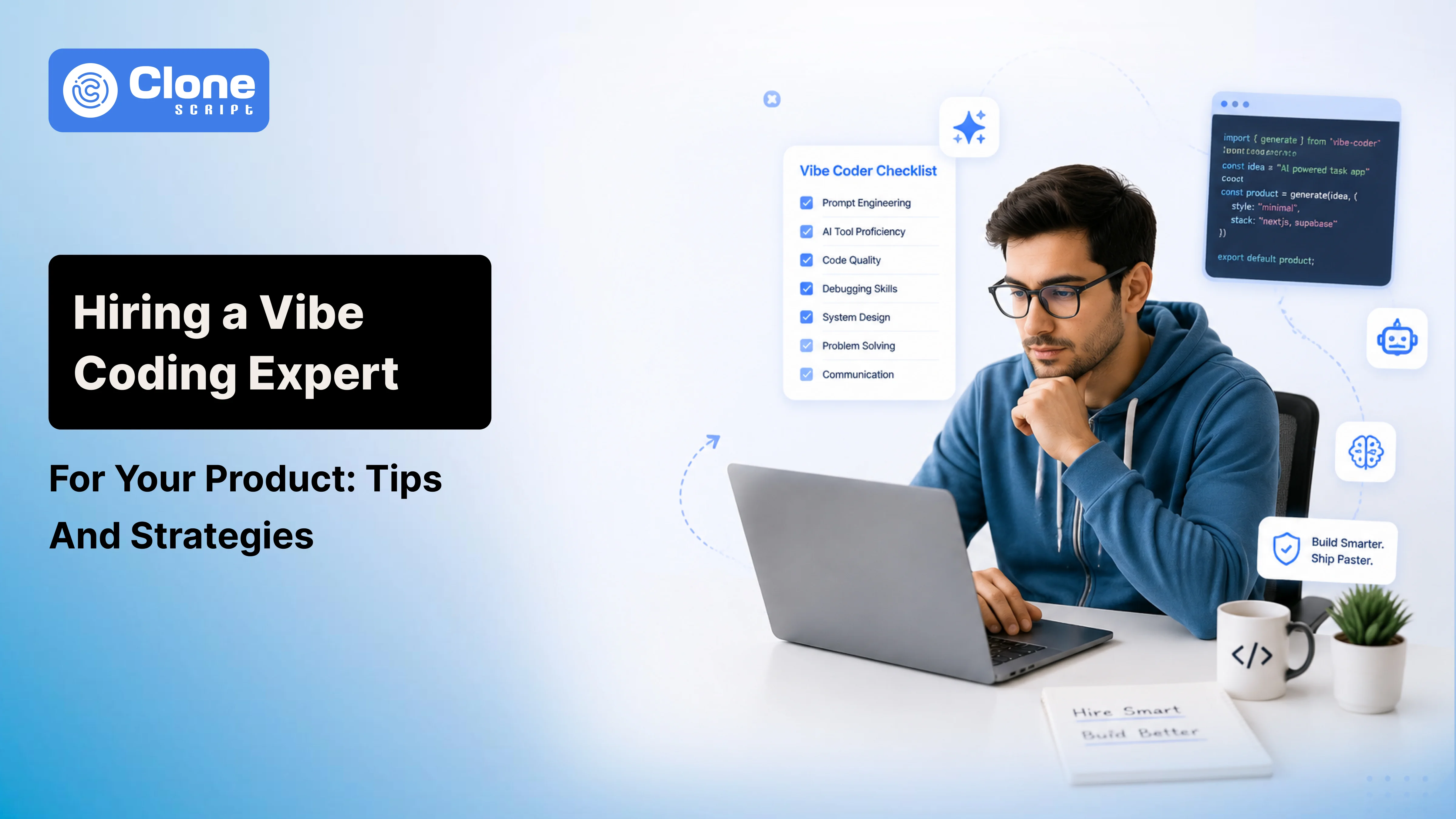
Ability to break work into clear engineering steps.
A strong candidate doesn’t jump straight into implementation. They first convert a feature into smaller technical parts, data flow, API behavior, edge cases, and UI or system dependencies. This shows they understand structure, not just syntax.
In practice, this is visible even before coding starts. The way they explain a solution often tells you more than the code they produce later.
Comfort working with AI as a tool, not a crutch.
Good developers use AI in a controlled way. They don’t rely on it to “figure things out,” but to speed up known steps. They know when to generate, when to stop, and when to take full manual control.
A weak signal is over-dependence on prompting until something works, without understanding why it worked.
Strong debugging instincts.
Real value shows up when something breaks. Skilled developers can quickly isolate issues, reproduce problems, and trace logic without constantly re-generating solutions.
They don’t guess. They test, observe, and narrow down the root cause systematically.
Awareness of system-level impact.
Beyond individual features, strong candidates understand how changes affect the entire system, performance, security, scalability, and maintainability.
That awareness is what separates “feature builders” from real engineering contributors.
Practical Hiring Checklist for Vibe Coding
Consider the following checklist when asking a vibe coder to join your team.
-
Observe how they approach a real task.
Instead of asking theoretical questions, give a small but real feature to build. The goal is not completion speed, but how they structure the work. Strong candidates naturally outline inputs, outputs, dependencies, and edge cases before producing anything.
-
Check their interaction with AI tools.
Ask them to use AI during the task. The key observation is control. Good developers use AI in steps, first for structure, then for generation, and finally for refinement. If they keep regenerating outputs without direction, that’s a weak signal.
-
Evaluate how they handle imperfect code.
Provide a partially broken or incomplete AI-generated snippet. A capable developer will not rewrite everything. They will identify the root issue, explain it simply, and fix only what’s necessary.
-
Look for decision clarity.
During the discussion, ask why they accepted or rejected certain AI outputs. Strong candidates can clearly explain trade-offs, what they kept, what they changed, and why.
Final hiring signal
The strongest indicator is not how fast they build something, but how stable their thinking stays under fast execution. If they maintain structure while using AI speed, they are the right fit for vibe coding-driven productivity.
Interview Questions to Identify Real Vibe, Coders
Ask these questions to understand if a vibe coder right choice for your product or not?
-
Questions that expose thinking, not memorization
The goal in an interview is not to test familiarity with tools, but to understand how a developer thinks when speed and uncertainty are both involved.
Ask them how they would build a simple feature, like authentication, a payment flow, or a dashboard module, while using AI tools. Pay attention to how they structure the solution before generating anything.
-
Focus on validation, not generation.
A strong question is: “How do you ensure AI-generated code is actually safe and production-ready?”
Good candidates will naturally talk about testing, edge cases, review steps, and system impact. Weak ones will focus only on “prompting better results.”
-
Test decision-making under constraints
Ask: “What do you do when AI gives you multiple solutions for the same problem?”
This reveals whether they understand trade-offs or just pick the first working output.
-
Check the debugging mindset.
Give a scenario where a feature works locally but fails in production. Ask how they would approach it. Strong developers will describe a step-by-step isolation process rather than guessing or regenerating code.
Key hiring signal
The best vibe coding developers don’t just use AI efficiently. They stay logically structured while working in fast, uncertain conditions.
Productivity vs Dependency Balance in Vibe Coding
Maintain the balance between productivity and dependency in the vibe coding for the digital product.
-
Speed only matters if control is maintained.
AI-assisted development naturally increases output speed, but speed alone doesn’t define productivity. What actually matters is whether the developer can still understand and control what is being built.
In real teams, this balance becomes visible when features start scaling. Fast delivery is useful, but only if the underlying system remains stable and understandable.
-
When productivity turns into dependency?
A common pattern is developers becoming too reliant on AI for even basic decisions. Instead of solving problems, they start generating multiple variations until something works.
This creates a hidden dependency where progress feels fast, but real understanding is shallow. Over time, this slows down debugging, refactoring, and scaling.
-
What balanced developers do differently?
Strong developers use AI to reduce effort, not replace thinking. They still design logic, validate outputs, and understand how each part connects to the system.
They don’t use AI to avoid engineering work. They use it to remove repetitive work so they can focus on better decisions.
Practical takeaway
Productivity in vibe coding is not about how much code is produced. It is about how much reliable progress is made without losing architectural clarity or ownership of the system.
Future of Hiring Developers in the AI Era
When hiring a vibe coder in the AI world, consider the important thing.
-
Hiring is shifting from coding ability to engineering judgment
The role of a developer is changing faster than the hiring process itself. Writing code is no longer the primary differentiator; most of it can now be accelerated with AI tools.
What matters more is how a developer thinks, structures problems, and ensures correctness while working at a higher speed.
-
Smaller teams, higher output expectations.
Companies are already moving toward leaner engineering teams. One strong developer using AI effectively can now produce the output that previously required multiple engineers for basic implementation work.
But this only works when the developer understands system design, not just feature delivery.
-
The rise of hybrid developers
A new category of engineers is emerging: those who combine traditional programming skills with AI-assisted workflows. They are comfortable switching between manual coding, system thinking, and AI-guided generation.
This hybrid skill set is becoming more valuable than specialization in a single framework or language.
What will hiring focus on next?
Future hiring decisions will focus less on “what you know” and more on “how you think under accelerated conditions.” The ability to maintain clarity while using AI tools will become a core requirement, not an advantage.
In short, coding skill alone is no longer enough; engineering judgment at speed is the new standard.
Conclusion
Hiring now depends on clarity, not just capability
The way developers are evaluated has shifted. Writing code is no longer the core skill that defines performance, because AI tools can already handle a large portion of implementation work.
What separates strong developers from average ones is how clearly they think, how well they structure problems, and how responsibly they handle AI-generated output.