BTC - Bitcoin
 USDTERC20 - USDT ERC20
 ETH - Ethereum
 BNB - Binance
 BCH - Bitcoin Cash
 DOGE - Dogecoin
 TRX - TRON
 USDTTRC20 - USD TRC20
 LTC - LiteCoin

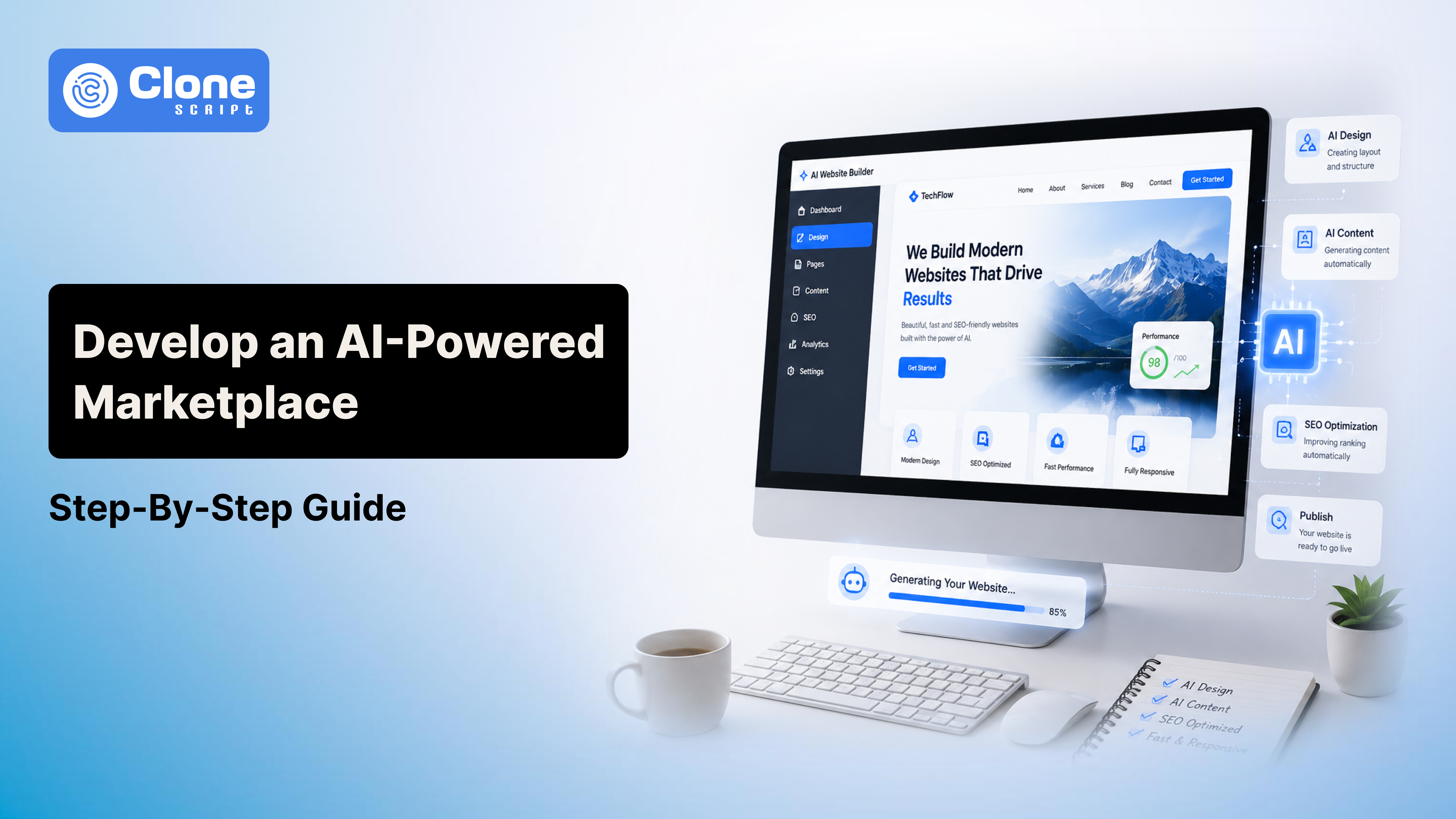
How to Develop an AI-Powered Marketplace: Step-by-Step Guide
Creating a successful marketplace today is about listing products?
No.
It’s about making transactions smarter, faster, and more personalized. Users expect platforms to understand their needs, recommend relevant options, and reduce friction in buying or selling.
An AI-powered marketplace achieves this by analyzing behavior, predicting preferences, and automating key processes.
For example, platforms like Upwork use AI to match freelancers with projects they are most likely to succeed in, while Etsy’s recommendation engine drives a significant portion of daily sales.
Adopting AI also solves operational challenges: dynamic pricing, fraud detection, and content moderation can now be automated, saving time and costs.
According to recent research, marketplaces using AI for personalization and search see up to 40% higher revenue and a 20-35% lift in conversion rates.
In this guide, we’ll walk you step by step through building an AI-powered marketplace, covering strategy, architecture, AI features, and metrics that actually move the business model forward.
What Is an AI-Powered Marketplace?
An AI-powered marketplace is more than a digital storefront; it’s an ecosystem that actively learns from user interactions. Every click, search, and purchase feeds the system, allowing it to provide smarter recommendations and faster discovery.
Core AI Capabilities
These marketplaces combine multiple AI technologies: predictive recommendation engines, intent-based search, dynamic pricing, and automated trust systems. Predictive engines suggest products or services a user is most likely to engage with. Dynamic pricing adjusts based on demand, inventory, and competitor activity.
Advantages for Users
For buyers, AI reduces decision fatigue by showing relevant options without manual searching. Users experience personalized suggestions and quicker access to high-value content, improving satisfaction and loyalty.
Advantages for Sellers
Sellers benefit from higher visibility, improved conversion rates, and smarter targeting. AI ensures their offerings reach the right audience at the optimal time, increasing the likelihood of sales and repeat transactions.
Real-World Applications
Platforms like Etsy use AI to suggest products based on browsing and purchase patterns, significantly increasing revenue per visitor. Upwork implements AI to match freelancers with projects where they have the highest probability of success, enhancing platform credibility and efficiency.
AI-powered marketplaces transform traditional commerce into a dynamic, adaptive system where data drives smarter experiences for everyone involved.
Why Use AI in a Marketplace?
For the following reasons, Artificial Intelligence is implemented in the marketplace.
-
Enhance Buyer Decision-Making
AI helps marketplaces understand customer behavior in real time. By analyzing previous purchases, browsing patterns, and preferences, platforms can present relevant options that reduce decision fatigue and guide users toward products they are most likely to buy.
-
Deliver Hyper-Personalization
Customers expect experiences tailored to them. AI allows marketplaces to offer personalized recommendations, curated collections, and targeted promotions, which significantly increase engagement and loyalty.
-
Optimize Revenue Through Dynamic Strategies
Dynamic pricing powered by AI adjusts costs based on demand, competition, and inventory levels. This approach maximizes profits for sellers while keeping buyers satisfied, creating a win-win scenario.
-
Strengthen Trust and Safety
Fraud, fake listings, and low-quality content are major challenges in marketplaces. AI continuously monitors transactions and flags anomalies, ensuring a safer and more reliable environment for all participants.
-
Increase Operational Efficiency
AI automates repetitive tasks such as categorization, content moderation, and trend prediction. This frees teams to focus on strategy, growth, and innovation, allowing marketplaces to scale efficiently without bloating operational costs.
Real-World Examples of Impact
Marketplaces integrating AI see measurable results. For instance, platforms can boost conversion rates by up to 30% through personalized recommendations and improve retention by anticipating customer needs. This makes AI a critical driver of growth and competitive advantage.
Step-by-Step Implementation Guide for AI-powered Marketplace
Step 1: Define Your Marketplace Vision
Start by identifying the niche, target audience, and core problem your marketplace solves. A clear vision ensures that AI features are integrated strategically, not just added as an afterthought.
Step 2: Choose the Business Model
Decide whether your platform will earn through commissions, subscriptions, listing fees, or hybrid models. Integrate AI into your revenue strategy by enabling predictive pricing, demand forecasting, or personalized promotions.
Step 3: Design the Technical Architecture
Build a platform that supports scalable AI integration from the beginning. Include data pipelines, APIs, AI models, search algorithms, and recommendation engines to ensure seamless performance as your user base grows.
Step 4: Identify Key AI Features
Focus on high-impact features first. Prioritize semantic search, personalized recommendations, dynamic pricing, automated fraud detection, and content moderation to enhance user experience and operational efficiency.
Step 5: Collect and Prepare Data
Data is the backbone of AI. Gather transaction histories, user activity logs, and product metadata. Clean, normalize, and label this data while maintaining compliance with GDPR or CCPA regulations.
Step 6: Develop and Train AI Models
Use frameworks like TensorFlow, PyTorch, or Hugging Face to train models on your prepared data. Start with small datasets for testing, then expand gradually to improve accuracy and performance.
Step 7: Test, Iterate, and Optimize
Perform A/B testing for AI-driven recommendations and search results. Track conversion, retention, and engagement metrics, and continuously refine models based on real-world performance.
Step 8: Deploy and Monitor
Deploy your AI models on scalable cloud platforms like AWS, Azure, or Google Cloud. Monitor model accuracy, latency, and drift to ensure the system remains effective as the marketplace grows.
By following these steps, your marketplace can utilize AI to improve matching, personalization, and operational efficiency, creating measurable value for both buyers and sellers.
Common Challenges & Solutions in AI Marketplace
Find the following challenges in AI marketplace development:
-
Data Quality and Management
AI marketplaces rely on accurate, high-quality data. Incomplete or inconsistent data can lead to poor recommendations, inaccurate search results, or incorrect pricing.
Solution: Implement data validation pipelines and regular audits. Use automated tools to clean, label, and normalize data before feeding it into AI models.
-
AI Bias and Fairness
AI models may unintentionally favor certain sellers or products if the training data is biased. This can reduce trust and harm user experience.
Solution: Use diverse datasets and continuously test models for fairness. Incorporate human oversight and transparent AI explanations to build user confidence.
-
Scalability and Performance
As marketplaces grow, AI models and search algorithms may struggle with high traffic or large datasets. Delays or slow predictions frustrate users.
Solution: Design for horizontal scalability using cloud infrastructure. Leverage caching, batch processing, and model optimization techniques to maintain performance.
-
Regulatory Compliance and Privacy
Marketplaces must handle sensitive user data while complying with GDPR, CCPA, or other local regulations.
Solution: Adopt privacy-by-design principles, anonymize data when possible, and provide clear user consent mechanisms for data collection and processing.
-
Operational Complexity
Integrating AI adds complexity to platform maintenance, requiring technical expertise for model training, monitoring, and updates.
Solution: Start with high-impact AI features first, use prebuilt AI tools where appropriate, and establish monitoring dashboards to track model performance continuously.
By addressing these challenges proactively, AI-powered marketplaces can maintain trust, deliver accurate recommendations, and scale efficiently, ensuring both users and sellers benefit from smarter, more reliable interactions.
Most KPIs to Track for AI Marketplaces
These indicators have to be measured properly.
-
Conversion Rate
Conversion rate measures how effectively your AI features turn visitors into buyers. Track changes in conversion after implementing recommendations or AI-driven search to understand their impact.
-
Recommendation Engagement
Monitor clicks and interactions with AI-generated product or service recommendations. High engagement indicates your models are accurately predicting user preferences, while low engagement signals a need for optimization.
-
Search Effectiveness
Evaluate how often users find what they’re looking for on the first search attempt. Metrics like “zero-results queries” or search click-through rates show how well your semantic and AI-driven search is performing.
-
Retention and Repeat Usage
Track how often users return to your platform. AI-powered personalization should increase retention by offering relevant, timely content and products that encourage repeat visits and purchases.
-
Average Order Value (AOV)
Dynamic pricing and personalized upselling features should increase the average transaction value. Monitoring AOV helps assess whether AI features are positively affecting revenue per customer.
-
Operational Efficiency
Measure reductions in manual workload and improvements in processing speed for tasks like fraud detection, content moderation, and trend analysis. Efficient AI systems allow your team to focus on strategy rather than repetitive tasks.
-
Real-Time Performance Metrics
Keep track of latency, accuracy, and model drift in your AI systems. Consistent monitoring ensures that recommendations, search results, and pricing remain reliable as your platform scales.
By tracking these KPIs, marketplace owners can quantify the impact of AI, optimize features continuously, and make informed decisions that improve both user experience and business performance.
Conclusion
Building an AI-powered marketplace transforms how buyers and sellers interact, improving personalization, efficiency, and revenue. By implementing strategic AI features, monitoring KPIs, and addressing operational challenges, platforms can scale intelligently. Thoughtful AI integration ensures a competitive, engaging, and future-ready marketplace that delivers measurable results for users and businesses alike.
FAQ
-
What is an AI-powered marketplace?
An AI-powered marketplace uses artificial intelligence to connect buyers and sellers more efficiently. It personalizes search, recommendations, pricing, and fraud detection based on user behavior and data patterns.
-
How does AI improve user experience in marketplaces?
AI analyzes browsing and purchase behavior to deliver personalized recommendations. It also optimizes search results, provides dynamic pricing, and automates repetitive tasks, creating a faster, more intuitive experience for users.
-
What are the main AI features in a marketplace?
Key features include recommendation engines, semantic search, dynamic pricing, automated moderation, and fraud detection systems. These features help both buyers and sellers engage more effectively and make informed decisions.
-
Why should I integrate AI into my marketplace?
Integrating AI increases conversion rates, improves retention, and reduces operational workload. It also enables scalable personalization and data-driven decision-making, giving your platform a competitive advantage.
-
How much does it cost to build an AI-powered marketplace?
Costs vary depending on complexity, AI features, and scale. An MVP may start around $50,000–$80,000, while advanced AI marketplaces with dynamic pricing, recommendations, and analytics can exceed $200,000.
-
How long does it take to develop an AI marketplace?
Development depends on scope and features. A basic AI marketplace MVP can take 4–6 months, while a full-featured platform may require 9–12 months for planning, development, testing, and deployment.
-
What KPIs should I track for an AI marketplace?
Monitor conversion rate, recommendation engagement, search effectiveness, retention, average order value, and operational efficiency. These metrics measure both user experience impact and business performance.
-
Can small marketplaces benefit from AI?
Yes. Even smaller platforms can use AI for personalized recommendations, search optimization, and fraud prevention, helping them compete with larger players without a massive team.