BTC - Bitcoin
 USDTERC20 - USDT ERC20
 ETH - Ethereum
 BNB - Binance
 BCH - Bitcoin Cash
 DOGE - Dogecoin
 TRX - TRON
 USDTTRC20 - USD TRC20
 LTC - LiteCoin

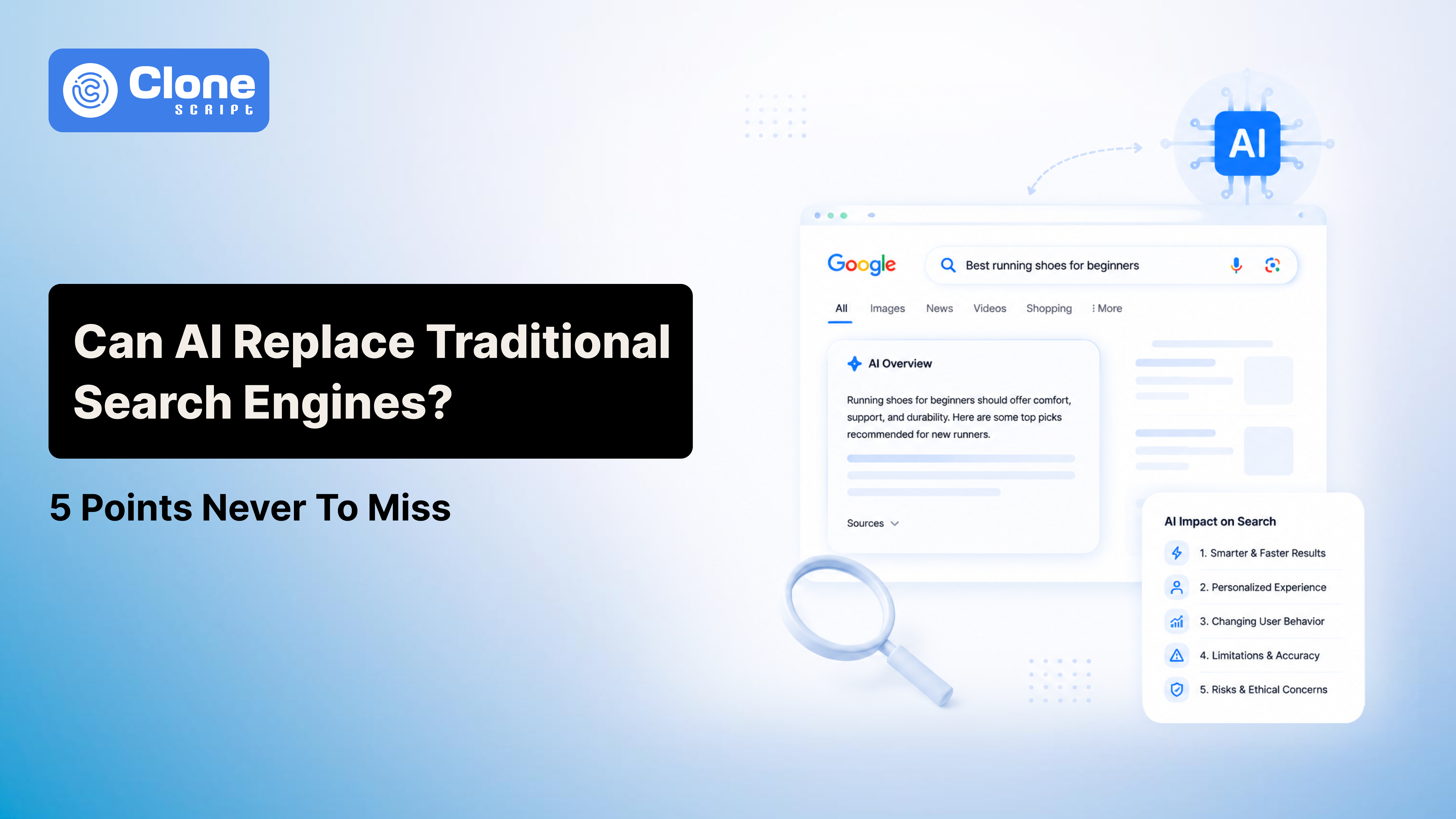
Can AI Replace Traditional Search Engines? 5 Points Never to Miss
A strange thing is happening on the internet.
Millions of people still open Google every day. Yet fewer people are clicking websites than they did just two years ago.
The reason isn't a new search engine. It's the answer itself.
Instead of showing ten blue links, search platforms now generate complete responses at the top of the page. A user asks a question. AI delivers a summary. The search ends before a single website receives a visit.
The numbers are beginning to reveal the impact. A Pew Research analysis found that users clicked traditional search results in just 8% of visits when an AI-generated summary appeared, compared with 15% when no AI summary was shown. In simple terms, the click rate nearly halved.
For users, this feels like progress.
For publishers, marketers, bloggers, SaaS companies, and businesses that depend on organic traffic, it raises a bigger question:
If AI can answer questions instantly, what role will traditional search engines play in the future?
The debate is no longer about whether AI search is growing.
The real debate is whether search engines are evolving into AI assistants or becoming obsolete themselves.
1. AI Is Replacing Search Results, Not Search Behavior
Can AI replace traditional search engines completely? Not yet. However, it is already replacing one of their most important functions: helping users find answers. Voice search optimization on a website is the prime example.
For decades, search engines worked as gateways to information. Users typed a query, reviewed multiple results, opened several websites, and built their own conclusions. AI search changes that process. A user asks a question and receives a complete response within seconds.
This shift is changing how people search online.
Think about a common query such as "best CRM software for startups" or "how to improve website SEO." Traditional search engines display pages of results. AI search tools generate a summary, compare options, highlight key differences, and provide recommendations without requiring users to visit multiple websites.
The attraction is speed.
Research from Gartner predicts traditional search engine volume could decline by 25% by 2026 as AI-powered search tools become more widely adopted. That projection reflects a growing preference for direct answers over link-based exploration.
Yet this trend does not mean search engines are disappearing. Google, Bing, and other platforms still provide the information that AI systems rely on. What is changing is the way users consume that information.
The real question is not whether AI can provide answers. The bigger question is whether those answers can always be trusted.
2. AI Search Is Fast, but Accuracy Remains a Challenge
Speed is one reason many people believe AI could replace traditional search engines. A detailed answer appears in seconds. No scrolling. No opening multiple tabs. No comparing five different articles.
That convenience creates a hidden problem.
Traditional search engines show users where information comes from. You can compare sources, check publication dates, review expert opinions, and identify conflicting viewpoints. AI search reduces that process by delivering a single synthesized answer.
The risk becomes clear when the topic involves money, health, legal matters, software selection, or business strategy.
A wrong answer about a movie release date may be harmless. A wrong answer about tax regulations, medical symptoms, or cybersecurity practices can create real consequences.
This is why many professionals still verify AI-generated responses through trusted websites, industry reports, and official documentation. AI can summarize information quickly, but summaries are only as reliable as the data behind them.
The challenge becomes bigger as users grow more dependent on AI-generated answers. When people stop checking sources, they may miss outdated information, missing context, or factual errors.
This limitation explains why traditional search engines still play an important role in the future of search. They provide access to sources, while AI provides convenience.
For now, AI search excels at delivering quick answers. Traditional search remains stronger when accuracy, transparency, and trust become critical.
3. AI Search Could Reshape Website Traffic Forever
If AI replaces traditional search engines in one area, it will be website discovery.
For years, the relationship was simple. Search engines sent visitors to websites. Websites created content. Search engines rewarded useful content with traffic.
AI search changes that equation.
When users receive complete answers directly inside search results, many never reach the source. The answer satisfies their query before a click becomes necessary.
This trend is already creating concern among publishers, bloggers, news websites, SaaS companies, and ecommerce brands. Their content may help train or inform AI systems, yet fewer visitors arrive on their websites.
The impact extends beyond traffic numbers.
Fewer visitors can mean:
-
Lower advertising revenue
-
Fewer product inquiries
-
Reduced affiliate income
-
Declining newsletter signups
-
Lower brand visibility
This is forcing businesses to rethink SEO.
Ranking first on Google no longer guarantees the same traffic it delivered a few years ago. Visibility now depends on whether a brand becomes a trusted source that AI systems reference and cite in their answers.
That shift creates a new reality for content marketing.
The goal is not just earning clicks. The goal is becoming the source behind the answer.
Companies that publish original research, expert insights, case studies, and unique data are more likely to remain visible as AI-powered search grows. Businesses producing generic content may find it increasingly difficult to attract organic traffic.
This is why the future of SEO is becoming less about rankings and more about authority.
4. Traditional Search Still Wins When People Need to Explore
The biggest weakness of AI search appears when people do not know exactly what they are looking for.
A direct answer works well for questions such as "What is cloud computing?" or "How does SEO work?" The goal is clear, and a summarized response saves time.
Real-world searches are rarely that simple.
Imagine planning a family vacation, choosing a new laptop, hiring a software development company, or comparing CRM platforms. Most people do not want a single answer. They want options, reviews, opinions, videos, pricing information, and experiences from real users.
This is where traditional search engines remain valuable.
A search query can lead users to industry reports, discussion forums, customer reviews, YouTube comparisons, expert blogs, and case studies. Each source adds a different perspective that helps people make informed decisions.
Human psychology plays an important role here.
Before making an important purchase or business decision, people seek reassurance. They compare. They validate. They look for evidence that supports or challenges their initial thinking. A single AI-generated answer cannot always provide that level of confidence.
This behavior explains why search engines continue to receive billions of searches every day despite the rapid growth of AI-powered search tools.
Information is not always the final goal. Confidence is.
When users need to explore possibilities, evaluate alternatives, or understand different viewpoints, traditional search remains difficult to replace. AI may shorten the research process, but exploration still requires access to diverse sources and original content.
That reality points to an important conclusion: the future may not belong to AI search or traditional search alone. It may belong to a combination of both.
5. The Future Is Not AI vs Search Engines, It Is AI-Powered Search
The debate around AI replacing traditional search engines may be asking the wrong question.
History shows that new technologies rarely eliminate successful platforms overnight. They transform them.
Streaming changed television. Smartphones changed computers. Ecommerce changed retail. None of these innovations completely erased what came before. They reshaped how people used them.
Search is following the same path.
Google, Microsoft, and other technology companies are investing billions of dollars into AI because they understand a simple reality: users want faster answers. Instead of fighting AI, search engines are integrating it directly into the search experience.
The result is a new model.
Users receive AI-generated summaries for quick understanding. Search engines still provide links, sources, videos, reviews, local listings, and expert content for deeper research. The experience becomes a combination of answer engine and discovery platform.
This hybrid approach solves a major problem.
AI delivers speed.
Traditional search delivers verification.
Together, they create a more efficient search experience than either system can provide independently.
For businesses, this shift changes the rules of online visibility. Ranking for keywords remains important, but authority becomes even more valuable. Brands that publish original research, expert opinions, unique statistics, and real-world experience are more likely to appear in both search results and AI-generated answers.
That is why the future of SEO is not about optimizing for search engines alone.
It is about becoming the most trusted source of information in your niche.
The companies that understand this change today will be far better positioned as AI-powered search becomes the new standard for finding information online.
What Most People Miss About AI Replacing Search Engines
Most discussions focus on what AI might replace.
Very few people discuss what happens if AI actually succeeds.
-
A World Where Nobody Needs to Click
Imagine a future where users stop clicking websites because every answer appears instantly inside an AI search interface. At first, the experience sounds perfect. Searches become faster. Research takes less time. Productivity increases.
Then a new problem emerges.
Where will fresh information come from?
-
AI Cannot Create the Internet's Knowledge Base.21
AI systems do not conduct original research. They do not attend industry conferences, interview customers, test software products, investigate breaking news, or publish firsthand experiences.
Instead, they rely on content created by journalists, researchers, businesses, educators, and independent creators. Every AI-generated answer begins with information that someone else produced.
Without that foundation, AI has nothing valuable to summarize.
-
The Hidden Risk for Content Creators
If websites lose significant traffic, many publishers could lose the revenue that funds content creation.
The consequences could include:
-
Fewer independent publishers
-
Reduced investment in original research
-
Lower-quality educational content
-
Less diverse viewpoints online
The internet succeeds because millions of creators continuously add new knowledge. A decline in content creation could weaken that ecosystem over time.
Why the Future Depends on Balance
This is why the future of AI search is not simply a technology story. It is a content sustainability story.
The winning model will not be one where AI replaces websites entirely. The winning model will be one where AI helps users discover information faster while continuing to reward the people and organizations that create valuable knowledge.
That balance may determine whether AI search strengthens the web or slowly weakens the foundation it depends on.
Can AI Replace Traditional Search Engines?
The answer is both yes and no.
AI is already replacing some of the tasks that made traditional search engines essential. Millions of users now rely on AI-generated answers for quick research, problem-solving, content ideas, and everyday questions.
That shift will continue as AI search becomes faster, smarter, and more integrated into digital experiences.