BTC - Bitcoin
 USDTERC20 - USDT ERC20
 ETH - Ethereum
 BNB - Binance
 BCH - Bitcoin Cash
 DOGE - Dogecoin
 TRX - TRON
 USDTTRC20 - USD TRC20
 LTC - LiteCoin

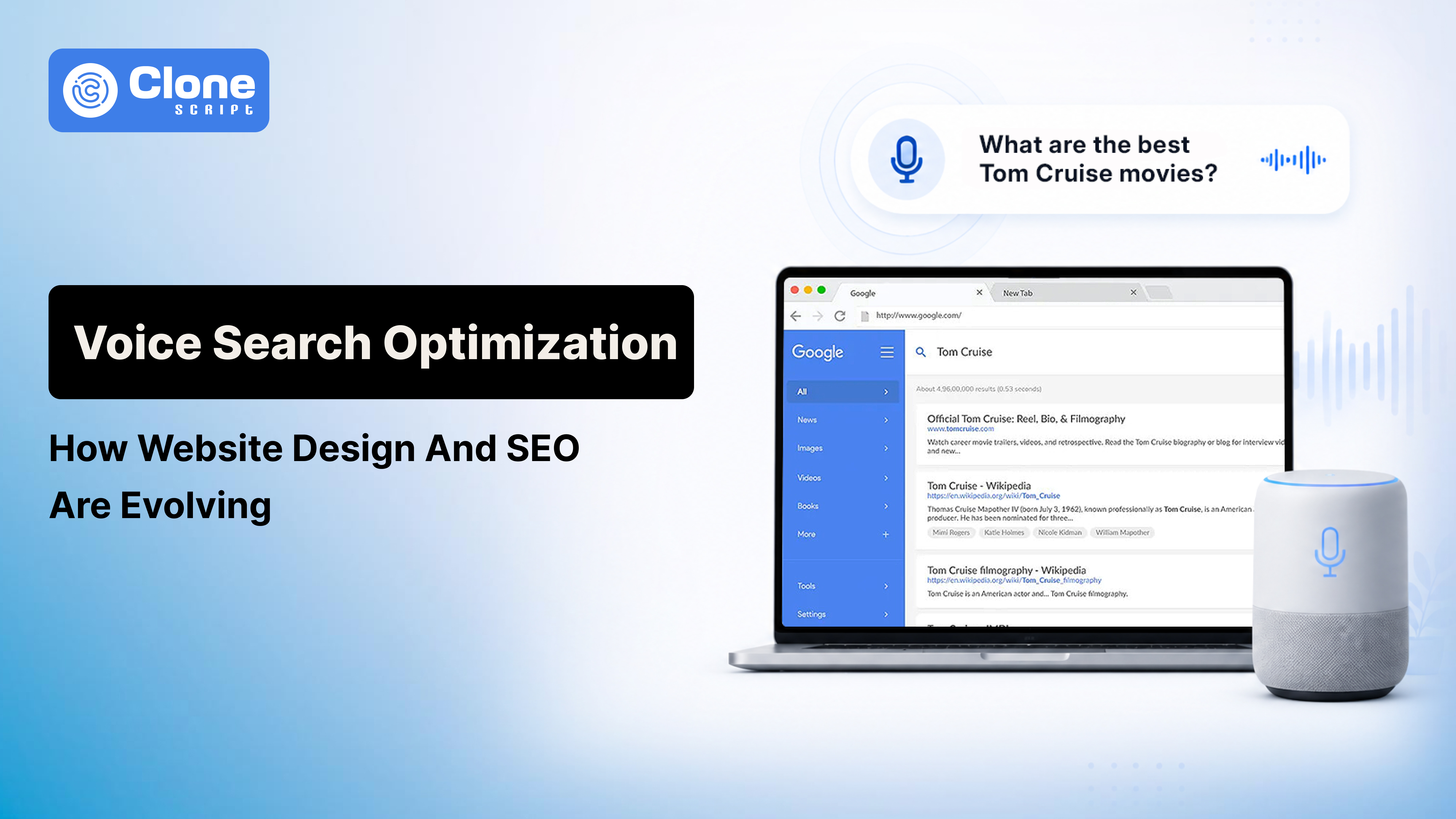
Voice Search Optimization: How Website Design and SEO Are Evolving
Most Websites Were Built for Typing. Today's Searchers Are Talking.
A customer asks their phone, “What is the best CRM for a small business?” Another asks, “Find a web design agency near me.” Someone else asks a smart speaker, “What MVP website features should a startup launch with?”
None of these users typed a keyword. They spoke a question.
That shift is changing how search engines understand content and how websites must be designed to compete online. Voice search optimization is no longer limited to adding long-tail keywords or creating FAQ pages. It is influencing website architecture, user experience, content strategy, and conversion design.
The trend is significant.
-
Research shows that approximately 20.5% of internet users actively use voice search, while an estimated 8.4 billion voice assistants are in use globally.
-
Around 27% of internet users conduct voice searches on mobile devices, making conversational search behavior a mainstream activity rather than a niche trend.
As search becomes more conversational and AI-driven, businesses face an important challenge: building websites that answer questions effectively instead of simply ranking for keywords.
Why Is Voice Search Changing Search Behavior?
Users need a complete answer without typing a phrase in the search bar. They need instant information, and with the voice search feature, it becomes easy whenever they want to do so.
Traditional SEO was built around short keyword phrases.
Users searched for:
-
CRM software
-
Web design agency
Voice search changes that behavior.
Instead of entering a few words, users ask complete questions:
-
What is the best CRM software for a growing startup?
-
Which website design company specializes in SaaS businesses?
-
How long does SEO take to produce results?
These queries reveal far more context and intent.
Search engines can now understand not only what a user wants but why they want it. This allows them to deliver more precise answers and rewards websites that provide comprehensive, trustworthy information.
This shift aligns directly with Google's E-E-A-T framework: Experience, Expertise, Authoritativeness, and Trustworthiness.
A website that demonstrates practical expertise, answers related questions, and covers a topic comprehensively is more likely to appear in voice search results than a page built solely around keyword optimization.
Voice search optimization therefore requires a broader approach. Businesses must think beyond keywords and focus on becoming the most relevant answer for their audience.
From Navigation-Centric to Answer-Centric Website Design, We've Come A Long Way.
For years, websites were designed around business structures.
Typical navigation included:
-
Home
-
About
-
Services
-
Blog
-
Contact
While these pages remain important, they do not reflect how modern users search.
People rarely begin their journey by looking for a navigation menu. They start with a question.
For example:
-
How much does a website cost?
-
What features should a startup website include?
These questions represent intent.
An answer-centric website structure organizes information around those intents rather than around internal business categories.
This approach benefits both users and search engines.
Users find information faster because answers are easier to access.
Search engines gain a clearer understanding of content relevance because the website directly addresses common questions.
Businesses that continue relying on complex navigation structures may find themselves competing against websites that deliver immediate, concise, and authoritative answers.
The future of website design is not about helping visitors browse. It is about helping visitors find answers with minimal effort.
Why Information Architecture Matters for Voice Search SEO?
Voice search optimization is not only about content. It is also about how content is organized. That’s why voice search is important.
Search engines increasingly evaluate relationships between topics, entities, and user intent. As a result, isolated pages are becoming less effective than interconnected topic ecosystems.
Consider a SaaS company selling project management software.
Instead of creating a handful of keyword-focused pages, the company could build content clusters covering:
-
Project management fundamentals
-
Remote team collaboration
-
Workflow automation
-
Productivity measurement
-
Software implementation strategies
Together, these pages demonstrate expertise and topical authority.
When users ask specific questions through voice search, search engines are more likely to surface websites that provide comprehensive coverage of the subject.
This strategy also strengthens E-E-A-T signals.
Expertise is rarely communicated through a single article. It is demonstrated through consistent, in-depth coverage of a topic over time.
Businesses that invest in strong information architecture position themselves for better visibility across both traditional and conversational search environments.
Featured Snippets and AI Search Visibility Do Not Work the Same.
One of the most important consequences of voice search optimization is the growing importance of direct answers.
Research indicates that more than 80% of Google Assistant responses originate from the top three search results. This means websites are no longer competing only for page-one rankings. They are competing to become the answer selected by the search engine.
Featured snippets, AI-generated summaries, and voice assistant responses often serve as a user's first interaction with a brand.
This changes how content should be structured.
High-performing pages typically:
-
Answer questions immediately
-
Use concise introductions
-
Provide supporting evidence
-
Organize information logically
-
Demonstrate expertise
Many businesses still bury key information beneath lengthy introductions. That approach can reduce visibility in voice and AI-driven search experiences.
Instead, the most effective content delivers a clear answer within the first 100 words before expanding into deeper analysis.
This structure improves user experience while increasing the likelihood of being featured in snippets and AI-generated responses.
In many industries, the featured snippet has effectively become the new homepage.
Mobile UX and Conversational Experiences Are Now Connected.
Voice search and mobile usage are closely linked.
Most voice searches occur on smartphones, often when users need immediate answers. They may be driving, shopping, traveling, or multitasking.
Because of this, website speed performance has become a critical ranking and usability factor.
Research suggests that pages appearing in voice search results load significantly faster than the average webpage.
Fast websites provide several advantages:
-
Lower bounce rates
-
Better engagement
-
Higher conversion rates
-
Improved search visibility
Businesses should prioritize Core Web Vitals, responsive design, and mobile usability.
Equally important is the rise of conversational user experiences.
Modern users increasingly expect websites to communicate naturally. Features such as intelligent search, AI-powered support, interactive FAQs, and guided recommendations create experiences that align with voice search behavior.
Consider an online software company.
Instead of forcing visitors through multiple navigation layers, the website could provide a conversational interface that helps users identify the best solution based on their requirements.
This reduces friction and creates a more intuitive customer journey.
Voice search optimization and conversational UX ultimately serve the same purpose: helping users find answers quickly and efficiently.
Local SEO and Structured Data Have Become Essential.
Local businesses stand to gain significantly from voice search optimization.
Many voice searches include strong local SEO intent.
Examples include:
-
Find a dentist near me
-
Best coffee shop open now
-
Website development company near me
Studies indicate that approximately 76% of voice searches have local intent. This means local visibility is a major opportunity for businesses.
To compete effectively, organizations should focus on:
-
Google Business Profile Optimization
Accurate business information remains essential.
Ensure consistency across:
-
Business name
-
Address
-
Phone number
-
Operating hours
-
Service categories
This is important for getting qualified leads from customers.
-
Review Management
Reviews help establish trust and influence recommendations made by search engines and voice assistants. Winning that position helps to appear in a higher ranking position when conversions do.
-
Location-Specific Content
Dedicated local landing pages improve relevance for location-based searches. For product-specific companies, the particular page helps to get additional benefit in the AI ranking.
-
NAP Consistency
Consistent Name, Address, and Phone Number information across directories helps search engines verify business legitimacy.
Structured data also plays an increasingly important role.
Schema markup helps search engines understand content more effectively.
Important schema types include:
-
FAQ Schema
-
Organization Schema
-
Local Business Schema
-
Product Schema
-
Review Schema
-
Breadcrumb Schema
Structured data does not guarantee rankings, but it improves content comprehension. Why? Because it makes it easier for search engines and AI systems to identify relevant answers.
As voice search continues to evolve, schema markup is becoming less of an advanced tactic and more of a fundamental SEO requirement.
How Is Voice Search Changing Conversion Design?
Users get information in seconds rather than reading a 15-minute blog post, watching a video, or referring to testimonials. Voice search summarizes the key points according to the user’s search intent and fulfills their information need. That’s why, for a conversion website, it is very useful.
You know visibility alone does not generate business results.
The next challenge is converting visitors into customers.
Voice search users often demonstrate stronger intent than traditional search users. Here is an example.
Someone searching for “website design services” may still be researching.
Someone asking “Book a website consultation today” is much closer to taking action.
This distinction influences conversion design.
Businesses should focus on reducing friction through:
-
Click-to-call functionality
-
Instant appointment scheduling
-
Simplified contact forms
-
Clear calls to action
-
Trust-building elements such as testimonials and case studies
The objective is straightforward: make it easy for users to act immediately after finding an answer.
Voice search optimization is most effective when it connects visibility with conversion.
Why Is Voice Search Optimization Becoming Conversational Search Optimization?
Businesses need qualified leads to generate revenue, and voice search shows the information that truly matters to users. That skips the long waiting time and helps users make decisions.
The future of search extends beyond voice.
Voice search is simply one interface within a broader movement toward conversational discovery.
Today, users interact with technology through:
-
Voice assistants
-
AI-powered search engines
-
Natural language interfaces
-
Multimodal search experiences
What connects these technologies is conversation.
People increasingly expect search engines to understand context, intent, and natural language.
At the same time, zero-click search behavior continues to rise. Studies suggest that approximately 58% of Google searches now end without a click because users receive answers directly within search results.
This does not reduce the importance of websites.
Instead, it increases the importance of creating authoritative content that search engines trust enough to surface, summarize, and recommend.
Businesses that focus only on rankings may struggle to adapt.
Businesses that focus on becoming the best answer will be better prepared for the future.
Conclusion
Voice search optimization is no longer a niche SEO tactic. It is reshaping how websites are designed, structured, and discovered online.
As users increasingly search through natural language and AI-powered interfaces, businesses must shift from keyword-focused thinking to answer-focused experiences.
The websites that succeed will prioritize user intent, topical authority, mobile performance, structured data, and frictionless conversion paths.
Search is becoming more conversational, more contextual, and more intelligent.
Organizations that adapt to this shift today will be better positioned to earn visibility, trust, and conversions in the next generation of search.