BTC - Bitcoin
 USDTERC20 - USDT ERC20
 ETH - Ethereum
 BNB - Binance
 BCH - Bitcoin Cash
 DOGE - Dogecoin
 TRX - TRON
 USDTTRC20 - USD TRC20
 LTC - LiteCoin

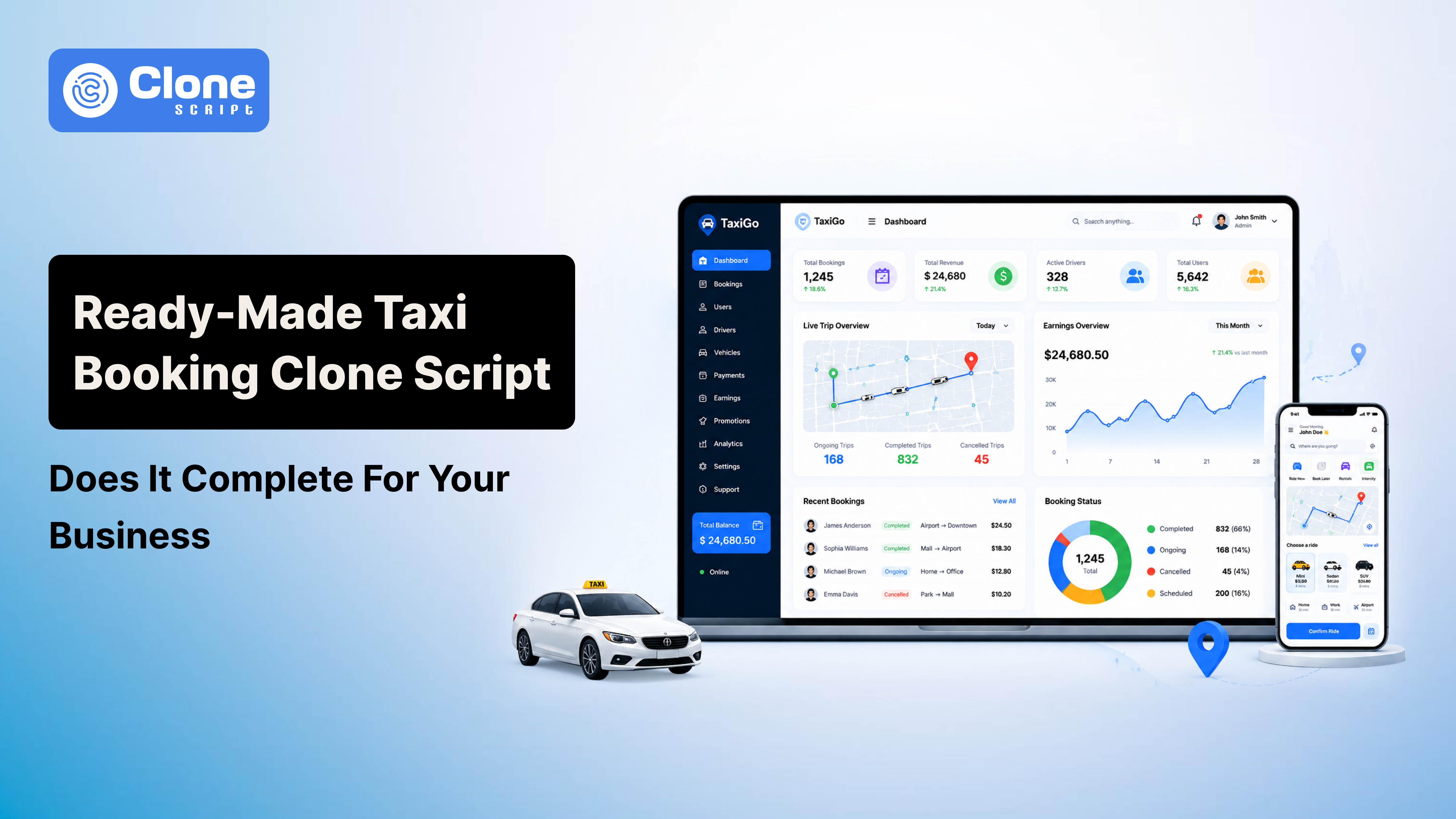
Can a Ready-Made Taxi Booking Clone Script Still Compete in 2026?
Would you invest $10,000 in a ready-made taxi booking clone script if it could save you over $100,000 in development costs?
Or would you avoid it because many founders claim clone scripts cannot compete with modern ride-hailing platforms anymore?
The question matters because the global ride-hailing market is expected to exceed $430 billion by 2028, creating opportunities for new transportation businesses worldwide.
Yet entering this market has become more expensive than ever.
Building a taxi app from scratch often requires months of development, a dedicated technical team, and a significant upfront investment before acquiring a single customer.
That's why many startups and transportation businesses continue to explore ready-made taxi booking clone scripts.
They promise faster deployment, lower costs, and a quicker path to market.
But here's the challenge.
Can a clone script truly compete in a market where customers expect seamless experiences, real-time tracking, intelligent dispatching, and reliable service?
Or does choosing a ready-made solution create limitations that eventually slow business growth?
The answer is more complex than most software vendors or developers would have you believe.
We’ll explore where taxi booking clone scripts still create value in 2026, where they fall short, and how to determine whether they're the right investment for your transportation business.
Why Entrepreneurs Are Still Looking at Taxi Booking Clone Scripts in 2026
Despite the availability of custom development services and no-code platforms, taxi clone scripts continue to generate interest among startups and transportation businesses.
The reason is simple: they solve several major challenges faced by founders during the early stages of launching a mobility business.
-
The Cost of Building a Taxi App From Scratch Keeps Rising
Building a modern taxi application involves much more than creating a passenger booking screen and driver dashboard.
A production-ready solution often requires:
-
Customer applications for iOS and Android
-
Driver applications
-
Admin management panels
-
Real-time GPS tracking
-
Payment integrations
-
Notification systems
-
Security infrastructure
-
Analytics dashboards
Each component adds complexity, development hours, and long-term maintenance requirements.
For startups testing a business concept, investing heavily in custom development before validating demand can introduce unnecessary financial risk.
This is where clone scripts offer an attractive alternative.
Instead of spending months building core functionality, businesses can launch with a pre-built framework and focus on acquiring customers and drivers.
-
Speed-to-Market Matters More Than Ever
The transportation industry rewards businesses that move quickly.
A delay of six to twelve months during development can create several challenges:
-
Competitors establish market presence
-
Customer acquisition costs increase
-
Driver recruitment becomes harder
-
New regulations emerge
Many entrepreneurs are no longer asking how to build the perfect platform.
Instead, they are asking: "How quickly can I launch and start generating bookings?"
Ready-made taxi booking clone scripts significantly reduce development timelines by providing a functional foundation from day one.
For founders focused on market validation, faster deployment often outweighs the benefits of building every feature from scratch.
The Biggest Misconception About Taxi Clone Scripts
One of the most common misunderstandings is that success in the ride-hailing industry depends entirely on technology.
Many founders assume that if they purchase software similar to Uber, they can replicate Uber's success.
Unfortunately, that assumption rarely holds.
Technology has become a commodity.
Customers today expect certain features as standard:
-
Real-time tracking
-
Digital payments
-
Driver ratings
-
Ride scheduling
-
Trip history
These features are no longer competitive advantages.
The real differentiators are:
-
Customer trust
-
Driver availability
-
Pricing strategy
-
Service reliability
-
Local market knowledge
A taxi booking clone script cannot solve operational problems.
It cannot automatically attract drivers.
It cannot build customer loyalty.
And it cannot create a sustainable business model.
The software is simply one component of a larger transportation ecosystem.
Businesses that understand this reality are far more likely to succeed.
Where Most Ready-Made Taxi Clone Scripts Fail Today
Although clone scripts provide a faster path to market, they are not without limitations.
Understanding these weaknesses before investing can help businesses avoid expensive mistakes later.
-
Generic User Experience
One of the biggest challenges with many clone scripts is the lack of differentiation.
Because the software is designed for mass distribution, multiple businesses often end up using nearly identical interfaces and workflows.
The result is a generic user experience.
Customers today compare every transportation app against the best experiences available in the market. If an application feels outdated, slow, or visually generic, users may abandon it regardless of pricing advantages.
This creates an important question: Why should a customer switch from an established platform to yours?
A clone script alone rarely provides a compelling answer.
Successful transportation businesses typically invest in branding, localized features, and customer-centric experiences that distinguish them from competitors.
-
Scalability Issues Appear Faster Than Expected
Many taxi clone scripts perform well during the early stages of business growth.
The challenge emerges when operations expand.
As the number of drivers, customers, and daily rides increases, weaknesses in the underlying architecture can become apparent.
Common issues include:
-
Slow booking performance
-
Delayed ride matching
-
Database issues
-
Increased server costs
-
System instability during peak demand
For a startup processing a few dozen rides per day, these issues may never surface.
For a business handling thousands of rides daily, scalability becomes a critical concern.
This is why founders should evaluate not only the current functionality of a clone script but also its long-term growth potential.
-
Weak Admin and Dispatch Capabilities
Many buyers focus heavily on customer-facing features.
However, transportation businesses are ultimately operational businesses.
Managing drivers, routes, customer disputes, pricing, fleet utilization, and service quality often requires sophisticated backend systems.
Unfortunately, some clone scripts prioritize front-end development functionality while providing only basic administrative tools.
As operations become more complex, businesses may discover that managing the platform requires significant manual intervention.
This can increase operational costs and reduce efficiency.
The ability to monitor performance, automate workflows, and optimize dispatching often becomes more valuable than customer-facing features.
-
Hidden Technical Debt
Perhaps the most overlooked risk associated with ready-made taxi booking software is technical debt.
Many scripts are built on older frameworks, outdated libraries, or poorly documented codebases.
While everything may appear functional during the initial deployment, problems often emerge later.
Examples include:
-
Security vulnerabilities
-
Compatibility issues
-
Expensive upgrades
-
Limited customization options
-
Difficult maintenance processes
The cheapest solution at the beginning can become the most expensive solution over time.
Before purchasing a taxi booking clone script, businesses should investigate the technology stack, update frequency, code quality, and long-term support offered by the vendor.
These factors often have a greater impact on total ownership costs than the initial purchase price itself.
What Successful Taxi Startups Are Doing Differently in 2026
The taxi businesses gaining traction in 2026 are not necessarily the ones with the biggest budgets or the most advanced technology. In many cases, they are the companies that understand their local markets better than larger competitors.
Instead of trying to become the next Uber overnight, successful operators focus on solving specific transportation challenges for specific customer groups.
-
Focusing on Niche Transportation Markets
One of the biggest mistakes founders make is targeting everyone.
Large ride-hailing companies already dominate general transportation services in many cities. Competing head-to-head often requires massive marketing budgets and driver incentives.
Smaller businesses are finding success by targeting underserved segments such as:
-
Airport transfer services
-
Corporate transportation
-
Medical transportation
-
Rural mobility services
-
School transportation
-
Women's ride services
-
Tourism and sightseeing transportation
A niche approach allows startups to build customer loyalty and establish a stronger market presence without competing directly against global brands.
-
Winning Through Local Advantages
Large ride-hailing platforms operate at scale, but they often struggle to deliver highly localized experiences.
Regional taxi businesses can experience advantages such as:
-
Local customer support
-
Familiarity with local routes
-
Partnerships with hotels and businesses
-
Region-specific pricing models
-
Strong driver relationships
In many cities, customers prefer reliable local services over global platforms when the experience is more personalized and responsive.
-
Building Loyalty Instead of Fighting on Price
Many startups believe lower pricing is the key to customer acquisition.
In reality, price wars are difficult to sustain.
Successful transportation businesses focus on retention strategies such as:
-
Loyalty rewards
-
Subscription plans
-
Corporate contracts
-
Frequent rider discounts
-
Priority booking benefits
Customer retention often delivers higher profitability than continuously acquiring new users through discounts and promotions.
Ready-Made Taxi Clone Script vs Custom Taxi App Development
Choosing between a taxi booking clone script and custom development is one of the most important decisions for transportation startups.
The right choice depends on business goals, budget, and growth expectations.
| Factor | Taxi Clone Script | Custom Development |
|---|---|---|
| Initial Cost | Lower | Higher |
| Launch Time | Weeks | Several Months |
| Customization | Moderate | Extensive |
| Maintenance Control | Limited | Full |
| Scalability | Depends on Architecture | Highly Flexible |
| Technical Ownership | Partial | Complete |
| Business Risk | Lower Initial Risk | Higher Initial Investment |
When a Clone Script Is the Smarter Choice
A ready-made taxi booking clone script makes sense when:
-
You want to validate a business idea quickly.
-
Budget constraints are significant.
-
You operate within a single city or region.
-
Rapid deployment is a priority.
-
Core ride-hailing functionality is sufficient for launch.
For many startups, launching quickly and collecting market feedback is more valuable than spending months building custom software.
When Custom Development Is Worth the Investment
Custom development becomes more practical when:
-
Multi-city expansion is planned.
-
Unique workflows are required.
-
Enterprise fleet management is involved.
-
Advanced analytics are necessary.
-
Long-term scalability is a top priority.
Businesses expecting significant growth should evaluate whether a clone script can support future expansion before committing to a platform.
Features That Actually Matter in 2026
Many software vendors promote extensive feature lists containing dozens of functionalities.
However, not every feature contributes directly to business growth.
The most valuable features are those that improve efficiency, customer experience, and profitability.
-
AI-Powered Dispatching
Modern dispatch systems can analyze factors such as:
-
Driver availability
-
Traffic conditions
-
Distance calculations
-
Historical demand patterns
The result is faster ride allocation and improved customer satisfaction.
As customer expectations continue to rise, intelligent dispatching is becoming a competitive necessity rather than a luxury feature.
-
Dynamic Pricing Management
Demand fluctuates throughout the day.
Static pricing models often reduce profitability during peak periods and create inefficiencies during low-demand hours.
Dynamic pricing systems help operators:
-
Balance supply and demand
-
Increase driver participation
-
Improve revenue generation
-
Reduce service disruptions
Pricing handling is the most important thing to do in taxi booking services.
-
Driver Performance Analytics
Drivers are the foundation of every transportation platform.
Performance monitoring helps businesses track:
-
Ride completion rates
-
Customer satisfaction
-
Driver retention
-
Revenue contribution
Data-driven driver management can improve service quality while reducing operational challenges.
-
Multi-Service Expansion
Many transportation businesses are expanding beyond passenger rides.
Modern platforms increasingly support:
-
Food delivery
-
Courier services
-
Parcel transportation
-
Logistics operations
This flexibility allows businesses to diversify revenue streams and maximize platform utilization.
The Hidden Costs Buyers Often Ignore
One of the most effective assumptions in the taxi software industry is believing that software cost represents the majority of the investment.
In reality, software is only a small portion of the total business expense.
-
Driver Acquisition Costs
A ride-hailing platform without drivers cannot operate.
Recruiting and retaining quality drivers requires:
-
Sign-up incentives
-
Marketing campaigns
-
Referral programs
-
Support resources
Driver acquisition frequently becomes one of the largest early-stage expenses.
-
Customer Acquisition Costs
Building an application is relatively straightforward.
Convincing customers to use it is significantly harder.
Transportation startups typically invest in:
-
Digital advertising
-
Social media campaigns
-
Referral programs
-
Local promotions
-
Partnership marketing
Without a customer acquisition strategy, even excellent software can struggle to generate bookings.
-
Software Customization Costs
Most clone scripts require modifications.
Common customization requirements include:
-
Branding changes
-
Additional features
-
UI improvements
-
Localization support
These costs can accumulate quickly and should be included in project planning.
-
Ongoing Maintenance and Updates
Technology evolves continuously.
Businesses must account for:
-
Security updates
-
Operating system compatibility
-
Performance optimization
-
Feature enhancements
Ignoring maintenance often leads to technical issues and customer dissatisfaction.
-
Payment Gateway and Infrastructure Fees
Operational costs continue after launch.
Examples include:
-
Server hosting
-
Cloud infrastructure
-
SMS notifications
-
Mapping services
-
Payment processing fees
These recurring expenses should be evaluated before selecting a software solution.
Can a Taxi Booking Clone Script Actually Compete Against Uber and Lyft?
This question is framed incorrectly.
Most local transportation businesses are not competing against Uber or Lyft on a global scale.
Instead, they compete within specific geographic regions and market segments.
A local operator serving airport transfers in a mid-sized city faces a completely different competitive environment than a global ride-hailing company.
Success depends on solving local transportation challenges better than available alternatives.
For example:
-
Faster airport pickups
-
Better customer support
-
Specialized transportation services
-
Regional pricing advantages
-
Local business partnerships
A clone script can absolutely support these business models when paired with a strong operational strategy.
The software itself is not the competitive advantage.
The business model is.
A Practical Framework Before Buying Any Taxi Clone Script
Before purchasing a ready-made taxi booking solution, business owners should evaluate several critical factors.
Ask the following questions:
-
Can the Platform Scale Beyond My First City?
Growth requirements often change faster than expected. Ensure the architecture can support future expansion.
-
Is Source Code Included?
Access to source code provides greater flexibility for future customization and development.
-
How Frequently Are Updates Released?
Active development indicates long-term product viability.
-
What Technology Stack Powers the Platform?
Modern frameworks typically provide better security, maintainability, and performance.
-
What Security Measures Are Included?
Customer information, payments, and location data require robust protection.
-
Can Features Be Customized Later?
Business requirements evolve. A rigid platform may become a limitation.
-
Is There a Proven Deployment History?
Real-world implementations demonstrate whether the software performs effectively in operational environments.
The Verdict: Is a Ready-Made Taxi Booking Clone Script Still Worth It in 2026?
The short answer is yes, but with important conditions.
Ready-made taxi booking clone scripts remain valuable because they provide entrepreneurs with a faster and more affordable way to enter the transportation market.
However, software alone is no longer enough to guarantee success.
A Taxi Clone Script Is Worth It If:
-
You need rapid market entry.
-
You want to validate business demand.
-
Budget limitations are a concern.
-
You operate in a local or niche market.
-
Speed-to-market is a priority.
A Taxi Clone Script May Not Be the Right Choice If:
-
Immediate large-scale expansion is planned.
-
Highly specialized workflows are required.
-
Extensive customization is essential.
-
Enterprise-level scalability is expected from day one.
Ultimately, the most successful transportation businesses in 2026 are not winning because they have the most complex software.
They are winning because they understand their customers, build reliable operations, support their drivers, and focus on solving transportation problems within specific markets.
A ready-made taxi booking clone script can absolutely compete in 2026. The question is not whether the software can compete. The real question is whether the business behind it has a strategy that can.