BTC - Bitcoin
 USDTERC20 - USDT ERC20
 ETH - Ethereum
 BNB - Binance
 BCH - Bitcoin Cash
 DOGE - Dogecoin
 TRX - TRON
 USDTTRC20 - USD TRC20
 LTC - LiteCoin

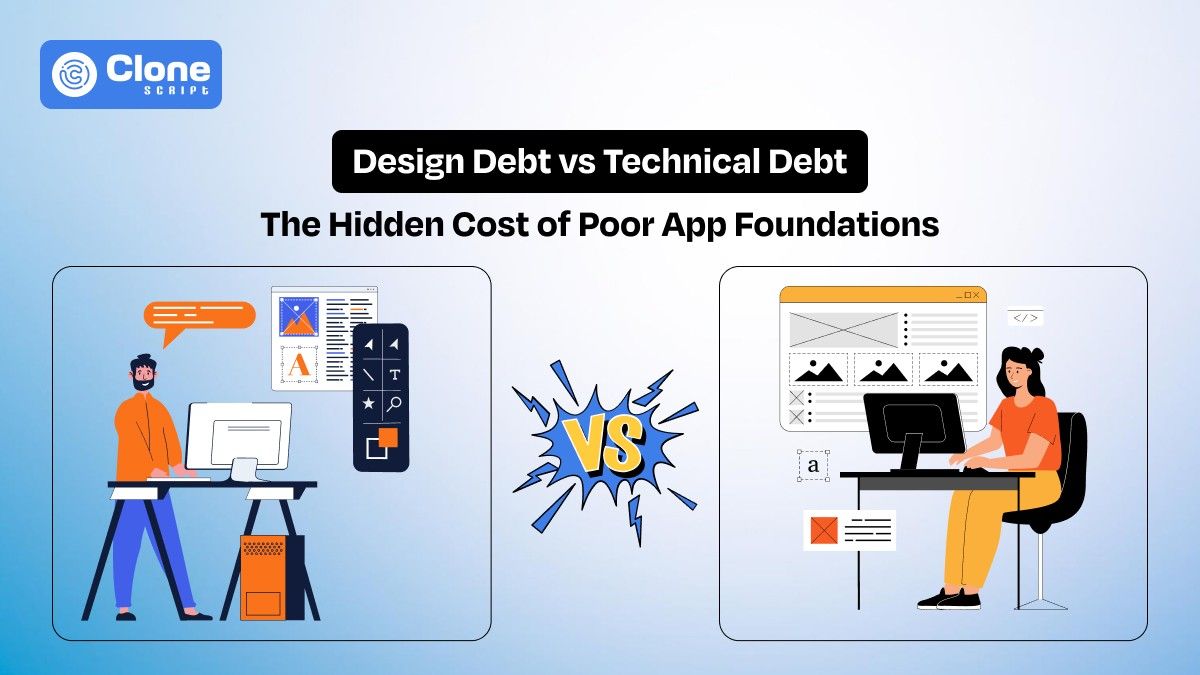
Design Debt vs Technical Debt: The Hidden Cost of Poor App Foundations
You’ve likely attended a review of a web project where someone says, “I just feel like this is harder than it needs to be.” Designers struggle with maintaining consistency. Developers are reluctant to lay their hands on the essential parts. Product managers feel the pain of velocity. Founders see timelines extend and expenses increase. It wasn’t any one decision, but a series of early trade-offs that quietly accumulated design debt and technical debt.
This article will present design debt and technical debt side by side, under the same lens. It will describe how they begin, how they accumulate, and how to mitigate them before the growth causes the pain to spike.
What Is Technical Debt in Software Development?
Technical debt is the future cost of making short-term trade-offs against maintainability. As technical debt for developers, it manifests as brittle architecture, hardcoded logic, and increasing regression risk. For product managers, technical debt manifests as slower time-to-market and increasing maintenance expenses.
IBM states that technical debt is a direct hindrance to innovation and productivity, hindering teams’ ability to adapt to market shifts. McKinsey further asserts that 10-20% of engineering capacity is spent on managing technical debt, rather than creating new value.
As a designer or PM, technical debt is a constraint on how easily your ideas can be executed. As a founder or CTO, it is a silent resource reallocation away from growth.
What Is Design Debt in UX/UI and Product Design?
Design debt is the future cost of inconsistent, incomplete, or short-term design decisions. Design debt impacts designers directly, but its effects propagate to engineering, product, and business teams.
On these following aspects, the design debt arises:
-
UI patterns are duplicated instead of being systematized
-
Design systems are in place, but not enforced
-
UX compromises are treated as permanent “temporary” solutions
According to Nielsen Norman Group, the findings show that usability issues undermine user trust and cause users to abandon, which impacts retention and conversion rates significantly.
Design Debt vs Technical Debt: Key Differences and Overlaps
Sometimes, the confusion happens to understand the difference between design debt and technical debt. The reality depends on execution.
-
Design debt originates from UX, UI, and interaction design decisions.
-
Technical debt originates from code, architecture, and infrastructure.
The intersection occurs in the build process. If designs are not segmented into reusable UI components, developers will have to hard-code UI behavior. This code turns into technical debt. Down the line, when you want to modify the design, it becomes difficult.
This is why teams that don’t address design debt end up with more technical debt quickly. To address one without the other is often ineffective.
How Poor App Foundations Create Design and Technical Debt
All process starts in the initial phase. MVPs, rapid deployment, and fast timelines mean rushing past foundation work. Then, design systems are skipped. Architecture decisions are made with speed in mind. And the documentation? Left for another day.
This approach brings the consequences:
-
Mobile app UI designers hold back when it’s time to improve interfaces as per the recommendation.
-
Native and cross-app developers hesitate to improve error-prone areas where the product’s usability is affected.
-
Product leaders prioritize user experience quality in favor of delivery certainty.
Industry research reveals a truth: fixing foundational issues later costs 2-10x more than addressing them in the first place. For product leaders, this means problems compound even as costs don’t scale linearly.
The Hidden Business Cost of Design Debt and Technical Debt
The harsh reality is that a hidden cost related to design debt and technical debt is non-negotiable. If you don’t pay attention, it impacts the entire app development project.
Let’s talk first about technical debt.
Programmers spend 23-42% of their time working through debt-related problems. They can’t spend time on innovation. This resulting product remains neither unique nor useful, but remains generic.
Design debt also has its own set of indirect costs. This has negative results:
-
Slower conversion rates are frequent.
-
Increased support costs and onboarding issues.
-
Time-consuming experimentation and iteration.
For product leaders and entrepreneurs, debt affects predictability. That’s why roadmaps cease to be a promise and become best efforts.
How Design Debt Impacts User Experience and Retention
In software and web application development, the debt for user experience design is found in friction and inconsistency. The examples are navigation is awkward, patterns fail to drive behavior, and trust is missed.
Research reveals that users form an impression of an interface’s credibility in an instant. Inconsistency loses professionalism and trustworthiness. For teams pursuing growth, this means increased churn and poorer engagement, even when the set of features appears competitive.
How Technical Debt Slows Development and Innovation
Technical debt slows down change, we know that. Developers become gun-shy as they have to invest their skills in refactoring that was delayed. Here, innovation languishes, and it costs more than expected.
This results in designers seeing roadmap items demoted in priority. Product managers see delivery velocity decrease. CTOs see system risk increase with each release.
Eventually, teams stop wondering what to build and start wondering what the system will withstand.
How to Identify Design Debt and Technical Debt Early
There are some criteria to understand whether the software development has design debt or technical debt.
You know you have design debt when:
-
UI components migrate between platforms
-
Small UI changes require large design overhauls
-
Handoff explanations become more common for front-end app development
You know you have technical debt when:
-
Small changes introduce regressions
-
Feature delivery slows, even with a stable team
-
Performance degradation accompanies expanded functionality
If you invest in early design and technical debt audits save costs in the long run.
Prevent Design Debt and Technical Debt With These Strategies
Every team, design, development, and product team must be actively working to prevent debt. When considered an afterthought, debt enters the pipeline and brings down the entire process.
-
First, align your design system with how components are developed.
When the components in UI design tools correspond to front-end components, designers and developers can work off the same source. This aligns design and development, reducing rework, inconsistencies, and making interface development more robust.
-
Consider UX consistency a technical requirement rather than a preference.
Consistent spacing, behavior, and interaction design should be enforced at a code level. It shouldn’t be left to personal preference. Otherwise, the misalignment surface on the back-end development.
-
Allocate time for incremental debt reduction.
Start with small changes rather than addressing a large problem, such as refactoring a component and removing outdated design patterns. This will not make a product that reworks at launch.
-
Make debt visible in planning and prioritization.
Record design and technical debt alongside new features to ensure system health is considered in decisions. Proving the workflow is optimized and data-dependent is a good move towards not facing development debt.
Understand that prevention is not about slowing down delivery. It is about keeping delivery sustainable.
Managing Existing Design Debt and Technical Debt in Live Apps
With a live app already burdened with design debt and tech debt, your goal is progress. We recommend following this approach.
-
Begin where it counts most. For example, in the primary user flows that drive engagement and conversion.
-
Next, focus on shared components and libraries. Small changes here can have a massive impact throughout the product. Instead of putting the brakes on new development to make radical overhauls, integrate small refactors with new development.
This reduces risk, avoids conflicts, and keeps everyone from stakeholders to teams in sync.
How the AllClone Script Helps Cross-Functional Teams
AllClone Script assists cross-functional teams in reducing both design and technical debt by providing a ready-to-use UI and scalable design systems. Every solution aligns correctly with the realities of software development.
Designers can focus on creating system-driven components, while developers work with predictable HTML front-end layouts that are simpler to build and maintain. Product managers and technical leads can deliver faster with fewer compromises.
Conclusion
Design and technical debt are systemic risk that affects the entire team. When the foundations are weak, designers take shortcuts, developers waste time on band-aids, product leaders stall, and the business pays the price in hidden costs. When the foundations are strong, the team can move faster with confidence.
The question is: Are you building products that last past launch day, or systems that evolve alongside you for years to come?
FAQs
-
What is technical debt in software development?
Technical debt is the "hidden cost of quick fixes." When you settle for a messy architecture instead of a clean and scalable one, it appears. In the end, it leads to code that is harder to maintain, slower to develop new features, more prone to bugs, and more work for even the tiniest changes.
-
What is design debt in UX and UI design?
Design debt occurs when "inconsistent layouts, hasty UI decisions, and unmanaged design systems" add up. You see it when the user experience is disjointed, with lots of redesigns and increased friction between design and development teams as the product evolves.
-
What is the difference between design debt and technical debt?
Design debt affects the user experience of the product, while technical debt affects the internal workings of the system. Design debt slows down usability improvements, while technical debt slows down programming velocity. Both add up to increased costs as you scale and iterate.
-
How does technical debt affect development speed and scalability?
When you have more technical debt, it means that new features take longer to deliver. Developers are stuck dealing with brittle code, debugging regressions, and managing dependencies. This makes scalability and quick market response even harder.
-
How does design debt impact user experience and retention?
Design debt leads to inconsistent interfaces, confusing navigation, and broken visual feedback. Users encounter issues, they begin to lose trust, and may abandon the experience. Over time, this affects retention, conversion rates, and brand trust, particularly in competitive SaaS and consumer apps. This adds more costs to SaaS app development.
-
Why does technical debt slow down product development?
Technical debt introduces complexity that multiplies. Debugging becomes harder, dependencies conflict, and integrations become brittle. Consequently, developers become reluctant to make changes, and teams spend more time supporting past decisions than building new value.
-
How do design and technical debt affect startups and MVPs?
In startups, unchecked debt quietly conflicts with agility. Design debt affects early user trust, while technical debt slows down iteration speed. This affects increases burn rate, and requires expensive rebuilds at the worst possible time.
-
How can teams reduce technical debt without rebuilding the app?
They have to address technical debt incrementally while building new functionality. Then, focus on high-leverage modules, shared libraries, and performance hotspots. This helps with minimal disruption while continually improving system robustness, supportability, and overall speed.
-
How do UI inconsistencies create long-term design debt?
Inconsistencies in UI mean that every new screen is a unique solution. This increases design work, hinders handoffs from design to development, and results in a scattered visual experience. Small changes can lead to a complete overhaul, increasing costs and undermining the product’s cohesion.
-
How can cross-functional teams prevent design and technical debt early?
The key is to “lock in debt prevention early” by integrating design systems with component architecture, considering UX consistency a technical requirement, and making debt visible in planning. Early collaboration between designers, developers, and product leaders helps maintain velocity while ensuring quality.