BTC - Bitcoin
 USDTERC20 - USDT ERC20
 ETH - Ethereum
 BNB - Binance
 BCH - Bitcoin Cash
 DOGE - Dogecoin
 TRX - TRON
 USDTTRC20 - USD TRC20
 LTC - LiteCoin

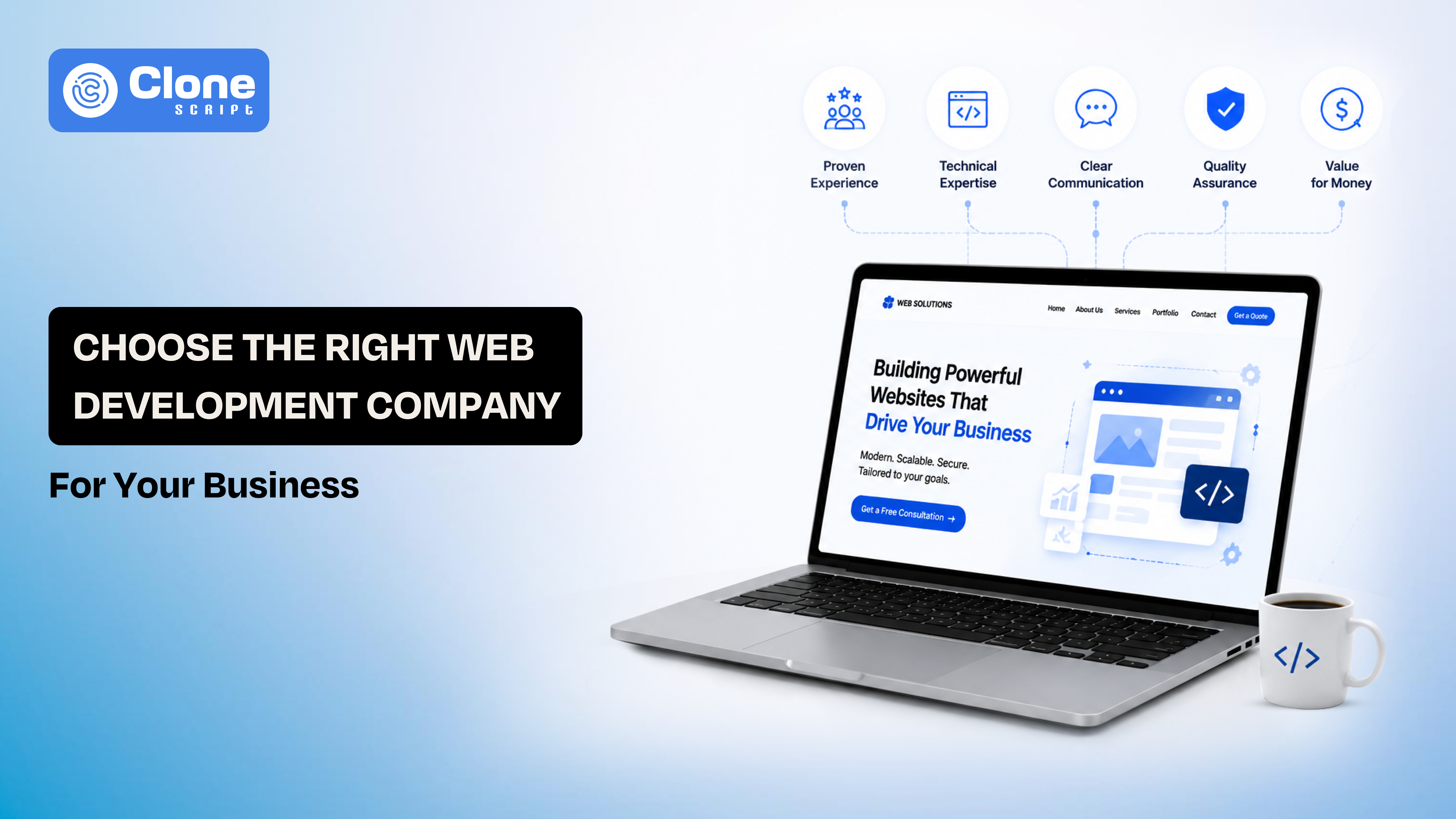
How to Choose the Perfect Web Development Company for Your Business
Hiring a web development company is one of the most critical decisions a business owner makes. Yet, it’s usually approached like a vendor comparison exercise.
The reality is different. Your website directly influences lead generation, customer acquisition, and revenue performance. A poor decision doesn’t just result in a bad website; it creates long-term inefficiencies that affect marketing, sales, and scalability.
Can’t you afford to lose a $10k after investing in a custom website or app development?
The problem is that many of the businesses fail because they evaluate development agencies based on the design, cost, or timelines. They overlook business impact. The result comes with a redesign within 12-18 months of struggling with low conversions.
This guide takes a different approach. Instead of generic tips, you’ll learn how to identify a web development partner that aligns with your business goals, growth strategy, and ROI expectations, and the critical signs most owners overlook before signing the deal.
Why Choosing the Right Web Development Company Matters More in 2026
In 2026, you’re not just selecting a service provider. You’re choosing a growth partner that directly impacts revenue, customer experience, and long-term scalability.
-
The Market Reality Business Owners Must Understand
The digital field is more competitive than ever:
-
Over 707,372 new websites are created every day, increasing competition for attention.
-
More than 60% of global traffic now comes from mobile devices, making performance critical.
-
53% of users abandon a site if it loads slowly, directly affecting conversions.
This means your website is a performance-driven system competing in a saturated environment.
-
Websites Are Now Revenue Engines, Not Digital Brochures
A major shift in recent years is the move from “design-first” to “conversion architecture.”
Modern businesses are no longer asking: “Does the website look good?”
They are asking: “Does this website generate leads, sales, and measurable ROI?”
This shift is backed by data:
-
Even a 1-second improvement in load time can increase conversions by ~2%.
-
Companies like Walmart observed similar performance gains tied directly to speed improvements.
-
Poor user experience can cause 52% of users to abandon a brand entirely after one bad interaction.
Implication: The agency you choose must understand conversion, user behavior, and performance. Not just development.
-
Performance Is Now a Business KPI (Not a Technical Detail)
In 2026, performance is directly tied to revenue:
-
Faster websites = higher conversions
-
Better UX = longer session duration
-
Optimized structure = higher SEO rankings
Organizations are now treating page speed, Core Web Vitals, and mobile responsiveness as primary business metrics, not technical metrics.
What this means for you:
If an agency doesn’t discuss performance in business terms, they are operating at an outdated level.
-
The Rise of AI, Automation, and Scalable Architecture
Modern development is no longer just coding. Key shifts include:
-
AI-assisted development is used by over 90% of designers.
-
Growth of serverless and edge architectures for scalability
-
Rapid adoption of low-code/no-code platforms (70% of apps)
What does this mean for business owners?
You need an agency that understands modern tech stacks, builds scalable systems, and avoids outdated, rigid architectures.
Otherwise, your website becomes obsolete quickly.
What Smart Business Owners Are Doing Differently
Instead of hiring based on the cheapest quote and best-looking portfolio found on Upwork, Freelancer, or from an agency website, you can consider these:
-
ROI-driven development
-
Conversion-focused design
-
Long-term scalability
They treat their website as a growth infrastructure, not a one-time project.
See the following steps to get the professional and correct website development partner for your business.
Step 1: Define Business Outcomes (Not Just Website Features)
Before you evaluate any web development company, you need absolute clarity on what your website is expected to achieve. This is where most business owners make a costly mistake. What? They focus on features instead of outcomes.

A development agency cannot deliver meaningful results if its requirements are limited to:
-
“We need a modern design.”
-
“We want better UI/UX.”
These are surface-level inputs. What actually drives success are business-defined goals.
Shift Your Thinking to Outcomes and Start by identifying:
-
How many leads should your website generate monthly
-
What conversion rate do you want to achieve
-
How users should move from landing to purchase
-
What integrations are required (CRM, payment systems, automation tools)
Why all these matters?
When you define outcomes, you force the agency to think strategically rather than visually. It also helps you filter out vendors who cannot connect development with business performance.
A strong web development company will ask deeper questions about your revenue model, target audience, and growth plans. If they don’t, they are not building a business asset. They are just building a website.
Step 2: Evaluate Real ROI, Not Just Portfolio
A visually impressive portfolio can be misleading. Most agencies highlight aesthetics, brand names, or animations. But, very few demonstrate measurable business impact. As a business owner, this is where your evaluation needs to be more rigorous.

The Problem with Traditional Portfolios
Typical portfolios showcase:
-
Clean UI design
-
Recognizable client logos
-
Generic success statements
What’s missing is the “so what?” factor: how did the website actually perform after launch?
What You Should Ask Instead
Shift the conversation from design to performance:
-
What were the client’s goals before the project?
-
What specific improvements were achieved post-launch?
-
How did the website impact conversions, leads, or revenue?
-
Can you share before-and-after performance metrics?
These will help you to understand whether the agency is a perfect fit for your niche or not.
Metrics That Actually Matter
Focus on quantifiable outcomes:
-
Conversion rate improvement
-
Lead generation growth
-
Page load time reduction
-
Bounce rate decrease
-
Revenue per visitor
The question is why these filter the right agencies?
Agencies that track and share these metrics operate with a business-first mindset. Those that cannot are typically focused on output (design and development) rather than outcomes (growth and ROI).
A professional web development partner doesn’t just show what they built. They prove what they have achieved.
Step 3: Understand Their Development Process
A well-defined development process is a strong indicator of how reliably an agency can deliver results. Without structure, projects drift, timelines slip, budgets expand, and outcomes become unpredictable.

What a Mature Development Process Looks Like
A professional web development company typically follows:
-
Discovery Phase: First, it comes to understanding your business model, audience, and goals.
-
Wireframing: At this level, structuring user journeys and page layouts comes.
-
UI/UX Design: Here, creating visual and interaction design has been done.
-
Development: The actual coding work starts with building a scalable, modular architecture.
-
Testing (QA): Here, the fixing of bugs ensures performance and responsiveness.
-
Deployment: Finally, the launch of a website has happened.
-
Post-Launch Optimization: The steps have been taken to improve based on real user data.
What You Should Validate
-
Do they define milestones clearly?
-
Do they provide timelines for each phase?
-
How do they handle revisions and feedback?
-
What tools do they use for collaboration and tracking?
Example: Structured vs Unstructured Approach
Scenario: A SaaS business wants to improve lead generation.
Agency A (Unstructured):
They initiate directly into design based on vague requirements. After launch, the site looks good, but fails to convert because user flow and messaging were never validated.
Agency B (Structured):
They begin with discovery, analyzing user intent and conversion paths. Wireframes are tested before design. After launch, the website includes optimized landing pages and clear CTAs, resulting in a 35–50% increase in lead conversions.
Why does this matter? A structured process ensures that decisions are based on data and strategy, not assumptions.
The difference between an average and high-performing website is rarely design. It’s the process behind how it was built.
Step 4: Check Technical Scalability & Future Readiness
A website should not just meet your current needs. It must support your business as it grows. Many companies face limitations within a year because their website was built without considering scalability.

What Scalability Actually Means
Scalability is the ability of your website to:
-
Handle increasing traffic without performance drops
-
Support new features without major redevelopment
-
Integrate with evolving tools and systems
Key Technologies You Should Be Paying For
As a business owner, you don’t need to code, but you must understand what you’re investing in.
1. Front-end (User Interface Layer)
This is what users see and interact with. Common modern stacks include:
-
React.js: It is usually scalable and used for dynamic SaaS platforms.
-
Next.js: This is SEO-friendly, with fast performance (ideal for business websites).
-
Vue.js: It is lightweight and flexible for faster development.
The front-end tech stack impacts speed, user experience, and SEO performance.
2. Back-end (Logic & Data Handling)
This powers functionality like user accounts, dashboards, and integrations. Common stack options:
-
Node.js (Express/NestJS): It is scalable and fast for modern apps.
-
PHP (Laravel): It is stable and widely used for business websites.
-
Python (Django/FastAPI): This is strong for data-driven and AI-based systems.
Back-end development analyzes how well your website handles growth and complexity.
3. CMS (Content Management System)
CMS website builder platforms allow your team to manage content without developers. Popular options include:
-
WordPress: It is best for SEO and content-heavy websites.
-
Webflow: This platform comes with visual control and decent flexibility.
-
Strapi / Contentful (Headless CMS): This is an advanced, scalable content system.
It directly affects marketing speed and content updates.
4. Database (Data Storage)
The website database is where your data lives. Here are common choices you can ask the agency to prefer in development:
-
MySQL / PostgreSQL: It is reliable and structured to manage the data.
-
MongoDB: This is a flexible database choice for dynamic applications.
Database selection affects performance, scalability, and data reliability.
5. Hosting & Infrastructure
At this level, your website runs and appears anywhere around the world. For hosting and infrastructure, the modern platforms:
-
AWS (Amazon Web Services): It is a highly scalable, enterprise-grade solution.
-
Google Cloud: It has strong performance and AI integration.
-
Vercel / Netlify: It is optimized for fast front-end deployment.
This aspect impacts uptime, speed, and ability to scale during traffic spikes.
Future-Readiness Factors
A forward-thinking agency will design your system with:
-
API-first architecture (easy integrations)
-
Headless CMS capability (flexibility across platforms)
-
AI integration readiness (chatbots, personalization)
-
Cloud scalability (no downtime during growth)
If your tech stack is outdated or rigid, every upgrade becomes expensive. Instead of scaling smoothly, you’ll face rebuilds, delays, and increasing costs.
Step 5: Analyze Pricing Beyond the Proposal
Pricing is where most business owners make reactive decisions. A lower quote looks attractive upfront, but in web development, initial cost rarely reflects total investment.

The Problem with Standard Proposals
Most agencies present pricing as a one-time cost:
-
Design and development
-
Basic revisions
-
Deployment
However, the real cost of ownership extends far beyond this.
Realistic Pricing Breakdown (2026 Market Range)
Here’s what you should expect across different levels:
1. Basic Business Website
This kind of website development costs in the range between ₹30,000 – ₹1,00,000 ($400 – $1,200).
It typically includes:
-
Template-based design
-
Limited customization
-
Basic performance
Best for: Small businesses with minimal requirements
2. Professional Business Website
This type of website development costs remain around ₹1,00,000 – ₹5,00,000 ($1,200 – $6,000).
It includes:
-
SEO-friendly structure
-
CMS integration (WordPress, Webflow)
-
Performance optimization
Best for: Growing businesses focused on lead generation
3. Advanced / SaaS-Level Website
This type of website costs ₹5,00,000 – ₹20,00,000+ ($6,000 – $25,000+).
It includes:
-
Custom development (React, Next.js, APIs)
-
Scalable back-end systems
-
Advanced integrations (CRM, dashboards)
-
High-performance infrastructure
Best for: SaaS, marketplaces, or scaling startups
Ongoing & Hidden Costs (Monthly / Annual)
These costs are often not clearly communicated:
-
Hosting & Infrastructure: ₹2,000 – ₹25,000+/month
-
Maintenance & Support: ₹5,000 – ₹50,000/month
-
Third-Party Tools & Plugins: ₹1,000 – ₹20,000/month
-
SEO & Optimization: ₹10,000 – ₹1,00,000/month (if outsourced)
You may have a question: where do most businesses miscalculate? They budget only for: “Website development cost.” But ignore: “Cost to maintain, scale, and grow the website.”
Questions You Should Ask Before Signing
-
What exactly is included in this price?
-
What happens after launch, support, or handoff?
-
How are additional features priced (₹/hour or fixed)?
-
What are the estimated monthly running costs?
Pricing Models You’ll Encounter
-
Fixed Cost (₹50K – ₹5L): It defines the scope with limited flexibility.
-
Hourly Billing (₹1,000 – ₹5,000/hour): It is a flexible but variable cost.
-
Retainer Model (₹20K – ₹2L/month): The continuous improvements and support available.
A website is not a one-time expense. It’s a long-term digital asset. Without pricing clarity, you risk:
-
Budget overruns
-
Delayed growth initiatives
-
Compromised performance
Because in reality:
A ₹50,000 website that doesn’t convert is more expensive than a ₹5,00,000 website that consistently generates leads and revenue.
Step 6: Identify Red Flags Before You Sign the Contract
Most hiring mistakes don’t happen after development starts. They happen during the sales conversation. Agencies present their best version upfront, but subtle signals can reveal whether they are the right fit.
Major Red Flags to Watch
1. They Talk About Tools Before Business Goals
If the conversation starts with “We use React, WordPress, or the latest stack” instead of understanding your business, it’s a warning sign. Technology should support strategy, not replace it.
2. No Questions About Your Target Audience or Revenue Model
A serious agency will dig into:
-
Who your customers are
-
How do you generate revenue
-
What your conversion funnel looks like
If they skip this, they are building blindly.
3. Vague Timelines and Deliverables
When getting statements like: “It depends” and “We’ll figure it out as we go.” Stop right there. This indicates a lack of planning.
You should receive:
-
Defined milestones
-
Clear timelines
-
Structured deliverables
4. Overpromising Results Without Data
Be cautious of claims like: “We’ll guarantee top rankings” and “Your conversions will double.”
Without data or strategy, these are sales tactics, not commitments.
5. No Clarity on Ownership and Access
If they hesitate to confirm Code ownership, Hosting control, and Admin access, you risk long-term dependency.
6. Poor Communication or Delayed Responses
Slow replies during sales often reflect future collaboration issues. Communication quality early on is a strong predictor of project experience.
Subtle but Critical Signals
-
They agree with everything you say (no strategic pushback).
-
They don’t challenge unrealistic expectations.
-
They rush you to sign without proper discovery.
Insight: A strong agency behaves like a consultant, not a salesperson.
Ignoring red flags leads to Misaligned expectations, Budget overruns, and Underperforming websites.
The quality of questions an agency asks is more important than the answers they give.
Step 7: Ensure You Avoid Vendor Lock-In
Vendor lock-in is one of the most expensive mistakes a business owner can make, and it’s rarely discussed upfront. Many companies realize the problem only when they try to scale, migrate, or switch agencies.
What Vendor Lock-In Actually Means
Vendor lock-in occurs when your website is built in a way that:
-
Only the original agency can manage or modify it
-
Migration to another provider becomes complex or costly
-
You don’t fully control your own digital assets
Where Lock-In Typically Happens
1. Proprietary Code or Closed Systems. Some agencies use custom-built frameworks that are not documented or transferable.
2. Hosting Controlled by the Agency. If your website is hosted on their private servers without direct access, you depend entirely on them.
3. Limited Access to CMS or Admin Panels. Restricted backend access prevents your team from managing content or making updates independently.
4. Lack of Documentation. Without proper documentation, even a new developer cannot easily take over the project.
What You Should Demand Upfront
Before signing, confirm the following:
-
Full ownership of source code
-
Access to hosting, domain, and database
-
Admin-level CMS access
-
Complete project documentation
-
Ability to migrate without restrictions
Why This Matters for Business Growth
Vendor lock-in affects:
-
Cost: Switching agencies becomes expensive
-
Speed: Updates and changes slow down
-
Flexibility: You cannot adapt quickly to market needs
Strategic Perspective
A reliable web development company builds systems that are Transparent, Transferable, and Scalable without dependency.
You are not just paying for development, you are investing in a business asset you must fully control.
Because the moment you lose control over your website, you lose control over how your business grows digitally.
A Practical Solution for Business Owners
If you’re evaluating web development partners, the priority should be who can build a system that drives measurable business outcomes. It should not be the one who can “build a website” fastest.
A reliable partner understands that your website sits at the center of:
-
Lead generation
-
Customer acquisition
-
Conversion optimization
-
Long-term digital scalability
What Sets a Strong Development Partner Apart
1. Business-First Approach. They begin with your goals, revenue, conversions, and user journeys, not just design preferences or tech stacks.
2. SEO and Conversion Integration. They build websites that are:
-
Structured for search visibility
-
Optimized for user behavior and conversions
-
Designed to support ongoing content and marketing efforts
3. Scalable Architecture. They use modern technologies and frameworks that allow your website to grow without requiring frequent rebuilds.
4. Transparent Processes. You get clear timelines, defined deliverables, and full visibility into progress and decisions.
5. Long-Term Support. Beyond launch, they help you:
-
Optimize performance
-
Add new features
-
Scale based on business growth
Final Thought
The right web development partner delivers a project and contributes to your business growth infrastructure.
Because ultimately, the value of your website is not measured by how it looks, but by how effectively it performs as a revenue-generating asset.