BTC - Bitcoin
 USDTERC20 - USDT ERC20
 ETH - Ethereum
 BNB - Binance
 BCH - Bitcoin Cash
 DOGE - Dogecoin
 TRX - TRON
 USDTTRC20 - USD TRC20
 LTC - LiteCoin

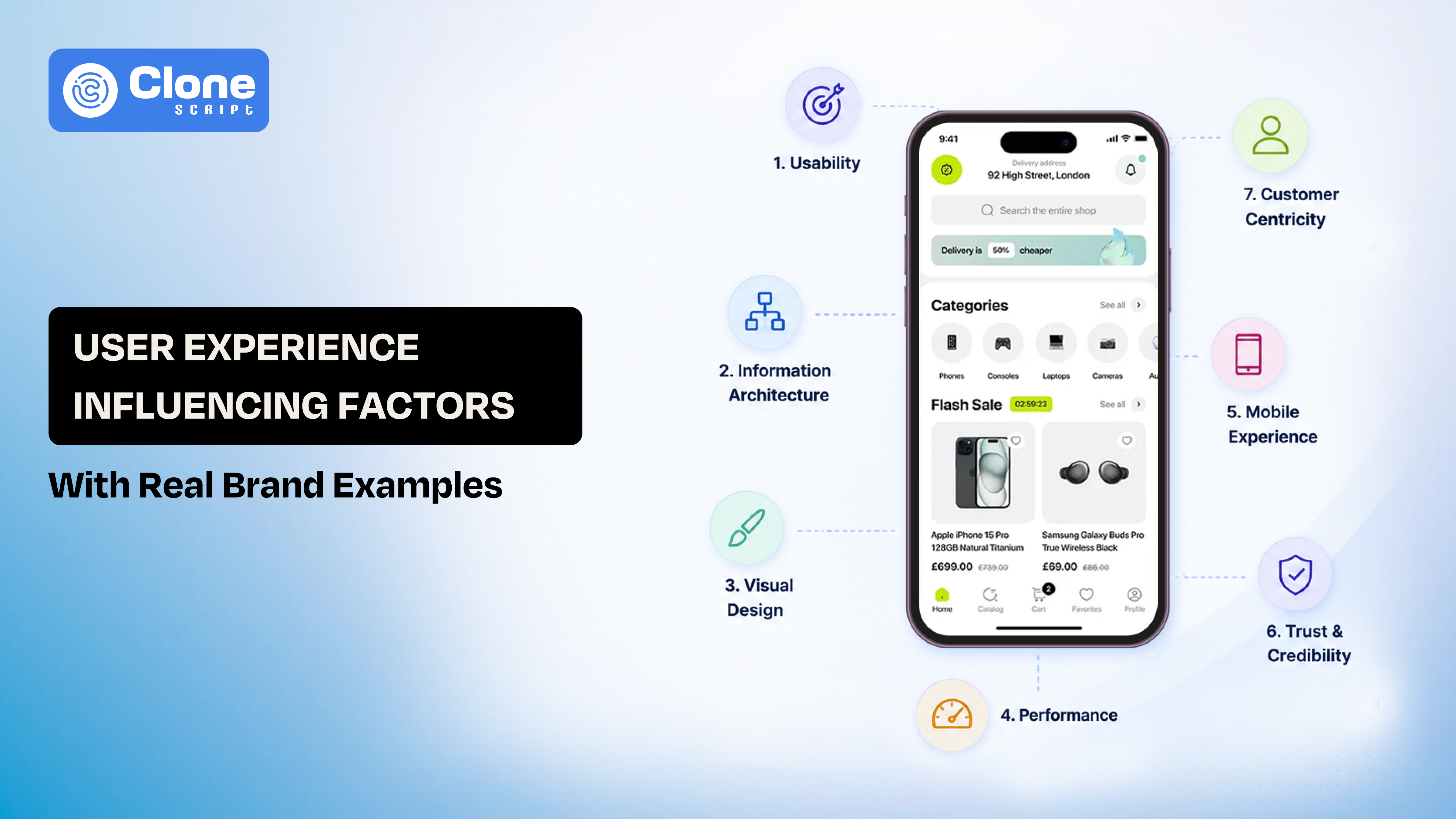
7 Factors That Influence User Experience With Real Brand Examples
You don’t usually notice good user experience.
There is no applause when a checkout flow feels obvious. No celebration when a dashboard loads instantly. No viral tweet when navigation makes sense.
But you always notice a bad experience. It’s our psychology.
A slow page makes you impatient. A confusing layout makes you doubt yourself. A hidden button makes you question the product. Within seconds, frustration turns into exit, and exit turns into churn.
This is why user experience has quietly become one of the most decisive drivers of growth in modern digital products.
Companies like Amazon, Apple, Netflix, and Airbnb did not just build useful platforms. They make journeys that feel predictable, trustworthy, and even enjoyable.
-
According to research by Forrester, better UX design can increase conversion rates by up to 400%, proving that experience is no longer a design concern. It is a revenue engine.
To understand what actually shapes these experiences, designers often turn to Peter Morville’s UX Honeycomb, a framework that identifies seven core factors influencing how users perceive and interact with products.
But frameworks alone don’t explain why some experiences feel effortless while others feel exhausting.
For that, we need to look deeper.
Think about the last digital product you truly enjoyed using.
It probably didn’t just work. It probably felt thoughtful.
That feeling is rarely accidental.
1. Useful - The Moment Users Realize “This Actually Helps Me.”
According to a PwC customer experience study, one in three users will leave a brand they love after just one bad experience. Often, that experience is simply the realization that the product isn’t actually helping anymore.
Most products don’t fail because of bad design. They fail because users never experience a meaningful win.
-
Uber made the app interface truly useful.
When Uber, a ride booking app, first launched, the interface wasn’t revolutionary. Users were confused. Then, they implement the thinking: what felt revolutionary has to be certain. Now, you could see your ride approaching. You knew the fare range. You didn’t have to negotiate or guess. That psychological relief, not just functionality, made the experience valuable.
-
Canva focused on the ease of use.
The same pattern appears with Canva, a visual content editing tool. Before Canva, creating social graphics meant waiting for professional designers or struggling with complex tools. Canva removed both barriers. Canva templates reduced decision fatigue. The best part of this tool is that drag-and-drop editing removes skill anxiety. Exporting became instant.
This is what usefulness looks like in practice:
-
It reduces frustration in real-world workflows
-
It creates small but meaningful productivity wins.
-
It replaces uncertainty with clarity
Usefulness is not about feature quantity.
It is about outcome quality.
2. Usable - When Complexity Disappears Without Users Noticing.
Good usability feels invisible. You can easily highlight it in a visual form.
You don’t think about it when Amazon’s checkout takes seconds. You don’t analyze it when Google Docs lets multiple people edit without conflict. You just move forward.
That forward motion is what usability protects.
-
Amazon makes browsing usable.
Amazon, the e-commerce giant marketplace platform, spent years removing steps from the buying journey. Address auto-fill, saved cards, and default delivery preferences; each decision reduced the number of micro-decisions users had to make. The result wasn’t just convenience. It was momentum.
Momentum is critical because digital attention is fragile.
Research from Google suggests users form usability impressions almost instantly after a page loads. If something feels difficult early, motivation drops.
Strong usability usually includes:
-
Predictable layouts that match user expectations
-
Immediate feedback after clicks or submissions
-
Clear error recovery paths
-
Logical progression between screens
When usability is done right, users don’t feel like they are learning a product.
They feel like they are continuing a task.
3. Findable - When Discovery Feels Effortless Instead of Exhausting
According to usability research by Nielsen Norman Group, poor navigation is one of the leading causes of website abandonment or app uninstall.
Users rarely arrive knowing exactly what they want. They arrive with intent and uncertainty.
This is where findability shapes experience.
-
Airbnb makes every search proper.
On Airbnb, a rental booking platform, users don’t just search. They explore. Filters like property type, trip style, and price range guide decision-making step by step. The interface reduces overwhelm by narrowing focus progressively.
-
Spotify knows what users want next.
Similarly, Spotify’s Discover Weekly playlist removes the burden of manual exploration. Instead of searching through thousands of songs on this music listening platform, users receive curated suggestions that feel surprisingly accurate. Discovery becomes passive and satisfying.
Improving findability often means:
-
Structuring information around user goals rather than internal logic
-
Surfacing relevant content before users actively search
-
Reducing menu complexity
-
Supporting decision-making with contextual cues
When findability improves, engagement depth increases naturally.
4. Credible - The Subtle Signals That Decide Trust
Stanford research has shown that 75% of users judge credibility based on visual design quality alone.
Trust is rarely built through bold headlines. Professional web copywriting services alone can’t help.
It is built through consistency.
-
PayPal follows strict standards of security.
When users complete a payment on PayPal, a payment processing and gateway platform, they are guided through a sequence of reassuring confirmations. Amount visibility, recognizable branding, and security messaging; each detail reinforces safety.
-
Booking.com gives transparency at every interaction point.
Another example is Booking.com, an accommodation rental platform. The platform combines urgency indicators, verified reviews, and transparent pricing breakdowns to remove doubt. Users feel informed rather than pressured.
Credibility in UX grows from:
-
Predictable behavior across pages
-
Honest communication about pricing or policies
-
Visible proof of other users’ experiences
-
Stable performance under pressure
When trust signals are weak, even well-built products feel risky.
Perceived risk is enough to stop a conversion.
5. Desirable - When Experience Creates Emotional Preference
Research from Adobe suggests 38% of users stop engaging with content if the layout feels unattractive.
Users don’t talk about desirable UX in technical terms.
They describe it with feelings.
They say a product feels “clean,” “premium,” or “pleasant.” That’s it.
-
Apple makes browsing simpler.
Look at Apple’s product pages. The Tech giant doesn’t just present specifications. They create anticipation. Scroll-triggered animations, cinematic visuals, and minimal copy guide emotional pacing. Users don’t feel overwhelmed; they feel intrigued.
-
Notion creates a relationship.
Similarly, Notion, a project management software with AI, built loyalty partly through emotional design. Its calm interface reduces visual stress. Micro-interactions in user experience provide subtle feedback. When referring to the flexibility, it gives users creative ownership of their workspace.
Desirability emerges from:
-
Visual rhythm and whitespace
-
Motion that encourages meaning
-
Brand personality in microcopy
-
Consistency in tone and style
Functionality may bring users once.
But emotional design brings them back.
6. Accessible - Designing for Edge Cases Improves the Center
The World Health Organization estimates more than one billion people live with some form of disability, highlighting the scale of inclusive design impact.
Accessibility often enters conversations late, after products are already built. But when considered early, it improves the experience for everyone.
-
Microsoft designs its products with accessibility.
Microsoft’s inclusive design approach led to innovations like live captions and adaptive controllers. While initially created for users with disabilities, these features are now used widely in everyday contexts. That’s why the organization led the technology around the world.
-
YouTube captions are easy to use everywhere.
Similarly, YouTube captions have become essential for mobile consumption in noisy environments or silent browsing situations. Users can access the content everywhere on this digital website and app.
Accessibility-driven UX improvements include:
-
Readable contrast and typography
-
Keyboard and voice navigation support
-
Media alternatives like transcripts
-
Responsive layouts across devices
Inclusive experiences are clearer, faster, and more usable for all users, not just specific groups.
7. Valuable - When Experience Drives Real Business Outcomes
According to McKinsey’s Design Index, companies that invest in design outperform competitors significantly in revenue growth.
User experience ultimately needs to justify itself beyond aesthetics. After all, people are likely to pay more attention when they feel their interactions are valued along with themselves.
-
Netflix showcases curated content based on user interest.
Netflix’s recommendation UX is a complete example of experience driving measurable value. The digital content streaming platform minimizes browsing time and surfacing relevant content instantly. Netflix increases viewing duration and reduces subscription cancellations.
-
The Duolingo platform is keeping users on track.
Another case is Duolingo’s gamified interface. Progress streaks, milestone celebrations, and gentle reminders transform language learning into a habit loop. Then, engagement becomes self-sustaining.
Value-driven UX creates:
-
Higher retention
-
Stronger user advocacy
-
Reduced support requests
-
Improved conversion efficiency
When experience aligns with business goals, UX becomes a growth engine rather than a cost center.
User Experience Continuity is the Advantage.
One of the most overlooked UX factors in website UI and UX design is continuity.
-
The Spotify platform is optimized for smooth performance everywhere.
Spotify Connect allows users to move music playback seamlessly between phone, laptop, and speakers. The experience feels uninterrupted, almost invisible.
-
Google Chrome syncs data in a perfect manner.
Google Chrome syncing ensures tabs, bookmarks, and browsing history remain accessible across devices. Users don’t restart journeys. They continue them.
Continuity builds habit. Habit builds loyalty. And loyalty reduces the need for constant re-acquisition.
Conclusion
User experience is not a feature you launch. It is a relationship you build. Memory shapes loyalty.
In crowded markets where pricing differences shrink, and features become easier to replicate, experience becomes the only sustainable advantage. Users don’t stay because products are perfect. They stay because interactions feel frustationless, familiar, and trustworthy.
The brands that dominate today, from Netflix to Spotify to Apple, understand this deeply.
Great UX doesn’t just improve usability metrics. It compounds into preference. Then, preference compounds into retention. Retention compounds into growth. And growth, in the end, is what every team is chasing.