BTC - Bitcoin
 USDTERC20 - USDT ERC20
 ETH - Ethereum
 BNB - Binance
 BCH - Bitcoin Cash
 DOGE - Dogecoin
 TRX - TRON
 USDTTRC20 - USD TRC20
 LTC - LiteCoin

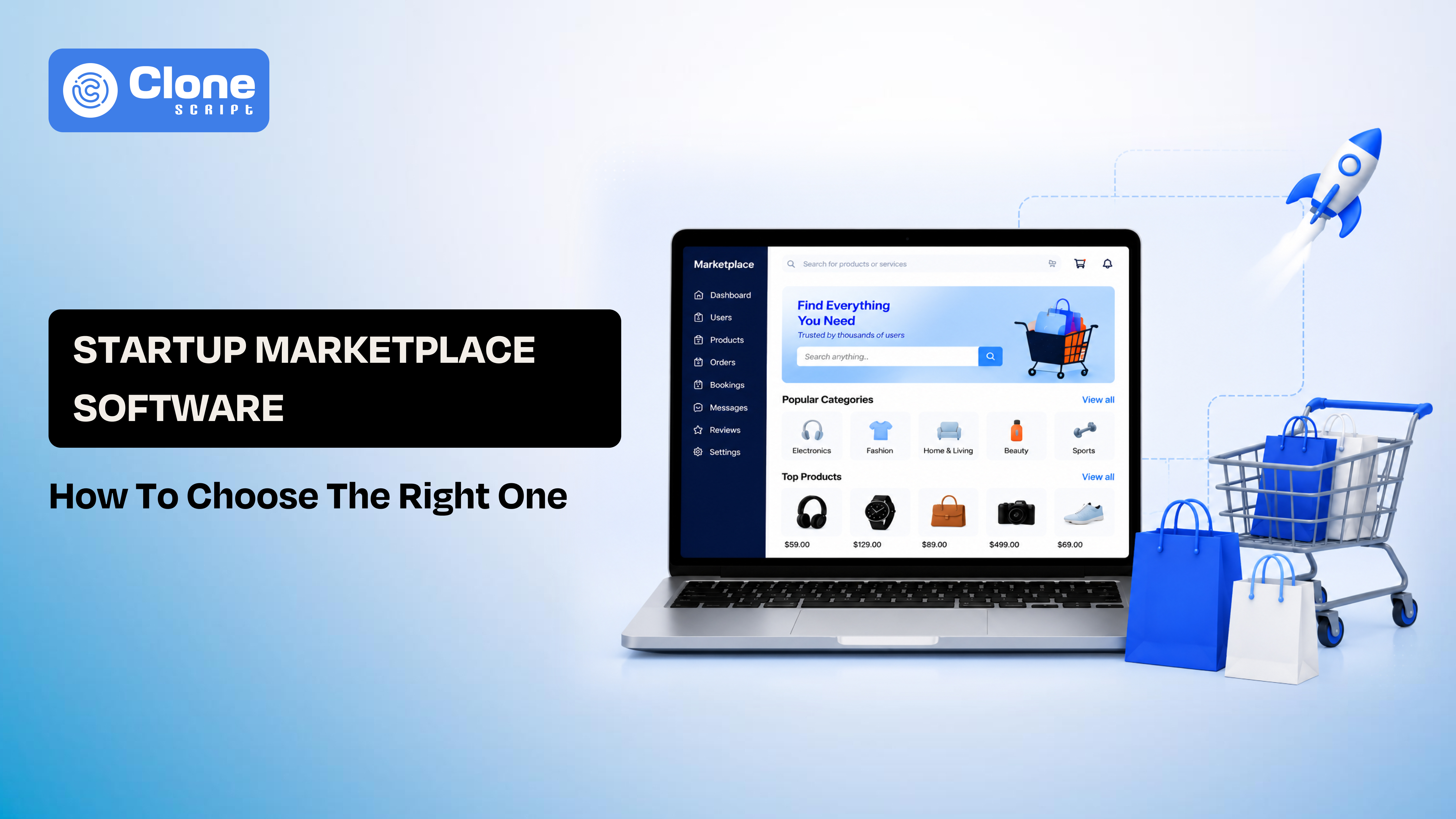
How to Choose the Right Marketplace Software for Your Startup
Choosing the right marketplace software determines how fast your startup can launch, scale, and generate revenue.
But what do startups have to do? Start assessing software based on launch speed, monetization flexibility, scalability, and ownership control. Not just features. SaaS, clone script, and no-code tools work for early validation, while custom development suits funded ventures.
For many business startups, clone script solutions provide the ideal balance of affordability, speed, and long-term adaptability. They reduce technical risk while offering proven marketplace frameworks.
Why Marketplace Software Is a Strategic Startup Decision
Many startups treat software as an operational tool. In reality, for a marketplace business, software is the business model in action.
Your platform controls how vendors onboard, how buyers discover products or services, how payments are processed, and how trust is built between users. Every frustration point in this journey affects retention and revenue.
Choosing the wrong marketplace software often creates three major startup risks:
-
Scalability failure when traffic grows
-
Feature limitations that block monetization models
-
Design and technical debt that forces redevelopment within a short time
For startups, these risks are increased because early-stage capital is limited. Every decision must maximize runway while enabling fast execution.
That is why marketplace software should be evaluated not only for what it can do today, but for how well it supports the next 24–36 months of growth.
The Startup Marketplace Readiness Matrix: A Smarter Evaluation Model
Most founders compare software based on feature lists. That approach is incomplete.
A stronger method is to assess software through what can be called the Startup Marketplace Readiness Matrix, a framework built around four business-critical dimensions.

-
Launch Velocity
How quickly can you go live? This question has to be resolved as soon as possible.
For startups, speed matters. The faster you enter the market, the sooner you can validate demand and generate traction.
Questions to ask:
-
Does the platform offer ready-made architecture?
-
Can branding and workflows be customized quickly?
-
How much development time is required?
A solution with faster deployment often provides stronger early-stage benefit.
-
Revenue Flexibility
Can the software support multiple monetization models? This is important to ensure the revenue.
Marketplaces generate revenue through more than commissions.
Look for support for:
-
Subscription plans
-
Listing fees
-
Featured promotions
-
Service charges
-
Membership models
Your software should allow monetization experiments without requiring redevelopment.
-
Growth Scalability
Will it support expansion? Once the marketplace reputation is established, growth is the next achievement.
Many startups launch a niche but plan to scale regionally or globally.
Evaluate the following:
-
Multi-language support
-
Multi-currency capabilities
-
vendor volume handling
-
cloud readiness
-
API integrations for front-end and back-end
Scalability should be designed into the platform, not added later.
-
Ownership Control
How much control do you retain? Find this aspect also.
Some solutions prioritize convenience but restrict access to core infrastructure.
Important considerations to know:
-
Source code access
-
Hosting freedom
-
Data ownership
-
Customization rights
-
Third-party integration flexibility
For startups aiming to build long-term enterprise value, ownership matters significantly.
Types of Marketplace Software Available for Startups
Understanding the available categories helps narrow your options.
-
SaaS Marketplace Platforms
These are subscription-based solutions hosted by providers.
Advantages of the SaaS marketplaces are:
-
They’re quick to set up with less budget.
-
There is minimal technical maintenance.
-
You can predict the monthly pricing.
Limitations of the SaaS marketplaces are:
-
There is limited customization to do.
-
The recurring costs for updation.
-
There is restricted ownership.
SaaS works well for testing ideas, but may become expensive as scale increases.
-
Custom Marketplace Development
This is a fully tailored solution built from scratch.
Advantages of a custom marketplace are:
-
You have complete control over the operation.
-
There is unlimited flexibility you can integrate.
-
The unique product architecture is helpful.
Limitations of the custom marketplace are:
-
It’s available at a high cost.
-
You have to wait for a long development timeline.
-
There is a resource-intensive maintenance.
This is a test suited for startups with strong funding and highly differentiated models.
-
No-Code Marketplace Builders
These kinds of models allow founders to create marketplaces visually.
Advantages of a no-code marketplace are:
-
Low technical barriers allow you to launch a platform where the provider and buyer come.
-
You can go forward with fast MVP creation.
Limitations of the no-code marketplace are:
-
The platform may face limited scalability in terms of advanced functionality.
-
Sometimes constrained complex workflows interrupt the operation.
A no-code marketplace builder is ideal for proof-of-concept stages rather than long-term operations.
-
Clone Script Marketplace Solutions
These are ready-made platforms inspired by successful marketplace business models.
Advantages of a clone script are:
-
You can launch faster than custom development
-
The lower upfront investment keeps your business's money saved.
-
Proven business logic is a key highlight.
-
The source code ownership in many cases is handed over to the buyer.
Limitations of a clone script are:
-
This requires strategic customization for differentiation, as most businesses choose that.
For startups balancing speed, budget, and scalability, clone script solutions often provide the strongest middle ground.
What Features Matter Most in Marketplace Software
Every feature has its own importance. Startups should prioritize capabilities tied to business growth.
-
Vendor Management System
A marketplace succeeds when sellers can onboard and operate efficiently. Look for these features:
-
Profile setup tools
-
Dashboard analytics
-
Order management
-
Payout tracking
Strong vendor tools improve retention, and you don’t have to consider the supply side shortage.
-
Secure Payment Infrastructure
Trust is essential when doing business online. The platform should support:
-
Multiple payment gateways
-
Escrow systems
-
Automated settlements
-
Fraud prevention
Payment reliability directly affects platform credibility. Prioritize integrating a payment gateway in a marketplace with possible options.
-
Search and Discovery Engine
Users must find what they need quickly. Essential capabilities include:
-
Smart filtering
-
Category navigation
-
Recommendation systems
-
Location-based search
Discovery efficiency increases conversions on the marketplace, and it can be very useful.
-
Review and Trust Systems
Reputation mechanisms reduce buyer hesitation. Key tools to integrate:
-
Verified reviews
-
Seller ratings
-
Dispute management
-
Reporting features
Trust infrastructure strengthens marketplace liquidity.
-
Mobile Readiness
Modern users expect seamless app experiences. Ensure the following:
-
Responsive design
-
Dedicated app compatibility
-
Push notifications
-
Mobile-first workflows
Marketplace software without strong mobile capability risks losing engagement.
Why Clone Script Solutions Are Gaining Startup Attention
For startups, the strongest advantage is execution speed.
Clone script solutions offer a strategic shortcut by providing ready-built marketplace structures modeled after proven businesses.
This does not mean copying competitors blindly. Instead, it means advantage validated frameworks while customizing the experience for your niche.
Some benefits include:
-
Reduced development cycles
-
Tested workflows
-
Lower risk of technical failure
-
Faster revenue generation
This is why many startup founders increasingly choose clone script solutions as their launch startup.
Where All Clone Script Fits in the Startup Journey
When evaluating clone script providers, execution quality matters as much as the product itself.
All Clone Script positions itself as a strategic technology partner for startups seeking marketplace website and app solutions without the delays of custom website development.
Rather than offering generic templates, the company focuses on scalable clone script frameworks tailored for marketplace businesses across industries.
Why Startups Consider All Clone Scripts
-
Ready-to-launch marketplace architectures
-
Website and mobile app compatibility
-
Source code ownership options
-
Customization flexibility
-
Startup-friendly pricing structures
For founders seeking a balance between speed and long-term control, All Clone Script provides a practical alternative to costly custom builds. Its solutions help startups enter the market faster while preserving the ability to evolve.
That combination is particularly valuable in competitive industries where timing influences survival.
Decision Checklist Before You Choose Marketplace Software
Before selecting marketplace software, validate these criteria:
-
Business Alignment: Check that it matches your niche model or not. Also, does it support your monetization plan?
-
Technical Fit: Identify the software support the demand while scaling. Then, understand whether it integrates with essential tools.
-
Financial Sustainability: In the marketplace, software selection depends on the long-term ownership cost. There is also consideration for the hidden fees involved.
-
Strategic Flexibility: Getting a software is related to customization and security by knowing if it can pivot without rebuilding. Do you control your platform data?
A software decision should reduce uncertainty. Do not create future obstacles.
Contact us for more details related to the marketplace software development clone script.
Final Thoughts: Choose for Growth, Not Just Launch
The best marketplace software is not the one with the most features. It is the one that aligns with your startup’s stage, strategy, and growth.
For business startups, the right platform should enable entry, flexible monetization, scalable operations, and long-term ownership.
That is why evaluating software through business readiness, not technical hype, is essential.
If your startup needs a practical route to launch without sacrificing future control, clone script solutions deserve serious consideration.
If speed, affordability, and scalability are priorities, providers like All Clone Script offer a structured path toward building a marketplace business with less friction and greater momentum.
In startup ecosystems, technology is not just infrastructure. It is an advantage.
Choose accordingly.