BTC - Bitcoin
 USDTERC20 - USDT ERC20
 ETH - Ethereum
 BNB - Binance
 BCH - Bitcoin Cash
 DOGE - Dogecoin
 TRX - TRON
 USDTTRC20 - USD TRC20
 LTC - LiteCoin

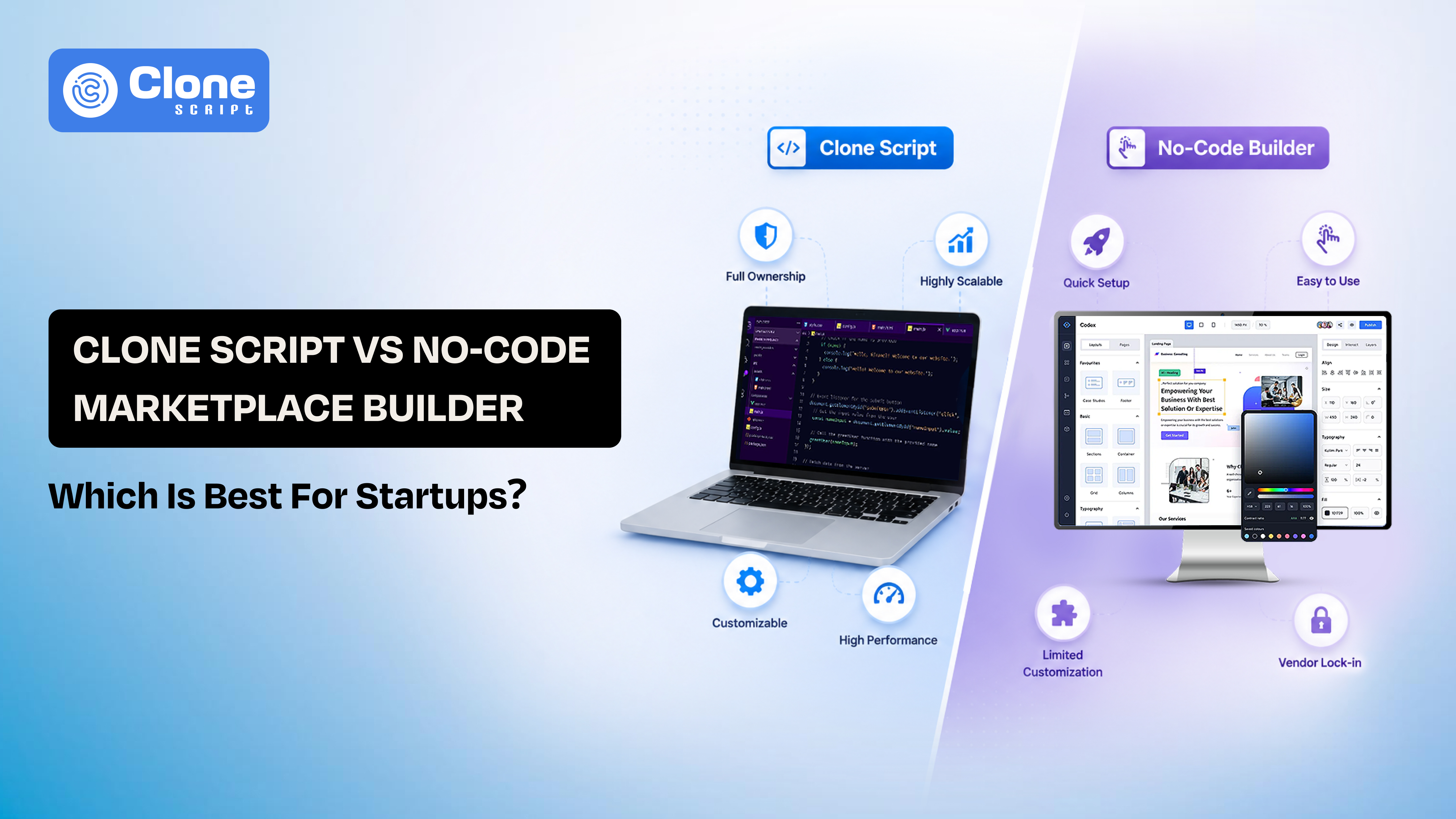
Clone Script vs No-Code Marketplace Builder: What Should You Choose
Launching a marketplace startup used to mean one thing: months of custom development, a large technical team, and a budget that could drain early-stage momentum. Today, startups have faster paths to market: primarily through clone scripts and no-code marketplace builders.
At first glance, both options promise speed and affordability. But the real difference lies in what happens after launch.
For startups, choosing between a clone script and a no-code marketplace builder is a growth decision. The wrong choice can create operational issues, limited scalability, and expensive migrations when your platform begins to grow.
This blog explains both models in practical business terms so founders can make the right call based on their startup stage, product vision, and long-term monetization goals.
And if your goal is to launch a scalable marketplace website or app with customization flexibility, platforms like All Clone Script offer a strategic advantage that many startups overlook.
Why This Decision Matters More Than Startups Realize
Many founders compare tools based only on cost and speed. That is understandable in early-stage execution. But marketplace business models are structurally different from regular websites.
A marketplace involves:
-
Multiple user roles
-
Listings or inventory management
-
Payment systems
-
Search and filters
-
Communication tools
-
Review and trust mechanisms
-
Commission models
-
Admin-level controls
This means your technology choice directly impacts how efficiently your marketplace operates.
The key question is not: “Which is cheaper today?”
The real question is: “Which solution supports my marketplace as it grows?”
That is where the difference between clone scripts and no-code builders becomes critical.
Understanding the Two Models: Clone Script and No-Code Platforms
The clarification is required to know the suitability of each option.
What Is a Clone Script?
A clone script is a pre-built software solution modeled after a successful business platform, such as ride-sharing apps, eCommerce marketplaces, rental platforms, or service marketplaces.
It comes with core functionalities already developed and tested, allowing startups to launch quickly without building from scratch.
However, unlike rigid templates, quality clone scripts often allow:
-
Source code access
-
Feature customization
-
UI/UX changes
-
Branding flexibility
-
Third-party integrations like payment gateways, CRM tools, APIs.
-
Mobile app deployment
This makes clone scripts suitable for startups that want a faster launch without sacrificing long-term control.
What Is a No-Code Marketplace Builder?
A no-code marketplace builder is a platform that enables users to create a marketplace using drag-and-drop tools and visual interfaces.
It is designed for non-technical founders who want to build without coding knowledge.
Typical no-code builders offer:
-
Templates
-
Workflow automation
-
Plugin integrations
-
Basic database setup
-
Hosting and maintenance
These tools are attractive because they reduce technical complexity.
But they also come with structural limitations that become visible as business needs evolve.
The Startup Lens: Speed vs Scalability
Most startup founders think they need the fastest solution.
That is partially true.
But in marketplace businesses, speed without scalability creates hidden debt.
A fast launch is proper only if the underlying platform can handle growth.
This is where the startup decision framework changes:
| Business Priority | Best Fit |
|---|---|
| Idea validation | No-code |
| MVP with monetization | Clone Script |
| Long-term marketplace growth | Clone Script |
| Full customization | Clone Script |
| Non-technical experimentation | No-code |
| Multi-platform expansion | Clone Script |
The choice depends on your business maturity. Not just technical preference.
Where No-Code Marketplace Builders Work Best
No-code platforms are excellent for startups in the validation phase.
If your goal is to test demand before investing heavily, no-code builders provide:
-
Rapid deployment
-
Lower upfront cost
-
Easy setup
-
Minimal technical dependency
This is ideal for founders exploring niche marketplace concepts.
For example:
-
Local service directories
-
Community-based product listings
-
Internal B2B exchange portals
-
Event ticket marketplaces
In these cases, speed matters more than advanced functionality.
No-code helps answer one critical startup question: Will users actually engage with this idea?
For testing assumptions, it is a strong tool.
Where No-Code Starts Breaking Down
The challenge begins when your marketplace gains traction.
As user activity increases, startups face issues such as:
-
Limited workflow customization
-
Restricted payment logic
-
Platform-imposed branding
-
Subscription-based pricing that scales aggressively
-
Vendor lock-in
-
Inability to access source code
-
Performance constraints
At this stage, founders realize they are building on rented infrastructure.
You can operate, but not truly control.
That distinction becomes expensive over time.
Especially in marketplace models where operational logic evolves rapidly.
Why Clone Scripts Offer Better Growth Architecture
A strong clone script solution gives startups something no-code often cannot: ownership with acceleration.
Instead of building from zero, you start with a tested product foundation while retaining flexibility to adapt.
This creates a middle ground between custom development and rigid SaaS builders.
For startups, this model delivers:
-
Faster launch than custom builds
-
Greater control than no-code tools
-
Scalable backend systems
-
Revenue-ready features
-
Technical extensibility
In short: You move quickly without locking your business into someone else’s ecosystem.
That balance is crucial.
The Hidden Cost Most Founders Ignore: Rebuilding
Here is the overlooked reality: Many startups that begin with no-code eventually rebuild.
That rebuild often happens after:
-
User demand increases
-
Investors request scalability proof
-
New monetization models emerge
-
App deployment becomes necessary
-
Competitive differentiation becomes urgent
Rebuilding means:
-
Migrating data
-
Recreating workflows
-
Redesigning architecture
-
Reintegrating payment systems
-
Retraining teams
This process is costly, not just financially, but strategically.
It delays momentum.
And in startup environments, lost momentum is often more damaging than development expenses.
Choosing a scalable foundation early reduces this risk.
Clone Script vs No-Code: A Strategic Comparison
Knowing the factors that differentiate clone scripts and no-code can help make a decision.
| Factor | Clone Script | No-code |
|---|---|---|
| Ownership | Business-owned software assets | Platform-controlled environment |
| Customization | Extensive code-level changes possible | Limited to platform capabilities |
| Scalability | Designed for larger transactional growth | Suitable for smaller operations |
| Cost Structure | Higher upfront investment, lower long-term dependency | Lower entry cost, recurring subscriptions |
| Mobile App Readiness | Frequently includes app solutions | Often requires external tools |
A Better Way to Decide: The 3-Year Question
Instead of choosing based on launch month, choose based on year three.
Ask: What will this business require if it succeeds?
If your answer includes:
-
Multi-region expansion
-
Advanced vendor systems
-
Unique pricing logic
-
App-based engagement
-
White-label branding
-
enterprise partnerships
Then a no-code platform may become a ceiling.
A clone script provides a stronger runway.
This is especially true in competitive industries where differentiation drives retention.
Why Startups Are Moving Toward Ready-Made Marketplace Solutions
The startup ecosystem is shifting.
Founders no longer see technology as something that must be fully custom from day one.
Instead, they prioritize:
-
Speed to market
-
Operational readiness
-
Modular scalability
-
Budget efficiency
This is why ready-made marketplace solutions are gaining traction.
A well-developed clone script enables startups to launch with confidence and preserve room for innovation.
It is not about copying another business.
It is about using proven infrastructure to build your own.
That distinction matters.
Where All Clone Script Fit Into the Decision
For startups seeking a clone script website and app solution, All Clone Script positions itself as a strategic partner, not just a software vendor.
Our value lies in combining pre-built business models with startup-focused customization.
That means founders can access:
-
Ready-made marketplace platforms
-
Branded website deployment
-
Mobile app integration
-
Customization support
-
Faster launch cycles
Instead of spending months assembling fragmented tools, startups can launch with a complete operational ecosystem.
That reduces execution friction.
And for early-stage businesses, reducing friction often determines success.
Check our marketplace clone scripts.
Why All Clone Script Is More Than a Template Provider
Many software vendors sell scripts.
Few offer launch-ready business infrastructure.
The difference is in how solutions are delivered.
A true startup-focused provider understands that founders need:
-
Product-market fit support
-
Monetization readiness
-
Feature flexibility
-
Future-proof scalability
All Clone Script addresses this by offering solutions designed for real business deployment, not just demo functionality.
That makes it especially relevant for startups planning to scale beyond MVP.
Because software should not only help you launch.
It should help you compete.
Which Option Should You Choose?
There are certain conditions to pick a clone script or a no-code platform.
Choose No-Code If:
-
You are testing an early idea
-
You need proof of concept fast
-
Your budget is extremely limited
-
Your marketplace logic is simple
Choose a Clone Script If:
-
You are building for long-term growth
-
You need ownership and flexibility
-
Your business model requires customization
-
You want both the website and app deployment
-
You plan to scale operations quickly
Final Verdict: Build for Growth, Not Just for Launch
For startups, the temptation to choose the fastest and cheapest option is understandable. But marketplace businesses are not static websites. They are evolving ecosystems, and ecosystems need foundations built for change.
A no-code marketplace builder is useful for experimentation. A clone script is stronger for execution and growth. That is where solutions like All Clone Script become strategically valuable. Because in startup environments, the winning decision is rarely the easiest one. It is the one that keeps working as your business grows.