BTC - Bitcoin
 USDTERC20 - USDT ERC20
 ETH - Ethereum
 BNB - Binance
 BCH - Bitcoin Cash
 DOGE - Dogecoin
 TRX - TRON
 USDTTRC20 - USD TRC20
 LTC - LiteCoin

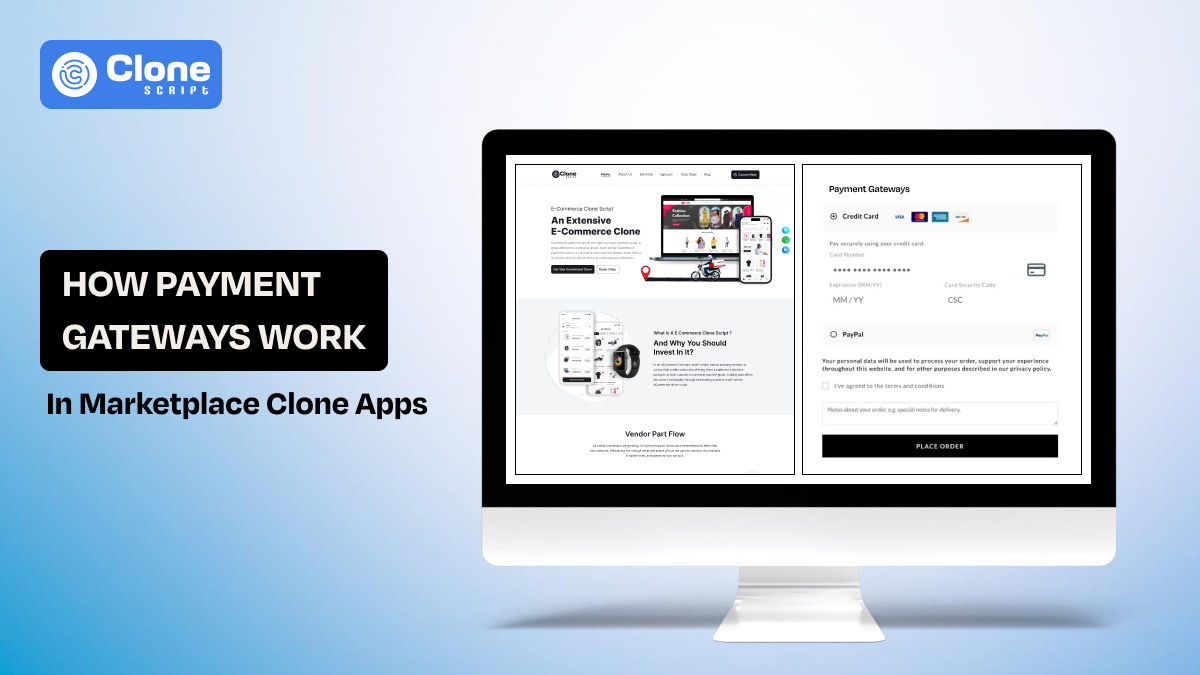
Payment Gateways in Marketplace Clone Apps: The Mechanism Behind Payments
Payment processing in a marketplace is extremely different than standard e-commerce. According to Stripe documentation, marketplaces introduce multi-party fund flows; therefore, authorization, routing, and settlement need to be handled separately. As a result, once the developer begins implementation, they quickly realize their basic payment gateway capabilities will not allow them to sufficiently orchestrate financial transactions.
On the other hand, the complexity increases at every stage of the transaction. Payment providers like Adyen highlight that payment failures, asynchronous confirmations (webhooks), and reconciliation mismatches are among the most common issues in marketplace environments. Similarly, without structured payout logic, platforms face delays in vendor settlements, leading to operational friction.
This is why marketplace payments require a dedicated architecture, not just integration. In this guide, we’ll explain how payment gateways work in marketplace clone apps, focusing specifically on payment flow mechanics, authorization, split handling, escrow, and settlement.
The 3-Tier Architecture of Marketplace Transactions
Marketplace payment systems operate as a layered architecture, where each layer is responsible for a specific part of the transaction. A common mistake in early-stage development is treating payments as a direct frontend-to-gateway interaction.
In reality, a scalable multi-vendor marketplace requires clear separation between three things: payment initiation, financial logic, and fund distribution to maintain accuracy and control.
-
Buyer Interface Layer (Payment Initiation & Authorization)
The first layer is where the transaction begins: the buyer interface.

This includes checkout, payment method selection, and authorization requests. While it looks simple from a user perspective, this layer handles critical operations such as secure data transmission, tokenization, and interaction with gateway APIs.
For example, when a user attempts a ₹6,000 transaction via card or UPI:
-
The system sends an authorization request to the gateway.
-
The gateway communicates with the bank.
-
A success or failure response is returned.
This layer must also handle this logic:
-
Retry logic for failed transactions
-
Timeout scenarios
-
Multiple payment method fallbacks
Remember that even small inefficiencies here, like delayed API responses, can result in higher payment failure rates and checkout drop-offs.
-
Operator Layer (Financial Logic & Control Engine)
The second layer is the operator or admin layer, which acts as the financial brain of the marketplace. This is where all payment rules and business logic are applied before funds are distributed.

In the operator layer, key responsibilities include:
-
Commission calculation (fixed, percentage, or dynamic)
-
Deduction of gateway fees and taxes
-
Handling discounts, coupons, and promotional adjustments
-
Managing refunds and reversals
Consider a ₹10,000 order involving two vendors. The system must:
-
Identify each vendor’s share
-
Deduct platform commission (e.g., 12%)
-
Adjust for any applied discounts
-
Prepare final payable amounts
This layer ensures that every transaction is accurate, traceable, and aligned with business rules.
On the opposite side, without a structured operator layer, financial inconsistencies become important as order volume increases.
-
Vendor Layer (Fund Allocation & Payout System)
The third layer is the vendor system, where funds are allocated and eventually paid out. Vendors are not just users. They are financial entities within the system, each requiring independent tracking and control.

This layer manages:
-
Vendor onboarding and KYC verification
-
Bank account linkage for payouts
-
Ledger systems to track balances
A typical vendor ledger includes:
-
Pending balance (awaiting settlement)
-
Locked balance (under escrow or dispute)
-
Available balance (ready for payout)
For example, after a successful transaction done by the user, the following things happen:
-
Funds may first appear as “pending.”
-
Move to “available” after delivery confirmation.
-
Finally transferred to the vendor’s bank account
Why This Architecture Matters?
Separating payments into these three layers ensures that:
-
Each transaction is auditable and traceable.
-
Financial logic remains consistent across all orders.
-
The system can scale without breaking under volume.
Without this structure, even minor issues like a failed payout or incorrect commission can produce large-scale reconciliation problems.
Marketplace Clone Apps Key Technical Features for Payments
Once the architecture is in place, the real strength of a clone marketplace payment system comes from its feature layer. These are not “nice-to-have” capabilities. They are core financial controls that define how money moves, how risk is handled, and how scalable your platform becomes.

Modern solutions like Stripe have evolved to support these features natively, but understanding their logic is critical before implementation.
-
Split Payments (Automated Fund Distribution)
Split payments are the key element of any multi-vendor system, we can say. Here, the money has not been sent to every single merchant manually. The gateway handles it and automatically distributes the funds across multiple parties.
Let’s say an example.
A customer made a payment for buying a sofa cover with an order worth ₹5,000. The vendor will get only ₹4100. Here’s the calculation.
| Aspect | Value |
| Order Value | ₹5000 |
| - Platform Commission | ₹500 |
| - Taxes/Fees (Levied to Vendor) | ₹400 |
| Ready Payout | ₹4100 |
These calculations may be different according to the marketplace regulations.
Key considerations about split payments:
-
Single charge vs multiple charges (affects UX and fees)
-
Real-time vs delayed splitting
-
Handling partial refunds per vendor
Platforms like Stripe allow programmatic fund routing, meaning you can define exactly how money flows in one transaction.
-
Escrow & Delayed Payouts (Trust Layer)
In online marketplaces, payment completion ≠ transactions. Funds often need to be held temporarily until a condition is met, like delivery confirmation. Take the example of Amazon.com, where the funds are not initially released but kept on hold until the customer receives the order successfully.
Typical flow of escrow payments
First, the buyer pays the amount, as ₹10,000 for cosmetic product bulk orders, and the gateway captures it. Then the received funds move to a holding state (ledger/wallet). Then, it is released after delivery or service completion.
Escrow payments importance
-
This method prevents fraud and disputes.
-
It builds trust between buyer and seller.
-
This payment type enables controlled payout timing.
Modern systems don’t always use “true escrow” (due to regulatory complexity). Instead, they simulate it using controlled payout schedules and ledger states.
-
Vendor Onboarding & KYC (Compliance Layer)
Every vendor in a white-label clone marketplace is a financial participant, which means compliance is non-negotiable. Payment gateways now offer built-in onboarding APIs to handle identity verification without leaving the platform or depending on third-party services.
The flow for vendor onboarding is as follows:
-
First, the vendor submits details that are necessary to handle payments (PAN, bank account, ID proof).
-
After receiving the information, the gateway verifies identity through (KYC/AML checks).
-
Finally, if all criteria have been followed, the vendor account gets activated for payouts.
Using this approach, the developers are free from worries:
-
They do not need to build compliance systems from scratch.
-
It reduced legal risk because payment gateways handle it.
-
The vendor can experience faster onboarding to make the marketplace accessible.
Gateways like Stripe automate identity verification, sanctions checks, and tax compliance, significantly reducing operational overhead.
-
Mass Payouts (Scalable Disbursement Engine)
Marketplace owners always feel nervous when they have to make payments to hundreds of vendors manually. They need the back-end systems development, payment handling teams, etc. However, these problems can be handled through a secure payment systems that manage thousands of transactions and vendor payments.
Here is the example.
1,000 vendors need payouts every Friday. Each has a different balance and currency. The payment service providers make it easy through advanced technology.
Mass payout systems enable:
-
Bulk bank transfers
-
Scheduled disbursements (daily/weekly/monthly)
-
Instant payouts (with additional fees)
Modern APIs support payouts across 100+ countries and multiple currencies, removing the need for local banking setups.
Why do these features define scalability?
It’s necessary to operate the business smoothly. Without these features:
-
Payments remain manual and error-prone.
-
Vendor trust breaks due to delays or mismatches.
-
Scaling beyond a few hundred transactions becomes difficult.
With them:
-
Payments become automated, traceable, and reliable.
-
Developers gain full control over money movement logic.
-
Startups can scale without rebuilding their payment infrastructure.
In short, these features convert a simple payment integration into a true marketplace payment system. It is capable of handling real-world complexity without breaking under growth.
How Money Actually Moves in a Marketplace (Real Payment Flow Explained)
The flow “authorization → capture → payout” is technically correct, but not how developers or founders experience payments in a live system. In reality, clone marketplace script payments behave more like a controlled money pipeline, where funds move through checkpoints instead of directly from buyer to vendor.
Let’s walk through a real-world flow, the way it actually behaves inside a white-label marketplace clone app.
Step 1: Payment Intent Creation (Before the User Pays)
Before the user even clicks “Pay,” your system prepares the transaction using a payment intent or order object.
What happens here:
-
Order amount is calculated (including tax, delivery, discounts)
-
Vendor mapping is defined (who gets what share)
-
Platform commission rules are attached
Example:
A cart with 2 vendors (₹2,000 + ₹3,000) becomes a structured payment object with pre-defined split logic.
Why this matters:
-
Prevents calculation errors after payment.
-
Ensures consistency between front-end and back-end.
-
Reduces reconciliation issues later.
Step 2: Payment Execution (User Completes Checkout)
This is the only part users see, but behind the scenes, multiple systems interact in milliseconds.
What actually happens? The example looks.
-
The payment request is sent to the gateway.
-
Gateway communicates with banking networks (UPI/card/wallet).
-
Response is returned via API and webhook.
Possible outcomes are as follows:
-
Success: Move to next stage
-
Failure: Retry or fallback triggered
-
Pending: Common in UPI or async methods
Example:
In UPI payments, the transaction may stay in a “pending” state until the user approves it in their app.
Step 3: Internal Ledger Entry (The Most Critical Layer)
This is where most marketplace clone apps fail. They skip or oversimplify the ledger system.
Instead of sending money directly to vendors, they give first preference to:
-
The platform records the transaction internally.
-
Funds are mapped into logical balances.
The typical structure is as follows:
-
Platform account: Full ₹5,000 recorded
-
Vendor A: ₹2,000 allocated
-
Vendor B: ₹3,000 allocated
-
Commission: Marked but not yet deducted physically
Think of this as:
A virtual wallet system that mirrors real money before actual bank transfers happen.
Why this is important:
-
It enables partial refunds.
-
It handles disputes cleanly.
-
It keeps financial records consistent.
Step 4: Conditional Release (Business Logic in Action)
Unlike e-commerce, marketplaces rarely release money immediately. Funds move only when conditions are satisfied.
There are common things:
-
Order marked as delivered
-
Return window expires
-
Service milestone completed
These examples help you to understand it properly.
-
The food delivery app is for instant release.
-
Freelance platform based on milestone-based release.
-
The rental marketplace is post-usage confirmation.
At this stage, the vendor balance becomes eligible for payout, and the platform commission is finalized.
Step 5: Actual Payout (Bank-Level Movement)
This is the final step that occurs when real money leaves the platform’s control.
What happens:
-
Funds are transferred to vendor bank accounts.
-
Payout APIs trigger bank settlements.
-
Transaction IDs are generated for tracking.
The payout models are as follows:
-
Instant (on-demand)
-
Scheduled (weekly cycles)
-
Manual (admin-triggered)
Example:
A vendor accumulates ₹25,000 during the week and receives a payout every Monday after deductions.
The key difference in marketplace systems is this:
Money does not move instantly. It is tracked, controlled, and released in stages.
Without this approach:
-
Refunds become chaotic
-
Vendor payments mismatch
-
Financial reporting breaks
With this approach:
-
Every transaction has a clear audit trail
-
Developers can isolate issues quickly
-
The platform maintains financial integrity at scale
This is what separates a basic payment integration from a production-ready marketplace payment system.
Top Payment Gateways for Marketplace Startups in 2026
Choosing a payment gateway for a marketplace is about how well the gateway supports multi-party transactions, compliance, and payout control. Most failures occur when teams pick a gateway designed for single-seller e-commerce and try to “force-fit” marketplace logic onto it.

Below is a breakdown of the most relevant marketplace-ready payment gateways in 2026, based on flexibility, regional support, and developer control.
-
Stripe Connect (Best for Custom Marketplace Logic)
Stripe Connect remains the most developer-friendly solution for building fully customized marketplace payment flows.
Why teams choose it:
-
It supports Custom, Express, and Standard account types.
-
There is availability for advanced APIs for split payments and fund routing.
-
The built-in KYC, compliance, and global payouts features exist.
Best use case for Stripe:
-
SaaS marketplaces
-
Global platforms with complex commission models
Limitations of Stripe:
-
Requires strong back-end development expertise to utilize its flexibility fully.
-
PayPal for Marketplaces (Best for Trust & Global Reach)
PayPal is still one of the most recognized payment systems globally, making it ideal for platforms where user trust is important.
Key strengths for PayPal:
-
It supports strong buyer protection mechanisms
-
Its Wide international acceptance.
-
There is simple onboarding for vendors.
Best use case of PayPal:
-
Consumer-facing marketplaces
-
Platforms targeting non-technical users
Limitations of PayPal:
-
Less flexible in handling complex split logic compared to Stripe.
-
Razorpay Route (Best for Indian Startups)
For India-based marketplaces, Razorpay Route is optimized for local payment methods and regulatory requirements.
Key advantages of Razorpay:
-
Native support for UPI split payments
-
Faster settlements within Indian banking systems
-
Simplified KYC for domestic vendors
Razorpay's best use case:
-
Hyperlocal marketplaces
-
Service platforms (e.g., home services, delivery apps)
Limitations of Razorpay:
-
Limited global payout capabilities compared to international providers.
-
Adyen (Best for Enterprise-Scale Platforms)
Adyen is designed for high-volume, enterprise-grade marketplaces that need a unified commerce infrastructure.
Core strengths of Adyen:
-
It offers advanced fraud detection tools.
-
It provides multi-currency and cross-border optimization.
-
Strong support for omnichannel payments.
Best use case of Adyen:
-
Large-scale platforms with global operations
-
Marketplaces handling high transaction volumes
Limitations for Adyen:
-
Higher entry barrier (cost + integration complexity)
-
Mangopay (Best for EU Compliance & Wallet Systems)
Mangopay is built specifically for marketplaces operating under European financial regulations.
Key features of Mangopay:
-
It offers wallet-based infrastructure for holding funds.
-
Strong PSD2 compliance support is offered.
-
Built-in escrow-like capabilities.
Best use case of Mangopay:
-
EU-based marketplaces
-
Platforms needing strict regulatory alignment
Limitations of Mangopay:
-
It’s less flexible for non-EU regions.
How to Choose the Right Gateway?
Instead of asking “Which gateway is best?”, ask:
-
Do you need global or local payments?
-
How complex is your commission and split logic?
-
Do you require instant payouts or scheduled settlements?
-
What level of compliance support do you need?
Practical approach for startups:
-
Start with a gateway that offers plug-and-play marketplace features.
-
Avoid over-engineering in early stages.
-
Scale to custom architecture as transaction volume grows.
The right choice is not the most powerful gateway. It’s the one that aligns with your current product stage and payment complexity.
Conclusion
Marketplace payment systems demand structured architecture, controlled fund flow, and compliance-driven execution. From split payments to payout orchestration, every layer ensures accuracy and scalability. Implementing the right gateway and ledger logic enables developers to build reliable, audit-ready systems that handle real-world transaction complexity without operational or financial inconsistencies.
Are you building your marketplace payment system with a scalable architecture that ensures accurate fund distribution, compliance, and seamless payouts, or relying on basic integrations that may fail under real transaction complexity?
Looking to integrate a payment gateway into your marketplace clone? Get a custom architecture plan tailored to your business model. Contact us.