BTC - Bitcoin
 USDTERC20 - USDT ERC20
 ETH - Ethereum
 BNB - Binance
 BCH - Bitcoin Cash
 DOGE - Dogecoin
 TRX - TRON
 USDTTRC20 - USD TRC20
 LTC - LiteCoin

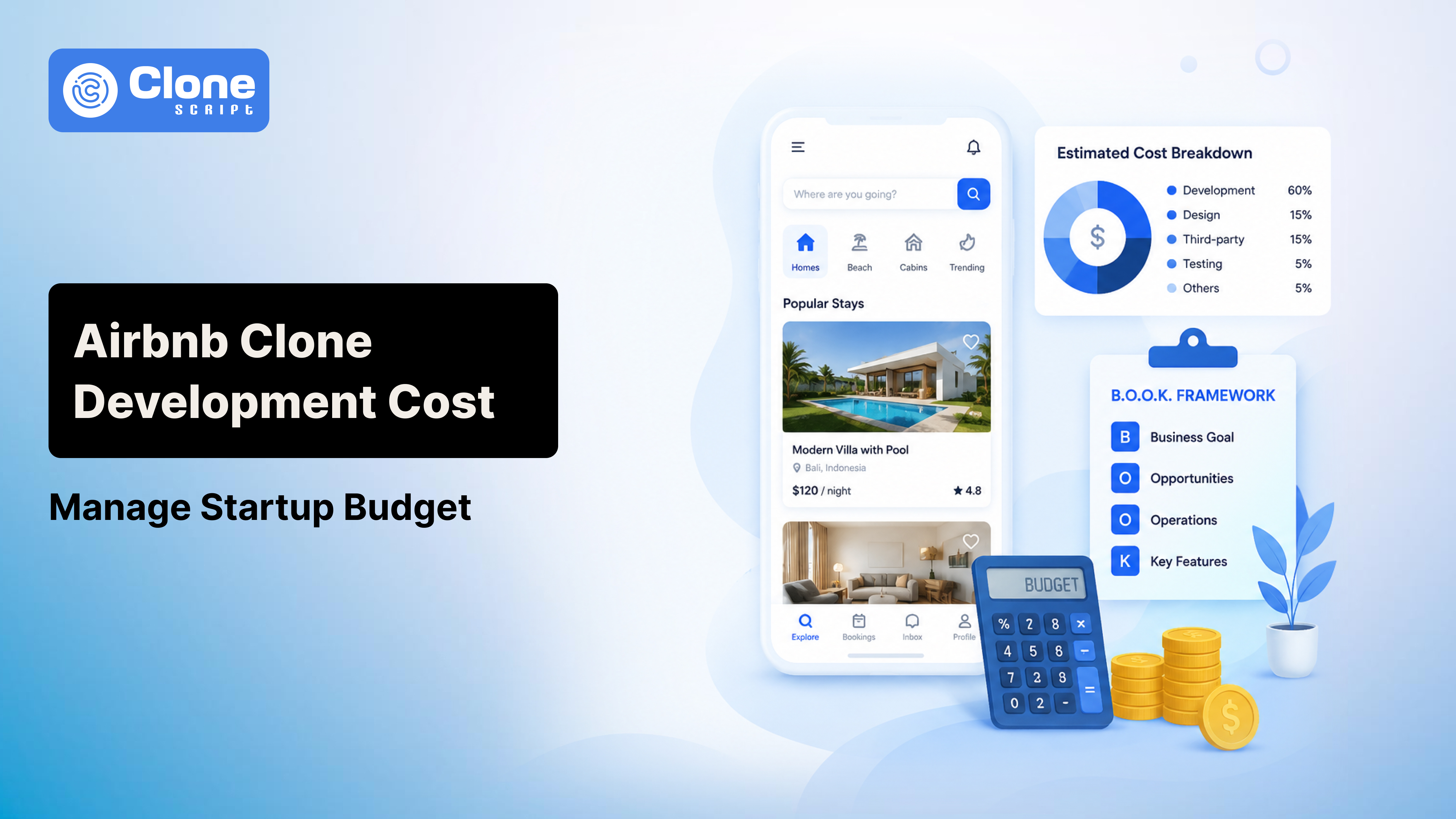
Airbnb Clone Development Cost Breakdown for Startups to Manage Budget
Key Takeaways
-
Most startups exceed budgets because of scope creep, not development rates.
-
Backend development typically consumes the largest share of the budget.
-
Hidden costs include infrastructure, maintenance, integrations, and marketing.
-
Use the B.O.O.K. Framework to prioritize features.
-
Use the 40-40-20 Rule to allocate funds strategically.
-
Launch with an MVP before investing in advanced features.
Launching an Airbnb-like platform sounds straightforward until the budget starts expanding faster than the product itself. Many startup founders begin with a target budget like $20,000, only to discover that development costs extend far beyond coding. Infrastructure, third-party integrations, compliance requirements, maintenance, and feature creep often turn a planned investment into a financial burden.
The challenge is worth solving.
Airbnb ended 2025 with more than 9 million active listings worldwide, while the global vacation rental market surpassed $149 billion and continues to grow at double-digit rates. The opportunity is enormous, but so is the risk of overspending.
What separates successful marketplace founders from those who exhaust their budgets is not how much they spend.
Then, what?
It is how strategically they allocate resources.
This guide explains the true cost structure of Airbnb clone development, exposes the hidden expenses most cost calculators ignore, and introduces two practical budgeting frameworks that help startups build, launch, and scale without losing control of their finances.
Why Most Startups Exceed Their Airbnb Clone Development Budget
Startup founders rarely exceed their budgets because they underestimate development rates. They exceed them because they underestimate complexity.
The biggest misconception in marketplace development is believing that an Airbnb clone is simply a website with property listings and a booking button.
In reality, every booking depends on multiple systems working together: user authentication, property management, calendar synchronization, payment processing, messaging, notifications, reviews, and administrative controls.
As a result, what appears to be a small feature request often impacts multiple areas of the platform.
-
The "Build Everything First" Trap
Many founders begin their journey by studying Airbnb's current platform. They create a feature list based on what Airbnb offers today rather than what a startup needs on day one.
This approach creates immediate budget pressure.
Features such as wishlists, dynamic pricing, AI recommendations, loyalty programs, multilingual support, advanced analytics, and personalized search experiences may look essential.
However, these features were not responsible for Airbnb's initial growth. Did you get what they meant?
They were introduced after the company had already validated demand and acquired users.
Building them too early increases development costs without increasing the likelihood of success.
-
Budget Assumptions vs. Reality
A common scenario looks like this:
A founder allocates a fixed budget for development and expects the platform to be launch-ready within a few months.
Website development begins smoothly.
Then new requirements appear.
The search experience needs improvement.
The booking flow requires additional validation.
A payment gateway requires extra compliance work.
Mobile responsiveness needs refinement.
Administrative workflows become more complex.
Individually, these changes seem small. Collectively, they can increase both cost and timeline significantly.
This is why marketplace budgets rarely fail because of one major decision. They fail because of dozens of minor decisions made throughout the project.
-
The Real Cost of Poor Planning
Poor planning creates a chain reaction.
A feature added today may require design changes, back-end modifications, testing efforts, infrastructure adjustments, and future maintenance.
The result is not simply a higher development bill. It is a delayed launch, slower customer acquisition, and lost market opportunities.
The most successful Airbnb-like startups do not begin by asking, "What can we build?"
They begin by asking:
"What is the minimum platform required to generate bookings and validate demand?"
That single question often saves more money than any technology decision made later in the project.
What Actually Contributes to Airbnb Clone Development Costs
Many founders focus on the final development quote that an agency sends to their email. The smarter question is understanding what creates that quote in the first place.
An Airbnb clone is not a single product. It is a collection of interconnected systems that work together to manage listings, bookings, payments, communication, and administration.
-
Product planning
The first cost driver is product planning.
Before development begins, teams need to define user flows, booking processes, business rules, and platform requirements. Decisions made during this phase often determine whether a project stays within budget or exceeds it.
-
UI and UX design
The second major component is UI/UX design. A booking platform must make searching, listing, and reserving properties feel simple. Even small improvements in user experience can significantly impact conversion rates.
For vacation rental booking websites and apps, different UI and UX design work has been done. But, usually, the overall cost is included in the quote.
-
Full stack development
Next comes front-end and back-end development, which usually account for the largest share of the budget. The front-end handles what users see, while the back-end powers critical functions such as booking management, payment processing, user accounts, messaging, and property listings.
-
Third-party apps and tools
Most founders also underestimate the cost of third-party integrations. Services like payment gateways, maps, notifications, analytics, and cloud infrastructure require both implementation and ongoing maintenance.
-
Quality Assurance testing for the platform
Finally, every marketplace requires testing and quality assurance. A booking platform that fails during a payment transaction or reservation process risks losing both revenue and customer trust.
Understanding these cost drivers is the first step toward controlling them. In the next section, we'll break down how these components are typically distributed across a startup's development budget.
Airbnb Clone Cost Breakdown by Development Stage
One of the biggest budgeting mistakes startup founders make is treating development as a single expense. In reality, an Airbnb clone budget is spread across several stages, each serving a different purpose.
A proper budget allocation typically looks like this:
| Development Stage | Typical Budget Allocation |
|---|---|
| Planning & Discovery | 5-10% |
| UI/UX Design | 10-15% |
| Front-end Development | 20-25% |
| Back-end Development | 30-35% |
| Integrations | 10-15% |
| Testing & QA Work | 10-15% |
Back-end development often accounts for the largest share because it powers the platform's core functionality. Features such as booking management, payment processing, messaging, user authentication, and property listings all depend on a reliable back-end architecture.
Front-end development follows closely behind. This includes the guest experience, host dashboard, and administrative interfaces that users interact with daily.
Many vacation rental platform entrepreneurs attempt to reduce costs by cutting spending on planning or testing. While this may reduce the initial investment, it frequently leads to rework, delays, and higher expenses later.
A useful rule to remember is this:
The earlier a problem is identified, the cheaper it is to fix.
That is why successful startups view planning and testing as investments rather than optional expenses. A balanced budget allocation creates a stronger foundation for growth and reduces the likelihood of costly surprises after launch.
The Hidden Costs Most Airbnb Clone Cost Calculators Ignore
Receiving a development quote feels like reaching the finish line. In reality, it is often just the beginning of the financial journey.
Most Airbnb clone cost calculators focus on development expenses but ignore the operational costs required to keep the platform running. This is one of the main reasons startup budgets exceed expectations.
-
Check the infrastructure and hosting.
The first hidden expense is infrastructure and hosting. A newly launched marketplace may spend anywhere between $100 and $500 per month on cloud hosting, storage, backups, and security services. As traffic and bookings grow, those costs can increase significantly.
-
Third-party tool integrations
Another overlooked area is third-party integrations. Payment gateways, SMS notifications, email automation, maps, and analytics tools usually charge recurring fees. Depending on platform activity, startups often spend $200 to $1,500 per month on these services alone.
-
Website and app maintenance
Then comes maintenance and support. Industry estimates suggest businesses should allocate roughly 15-20% of their initial development cost annually for updates, bug fixes, security patches, and performance improvements. A platform that costs $30,000 to build may require an additional $4,500 to $6,000 per year in maintenance.
However, the biggest hidden cost is usually customer acquisition.
Many founders invest their entire budget into development and leave little for growth. In reality, startups frequently spend 30-50% of their total launch budget on SEO, content marketing, paid advertising, partnerships, and user acquisition campaigns.
This leads to an important realization:
Building the platform is only part of the investment. Operating, maintaining, and growing it often costs just as much as developing it.
Understanding these expenses before development begins helps startups avoid financial surprises and build a more realistic launch strategy.
The B.O.O.K. Framework for Airbnb Clone Budget Management
One of the fastest ways to lose control of a startup budget is adding features simply because competitors have them.
Successful owners don't prioritize features based on popularity. They prioritize features based on business impact.
To simplify this decision-making process, use the B.O.O.K. Framework before approving any development request.
-
B - Booking Impact
The first question to ask is:
Will this feature directly help users complete a booking?
Features such as property search, booking calendars, payment processing, availability management, and checkout flows fall into this category.
These are the features that generate revenue and should receive the highest priority.
-
O - Operational Necessity
Next, determine whether the feature is required to run the marketplace efficiently.
Examples include host dashboards, listing management, notifications, dispute handling, and admin controls.
These features may not generate bookings directly, but they are essential for day-to-day operations.
-
O - Optional Enhancements
These features improve the user experience but are not required for launching the platform.
Examples include wishlists, social logins, advanced filters, and personalized user profiles.
While useful, they rarely determine whether a startup succeeds or fails during its early stages.
-
K - Killer Budget Drains
This category contains features that consume significant development resources without creating immediate business value.
Examples include AI recommendation engines, dynamic pricing systems, loyalty programs, and advanced analytics dashboards.
Many startups spend thousands of dollars building these features before acquiring their first paying customers.
A simple rule applies:
If a feature does not help generate bookings, operate the marketplace, or validate demand, it probably belongs in a future phase, not the MVP.
The B.O.O.K. Framework helps founders separate essential investments from expensive distractions. It easier to launch faster and stay within budget.
How Startups Can Reduce Airbnb Clone Development Costs Without Sacrificing Quality
Reducing development costs does not mean choosing the cheapest developers or cutting essential features.
It means investing in the right areas at the right time.
The most successful marketplace startups focus on launching a functional product quickly, validating demand, and improving the platform based on real user behavior.
-
The website MVP has to be prioritized.
The first cost-saving strategy is building an MVP (Minimum Viable Product). Instead of launching with 30 or 40 features, focus on the core functionality required to facilitate bookings. Property listings, search, booking management, payments, and user profiles are often enough to validate the business model.
-
Integrating third-party platforms.
Another effective approach is using proven third-party solutions. Building a custom payment gateway, authentication system, or messaging infrastructure from scratch can add thousands of dollars to a project. Integrating established services is usually faster, cheaper, and more reliable.
-
Customization can be done later.
Founders should also avoid premature customization. A custom feature may cost $2,000 to $10,000+ depending on complexity. Building five unnecessary features can easily consume the budget that should have been reserved for marketing and growth.
A practical benchmark is this:
Launch with 20% of the features and validate 80% of the business idea.
The goal is not to build the most advanced Airbnb clone in the market. The goal is to build the fastest path to real bookings, real users, and real revenue.
Startups that adopt this mindset typically spend less, launch faster, and learn more from actual customer behavior than competitors who spend months building features nobody requested.
Custom Development vs Clone Script vs Hybrid Development
Choosing the wrong development approach can impact your budget long before the platform generates its first booking.
Most Airbnb-like startups typically choose one of three paths: custom development, a ready-made clone script, or a hybrid approach.
| Factor | Custom Development | Clone Script | Hybrid Development |
|---|---|---|---|
| Initial Cost | High | Low | Medium |
| Time to Market | Slow | Fast | Moderate |
| Customization | High | Limited | High |
| Scalability | High | Moderate | High |
| Long-Term Flexibility | High | Limited | High |
Let’s understand them.
-
Custom development
Custom development offers maximum flexibility. Every feature, workflow, and user experience can be tailored to specific business requirements. However, startups often spend $25,000 to $100,000+ depending on complexity, making this option better suited for funded ventures with long-term growth plans.
-
Clone scripts
Airbnb clone scripts provide the fastest route to market. Many solutions can be launched for a fraction of custom development costs. The trade-off is limited flexibility and potential scalability challenges as the business grows.
-
Hybrid development
For many startups, hybrid development provides the best balance. Instead of building everything from scratch, founders start with a proven foundation and customize only the features that create a competitive advantage. This approach can reduce both development time and upfront costs while maintaining future scalability.
The key question is not which option is cheapest.
The better question is:
Which option allows you to validate your business model with the lowest possible risk?
For early-stage startups, speed to market creates more value than building a perfect platform from day one.
The 40-40-20 Startup Budget Rule
One of the biggest reasons marketplace startups fail is not because they run out of ideas.
They run out of money.
Many founders allocate 70-90% of their budget to development and reserve only a small amount for customer acquisition and post-launch operations. The result is a well-built platform with very few users.
The 40-40-20 Rule is designed to prevent that mistake.
-
40% for Development
The first 40% should be invested in building the MVP.
This budget covers:
-
Planning and discovery
-
UI/UX design
-
Front-end development
-
Back-end development
-
Essential integrations
-
Testing
The objective is simple: launch a stable platform that can manage real bookings.
-
40% for Customer Acquisition
The next 40% should be reserved for growth.
This includes:
-
SEO
-
Content marketing
-
Influencer partnerships
-
Referral campaigns
A marketplace without users generates no revenue, regardless of how advanced the platform may be.
-
20% for Optimization and Support
The final 20% should support the platform after launch.
This budget typically covers:
-
Maintenance
-
Infrastructure
-
Analytics
-
Customer support
-
Security updates
-
Feature improvements
For example, if a startup has a total budget of $50,000, a balanced allocation could look like this:
| Category | Budget Allocation |
|---|---|
| Development | $20,000 |
| Customer Acquisition | $20,000 |
| Optimization & Support | $10,000 |
The lesson behind this framework is straightforward:
Building the platform gets you into the market. Acquiring customers keeps you in the market.
Startups that balance product development and customer acquisition often achieve faster validation, lower risk, and a clearer path toward sustainable growth.
Signs You're Spending Too Much on Airbnb Clone Development
Overspending rarely happens overnight.
Most startup founders do not realize they have a budget problem until a significant portion of their capital has already been spent.
Fortunately, there are warning signs that appear long before the budget runs out.
-
Your Feature List Keeps Growing
A marketplace should become simpler as it moves toward launch.
If new features are being added every week, development costs will continue increasing while launch dates continue moving further away.
This is often called scope creep, and it is one of the biggest causes of budget overruns.
-
More Than 50% of Your Budget Is Gone Before MVP Launch
A startup should not consume most of its resources before validating market demand.
If more than half of the budget has been spent without reaching a usable MVP, it may indicate that development priorities need reassessment.
-
Your Launch Date Keeps Changing
When timelines constantly shift, costs usually follow.
Every additional month of development introduces new expenses related to project management, infrastructure, testing, and ongoing revisions.
-
No Budget Remains for Marketing
This is one of the most dangerous warning signs.
A platform without users generates no bookings, no reviews, and no revenue. If development consumes nearly all available funds, growth becomes difficult after launch.
-
You're Building Advanced Features Before Validation
AI recommendations, dynamic pricing, loyalty programs, and advanced analytics can wait.
If the platform has not yet proven that users are willing to book through it, these features are solving problems that do not yet exist.
A simple rule applies:
If development spending is growing faster than customer validation, the startup is likely investing in features instead of business growth.
When Should Startups Invest in Advanced Airbnb Features?
Many founders assume that adding more features will make their platform more competitive.
In reality, advanced features generate the highest return only after a marketplace has achieved consistent user activity and booking volume.
During the early stages, the focus should remain on validating demand, acquiring users, and optimizing the booking experience. Once those fundamentals are working, additional features can be introduced to improve retention, automation, and operational efficiency.
As a general benchmark, startups should consider investing in advanced functionality after they have achieved:
-
Consistent monthly bookings
-
Active hosts and guests
-
Predictable customer acquisition channels
-
Stable platform performance
-
Reliable revenue generation
At that stage, features such as AI-powered recommendations, dynamic pricing engines, loyalty programs, advanced analytics dashboards, and multi-language support can create measurable business value.
For example, dynamic pricing becomes useful when enough booking data exists to identify seasonal trends and demand fluctuations. Similarly, AI recommendations perform better when the platform has accumulated sufficient user behavior data.
A practical growth roadmap often looks like this:
| Stage | Primary Focus |
|---|---|
| Launch | Listings, Search, Booking, Payments |
| Validation | User Acquisition, Reviews, Trust Building |
| Growth | Automation, Analytics, Optimization |
| Scale | AI Features, Dynamic Pricing, Personalization |
The most successful marketplaces are not built all at once.
They are built in phases, with each investment aligned to a proven business need. This approach reduces unnecessary spending, accelerates time to market, and ensures that every new feature contributes to measurable growth rather than development complexity.
Conclusion
The biggest budgeting mistake startup founders make is believing that success comes from building more features.
Successful marketplaces are not built by spending the most money. They are built by allocating resources where they create the greatest business impact.
The goal is not to build the next Airbnb on day one.
The goal is to launch a platform that validates demand, generates bookings, and creates a foundation for sustainable growth.