BTC - Bitcoin
 USDTERC20 - USDT ERC20
 ETH - Ethereum
 BNB - Binance
 BCH - Bitcoin Cash
 DOGE - Dogecoin
 TRX - TRON
 USDTTRC20 - USD TRC20
 LTC - LiteCoin

Swiggy & DoorDash Food Delivery Clone App Development Pricing
Most founders don't overspend on a food delivery app because they have a big budget.
They overspend because they don't know what they're actually paying for.
Swiggy clone app development cost or DoorDash clone pricing is not a fixed number. In reality, two food delivery apps can look almost identical but have Flutter development costs that differ by 5x or even 10x.
Why?
Because the real cost isn't determined by app screens. It's determined by delivery operations, order volume, scalability, real-time tracking, and platform complexity.
That's why one company receives a quote of $20,000 while another is quoted $150,000+ for a seemingly similar product.
Before discussing numbers, founders need to understand a critical truth:
The cheapest food delivery app is not always the most affordable, and the most expensive one is not always the best investment.
Understanding this difference can save thousands of dollars and prevent costly rebuilds later.
Why Estimating Food Delivery App Cost Is So Difficult
Many entrepreneurs start their research looking for a fixed food delivery app development cost, hoping to find a single number that applies to every project.
The reality is very different.
A Swiggy-like app, DoorDash clone, or online food ordering platform can have vastly different development budgets, even when the feature list looks almost identical.
For example, one startup may launch a local restaurant delivery app with 20 partner restaurants and 100 daily orders. Another business may be building a multi-city food delivery marketplace designed to support thousands of orders, hundreds of restaurants, and a dedicated delivery fleet.
From a customer's perspective, both applications may offer the same experience:
-
Browse restaurants
-
Place orders
-
Make payments
-
Track deliveries
Behind the scenes, however, the technology requirements are completely different.
Factors such as real-time order tracking, delivery partner management, payment gateway integration, cloud infrastructure, restaurant onboarding systems, and scalability requirements have a direct impact on app development costs.
This is why a basic food ordering app development project may start around $15,000–$25,000, while a scalable food delivery marketplace app can exceed $150,000.
Before requesting a quote, ask yourself:
-
How many restaurants will use the platform?
-
What is your expected order volume?
-
Do you need a dedicated driver management system?
The cost of building a food delivery app is determined more by operational complexity and scalability requirements than by the number of screens or features users see.
The Four Systems Behind Every Food Delivery App (The Cost Factor Most Founders Miss)
One conversation comes up in almost every food delivery app project.
A founder asks:
"Why am I being quoted $60,000 when I only need one mobile app?"
The answer is simple.
You're not building one app.
You're building four different products that need to work together in real time.
This is where many entrepreneurs underestimate their food delivery app development budget.
Let's say a customer places an order.
The order doesn't just appear on their screen.
The request instantly travels through four separate systems:
-
Customer App
The customer browses restaurants, places an order, completes payment, and tracks delivery.
This is the part everyone sees.
-
Restaurant Dashboard
The restaurant receives the order, accepts it, updates preparation status, and manages menu availability.
Without this system, restaurant operations become manual.
-
Delivery Partner App
A driver receives the delivery request, navigates to the restaurant, picks up the order, and updates delivery status in real time.
This is where features like GPS tracking and route management increase development costs.
-
Admin Panel
Meanwhile, the platform owner monitors orders, manages commissions, resolves disputes, tracks revenue, and controls the entire marketplace.
This system becomes critical as the business grows.
The important thing to understand is that every new food delivery feature often affects all four systems, not just one.
Add order tracking?
Now the customer, restaurant, driver, and admin panel must all communicate in real time.
Many founders budget for a mobile app. Successful food delivery businesses budget for an ecosystem. That's one of the biggest reasons why a basic food ordering app and a scalable DoorDash-style platform can have different development costs.
The Hidden Cost Drivers Most Agencies Don't Mention
When comparing food delivery app development costs, we usually focus on visible features.
Things like:
-
User registration
-
Restaurant listings
-
Food ordering
-
Payment integration
-
Order tracking
The problem?
These aren't usually the features that increase your budget the most.
In most projects, the real costs come from what users never see.
-
Real-Time Tracking Isn't Just a Map
Many entrepreneurs assume delivery tracking is a simple Google Maps integration.
In reality, the platform must continuously update driver locations, calculate routes, handle GPS interruptions, and sync information between customers, restaurants, and delivery partners.
The feature looks simple.
The technology behind it isn't.
-
Peak-Hour Traffic Changes Everything
A food delivery app that handles 50 orders per day is very different from one handling 5,000 orders during dinner hours.
As order volume grows, businesses need stronger servers, database optimization, caching systems, and scalable cloud infrastructure.
This is often where development budgets start increasing rapidly.
-
Third-Party Integrations Add Hidden Expenses
Most modern food ordering apps depend on external services.
Examples include:
-
Payment gateways
-
SMS providers
-
Push notifications
-
Maps and navigation APIs
-
Analytics platforms
While these services accelerate development, they often create recurring costs after launch.
-
The Cost of Future Growth
One mistake we frequently see is businesses building only for today's requirements.
Six months later, they need:
-
Multi-city support
-
Multiple restaurant locations
-
Loyalty programs
-
Advanced reporting
-
Driver performance analytics
Adding these features later is usually more expensive than planning for them from the beginning.
The biggest cost drivers in a food delivery app are rarely the screens users interact with. They're the systems that keep orders, restaurants, drivers, and customers connected without delays or failures.
Food Delivery App Development Cost Breakdown by Business Stage
Here's a reality most founders learn after spending thousands of dollars:
Building a Swiggy-like app on day one is usually a mistake.
The companies dominating the food delivery market today didn't start with enterprise-grade platforms. They started with the minimum technology required to acquire customers, process orders, and prove demand.
Only after achieving traction did they invest in advanced infrastructure, logistics systems, and automation.
The same principle applies to your project.
Your investment should match your current stage, not your five-year vision.
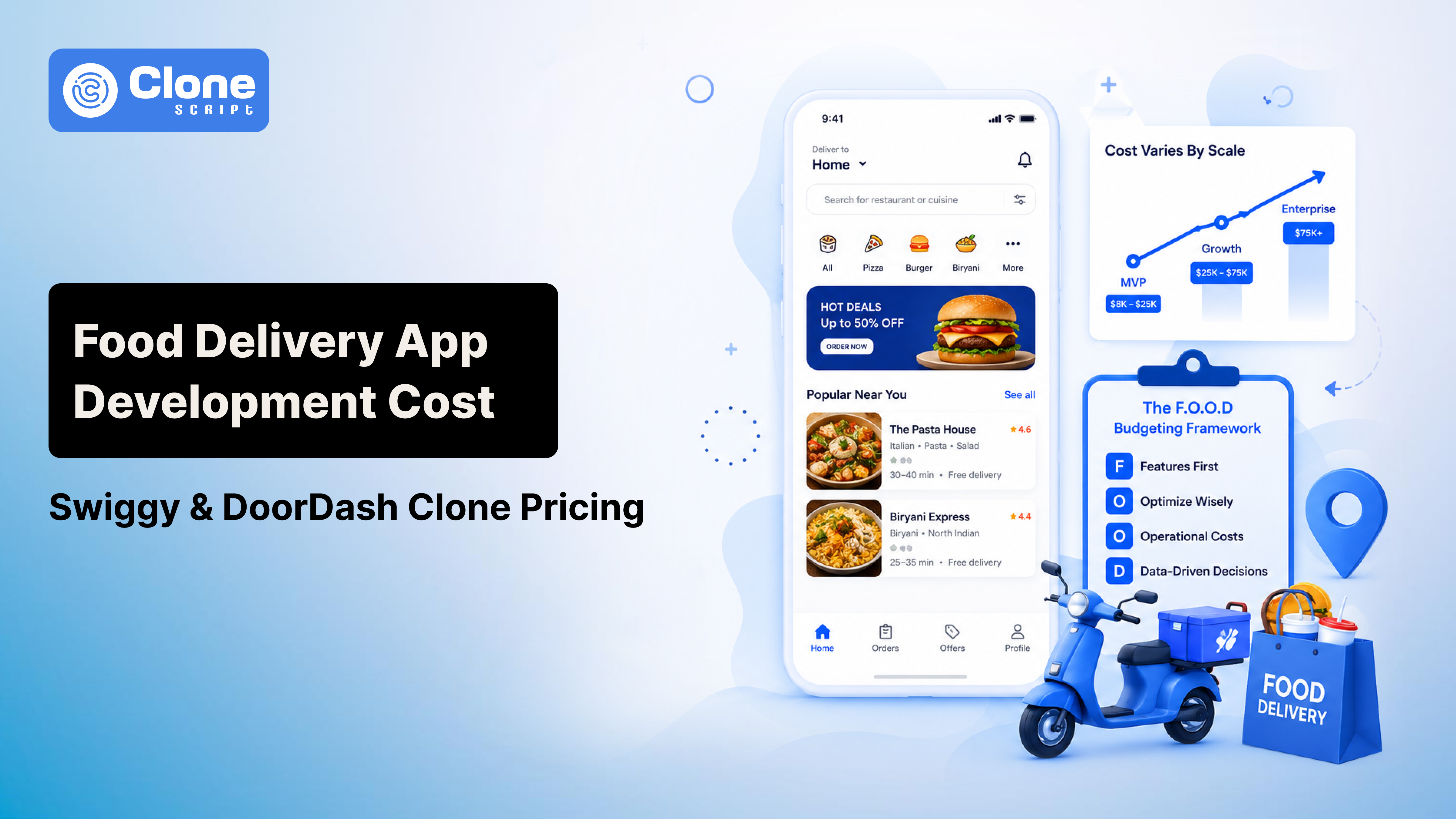
Stage 1: MVP Food Delivery App ($15,000–$24,999)
At this stage, the objective is simple:
Can your platform attract restaurants and generate consistent orders?
Nothing else matters.
An MVP features checklist typically includes:
-
Customer mobile app
-
Restaurant listings
-
Online ordering
-
Payment gateway integration
-
Basic order tracking
-
Admin panel
This is all most startups, cloud kitchens, and local food delivery businesses need to validate the market.
The goal isn't building the next DoorDash.
The goal is proving customers will use your service.
Stage 2: Growth-Stage Food Delivery Marketplace ($25,000–$79,999)
Once orders start increasing, operational efficiency becomes the priority.
This is where many businesses hit their first growth issue.
Manual delivery assignment becomes difficult.
Restaurant management becomes time-consuming.
Customer support requests increase.
To solve these challenges, businesses typically add:
-
Delivery partner app
-
Restaurant dashboard
-
Promotions and coupon management
-
Push notifications
-
Analytics and reporting
-
Multi-location support
At this stage, technology starts reducing operational costs instead of simply enabling orders.
Stage 3: Enterprise Food Delivery Platform ($80,000–$200,000+)
This is where platforms compete on efficiency, speed, and customer experience.
Businesses operating across multiple cities invest in:
-
Route optimization
-
AI-powered recommendations
-
Dynamic pricing engines
-
Advanced business analytics
-
Multi-city infrastructure
-
High-performance cloud architecture
These features are expensive.
But they become essential when processing thousands of daily orders.
The biggest budget mistake founders make is paying for Stage 3 technology while still operating a Stage 1 business. The most successful food delivery platforms invest in technology only when growth demands it.
Swiggy vs DoorDash: What Actually Makes These Platforms Expensive?
A customer opens an app, orders a burger, and receives it 25 minutes later.
From the outside, the process looks simple.
Behind the scenes, dozens of decisions happen in real time: restaurant availability, driver assignment, route selection, traffic conditions, payment verification, and delivery tracking.
This is exactly why platforms like Swiggy and DoorDash cost significantly more to build than a standard food ordering app.
The difference isn't the interface.
The difference is the operational engine running underneath it.
What Increases Swiggy-Like App Development Costs?
A Swiggy clone app is built around hyperlocal delivery operations.
The platform must coordinate restaurants, customers, and delivery partners simultaneously while maintaining fast delivery times.
Key cost drivers include:
-
Real-time driver tracking
-
Dynamic order allocation
-
Restaurant partner management
-
Peak-hour order handling
-
Hyperlocal delivery optimization
As order volume increases, these systems become more complex and more expensive to maintain.
What Increases DoorDash Clone Development Costs?
A DoorDash-like platform focuses heavily on delivery efficiency and logistics automation.
To support large-scale operations, businesses often invest in:
-
Intelligent dispatch systems
-
Route optimization engines
-
Driver performance monitoring
-
Multi-market expansion support
-
Scalable cloud infrastructure
These systems help reduce operational costs while improving delivery speed.
Why This Matters for Your Budget
A local restaurant delivery app may need basic order management.
A marketplace handling thousands of deliveries per day needs automation, optimization, and infrastructure capable of processing massive amounts of real-time data.
That's where development costs increase rapidly.
Swiggy and DoorDash aren't expensive because they have more screens or features. They're expensive because they solve operational problems at scale, every second of every day.
The Hidden Costs That Appear After Launch
Launching your food delivery app isn't the expensive part.
Keeping it running is.
This catches many founders by surprise because the initial development quote often becomes the benchmark for the entire project budget. Six months later, they're dealing with costs that were never part of the original discussion.
The reality is that a food delivery platform is a living product. As users, restaurants, and delivery partners increase, so do the operational expenses required to support them.
-
Cloud Infrastructure
Every order, payment, notification, and location update consumes server resources.
As traffic grows, businesses need to upgrade their cloud infrastructure to maintain speed and reliability.
-
Maps, SMS, and Push Notifications
Features such as OTP verification, delivery tracking, and order updates rely on third-party services.
Common ongoing expenses include:
-
Map API usage
-
SMS verification
-
Push notification services
-
Email delivery systems
Individually, these costs seem small, but they increase with user activity.
-
App Maintenance and Updates
Operating systems change constantly.
New devices are released every year.
To ensure a smooth user experience, businesses must regularly update their apps, fix bugs, and improve performance.
Many companies allocate 15–20% of their initial development budget annually for maintenance alone.
-
Security and Compliance
As payment transactions increase, security becomes non-negotiable.
Regular security audits, data protection measures, and compliance updates become essential investments rather than optional expenses.
-
The Cost Nobody Plans For
Success.
When your app starts processing thousands of orders, you'll need better analytics, customer support systems, marketing strategies, tools, and operational automation.
Ironically, growth itself creates new costs.
The true cost of a food delivery app isn't what you spend to launch it. It's what you invest to keep it fast, secure, and scalable as your business grows.
Should You Build a Clone, Buy a Ready-Made Solution, or Develop Custom Software?
Three businesses can enter the food delivery market this month.
One will spend $5,000.
Another will spend $50,000.
The third may invest more than $150,000.
None of them are necessarily wrong.
The right choice depends on how quickly you want to launch, how much control you need, and how aggressively you plan to grow.
Option 1: Ready-Made Food Delivery Clone
A clone solution is the fastest way to enter the market.
Most clone apps already include:
-
Customer application
-
Restaurant panel
-
Delivery partner app
-
Admin dashboard
This approach works best for businesses that want to validate demand before making a larger investment.
However, customization can become difficult as your platform grows.
Best for: Startups testing a business idea.
Option 2: SaaS Food Delivery Platform
Instead of owning the software, you pay a monthly subscription.
The biggest advantage is lower upfront cost.
You can launch quickly without worrying about infrastructure, updates, or maintenance.
The trade-off is flexibility.
You're limited by the platform's capabilities and pricing structure.
Best for: Restaurants and local businesses launching quickly.
Option 3: Custom Food Delivery App Development
Custom development requires the highest investment but provides complete ownership and flexibility.
You control:
-
Features
-
User experience
-
Integrations
-
Scalability
-
Future product roadmap
This approach becomes valuable when your business model differs from existing platforms or when long-term growth is a priority.
Best for: Startups planning to build a scalable food delivery marketplace.
A Simple Decision Rule
If you're still validating demand, avoid enterprise-level development.
If you're generating consistent orders and planning expansion, invest in custom software.
If speed matters more than differentiation, start with a clone or SaaS solution.
The cheapest option isn't always the smartest choice. The best investment is the one that supports your next stage of growth without forcing a complete rebuild later.
The F.O.O.D Framework: A 10-Minute Method to Estimate Your Real App Budget
Before speaking with a development company, answer four questions.
Not fifty.
Not a detailed technical questionnaire.
Just four.
In our experience, founders who can clearly answer these questions receive more accurate project estimates, avoid unnecessary features, and make better technology decisions from day one.
We call it the F.O.O.D Framework.
-
F - Footprint
How large will your operation be during the first 12 months?
Think about:
-
Number of cities
-
Number of restaurants
-
Expected daily orders
A platform serving 500 orders per month requires a completely different architecture than one handling 5,000 orders per day.
The bigger the footprint, the bigger the infrastructure investment.
-
O - Operations
Who is responsible for deliveries?
Your answer impacts development costs immediately.
Options include:
-
Restaurant-managed delivery
-
Platform-managed delivery
-
Hybrid delivery model
The more logistics you control, the more technology you'll need.
-
O - Ownership
How much control do you need?
This determines whether a clone app, SaaS platform, or custom solution makes sense.
Many startups overspend because they buy enterprise-level ownership before validating market demand.
-
D - Differentiation
Why would customers choose your platform instead of existing alternatives?
Examples include:
-
Faster delivery
-
Subscription plans
-
Niche cuisine focus
-
Better restaurant partnerships
-
AI-powered recommendations
This is where custom development often begins.
Your competitive advantage usually becomes your most important feature investment.
Put It All Together
If your footprint is small, operations are simple, ownership requirements are low, and differentiation is minimal, a clone solution may be enough.
If you're planning multi-city expansion, managing your own delivery fleet, and building a unique marketplace experience, expect a significantly larger development budget.
Most founders ask, "How much does a food delivery app cost?"
The better question is, "What type of food delivery business am I actually building?"
The answer determines your budget far more accurately than any online pricing estimate.
Cost Optimization Strategies That Can Save Thousands in Development
Not every dollar spent on development creates equal value.
We've seen businesses spend months building advanced features that barely get used, while simple improvements to ordering and delivery workflows generated far better results.
The goal isn't to build the cheapest food delivery app.
The goal is to maximize return on every development dollar.
-
Launch With an MVP First
The fastest way to waste budget is building for future customers instead of current ones.
Start with core functionality:
-
Restaurant listings
-
Food ordering
-
Online payments
-
Order tracking
If customers aren't placing orders consistently, additional features won't solve the problem.
-
Prioritize Revenue-Generating Features
Some features directly impact revenue.
Examples include:
-
Loyalty programs
-
Referral systems
-
Subscription plans
-
Promotional campaigns
Focus on features that increase orders before investing in advanced automation.
-
Use Existing Integrations
Building everything from scratch rarely makes sense.
Payment gateways, maps, notifications, and analytics tools already exist and can significantly reduce app development time.
-
Scale Infrastructure Gradually
Many startups pay for enterprise-level infrastructure long before they need it.
A platform handling 100 daily orders doesn't require the same cloud architecture as one processing 10,000.
Upgrade infrastructure as demand grows.
-
Build Based on Data, Not Assumptions
Every feature should answer a business question.
If users aren't requesting a feature and data doesn't support it, postpone it.
The most successful food delivery platforms grow through continuous improvement rather than massive feature launches.
The biggest savings don't come from hiring cheaper developers. They come from building only what your business needs today and expanding when customer demand proves it's necessary.
So, How Much Does It Actually Cost to Build a Food Delivery App?
After discussing features, operations, infrastructure, and scalability, we're back to the question that brought you here.
What's the actual cost?
The honest answer is that pricing depends on the stage of business you're building for.
Here's a realistic breakdown:
| Business Stage | Estimated Cost Range |
|---|---|
| MVP Food Delivery App | $15,000 – $24,999 |
| Growth-Stage Marketplace | $25,000 – $79,999 |
| Enterprise Delivery Platform | $80,000 – $200,000+ |
These estimates typically include core development, design, testing, and deployment.
However, the final investment can increase depending on:
-
Number of platforms (iOS, Android, Web)
-
Custom feature requirements
-
Third-party integrations
-
Delivery fleet management
-
Real-time tracking complexity
-
Scalability requirements
This is why asking for the cost of a Swiggy clone or DoorDash clone can be misleading.
Two businesses may request the same feature list but receive completely different estimates because their growth goals are different.
A startup targeting one city should not budget like a national marketplace.
Likewise, a business planning rapid expansion shouldn't build technology that will need replacing after six months.
Food delivery app development is not a fixed-cost project. It's a growth investment. The right budget isn't determined by what industry leaders spent. It’s determined by what your business needs to achieve its next milestone.