BTC - Bitcoin
 USDTERC20 - USDT ERC20
 ETH - Ethereum
 BNB - Binance
 BCH - Bitcoin Cash
 DOGE - Dogecoin
 TRX - TRON
 USDTTRC20 - USD TRC20
 LTC - LiteCoin

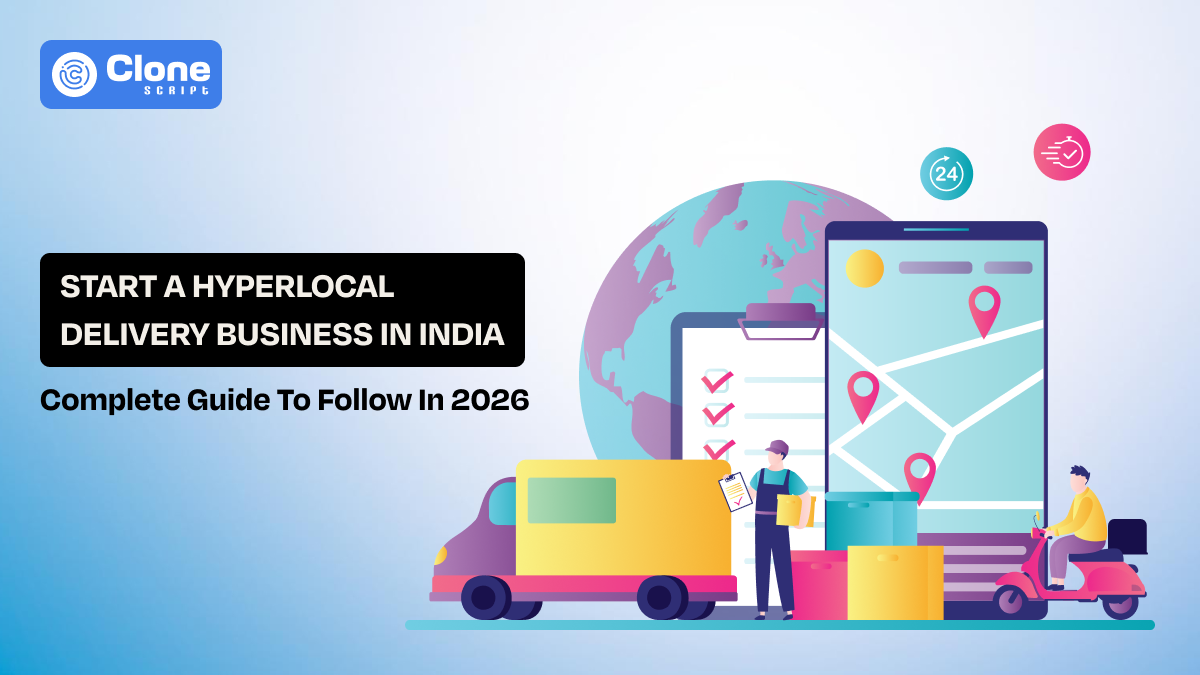
How to Start a Hyperlocal Delivery Business in India (2026 Complete Guide)
India’s hyperlocal delivery ecosystem has grown from experimental convenience to mainstream infrastructure. What began as food delivery is now a multi-category, ultra-fast logistics economy covering groceries, medicines, electronics, pet supplies, and essential household products.
By 2026, consumer behavior will have fundamentally shifted. Urban and semi-urban customers expect deliveries within 10–30 minutes. The rise of quick commerce platforms such as Zepto, Instamart, and Blinkit has accelerated this expectation across metros and Tier-2 cities.
For entrepreneurs, this is not just a trend. It is a structural shift in retail logistics.
This guide explains, step by step, how to start a hyperlocal delivery business in India in 2026, including business models, technology, costs, unit economics, legal setup, and scaling strategies.
Understanding the Hyperlocal Delivery Opportunity in 2026
Hyperlocal delivery refers to fulfilling orders within a defined geographic radius (usually 2–8 km) using localized inventory and optimized last-mile operations.
In 2026, several forces make this sector attractive:
-
Consumer Behavior Shift Toward Instant Delivery: Customers prioritize speed over price differences of ₹10–₹20. Convenience has become a competitive factor.
-
Expansion Beyond Metros: Tier-2 and Tier-3 cities now demonstrate strong demand for grocery and medicine delivery. Competition is lower compared to Mumbai, Delhi, and Bangalore.
-
Improved Logistics Infrastructure: Better digital payments, GPS mapping, and route optimization software reduce operational inefficiencies.
-
Gig Economy Maturity: Flexible delivery workforce models reduce fixed employment risk.
Platforms like Swiggy Instamart prove that integrated logistics and inventory control drive faster fulfillment cycles.
The opportunity exists. But, only for disciplined operators who understand unit economics.
Let’s see the process for the hyperlocal delivery business launch in India.
Step 1: Choosing the Right Hyperlocal Business Model
Your business model determines capital intensity, margin potential, and scalability. Here are common models working in hyperlocal brands.
-
Aggregator Model
This model connects customers with local kirana stores or pharmacies. You earn commission per transaction and charge delivery fees.
The best part of the aggregator model is that it requires minimal inventory investment, making it suitable for entrepreneurs starting with limited capital.
But when you need a high margin of profit, you may find it thinner because the model operates on store markups and shared profit.
When it comes to where the aggregator model works? Tier-2 cities like Ahmedabad, Surat, Navi Pune, Jaipur, Vidisha, Raipur, and Dehradun are a perfect choice. In these Indian cities, the store digitization is still growing.
-
Inventory-Led (Dark Store) Model
You operate a micro-warehouse stocked with high-demand SKUs. When the customer makes an order from the mobile app or website, the orders are fulfilled directly from your inventory.
Advantages of the inventory lead model:
-
Higher gross margins. You don’t have to share the profit with the local store, but you can keep the earnings.
-
Better inventory control. It prevents stock overflows or bottom-level inventory during the high peak of orders.
-
Faster dispatch times. As you have the products in your warehouse, the order can be completed within a short span.
Challenges in this hyperlocal business model:
-
Inventory holding risk. Not all the items you have can be sold daily at certain times, so the guesswork does not work here.
-
Capital requirement for stocking. To add different categories of products the huge amount of finance is deployed, and for startups, it is becoming tough.
-
Wastage risk for perishables. Sometimes, items such as dairy products and daily essentials need more care, and with limited resources, it’s complex to manage.
Quick commerce companies such as Zepto use dense dark-store networks to guarantee 10-minute delivery.
For entrepreneurs, this model works best in high-density residential areas.
-
B2B Hyperlocal Fulfillment Model
Instead of serving end customers directly, you offer last-mile delivery services to local retailers, D2C brands, and SMEs. This is the new model entrepreneurs are looking to join.
Revenue comes from logistics contracts. As you supply the products to other businesses, they will release the funds as decided. You do not have to employ the delivery partners to deliver the products to end customers.
That means spending on digital marketing or discount appeals can be saved. But this model demands operational excellence and route optimization capabilities.
-
Niche Vertical Model
Quick delivery businesses like Blinkit that holds 44%, Zepto is behind it with 29%, and Instamart holds 23% of the share of the hyperlocal market in India. So, as a startup, competing with limited capital and resources is risky. That’s why the niche vertical model is useful. You can specialize in:
-
Medicine delivery, see the example of PharmEasy, Netmeds, and Medtown.
-
Organic vegetables are available on platforms such as Jiomart, Dmart, BigBasket, and Zepto.
-
Pet food delivery platforms like Zigly, Supertails, Vetic, and Blinkit.
-
Bakery products selling websites like FNP (Ferns N Petals), Bakingo, and Swiggy Instamart.
-
Hardware & electrical supplies supplying companies like Industrybuying, Moglix, and other instant commerce platforms.
Niche positioning allows faster brand recall and reduced competition pressure.
Step 2: Conducting Market Research and Validation
Before investing ₹10 lakhs or ₹5 crores or even more, validate demand thoroughly. This is where the second step comes in: see the market situation, thorough research, and bias-free validation.
-
Identify Demand Clusters
Without the demand, or not understanding, making the app like Zepto or Blinkit clone website doesn’t make sense.
Look at where the orders are coming from to quick delivery businesses:
-
High-rise apartment societies
-
Gated communities
-
Dense residential neighborhoods
-
Areas far from supermarkets
Now, you think about how it can be done because on paper, this task is easy, but in reality, the picture is different.
First, interview 100–200 residents. Ask the following questions:
-
How often do you order groceries? Like daily, odd or even day, weekly, or in a month.
-
What is your average monthly spending? The range could be Rupees 5,000 to 25,000.
-
What frustrates you about current delivery services? Such as late deliveries, low-quality items, and order tracking.
Data-driven validation reduces failure probability for business investment.
-
Analyze Competition
You have a demand in mind, and now it’s focus on competition. Through competition analysis, you will identify their strengths, weakness and USP that brings them millions of users.
Study these aspects:
-
Delivery time promises like 10-minutes, 20 minutes, and up to 5 hours.
-
Minimum order value is 9 rupees or 20 rupees.
-
Pricing models include distance-based, location-wise/geographical pricing, and commission-based.
-
Subscription plans according to the prior location or frequent customers making orders.
-
App ratings on Google Play Store and Apple Store.
If competitors consistently show delivery delays or poor ratings, there is an operational gap opportunity. You can fill it with a proper strategy.
-
Assess Order Frequency
Hyperlocal delivery becomes viable when repeat purchases occur weekly or bi-weekly. Grocery and medicine segments offer the highest frequency.
Without repeat behavior, customer acquisition cost becomes unsustainable. So, when you have a goal to get more profit or customers after launching the quick delivery app, the business model type is important.
Step 3: Legal Registration and Compliance in India
A compliant legal structure is not just a formality. It is the key to long-term scalability for your hyperlocal delivery business in India. As operations expand, regulatory gaps can result in penalties, shutdowns, or investor hesitation. Setting up correctly from the beginning prevents costly restructuring later.
-
Choose the Right Business Structure
Your business structure determines taxation, liability, and fundraising capability:
-
Proprietorship: Perfect for small-scale launches with minimal compliance requirements, but offers no liability protection.
-
LLP (Limited Liability Partnership): It provides liability protection while keeping compliance moderate.
-
Private Limited Company: This is best suited for startups planning rapid expansion, external funding, or multi-city operations.
If you aim to raise venture capital or angel investment, a Private Limited Company is strongly recommended due to better governance and investor trust.
-
Mandatory Registrations
Complete these registrations before launching the business:
-
GST Registration
-
Trade License
-
Shops & Establishment Registration
-
FSSAI License (if handling food)
-
Professional Tax Registration (state-dependent)
Additionally, formal agreements with delivery partners, vendors, and warehouse owners protect operational interests. Insurance coverage, including liability and rider accident insurance, further reduces financial risk exposure.
Step 4: Building the Technology Stack
Technology determines delivery speed, operational visibility, and cost control in a hyperlocal delivery business. In 2026, customers expect convenient ordering and near-instant fulfillment.
Without an integrated tech stack, coordination gaps between inventory, dispatch, and riders quickly affect margins and customer trust.
A robust system begins with four core components:
-
Order Management System (OMS)
The OMS acts as the central command center. It handles order intake, payment verification, invoice generation, SKU-level inventory checks, and real-time status updates. A reliable OMS reduces manual errors and ensures smooth coordination between the warehouse and delivery teams.
-
Delivery Management System (DMS)
The DMS automates rider allocation based on proximity, order priority, and workload distribution. Intelligent assignment improves delivery turnaround time while minimizing idle rider hours, directly impacting last-mile efficiency.
-
GPS Tracking Integration
Live tracking enhances transparency for both customers and operations managers. Customers can monitor deliveries in real time, while back-end analytics help identify delays, rider inefficiencies, or service bottlenecks.
-
Route Optimization Engine
This system uses traffic patterns and clustering algorithms to determine the most efficient delivery routes. AI has been introduced here that reduces travel time, lowers fuel expenses, and increases per-hour order capacity.
Customer-Facing Applications
Your digital ecosystem should include the following:
-
Android app
-
iOS app
-
Rider app
-
Admin dashboard
In 2026, users expect real-time notifications, seamless checkout, UPI and wallet payments, and instant refund mechanisms. Advanced operators deploy AI-driven demand forecasting to anticipate peak hours and optimize stock levels.
Without scalable, integrated technology, operational issues appear quickly, and profitability becomes unsustainable.
Step 5: Operational Setup and Execution
Hyperlocal delivery is operationally intensive. Margins are thin, delivery windows are short, and customer expectations are high. Success depends on how efficiently you design fulfilment, manage riders, and control procurement costs.
-
Fulfilment Strategy
If you operate a dark store model, warehouse design must prioritize speed and accuracy. Focus on these things:
-
High-demand SKUs that drive repeat orders
-
Fast-moving inventory to reduce holding costs
-
Smart shelf organization for quick picking
-
Minimal walking distance for pickers to reduce fulfillment time
Micro-warehouses should ideally range between 2,000 and 3,000 sq ft for a single-zone operation. The layout should support rapid picking, barcode scanning, and real-time inventory sync with your Order Management System. Note that efficient fulfilment directly improves delivery time and customer satisfaction.
-
Delivery Fleet Model
You can structure your fleet in three ways:
-
Gig-Based Riders: This is a flexible and easily scalable option, but rider churn can be high.
-
Owned Fleet: Here, you have more control and service consistency, but higher fixed payroll costs.
-
Hybrid Model: Common for startups scaling beyond one zone, balancing flexibility and stability.
Retention incentives, peak-hour bonuses, and transparent payout systems improve reliability and reduce attrition.
-
Vendor Relationships
To make your quick delivery platform successful, strong supplier negotiation ensures the following:
-
Better procurement margins that help, not influence them to move towards competition.
-
Consistent stock availability is needed for order fulfillment.
-
Promotional collaboration opportunities to incentivize the vendors.
Procurement efficiency directly impacts contribution margins and long-term profitability.
Step 6: Hyperlocal Startup Costs and Budgeting for 2026
Startup costs for a hyperlocal delivery business in India vary significantly depending on the model, city, and scale of launch. Metro cities demand higher warehouse rentals and marketing spend, while Tier-2 locations offer lower entry barriers but may require stronger awareness campaigns.
-
Small Single-Zone Aggregator Model
This model is useful for startups who entering the market for the first time. This model requires relatively low capital since you do not hold inventory. Typical costs include:
-
Registration – ₹40,000: It covers business incorporation, GST registration, licenses, and essential legal documentation requirements.
-
Basic Tech – ₹3–6 lakhs: It includes app development, admin dashboard, payment gateway, and back-end infrastructure development setup.
-
Marketing – ₹2–4 lakhs: It includes initial digital ads, local promotions, launch offers, and customer acquisition campaigns.
-
Operations Buffer – ₹5–8 lakhs: It includes rider payouts, support staff salaries, utilities, and contingency working capital reserve.
Estimated Total – ₹12–20 lakhs: Suitable for testing demand in one focused service zone.
-
Dark Store Model
The inventory-led model requires significantly higher capital but offers better margin control.
-
Warehouse Setup – ₹10–20 lakhs: This includes rental deposits, shelving systems, cold storage, packing stations, and operational equipment.
-
Inventory Stocking – ₹15–30 lakhs: This includes the finance range for initial high-demand SKU procurement to maintain adequate order fulfillment levels.
-
Tech Infrastructure – ₹15–25 lakhs: Its capital includes advanced OMS, DMS, route optimization, analytics integration, and scalability features.
-
Initial Marketing – ₹5–10 lakhs: Its cost includes brand awareness campaigns, influencer promotions, performance marketing, and launch incentives.
Estimated Total – ₹50 lakhs to ₹1 crore: This enables controlled inventory, faster delivery, and stronger margin management.
Maintain a six-month operational runway to stabilize order volume and optimize unit economics.
Step 7: Revenue Model and Unit Economics
Quick commerce delivery businesses in India often fail not because of low demand, but because founders ignore unit economics. Fast growth without financial discipline quickly leads to cash burn. Before scaling, you must ensure that each order contributes positively after covering variable costs.
-
Revenue Streams
A sustainable hyperlocal delivery business typically combines multiple income sources:
-
Delivery fee per order: This is a fixed or distance-based charge added to each transaction. It’s preferable not to suffer from cash flow issues.
-
Commission from vendors: A certain percentage amount earned from partner stores or brands on every order.
-
Subscription memberships: This is useful for monthly or annual plans offering free delivery or priority service.
-
Advertising placements: This includes paid promotions from brands for in-app visibility and featured listings.
-
B2B contracts: It contains logistics agreements with retailers or D2C brands requiring local fulfillment support.
Diversified revenue reduces reliance on a single margin source.
-
Core Metrics to Monitor
Track marketing spend per new user.
-
Customer Acquisition Cost (CAC): It measures total marketing spend divided by new paying customers acquired.
-
Average Order Value (AOV): This checks increase through bundle offers, upselling, and minimum order thresholds.
-
Contribution Margin: The revenue minus variable costs, such as rider payout and inventory cost, can be understood with this metric.
-
Last-Mile Delivery Cost: Typically, the largest expense, influenced by fuel, rider efficiency, and order density.
Companies like Dunzo struggled due to unsustainable cost structures, reinforcing the need for disciplined financial planning and controlled expansion.
Step 8: Go-To-Market Strategy
Launching a hyperlocal delivery business without strong local leads results in slow traction and high customer acquisition costs. Since your service operates within a limited radius, early momentum must come from concentrated geographic clusters rather than broad digital exposure.
-
Pre-Launch Strategy
Before officially going live, build demand within a defined zone:
-
Partner with 3–5 residential societies to secure early adopters and predictable order density.
-
Offer early access discounts to incentivize first-time usage and generate word-of-mouth referrals.
-
Conduct offline activation campaigns such as pamphlet distribution, kiosk setups, and society demos to build trust locally.
The objective is to create repeat behavior within a small cluster before expanding coverage.
-
Digital Strategy
Once operations stabilize, digital channels improve growth:
-
Google Business Profile optimization ensures visibility for searches like “grocery delivery near me.”
-
Hyperlocal SEO targets location-specific keywords to capture organic demand.
-
Social media marketing, including advertising, helps drive awareness within defined pin codes.
-
Referral programs encourage existing customers to bring in new users at lower acquisition costs.
Retention is more important than acquisition. Focus on consistent delivery performance, personalized offers, and loyalty incentives to ensure customers place a second and third order quickly.
Conclusion
India’s hyperlocal delivery market is structurally integrated into urban consumption patterns. Industry estimates suggest the quick commerce and hyperlocal segment could exceed a multi-billion-dollar scale within the next few years, driven by dense urban clusters and rising digital adoption.
However, growth alone does not guarantee success. Sustainable profitability depends on tight unit economics, operational discipline, and controlled expansion.
Entrepreneurs who validate demand carefully, invest in scalable technology, and optimize last-mile costs can build defensible businesses. In 2026, the opportunity remains strong, but only for founders who prioritize efficiency over aggressive, cash-burning growth.