BTC - Bitcoin
 USDTERC20 - USDT ERC20
 ETH - Ethereum
 BNB - Binance
 BCH - Bitcoin Cash
 DOGE - Dogecoin
 TRX - TRON
 USDTTRC20 - USD TRC20
 LTC - LiteCoin

Crypto Exchange HTML Template: Features, Ready-to-Use Design and Code
The crypto industry has matured beyond experimental platforms and minimal interfaces. Today’s users expect institutional-grade dashboards, real-time market depth, frictionless wallet management, and performance that rivals top centralized exchanges. Crypto exchange HTML template becomes strategically valuable there.
For developers and Web 3.0 startups, building that experience is expensive, time-consuming, and risky when choosing to go from scratch.
This guide explains the technical architecture, modern UI standards, core features, and real-world use cases of a crypto exchange template that helps developers evaluate and deploy the right foundation for a trading platform.
Why Crypto Exchange Platforms Need Production-Ready UI
Crypto exchanges are interface-heavy systems. Unlike content websites, trading sites require precision UI engineering.
A professional crypto website template eliminates common development challenges:
-
Trading dashboards demand high-density layouts. In templates, real-time charts, order books, and trade panels must coexist without clutter while maintaining clarity and speed. The dashboard UI and UX design principles have been implemented.
-
User trust depends on UI structure and transparency. Web templates have a clean design to display balance, summaries, transaction history visibility, and clear fee displays, which directly influence credibility.
-
Speed-to-market defines competitive advantage. Delayed launches reduce first-mover benefit in niche token markets or regional crypto ecosystems. Using an HTML template can save time and resources on UI design and basic front-end optimization.
-
Front-end errors create costly UX breakdowns. Poor layout hierarchy or inconsistent UI components can reduce trader retention and increase churn. The paid templates are solving these issues properly.
Instead of allocating weeks to interface planning, a modular template offers a stable visual and structural framework.
Market Expectations for Modern Crypto Exchange UI (2026 Standard)
User expectations in crypto UI have shifted significantly. Exchanges launched today must align with current Web 3.0 and fintech standards. Here are some glimpses of it.
1. Dark-Mode Dominant Interfaces
Modern crypto traders prefer dark interfaces that reduce eye strain during prolonged market monitoring sessions.
Dark-first crypto dashboard layouts enhance contrast for candlestick charts and order book data to encourage a professional trading environment.
2. High-Density Trading Layouts
Professional traders want maximum market data visibility within a single screen.
Using a modern crypto trading dashboard HTML layout for development typically includes the following:
-
Chart area with multi-timeframe support
-
Order book with real-time updates
-
Buy or sell execution panel
-
Market depth visualization
-
Trade history feed
These design elements must remain structured and responsively work on desktop and mobile without showcasing errors to the user.
3. Real-Time Data Integration Compatibility
In a crypto exchange website, the perfect data fetching works as a main aspect, and compromising with it brings unexpected results. Using the static HTML template, developers feel uncomfortable. But when the template is optimized for the following, it works.
-
WebSocket integration
-
REST API endpoints
-
Dynamic price feed insertion
A scalable crypto exchange template prepares UI placeholders for live market integration.
4. Security-Centric UI Sections
Security is the most important thing on a crypto website. From a design perspective, every section, such as the website hero section and interaction, has to prioritize transparency. Modern designs prominently include:
-
Two-factor authentication settings that signal a top security level.
-
Withdrawal whitelist pages that showcase the numbers with decimal points.
-
Device management logs to prevent any unauthenticated login attempts.
-
Security notification panels that help admins control the safety of users.
Security-related UI placement influences platform trustworthiness. It’s recommended.
Technical Architecture of a Crypto Exchange HTML Template
Developers should evaluate architecture before visual aesthetics. HTML structure determines scalability. The template has been optimized for the following.
-
Modular Dashboard Components
A strong HTML5 crypto template structure separates trading UI into reusable sections.
-
Independent order book modules: This element allows seamless API binding without modifying unrelated dashboard components because it takes time to redesign.
-
Separated trading panel layout: Buy and sell forms remain adaptable for spot, margin, or swap logic integration. This makes the integration easy during development.
-
Reusable wallet components: Deposit, withdrawal, and transaction tables can be repurposed across multiple tokens with design consistency.
This modularity simplifies back-end development and manages the timeline to be completed for clients.
-
Backend-Ready Front-End Design
A crypto exchange template should not restrict back-end stack decisions.
It must integrate easily with the following:
-
Node.js trading engines
-
Laravel-based admin systems
-
Python or Django crypto APIs
-
Custom blockchain smart contract endpoints
The front-end must remain framework-agnostic. After all, enhancing the user experience with security is the required combined effort for both.
-
Clean HTML5 Semantic Markup
Structured HTML improves both maintainability and performance for crypto website SEO.
-
Proper heading hierarchy enhances SEO visibility: Clear H1, H2, and H3 usage strengthens keyword structure and indexing clarity.
-
Semantic sectioning improves developer readability: Organized markup accelerates customization and onboarding for new contributors.
-
Optimized asset loading reduces page weight: Minified CSS and JS ensure faster dashboard rendering under trading load.
This functionality is important to save time in setting it up through manual effort.
-
Cross-Browser & Device Compatibility
Traders operate across devices and browsers. Somewhere in the USA, an investor opens the crypto exchange site in the Safari desktop version, and in India, iPhone has been preferred with Google Chrome. Using a responsive crypto exchange website template for development must be optimized for:
-
Maintain dashboard integrity on tablets
-
Adjust order book stacking for mobile
-
Preserve chart readability on smaller screens
Responsive architecture increases trading accessibility. It is required to be the next crypto exchange that users like.
Features List of Every Crypto Exchange HTML Template Must Include
A competitive crypto exchange HTML website template must go beyond a visually attractive homepage. It should replicate the structural depth of leading platforms like Binance and Coinbase while remaining lightweight, customizable, and back-end-ready.
-
Trading Dashboard Interface
The trading dashboard is the operational core of any cryptocurrency exchange platform.
-
Integrated chart display area: Designed to embed TradingView or similar real-time chart libraries without layout distortion or responsiveness issues. The chart container must support multiple timeframes, indicators, and smooth data fetching via WebSocket or REST APIs.
-
Structured order book interface: Clear buy and sell visualization enhances decision-making accuracy and reduces execution hesitation during volatile market conditions. Proper alignment prevents misinterpretation of liquidity levels.
-
Market pair selector panel: This enables dynamic switching between trading pairs without navigation reloads, supporting fast execution workflows essential for active traders monitoring multiple assets simultaneously.
-
Recent Trades Feed: It displays real-time executed trade data with timestamp precision, increasing transparency and improving user confidence during high-volume trading periods.
-
Advanced Order Panel Support: This is required for a prepared layout structure for limit, market, stop-limit, and conditional orders without requiring major UI restructuring later.
2. Wallet & Transaction Management Pages
Crypto platforms require precise and well-structured asset management interfaces.
-
Asset overview summary section: It displays token balances, valuation metrics, and portfolio allocation breakdown clearly, which helps users understand exposure and asset distribution instantly.
-
Deposit and withdrawal UI forms: Prepared for QR code integration, blockchain address validation, network selection, and fee transparency modules to prevent user input errors.
-
Transaction history table layout: It is structured for API-fetch transaction logs with sorting, filtering, pagination, and export-ready formatting for compliance and reporting needs.
-
Multi-Asset Wallet Listing: Organized wallet interface capable of listing dozens or hundreds of cryptocurrencies without visual clutter or performance degradation.
-
Internal Transfer Interface: This supports wallet-to-wallet transfers within the exchange ecosystem, reducing blockchain fee dependency for internal asset movement.
3. Authentication & KYC Interfaces
Security and regulatory compliance are non-negotiable in crypto platforms.
-
Login and registration forms with validation placeholders: This feature supports OAuth integration, email verification flows, CAPTCHA modules, and password strength indicators to reduce account compromise risks.
-
KYC submission workflow layout: Structured file upload sections, ID verification fields, and status-tracking panels help to simplify integration with third-party compliance APIs.
-
Two-factor authentication setup page: Ready-to-integrate 2FA systems like authenticator apps or SMS verification to enhance platform-level account security.
-
Device & Session Management Page: Displays active login sessions, IP logs, and device recognition data for enhanced transparency and suspicious activity monitoring.
-
Security Notification Settings Panel: Allows users to configure alerts for withdrawals, password changes, and login attempts, improving user trust and platform accountability.
4. Responsive Mobile Trading UI
Mobile trading adoption continues to expand across emerging and developed markets.
-
Adaptive Chart Resizing Logic: It preserves candlestick readability and technical indicator clarity without compromising touch-based zoom and scroll interactions.
-
Stacked Order Panels for Smaller Screens: This feature helps to rearrange buy and sell modules vertically to ensure intuitive trade placement on smartphones and tablets.
-
Optimized Navigation Menu Structure: The collapsible menus, bottom navigation patterns, and simplified dashboards maintain usability in compact interfaces.
-
Touch-Friendly Button Spacing: It prevents accidental order placement by ensuring adequate tap-target sizing in high-volatility scenarios.
5. Homepage & Market Overview Sections
A strong crypto exchange website template should also include high-conversion landing page design components.
-
Live Market Ticker Section: With a scrolling real-time crypto price ticker, it’s easy to showcase trending assets to create urgency and engagement on the homepage.
-
Featured Trading Pairs Grid: This feature highlights high-volume pairs with price change indicators and quick-access trade buttons for faster onboarding.
-
Platform Statistics Counter Section: To display user count, 24h volume, and total transactions, it’s required to build social proof and exchange credibility.
-
Call-to-Action (CTA) Blocks: Strategically placed “Start Trading” and “Create Account” sections optimized for conversion flow across devices. It is needed.
6. Admin & Back-end-Ready UI Panels
Even if back-end logic is separate, UI preparation is important.
-
User Dashboard Overview: This feature displays account verification status, wallet balances, and recent activity in a centralized control panel layout.
-
Referral & Rewards Interface: Pre-structured sections for affiliate tracking, referral commissions, and bonus distribution modules improve the usability of the crypto website.
-
Notification Center: In this feature, a dropdown alert system is designed for system messages, deposit confirmations, and maintenance announcements.
7. Trust & Transparency UI Sections
Crypto users prioritize credibility before depositing funds. The website has to improve trust.
-
FAQ & Knowledge Base Layout: Prepared structure for onboarding guides, trading tutorials, and platform FAQs to reduce support dependency.
-
Terms, Privacy, and Compliance Pages: Dedicated layouts ready for regulatory documentation and legal disclosures help to do not redesign again and customize as required.
-
Testimonials & Partner Sections: A structured display area for ecosystem partnerships, media mentions, or blockchain affiliations increases credibility as a famous crypto exchange does.
Use Cases for Crypto Exchange HTML Website Template
A crypto exchange HTML template supports multiple strategic deployment scenarios beyond early-stage startups, enabling scalable front-end development across Web 3.0, fintech, and enterprise trading ecosystems.
-
Crypto Exchange MVP Development
Launch a functional trading interface quickly using a crypto website template, allowing startups to validate user demand, test trading flows, and demonstrate core exchange capabilities before investing in full liquidity infrastructure.
-
DeFi Platform Expansion
Web 3.0 projects can integrate spot or swap trading dashboards into existing ecosystems without redesigning their entire interface, maintaining brand consistency to expand services like staking, liquidity pools, or token swaps.
-
Agency Client Projects
Web development agencies building cryptocurrency trading platforms can deploy structured exchange front-ends efficiently, reducing custom UI development time. This delivers professional, scalable trading dashboards tailored for fintech or blockchain clients.
-
Investor Fundraising Prototypes
A high-fidelity crypto trading dashboard built from a ready template enhances product credibility, enabling founders to present realistic exchange workflows and technical preparedness during venture capital or strategic investment discussions.
Why HTML Templates Still Matter in a React & Web 3.0 Era
Modern exchanges often showcase advanced front-end stacks powered by frameworks like React and Next.js. However, static and modular HTML architectures remain strategically relevant, especially during early development cycles.
A well-built crypto exchange HTML template delivers structural clarity and rapid deployment advantages without forcing teams into premature framework commitments.
-
Faster Prototyping Capability
HTML templates allow developers to deploy a fully functional trading dashboard within days instead of weeks. Teams can visualize exchange workflows, validate UI decisions, and test user journeys before building complex single-page applications.
-
Back-end-Independent Deployment
A static front-end does not lock projects into specific JavaScript ecosystems. Developers can integrate APIs using Node.js, Laravel, Python, or blockchain endpoints without restructuring core interface logic.
-
Easier Migration Paths
HTML-based architecture can later transition into React or Vue component systems incrementally. This phased migration reduces technical debt while preserving initial UI investment and design consistency.
-
Lower Architectural Complexity
SPA frameworks introduce routing logic, state management layers, and performance considerations. Early-stage exchanges benefit from simpler HTML structures that reduce overhead and debugging complexity during MVP stages.
For startups and Web 3.0 builders, adopting a trading and exchange HTML template ensures front-end stability, faster validation, and flexible scalability without committing immediately to high-maintenance framework ecosystems.
Crypto Exchange HTML Website Template With Design and Code
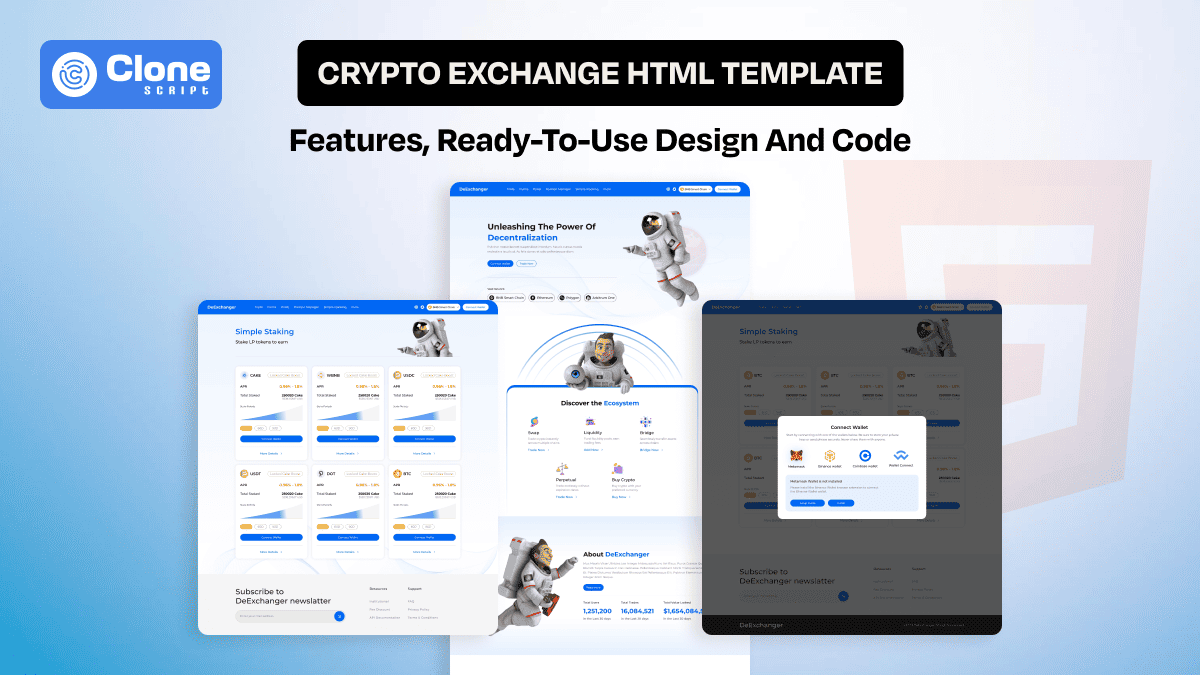
If you're seeking a production-ready crypto exchange HTML template built specifically for trading platforms, the DeExchanger website template, with design and code, delivers a structured, developer-focused front-end foundation.

-
Structured Trading Dashboard Layout: A modular trading dashboard designed for real-time charts, order books, and seamless API-driven market data integration.
-
Wallet and Transaction Pages: Pre-built wallet interfaces with deposit, withdrawal, and transaction history layouts ready for blockchain and API connectivity.
-
Authentication and KYC UI: Secure login, registration, KYC workflow, and 2FA-ready pages structured for compliance and user verification integration.
-
Modern light-Mode Fintech Design: Professional light-mode interface optimized for high-density trading data visibility and modern Web 3.0 user experience standards.
-
Clean, Scalable HTML Architecture: Organized HTML5 structure enabling easy customization, back-end integration, and scalable white-label crypto exchange deployment.
Instead of investing weeks designing trading dashboards manually, developers can integrate live APIs, customize components, and launch a market-ready interface significantly faster.
FAQ
-
Can I integrate real-time crypto APIs with this crypto exchange HTML template?
Yes. The template is structured to support REST and WebSocket integration, allowing developers to connect live cryptocurrency price feeds, order book data, trading history, and wallet balance updates without restructuring the core layout.
-
Is this crypto website HTML template fully mobile responsive?
Yes. The template uses a responsive layout system that adapts trading dashboards, order panels, and wallet pages across desktops, tablets, and smartphones while preserving chart readability and execution usability.
-
Does the template include wallet management pages?
Yes. It includes structured wallet overview pages, deposit and withdrawal interfaces, and transaction history tables designed for multi-asset cryptocurrency integration and API-based data rendering.
-
Can I customize the branding and UI design?
Yes. The clean HTML5 architecture allows easy modification of logos, color schemes, typography, layout sections, and UI components to match your crypto exchange brand identity.
-
Is this template suitable for white-label crypto exchange projects?
Yes. The modular design and scalable file structure make it ideal for white-label deployments, enabling agencies and startups to launch multiple branded crypto exchange platforms efficiently.
-
What is the cost of a crypto exchange HTML template?
It remain $50 to $500 for an HTML template with crypto-specific layout designs, UI assets, front-end code, and partial back-end development. Choose what the client budget is and your development team's expertise.