BTC - Bitcoin
 USDTERC20 - USDT ERC20
 ETH - Ethereum
 BNB - Binance
 BCH - Bitcoin Cash
 DOGE - Dogecoin
 TRX - TRON
 USDTTRC20 - USD TRC20
 LTC - LiteCoin

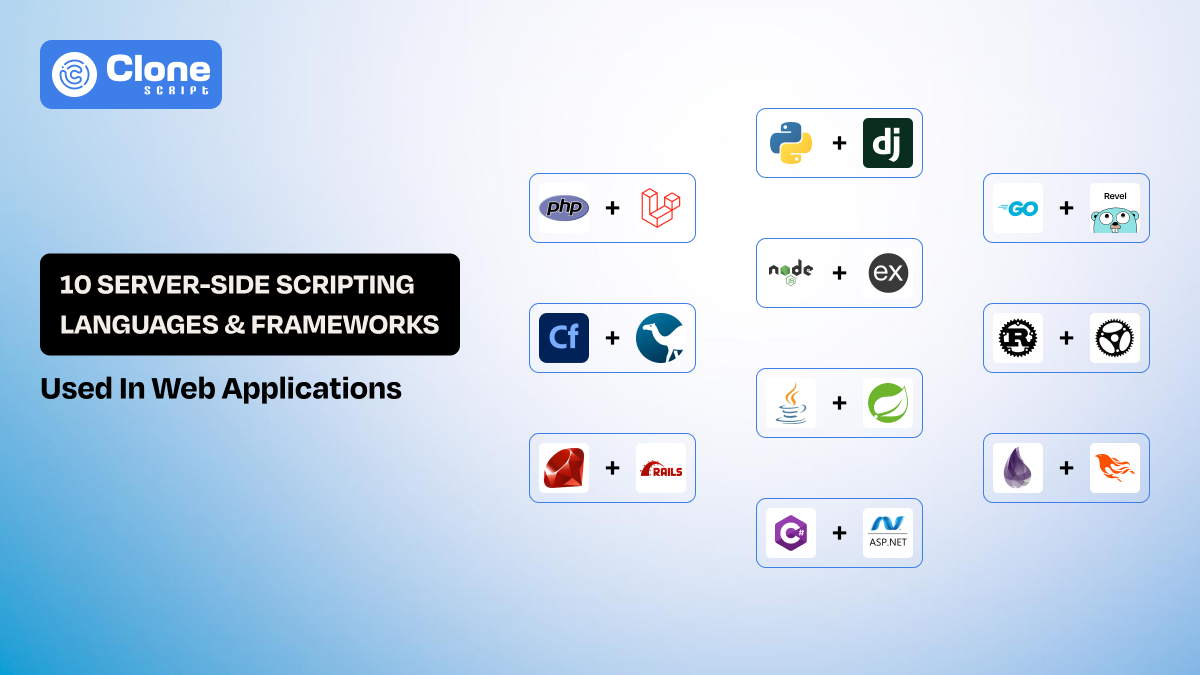
10 Server-side Scripting Languages & Frameworks in Web Applications
Most people think the browser is where a web application lives. Anything that shows up on a screen, the server has already made several decisions about:
-
Who the user is
-
Whether the request should be trusted
-
What data can be returned
-
What must be rejected outright
If any of that logic fails, the application fails, regardless of how polished the interface looks.
Back-end development has become harder to get right, not easier. Applications now run across containers, cloud platforms, background workers, and external services. Latency, concurrency, and failure handling are everyday concerns. That reality chooses a server-side language or framework as a long-term commitment.
The technologies discussed here are the stacks teams actually ship with, maintain under load, and struggle with when assumptions break in production.
What Is Server-Side Scripting?
When a request hits a server, there is a narrow window where everything important happens. Identity is checked, rules are applied, data is fetched or rejected, and a response is shaped. That decision-making layer is server-side scripting.
In practical terms, this is the code responsible for answering questions like:
-
Is this user allowed to do this?
-
Is this data valid right now?
-
What happens if the request fails halfway through?
These decisions are made long before a browser renders anything or a mobile app updates its UI designs.
You think that what’s the role of client-side scripts? They deal with the experience.
So, what for a server-side script? The logic deals with trust. It protects credentials, applies business rules, manages state, and exposes APIs that other systems rely on.
Modern back-end frameworks extend this responsibility further by handling concurrency, failures, scaling behavior, and integration with cloud infrastructure. It makes server-side scripting an important factor of application reliability.
How Server-Side Languages and Frameworks Are Evaluated?
Back-end technologies are rarely selected because they look good on paper. In practice, teams choose them based on how reliably they behave once an application is under real pressure. Traffic spikes, partial outages, changing requirements, and long-term maintenance tend to expose the strengths and weaknesses of a stack far more clearly than benchmarks or feature lists.
-
The language’s performance has to be considered.
In web applications, performance is usually the first concern. Raw execution speed matters along with. But how a language and framework handle concurrency, memory usage, and blocking operations at scale is important. You think the system performs well in isolation, but when requests pile up or when services need to communicate asynchronously, it struggles.
-
How much the ecosystem is matured.
At the same time, ecosystem maturity strongly influences day-to-day development. Stable libraries, well-maintained database drivers, and proven integrations reduce the need for custom solutions and lower operational risk.
Development teams also rely heavily on community knowledge. Active communities surface production issues, security vulnerabilities, and real-world patterns long before they appear in official documentation.
-
Developer experience in back-end technology.
Finally, developer experience plays a decisive role over time. Clear conventions, predictable tooling, and readable codebases directly affect onboarding, collaboration, and maintainability. As systems evolve and teams grow, these factors often outweigh initial performance or popularity advantages.
Top 10 Server-Side Languages and Frameworks
Choosing a server-side stack usually depends on what you are building, who will maintain it, and how long the system is expected to live.
For example, a CMS, an internal dashboard, and a high-traffic API all have very different demands on the back-end. The technologies below are not popular because they are fashionable, but because teams continue to ship real applications with them.
1. PHP with Laravel, Symfony, and CodeIgniter
PHP remains widely used in production environments, with Laravel, Symfony, and CodeIgniter offering distinct approaches to structure, scalability, and development speed.
-
PHP
PHP still runs a large portion of the web, and its continued relevance is tied to how much the language and its ecosystem have matured. Modern PHP versions are significantly more performant and predictable than their earlier iterations. The surrounding frameworks have imposed structure where the language itself once lacked discipline.
-
Laravel
Laravel is often chosen when teams want to move quickly without sacrificing readability. It emphasizes conventions, expressive syntax, and built-in solutions for common concerns such as authentication, queues, caching, and database access. This makes it well-suited for product-focused teams and CMS-driven applications where rapid iteration matters.
-
Symfony
Symfony occupies a different space. It is more explicit, component-oriented, and commonly found in enterprise systems that value long-term stability and architectural control. Development teams using Symfony tend to assemble systems deliberately rather than rely on defaults.
-
CodeIgniter
CodeIgniter takes a lighter approach. It avoids heavy abstractions and is seen in smaller applications or legacy systems where simplicity and low overhead are more important than modern architectural patterns.
PHP as a stack works best when teams need predictable deployment environments, broad hosting support, and a mature ecosystem that reduces operational surprises over time.
2. Python with Django, Flask, and FastAPI
Python is favored for its readability and ecosystem, with Django, Flask, and FastAPI supporting scalable, API-driven, and rapid application development.
-
Python
Python has earned its place in back-end development not because it is the fastest language, but because it reduces friction. Development teams choose Python when clarity, ecosystem depth, and long-term adaptability matter more than squeezing out the last unit of performance. Its widespread use in data engineering, automation, and machine learning also makes it a natural choice for systems that extend beyond traditional web applications.
-
Django
Django represents the “batteries-included” philosophy. It applies structure early by providing a built-in ORM, authentication, admin interfaces, and security defaults. This rigidity can feel limiting at first, but it often pays off in large codebases where consistency and guardrails prevent architectural drift.
Django is commonly used in content-heavy platforms, internal tools, and products where correctness and maintainability outweigh customization.
-
Flask
Flask sits at the opposite end of the spectrum. It provides only the essentials, leaving architectural decisions to the team. This flexibility makes Flask attractive for smaller services, prototypes, and APIs where control is more important than convention.
The trade-off is that teams must define their own patterns, which can lead to inconsistency if discipline is lacking.
-
FastAPI
FastAPI reflects how modern Python back-ends are being built. Designed around asynchronous execution, it excels at building high-performance APIs with clear data contracts. Automatic validation, OpenAPI generation, and strong typing support make it especially suitable for microservices and systems that prioritize API correctness and integration.
Python works best when teams value readability, a rich third-party ecosystem, and the ability to evolve systems over time without rewriting foundational components.
3. JavaScript (Node.js) with Express, Koa, and Meteor
JavaScript on Node.js is useful for full-stack development, with Express, Koa, and Meteor to support scalable, event-driven, and real-time web applications.
-
Node.js
Node.js changed back-end development by making JavaScript a first-class server-side language. Its event-driven, non-blocking model made it possible to handle large numbers of concurrent connections efficiently, especially for I/O-heavy workloads.
For teams already invested in JavaScript on the front-end website development, Node.js also reduces context switching and enables shared tooling across the stack.
-
Express
Express remains the most widely used Node.js framework, largely because it stays out of the way. It provides a thin routing and middleware layer without enforcing strong architectural opinions. This flexibility makes Express suitable for APIs, lightweight services, and applications where teams want full control over structure.
The downside is that large Express codebases require discipline to avoid fragmentation.
-
Koa
Koa was created to address some of Express’s limitations. It uses modern JavaScript features and a cleaner middleware flow. This means developers can write more predictable and composable logic.
This server-side framework is chosen for systems where finer-grained control over request handling and error propagation is important, though it assumes a higher level of experience from the team.
-
Meteor
Meteor takes a more opinionated, full-stack approach. It tightly integrates the server, client, and data layer, enabling rapid development of real-time applications.
While this can speed up early development, Meteor’s abstractions can become restrictive as systems grow and requirements diverge from its assumptions.
4. Java with Spring Boot
Java with Spring Boot is widely adopted for building secure, scalable, and enterprise-grade applications with strong tooling and long-term stability.
-
Java
Java continues to be a default choice for large-scale back-end systems, particularly in environments where stability, tooling, and long-term support are non-negotiable.
While the language is criticized for verbosity, modern Java has evolved significantly, and its ecosystem remains one of the most mature in production software.
-
Spring Boot
Spring Boot simplified Java application development by removing much of the configuration overhead traditionally associated with the Spring ecosystem.
It favors convention over configuration, provides embedded servers, and integrates cleanly with databases, messaging systems, and security frameworks. This makes it possible to move from concept to production without assembling infrastructure piece by piece.
Spring Boot is commonly used in enterprise systems, microservices architectures, and high-throughput APIs. It performs well under sustained load and offers predictable behavior when applications scale horizontally. Strong support for dependency injection, observability, and testing also makes it easier to manage large codebases maintained by multiple teams.
Java with Spring Boot works best when organizations need reliability, clear architectural boundaries, and a technology stack that can be supported for many years without frequent rewrites or ecosystem volatility.
5. C# with ASP.NET and .NET Core
C# with ASP.NET and .NET Core is used to build high-performance, cross-platform applications with strong security, tooling, and enterprise support.
-
C#
C# has become a strong contender in modern back-end development, particularly after the evolution of .NET into a cross-platform, open ecosystem. What was once closely tied to Windows-based environments now runs comfortably across Linux, macOS, containers, and cloud-native platforms.
-
ASP.NET Core
ASP.NET Core provides a high-performance framework for building APIs and web applications. It is designed with scalability in mind, offering efficient request handling, asynchronous processing, and first-class support for modern authentication and authorization standards.
The framework’s middleware pipeline is explicit and predictable, which helps teams reason about request flow and system behavior.
-
.NET
One of the strengths of the .NET ecosystem is its tooling. Strong IDE support, robust debugging, and mature monitoring libraries make it easier to maintain complex systems over time.
C# also benefits from a clear type system, which reduces runtime errors in large codebases and improves long-term maintainability.
C# with ASP.NET Core is well-suited for teams building high-performance APIs, scalable applications, or cloud-native services for business.
6. Ruby with Ruby on Rails and Sinatra
Ruby emphasizes developer productivity, with Rails and Sinatra enabling rapid application development through convention-driven design and minimal configuration.
-
Ruby
Ruby remains a popular choice for back-end development thanks to its elegant syntax and developer-friendly philosophy. Its most well-known framework, Ruby on Rails, emphasizes convention over configuration, enabling rapid development of web applications with less boilerplate code.
Rails provides a rich set of built-in tools for database interaction, routing, and testing for a comprehensive solution used in startups and small-to-medium projects.
-
Sinatra
Sinatra, a lightweight Ruby framework, offers a minimalist approach for building APIs and microservices. Developers can be flexible without the overhead of a full-stack framework.
Ruby’s dynamic typing and expressive syntax allow for fast iteration, though developers need to carefully manage performance and scalability in larger systems.
Ruby with Rails or Sinatra is ideal for teams aiming for rapid development, clean code, and maintainable web applications, especially when time-to-market and developer productivity are top priorities.
7. Go (Golang) with Gin and Revel
Go is valued for simplicity and performance, with Gin and Revel supporting fast, concurrent web services and scalable backend architectures.
-
Go
Go, also known as Golang, is designed for simplicity, performance, and concurrency, a strong contender for modern back-end development. Its statically typed nature and compiled execution result in fast, predictable performance, ideal for high-throughput APIs and microservices.
Go’s standard library is extensive, providing built-in support for HTTP servers, JSON handling, and concurrency primitives to reduce dependency overhead.
-
Gin and Revel
Frameworks like Gin offer lightweight routing, middleware support, and high-speed request handling, while Revel provides a more full-featured MVC approach for developers seeking structure alongside Go’s simplicity.
Go’s focus on concurrency with goroutines and channels allows teams to efficiently manage multiple tasks without heavy resource consumption.
Go with Gin or Revel is particularly suited for scalable web services, cloud-native applications, and performance-critical systems, where simplicity, speed, and concurrency support are key operational requirements.
8. Rust with Actix and Axum
Rust enables memory-safe, high-performance systems, with Actix and Axum powering reliable web services built for concurrency and long-term efficiency.
-
Rust
Rust has rapidly gained attention in server-side development for its focus on performance, safety, and concurrency. Its strict compiler and ownership model eliminate many common runtime errors, such as memory leaks and data races. This can be ideal for building reliable and high-performance systems.
Rust is particularly suited for applications where safety and predictability are important.
-
Actix and Axum
Frameworks like Actix deliver blazing-fast web server performance with a highly concurrent actor-based model, while Axum provides a more modular, ergonomic approach to building APIs with async-first design.
Both frameworks integrate seamlessly with Rust’s strong type system, offering compile-time guarantees that reduce runtime errors and improve maintainability.
Rust with Actix or Axum is perfect for performance-sensitive services, low-latency APIs, and systems that require maximum safety and reliability. It is an excellent choice for teams building next-generation back-end applications.
9. Elixir with Phoenix
Elixir with Phoenix excels at real-time, fault-tolerant applications, taking advantage of the Erlang VM for massive concurrency and reliable performance.
-
Elixir
Elixir is a functional, concurrent language built on the Erlang VM, renowned for its fault-tolerance, scalability, and ability to handle massive concurrency. Its syntax is clean and approachable, while its underlying architecture provides unmatched reliability for distributed systems.
Elixir is particularly effective for applications requiring real-time communication, such as chat platforms, messaging systems, or streaming services.
-
Phoenix
The Phoenix framework complements Elixir by offering high-performance web development tools, including channels for real-time features, an intuitive routing system, and built-in support for database integration. Its lightweight processes and non-blocking architecture allow developers to build scalable, low-latency applications without sacrificing maintainability or code clarity.
Elixir with Phoenix is ideal for teams building real-time applications, fault-tolerant systems, or high-concurrency platforms, where reliability, scalability, and developer productivity are key priorities.
10. Perl, ColdFusion, and Other Uncommon back-ends
Perl, ColdFusion, and other niche back-end technologies persist in specific domains, supporting legacy systems and specialized workflows with proven reliability.
-
Perl
While not as mainstream as languages like C# or Go, Perl and ColdFusion still play a role in legacy systems and niche applications. Perl, with its text-processing strengths, is usually used for scripting, automation, and rapid prototyping. ColdFusion provides a high-level platform for building web applications quickly with minimal boilerplate.
Both benefit from mature ecosystems and established community support, though modern development trends favor newer, more scalable options.
-
Other back-ends
Other less common back-end languages and frameworks, such as Haskell, Scala, or F#, offer unique advantages in functional programming, strong typing, or domain-specific applications. While adoption may be limited, they provide excellent solutions for teams seeking performance, safety, or specialized computational capabilities.
These uncommon back-ends are valuable for maintaining legacy systems, experimenting with functional paradigms, or relying on domain-specific advantages. Particularly in environments where stability, efficiency, and reliability outweigh mainstream popularity, these back-ends are used.
Comparative Overview of Server-Side Languages and Frameworks
After reviewing individual languages and frameworks, developers usually want a quick way to compare trade-offs without rereading entire sections. This comparison is not about ranking technologies as “better” or “worse,” but about understanding where each stack fits naturally in production.
|
Language / Framework |
Typing Model |
Best Suited For |
Community & Ecosystem |
Performance Profile |
|---|---|---|---|---|
|
Python (Django) |
Dynamic |
Data-heavy apps, admin-driven systems, monoliths |
Very strong, mature |
Moderate, scales with caching |
|
Python (Flask / FastAPI) |
Dynamic |
APIs, microservices, async services |
Strong, growing |
FastAPI: High, Flask: Moderate |
|
Node.js (Express) |
Dynamic |
APIs, real-time apps, gateways |
Very large |
Good for I/O-heavy workloads |
|
Node.js (Koa) |
Dynamic |
Clean async APIs, custom stacks |
Medium |
Similar to Express, a cleaner flow |
|
Java (Spring Boot) |
Static |
Enterprise systems, microservices |
Extremely strong |
High, JVM optimized |
|
C# (ASP.NET Core) |
Static |
Enterprise APIs, cloud services |
Strong, enterprise-focused |
High, very consistent |
|
Ruby (Rails) |
Dynamic |
CRUD apps, internal tools |
Mature but shrinking |
Moderate, tuning required |
|
Go (Gin / Revel) |
Static |
High-performance APIs, infra services |
Strong, pragmatic |
Very high, low overhead |
|
Rust (Actix / Axum) |
Static |
Safety-critical, high-load systems |
Smaller but growing |
Extremely high |
|
Elixir (Phoenix) |
Dynamic (functional) |
Real-time systems, fault-tolerant apps |
Smaller, specialized |
High concurrency efficiency |
|
Perl / ColdFusion |
Dynamic |
Legacy systems |
Limited |
Varies, legacy-dependent |
This table should help narrow choices, not make them for you. The final decision always depends on system constraints, team experience, and operational reality.
How to Choose the Right Back-End Stack?
Selecting the right back-end stack is a key decision that impacts scalability, maintainability, and overall project success. Development teams should evaluate choices based on project requirements, team expertise, performance needs, and long-term support.
-
Project Type and Scale: High-concurrency applications like chat platforms or real-time dashboards may benefit from languages like Elixir, Go, or Rust. Content-heavy websites or enterprise apps may suit C# with ASP.NET Core or Ruby on Rails.
-
Team Expertise: Consider the existing skill set of your developers. Adopting a language or framework unfamiliar to the team can slow development and increase errors.
-
Ecosystem and Tooling: Mature ecosystems provide libraries, debugging tools, monitoring solutions, and community support, important aspects for productivity and maintainability.
-
Performance and Concurrency Needs: If low-latency or high-performance processing is key, compiled languages like Go or Rust outperform interpreted languages like Ruby or Perl.
-
Long-Term Maintainability: Consider type safety, code readability, and long-term support. Strong typing (e.g., in C# or Rust) reduces runtime errors, while dynamic languages enable rapid prototyping.
Ultimately, the best back-end stack balances performance, productivity, and maintainability while aligning with project goals and team capabilities. Careful evaluation ensures that the system is scalable, reliable, and easy to evolve.
Best Practices to Implement in Server-Side Development
Implementing effective server-side development practices makes robust, scalable, and maintainable back-end systems. Adhering to standards and conventions can reduce technical debt and improve long-term productivity. Here are the key best practices:
-
Modular and Clean Architecture: Organize code into clear modules, layers, or services. Separation of concerns reduces complexity and makes systems easier to maintain and test.
-
Use Strong Typing and Validation: Where possible, take advantage of type systems (e.g., C#, Rust) and validate all input data to minimize runtime errors and improve reliability.
-
Scalable Design Patterns: Implement patterns such as MVC, microservices, or event-driven architecture based on the application’s size and expected growth.
-
Efficient Database Management: Optimize database schemas, use indexing judiciously, and implement caching strategies to reduce query load and improve performance.
-
Error Handling and Logging: Provide meaningful error messages, centralized logging, and monitoring for easier debugging and proactive issue detection.
-
Secure Development Practices: Follow security best practices, including authentication, authorization, encryption, and protection against SQL injection or XSS attacks.
-
API Design Standards: Use RESTful or GraphQL principles, maintain consistent endpoint naming, version APIs properly, and document them for consumer teams.
-
Asynchronous Processing: Use async workflows, queues, and background jobs for long-running tasks to improve system responsiveness.
-
Testing and Continuous Integration: Implement unit, integration, and performance tests. Combine with CI/CD pipelines to catch issues early and deploy reliably.
-
Monitoring and Observability: Use metrics, logging, and alerting to track application health, detect anomalies, and plan capacity effectively.
By applying these best practices, teams can deliver reliable, secure, and high-performing server-side applications while keeping technical debt manageable and adding smooth scaling as applications grow.
Conclusion
Choosing the right back-end language and framework is more than a technical decision. It directly impacts performance, scalability, maintainability, and team productivity. From established ecosystems like C# with ASP.NET Core and Ruby on Rails, to high-performance options like Go, Rust, and Elixir, each technology brings unique advantages suited to different project needs. Uncommon back-ends like Perl, ColdFusion, or functional languages can still provide value in niche scenarios or legacy systems.
Ultimately, the ideal back-end stack aligns technical requirements with team expertise, project goals, and long-term maintainability. Evaluate these factors, and following proven development practices, development teams can confidently build robust, high-performing, and future-proof backend systems that meet both current and evolving business needs.