BTC - Bitcoin
 USDTERC20 - USDT ERC20
 ETH - Ethereum
 BNB - Binance
 BCH - Bitcoin Cash
 DOGE - Dogecoin
 TRX - TRON
 USDTTRC20 - USD TRC20
 LTC - LiteCoin

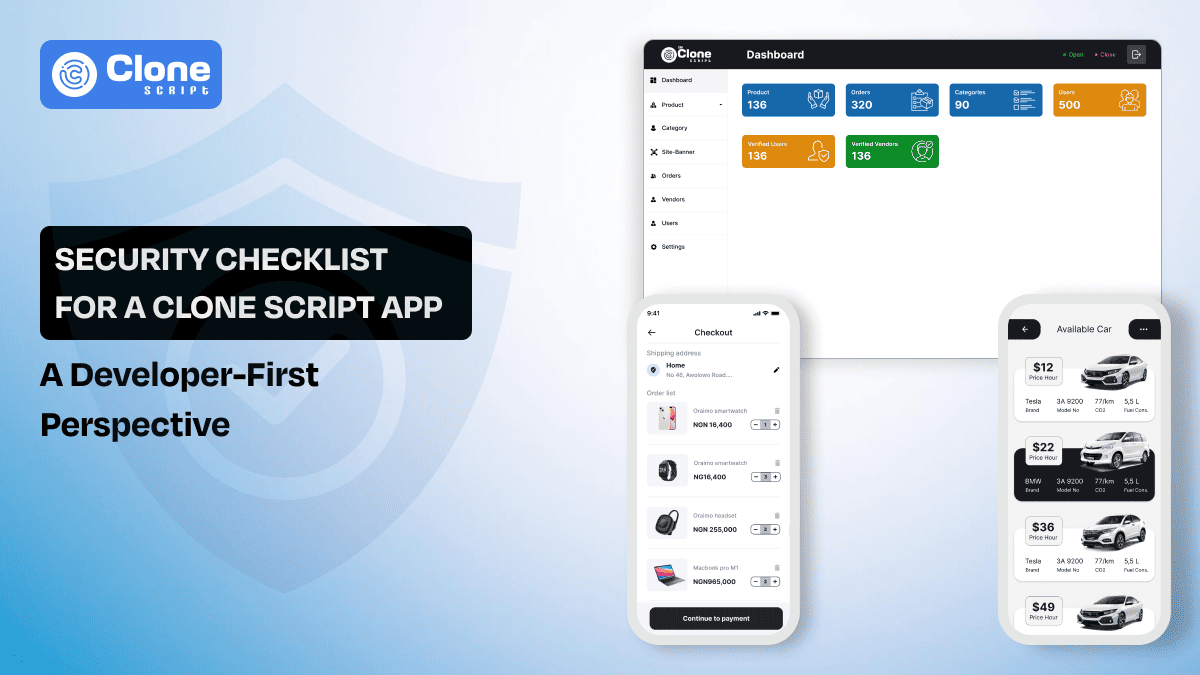
Security Checklist for Launching a Clone Script App: A Developer-First Framework
Launching a clone script app is fast. Launching it securely is not.
Most marketplace, SaaS, fintech, and on-demand clone scripts ship with prebuilt modules, third-party integrations, configurable admin panels, and deployment-ready dashboards. But they also inherit unknown vulnerabilities, outdated dependencies, permissive access rules, and insecure default configurations.
If you are preparing for production, you need more than installation documentation. You need a security checklist for launching a clone script app that validates the codebase, infrastructure, authentication layers, and operational workflows before public exposure.
This guide provides a structured, developer-first framework for secure clone script deployment.
First is Codebase Audit & Architecture Review.
Before provisioning servers or scaling infrastructure, audit the application layer accordingly. Clone script security begins with source-level verification.
-
Source Code Integrity
A modern clone-script vulnerability assessment starts with cleaning up inherited technical debt.
-
Remove Unused Components: Clone scripts often include demo routes, sample controllers, mock payment modules, and test dashboards. Unused endpoints increase the attack surface and should be permanently removed before deployment.
-
Scan for Hardcoded Secrets: Search the repository for API keys, database credentials, SMTP passwords, OAuth secrets, and payment tokens. All secrets must be stored in secure environment variables. They are never in the committed source files.
-
Validate Dependency Versions: Outdated open-source libraries frequently contain known CVEs. Run automated audits (e.g., npm audit, composer audit, pip-audit) and update vulnerable packages before go-live.
-
Secure Coding Standards
Is it legal to use a white-label solution for a business launch? This question is very common. Even scripts must be validated against modern web application security standards.
-
Input Validation: All user inputs must be validated server-side using strict schema enforcement. Client-side validation improves UX but does not provide security.
-
SQL Injection Protection: Ensure parameterized queries or ORM bindings are used. Eliminate raw SQL string concatenation, especially in search, filtering, and reporting modules.
-
XSS Mitigation: Escape user-generated content before rendering it. Apply contextual output encoding across comments, messaging systems, and dynamic content fields.
-
CSRF Protection: Implement CSRF tokens for state-changing operations and configure cookies with SameSite and secure attributes to prevent request forgery.
-
Secure Configuration Management
Misconfiguration remains one of the most common breach causes while using the white-label application.
-
Environment Segregation: Isolate development, staging, and production environments. Do not reuse database credentials, secret keys, or storage buckets across environments.
-
Disable Debug Mode: Debug logs and stack traces expose internal architecture. Ensure production builds suppress verbose error output and disable development tooling.
2. Authentication & Authorization Hardening Required.
Authentication weaknesses are high-impact vulnerabilities in clone script applications.
-
Authentication Controls
Due to authentication handling, the script does not become compromised.
-
Strong Password Policies: Enforce minimum length requirements (12+ characters), complexity standards, and breach detection to reduce credential stuffing risk.
-
Multi-Factor Authentication (MFA): Administrative dashboards and financial modules should require multi-factor authentication. Password-only access is insufficient for high-privilege accounts.
-
Secure Session Management: Use HTTP-only, secure cookies with defined expiration times. Implement refresh token rotation and invalidate sessions after password changes or privilege updates.
-
Role-Based Access Control (RBAC)
Clone scripts frequently include default roles with broad permissions. So, when opting for any of them, check the RBAC first.
-
Apply Least Privilege: Assign only necessary permissions to users, vendors, moderators, and administrators. Audit every route against role requirements.
-
Protect Management APIs: Administrative endpoints should require strict authentication and authorization checks. Apply rate limits to prevent abuse or enumeration attacks.
-
API Authentication
Modern clone apps rely heavily on APIs. If any of the issue exists, it brings unexpected results.
-
Secure JWT Implementation: Validate token signatures, enforce expiration, and use strong algorithms such as RS256. Reject unsigned or improperly formatted tokens.
-
Rate-Limit Auth Endpoints: Throttle login, registration, OTP, and password reset endpoints to mitigate brute-force and automated attacks.
3. Focus on Infrastructure & Server Security.
Application-layer hardening fails if the infrastructure is exposed. You have to optimize the scripts as required for the client's needs.
-
Operating System & Server Hardening
Managing the OS for the clone script is required to work as intended with the servers.
-
Update OS Patches: Regularly patch operating systems and server packages to eliminate known vulnerabilities. It makes the application as prominent as possible.
-
Disable Root SSH Access: Disable direct root login. Apply SSH key authentication and restrict access to specific IP addresses.
-
Restrict Inbound Ports: Allow only essential services (e.g., HTTPS, SSH). Block unnecessary ports to reduce exposure to automated scanning.
-
HTTPS & TLS Configuration
Encryption is mandatory for secure clone script deployment for business.
-
HTTPS Enforcement: Redirect all HTTP traffic to HTTPS to ensure encrypted communication between users and servers.
-
Enable HSTS: Activate HTTP Strict Transport Security to prevent downgrade attacks and apply secure connections.
-
Automatic Certificate Renewal: Configure automated SSL certificate renewal to prevent service disruptions and insecure expired certificates.
-
Secure Deployment Pipeline
Databases are prime targets in clone app development and deployment to the web system.
-
Static Application Security Testing (SAST): Integrate static code analysis tools into CI pipelines to detect vulnerabilities before deployment.
-
Dynamic Application Security Testing (DAST): Run dynamic scans against staging environments to identify runtime vulnerabilities.
-
Dependency Scanning: Continuously monitor open-source dependencies for newly discovered security vulnerabilities.
4. Database & Data Protection is a Must.
Databases are prime targets in clone app development and deployment to the web system.
-
Database Security
Securing the data is a must for any website. Here is an overview of how it can be done in a clone script for website development.
-
Restrict Public Access: Ensure databases are accessible only from internal servers, never directly exposed to public networks.
-
Encrypted Database Connections: Use SSL/TLS connections between application servers and databases to protect sensitive data in transit.
-
Strong Database Passwords: Use complex credentials and rotate them periodically to prevent unauthorized access.
-
Data Encryption
Protect user data comprehensively through encryption that can’t be decoded.
-
Encrypt Sensitive Personal Data: Store personally identifiable information using strong encryption algorithms to protect user privacy.
-
Encrypt Data in Transit: Secure all API communication with TLS encryption to prevent data interception.
-
Hash Passwords Properly: Use bcrypt or Argon2 hashing algorithms with salting to securely store user passwords.
-
Backup & Recovery
Security includes resilience, and it is never to be compromised.
-
Automated Encrypted Backups: Schedule encrypted backups regularly to ensure recoverability in case of breaches or ransomware attacks.
-
Off-Site Storage: Store backups in geographically separate locations to protect against localized infrastructure failures.
-
Restoration Testing: Periodically test backup restoration processes to verify data integrity and disaster readiness.
5. Payment & Transaction Security
If the clone script processes financial transactions, additional protection layers are mandatory.
-
PCI Considerations
Handling payment data requires strict control over sensitive information.
-
Do Not Store Card Data: Never store card numbers, CVV codes, or raw payment tokens inside your database or logs. Offload sensitive handling to PCI-compliant gateways.
-
Tokenization Enforcement: Use trusted payment gateways that tokenize card data before it reaches your servers. This reduces compliance scope and breach exposure.
-
Secure Payment Processing Flow: Ensure encrypted transmission of payment data and isolate payment services from the core application infrastructure.
-
Webhook Validation
Payment webhooks are common exploitation targets in production systems.
-
Verify Signature Authenticity: Validate cryptographic signatures included in webhook requests before processing transactions.
-
Validate Source Integrity: Restrict webhook endpoints to verified IP ranges whenever supported by the payment provider.
-
Prevent Replay Attacks: Implement timestamp validation and idempotency checks to block duplicated or delayed malicious requests.
6. API & Integration Security
Modern clone applications rely heavily on external APIs and microservices.
-
Rate Limiting & Abuse Prevention
By integrating third-party services, you have to optimize the application.
-
Rate Limiting: Apply rate limits on login, registration, and password reset APIs to prevent brute-force attacks.
-
Strict CORS Policies: Limit requests to search, filtering, and reporting endpoints to prevent denial-of-service attempts.
-
Secure Webhook Endpoints: Use adaptive throttling and temporary IP blocking to mitigate automated abuse patterns.
-
CORS & Cross-Origin Protection
Improper CORS configuration exposes backend APIs to unauthorized domains.
-
Avoid Wildcard Origins: Never use Access-Control-Allow-Origin: * in production environments.
-
Define Strict Origin Policies: Allow only trusted domains and explicitly define permitted HTTP methods and headers.
-
Audit Preflight Requests: Monitor and validate CORS preflight behavior to ensure no unintended exposure.
-
Secure Third-Party Webhooks
All external callbacks must be treated as untrusted traffic.
-
Validate Digital Signatures: Verify provider signatures before accepting webhook payloads.
-
Reject Unauthorized Requests: Immediately discard requests that fail validation checks.
-
Log Suspicious Activity: Record failed verification attempts for further security analysis.
6. Front-End & Client-Side Security
Client-side language and architecture play a direct role in protecting user sessions in website.
-
Secure Token Storage
Improper storage of tokens leads to session compromise.
-
Avoid localStorage for JWTs: Storing JWTs in localStorage exposes tokens to XSS attacks, allowing malicious scripts to steal active authentication sessions.
-
Use HTTP-Only Cookies: Store session tokens in secure, HTTP-only cookies to block JavaScript access and reduce cross-site scripting risks.
-
Encrypt Sensitive Client Data: Never expose API keys, secrets, or confidential tokens within front-end source code or publicly accessible files.
-
Content Security Policy (CSP)
Content Security Policy reduces script injection risks by restricting executable sources and controlling browser resource loading behavior.
-
Block Inline Scripts: Disable unsafe-inline scripts to prevent attackers from injecting and executing malicious JavaScript within application pages.
-
Restrict External Resources: Allow scripts, styles, and media resources only from explicitly trusted domains to minimize supply-chain attack risks.
-
Monitor CSP Violations: Enable real-time CSP reporting to detect policy violations and identify attempted script injection attacks quickly.
-
Clickjacking Prevention
Clickjacking attacks manipulate user interface elements, tricking users into unintended actions that compromise security and privacy.
-
Enable X-Frame-Options: Use X-Frame-Options headers to prevent unauthorized domains from embedding your application within hidden or deceptive iframes.
-
Use frame-ancestors Directive: Configure the CSP frame-ancestors directive to strictly control which domains can display your application content.
-
Test Frame Blocking: Validate iframe blocking configurations in staging environments to ensure effective protection before production deployment.
7. Logging, Monitoring & Incident Response.
Security management must continue after deployment to detect threats early and minimize operational and financial damage for apps.
-
Centralized Logging
Centralized logging aggregates system events, enabling faster threat detection, forensic analysis, and improved overall security visibility.
-
Log Authentication Failures: Track repeated failed login attempts to detect brute-force attacks and suspicious account access patterns early.
-
Monitor Privilege Escalation: Record all role changes, permission updates, and administrative actions to detect unauthorized privilege escalation attempts.
-
Avoid Logging Sensitive Data: Never log passwords, payment information, or raw authentication tokens to prevent data exposure during breaches.
-
Real-Time Threat Monitoring
Continuous monitoring enables proactive threat detection and significantly reduces breach response time and overall impact.
-
Deploy Intrusion Detection Systems: Implement intrusion detection systems to monitor network traffic and identify malicious activity across servers.
-
Enable Rate Anomaly Alerts: Configure alerts to detect abnormal spikes in login requests, API usage, or suspicious automated traffic.
-
Monitor Server Health: Track CPU usage, memory consumption, and disk activity to identify unusual behavior indicating compromise.
-
Incident Response Planning
Preparation and documentation ensure rapid containment, recovery, and communication during security incidents.
-
Define Responsibility Matrix: Clearly assign roles and responsibilities for breach investigation, containment, technical response, and executive communication.
-
Establish User Notification Flow: Create predefined procedures for notifying affected users in compliance with regulatory and contractual obligations.
-
Document Recovery Workflow: Outline patch deployment, system restoration, data validation, and post-incident review processes thoroughly.
8. Pre-Launch Security Testing
Before production deployment, validate system resilience to prevent vulnerabilities from reaching live user environments.
-
Conduct Penetration Testing: Simulate real-world attack scenarios against staging environments to uncover exploitable vulnerabilities before public release.
-
Run Vulnerability Scans: Identify outdated libraries, insecure dependencies, and configuration weaknesses using automated security scanning tools.
-
Perform Load Testing: Validate application stability, scalability, and performance under peak traffic and stress conditions.
-
Simulate Brute-Force Attacks: Test authentication rate limits, CAPTCHA enforcement, and account lockout mechanisms against automated credential attacks.
9. Post-Launch Maintenance
Security requires ongoing monitoring, updates, and improvements to maintain resilience against evolving threats and emerging vulnerabilities.
-
Schedule Monthly Dependency Reviews: Regularly review and update outdated frameworks, plugins, and libraries to eliminate known security vulnerabilities.
-
Perform Quarterly Vulnerability Scans: Conduct automated scans to identify new misconfigurations, exposed services, and emerging security weaknesses.
-
Conduct Annual Penetration Testing: Engage third-party security experts annually to reassess infrastructure, application logic, and overall defense posture.
-
Monitor Emerging CVEs: Track newly disclosed vulnerabilities affecting your technology stack and apply patches without delay.
Conclusion
Securing a clone script requires continuous effort across infrastructure, payments, APIs, and client-side protection. Pre-launch testing reduces vulnerabilities, while ongoing monitoring, patch management, and incident planning maintain efficiency. A layered, proactive security strategy protects user data, prevents breaches, and ensures long-term application stability and business credibility.