BTC - Bitcoin
 USDTERC20 - USDT ERC20
 ETH - Ethereum
 BNB - Binance
 BCH - Bitcoin Cash
 DOGE - Dogecoin
 TRX - TRON
 USDTTRC20 - USD TRC20
 LTC - LiteCoin

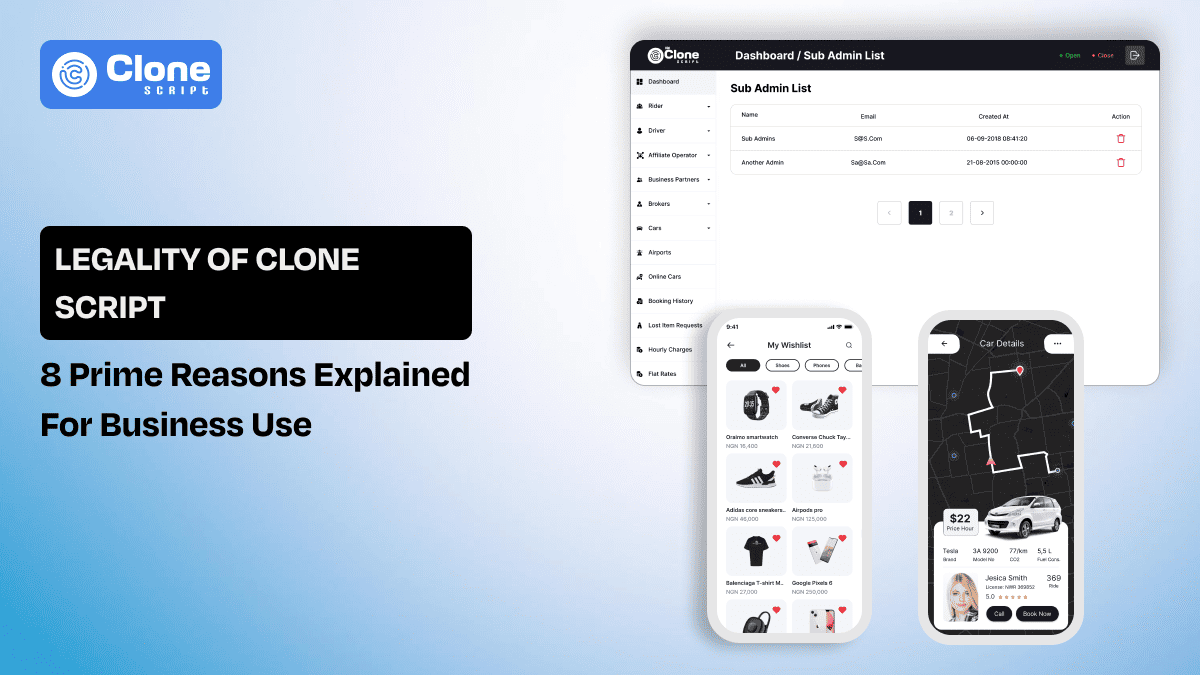
Is It Legal to Launch a Business Using a Website and App Clone Script: 8 Prime Reasons Explained
Do you have the cost for $80,000 to launch an eCommerce marketplace for a car rental platform, allocate $50,000 to $100,000 for a scalable online marketplace, or invest $150,000+ to build a hotel booking website and mobile app from scratch?
For most founders and development teams, the answer is no.
Custom website development at that level demands significant capital, extended timelines, architecture planning, testing cycles, DevOps setup, and compliance implementation. The financial barrier alone prevents many viable business ideas from entering the market.
This is where a clone script for business websites and applications becomes a strategic alternative.
However, before adopting this approach, a crucial question must be addressed:
Is it legal to launch a business using a clone script?
This guide explains the legal framework behind clone scripts, clarifies common misconceptions, and explains how web developers or even entrepreneurs with a limited team can launch platforms such as car rental systems, ecommerce marketplaces, and hotel booking applications within a legally compliant structure.
Understanding What a Clone Script Actually Is
Before analyzing clone script legality, it is essential to define what a clone script truly represents from a technical and legal standpoint.
A clone script is a pre-developed software solution that replicates the core functionality of an established business model. It does not copy proprietary source code from another company. Instead, it independently recreates similar workflows, system architecture, and feature sets.
For developers, this typically includes:
-
Pre-built design and full-stack framework (front-end and back-end)
-
Structured database schema
-
Admin control panel
-
User authentication modules
-
Payment gateway integrations
-
Booking or marketplace logic
-
API-ready architecture
The objective is functional similarity the script to have, not brand duplication.
For example:
-
A car rental platform clone script can manage fleet listings, reservations, and payment processing.
-
An e-commerce clone script can support multi-vendor onboarding, product catalogs, cart systems, and order management.
-
A hotel booking clone script can enable room availability management, calendar-based booking, and pricing control.
These workflows are not protected ideas. Business processes such as “online booking” or “multi-vendor checkout” are operational models, and operational models are not copyrighted.
What is protected under intellectual property law includes:
-
Proprietary source code
-
Trademarked brand names
-
Logos and visual identities
-
Unique design assets
-
Copyrighted UI graphics
-
Confidential algorithms
Understanding this distinction is important when evaluating legal risks of clone scripts.
A properly developed and licensed clone script provides:
-
Independently written source code
-
Commercial usage rights
-
Modification permissions
-
Deployment flexibility
In other words, it functions as a legally distributable software framework that allows developers to build a customized business platform without infringing on protected intellectual property.
This foundational clarity is necessary before moving into the legal analysis of whether launching a business using a clone script is lawful.
The Legal Landscape: When Is a Clone Script Legal?
The question is not whether clone scripts exist. It is whether their use complies with intellectual property law and licensing regulations.
Clone script legality depends on three primary legal pillars:
-
Copyright compliance
-
Trademark protection
-
Software licensing terms
Understanding these pillars eliminates ambiguity and reduces the legal risks of clone scripts.
-
Copyright Law: Protects Expression, Not Functionality
Under copyright law, protection applies to the following:
-
Original source code
-
Visual assets
-
Written content
-
Unique design elements
It does not protect the following:
-
Business ideas
-
Marketplace structures
-
Booking logic
-
Revenue models
-
Workflow concepts
Here is the example.
An ecommerce checkout flow or a hotel reservation calendar is a functional process. Multiple businesses can implement similar systems without violating copyright. This is provided that the underlying code is independently developed.
Therefore, if a clone script vendor has created its own original codebase and grants you a commercial license, using it is legally permissible.
The legal risk arises only when proprietary code is copied without authorization.
2. Trademark Law: Where Most Legal Conflicts Occur
Trademark infringement clone app cases are more common than copyright disputes in clone script businesses.
Here are some aspects that trademark law protects:
-
Brand names like Amazon, Walmart, Maruti Suzuki, Apple, etc.
-
Logos like a smiling face (Amazon does), Coated “S” (Maruti Suzuki).
-
Taglines like “Way of Side. (in Maruti Suzuki).”
-
Domain confusion: “goibibo.com” is a registered domain, and you get “goizibo.com.”
-
Trade dress (distinctive visual identity) that indicates the real product source to customers.
If a clone script is launched with branding that closely resembles an established company, legal action can follow. You may not believe but even if the code is independently written, the obligation has been implemented.
The solution is straightforward:
-
Create a unique brand identity
-
Customize UI elements
-
Avoid market confusion
-
Register your own trademark.
Clone script legality is rarely about functionality. It is about brand misrepresentation.
3. Licensing: The Deciding Factor
Clone script licensing requirements define what you are legally allowed to do with the software.
Developers must verify the following before choosing the solution:
-
Commercial usage rights
-
Modification permissions
-
Source code access
-
Redistribution restrictions
-
Multi-domain limitations
-
White-label rights
A properly licensed clone script grants legal authority to operate a business using the application.
If the license includes commercial deployment rights, then launching a revenue-generating platform is lawful.
If the license restricts resale or redistribution, violating those terms can result in breach-of-contract liability.
Licensing clarity eliminates 80% of clone script compliance uncertainty.
Risks of Not Following Legal Standards
Ignoring clone script compliance exposes businesses to lawsuits, financial loss, operational shutdowns, and long-term credibility damage in competitive markets.
-
Intellectual Property Lawsuits
Unauthorized branding, copied assets, or proprietary code misuse can trigger cease-and-desist notices, legal disputes, and costly litigation proceedings. This has to be resolved as soon as possible.
-
License Termination
Breaching clone script licensing requirements may result in revoked usage rights, contract termination, and immediate business disruption risks. It also interrupts the operability if the website or app is live and users are using it.
-
Platform Shutdown
Hosting providers may suspend or permanently disable platforms receiving verified intellectual property infringement complaints from rights holders. This results in legal obligation business paying off.
-
Financial Penalties
Non-compliance with data protection regulations can lead to regulatory investigations, substantial fines, and mandatory corrective measures. If not optimized, the financial penalty has to be fulfilled.
-
Reputation Damage
Legal disputes reduce investor confidence, weaken customer trust, and negatively impact long-term brand authority and growth potential. This is not affordable for startups and even established businesses.
The legal risks of clone scripts arise from misuse, not from properly licensed and compliant deployment.
8 Prime Reasons Why Launching with a Clone Script Can Be Legal and Smart
When evaluated from a compliance and development perspective, clone scripts are not shortcuts around regulation. They are structured software frameworks that, when used properly, operate within clear legal boundaries.
Below are eight reasons why launching with a licensed website and application clone script can be both legally sound and strategically intelligent.
-
You Operate Under a Valid Commercial License
The foundation of clone script legality begins with licensing.
A professionally distributed clone script includes documented commercial usage rights. This means you are legally authorized to deploy the software for revenue-generating purposes.
For example:
-
A car rental clone script can be deployed as a booking marketplace.
-
An ecommerce clone solution can power a multi-vendor online store.
-
A hotel booking clone script can support reservation management systems.
When acquired under proper commercial terms, these solutions provide lawful deployment rights. The critical step is retaining and reviewing license documentation.
Note that clone script licensing requirements define the boundaries of use, and when respected, they protect your business.
-
You Customize Branding and User Interface
Trademark infringement clone app cases typically arise from brand imitation, not functional similarity.
White-label customization eliminates this risk.
For that, these best practices include:
-
Redesigning UI themes
-
Writing unique product content
-
Adjusting typography and color systems
-
Modifying layout structures
When you transform the front-end identity, you remove brand confusion concerns.
Customization not only reduces intellectual property in clone scripts but also strengthens your market positioning. A heavily modified user interface signals independent brand ownership, which is important for legal and commercial clarity.
-
You Avoid Direct Code Copying
One of the primary legal risks of using a white-label script involves the origin of the codebase.
A legitimate vendor independently develops the system architecture. You are not copying source code from a live competitor platform or reverse-engineering proprietary systems.
This distinction protects you from copyright issues in clone scripts.
Due diligence should include verifying these:
-
The vendor owns the source code.
-
The software is not reverse-engineered illegally.
-
No pirated or nulled components are embedded.
-
Third-party libraries are properly licensed.
Vendor validation is a legal safeguard. Using licensed software is fundamentally different from copying protected code.
4. You Build Unique Business Logic on Top
A clone script is an infrastructure on which the application is built. It is not a finished business.
Its purpose is to provide a functional base. Developers retain full control over extending and modifying that structure.
The enhancements in the white-label script may include:
-
Adding custom modules
-
Integrating external APIs
-
Building niche-specific workflows
-
Introducing subscription or commission models
-
Creating proprietary service logic
These create legal differentiation. By evolving the framework, your platform becomes functionally distinct from any reference model.
The layered development reduces legal ambiguity and strengthens competitive positioning.
5. You Comply With Data Protection Laws
Clone script legality extends beyond intellectual property.
Here, operational compliance is equally important.
Developers must implement the following:
-
GDPR-compliant data collection practices
-
Transparent privacy policies
-
Cookie consent mechanisms
-
SSL encryption
-
Secure payment gateways
-
Data retention policies
A thorough clone script compliance checklist should include regulatory review before public launch.
Legality is not limited to code ownership; it includes user data protection and security governance. Platforms that integrate compliance into deployment significantly reduce regulatory exposure.
6. You Reduce Development Risk and Legal Exposure
Building a complex website or application from scratch can increase legal risk if legal review is absent.
Developers working without structured guidelines may unintentionally replicate:
-
Proprietary UI flows
-
Protected animations
-
Trademarked visual identities
-
Copyrighted layout compositions
Using structured clone scripts from reputable vendors reduces accidental infringement. The architecture is independently developed and licensed, minimizing uncertainty around originality.
7. You Accelerate Time-to-Market Without Violating IP Laws
Speed is often misunderstood as risk. In reality, acceleration does not equal infringement.
Launching with pre-built architecture is lawful when:
-
You possess a commercial license.
-
You customize branding appropriately.
-
You follow the clone script licensing requirements.
-
You comply with intellectual property regulations.
The time-to-market advantage allows developers to focus on feature optimization, user acquisition, and performance scalability instead of rebuilding foundational systems.
For web designers and developers, this creates efficiency without compromising legal integrity.
8. You Launch a Legally Structured Business Model
A compliant clone script business includes more than software deployment.
It requires the following to accomplish the intention:
-
Retained license documentation
-
Unique branding and identity
-
Registered business entity
-
Published Terms and Conditions
-
Privacy policy documentation
-
Regulatory compliance controls
-
Secure hosting infrastructure
When structured within these parameters, clone script businesses operate within legal frameworks.
The risk is not inherent in the script itself. The risk arises from misuse, misrepresentation, or license violation.
When licensing, customization, and compliance align, launching with a clone script becomes both legally viable and strategically sound.
Real-World Clone Script Examples for Legitimate Business Launch
Understanding clone script legality becomes clearer when applied to practical business models. Below are examples of how licensed white-label scripts can power legally compliant platforms when deployed with proper customization and commercial rights.
-
Secured Car Rental Marketplace Clone Script
A car rental clone script provides a pre-built framework for launching an online vehicle booking marketplace. Instead of building fleet management and reservation logic from scratch, developers can deploy a structured system under commercial licensing terms and customize it for branding and regional compliance.
Core capabilities include:
-
Vehicle listing and availability management
-
Real-time booking engine
-
Secure payment integration
-
Admin dashboard for fleet control
-
User registration and reservation tracking
When licensed properly, this solution enables the lawful deployment of a car rental marketplace with reduced development cost and minimized intellectual property risk.
-
Multivendor Ecommerce Marketplace Clone Script
An ecommerce clone script allows developers to launch a scalable multi-vendor marketplace using a pre-built commerce architecture. The system replicates marketplace workflows while permitting branding customization and feature expansion. The advantages of ecommerce marketplace clone scripts are various and useful to entrepreneurs.
Key components typically include:
-
Multi-vendor onboarding system
-
Product catalog management
-
Cart and checkout functionality
-
Commission-based revenue model
-
Order tracking and reporting tools
With valid clone script licensing requirements satisfied, this framework becomes a legally deployable ecommerce infrastructure adaptable to niche industries.
-
Online Hotel Booking Platform Clone Script
A hotel booking clone script provides the technical backbone for building an online reservation platform. It enables room listing, pricing configuration, and booking management within a commercially licensed environment.
Essential features often include:
-
Room availability calendar
-
Reservation management system
-
Pricing and discount controls
-
User dashboard and booking history
-
Admin-level reporting tools
When customized and branded independently, this solution supports the lawful launch of a hotel reservation business while avoiding trademark infringement and code duplication concerns.
AllClone Script: Trustworthy Clone Script Provider
AllClone Script delivers professionally developed, commercially licensed clone solutions that help entrepreneurs launch scalable digital platforms efficiently. Our scripts are built for customization, performance optimization, and compliance readiness across diverse industries and business models.
Beyond the mentioned scripts, our solutions support:
-
Ride-sharing and taxi booking businesses
-
Food delivery and restaurant marketplaces
-
Real estate listing platforms
-
Job portals and freelance marketplaces
-
Healthcare appointment systems
-
Online education and e-learning platforms
-
Grocery delivery services
-
On-demand service marketplaces
If your business requires a specialized platform, contact our team for tailored guidance and solution recommendations.