BTC - Bitcoin
 USDTERC20 - USDT ERC20
 ETH - Ethereum
 BNB - Binance
 BCH - Bitcoin Cash
 DOGE - Dogecoin
 TRX - TRON
 USDTTRC20 - USD TRC20
 LTC - LiteCoin

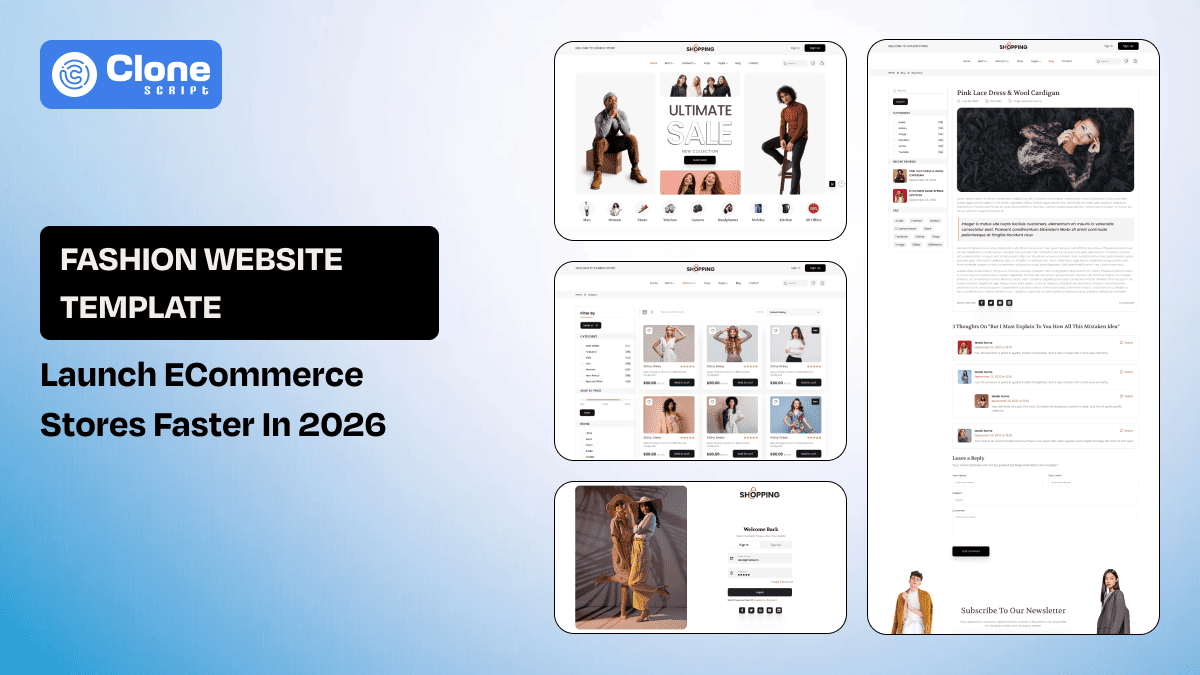
Fashion Website Template: Launch High-Converting E-commerce Stores Faster in 2026
When building fashion-focused websites in 2026, e-commerce agencies and individual UI/UX professionals don’t have to deal with beautiful layouts anymore. They are, in fact, building full storefront applications with the capacity to balance storytelling elements with performance tracking, personalized experience, and rapid deployment.
There’s a point about using a fashion website template as a shortcut. However, if you are paying attention, you will find that it is actually a scalable production framework. For any team operating with several fashion clients, making this decision can have significant impacts on how quickly projects are delivered, as well as the profit margin.
This guide describes what modern fashion brands expect, where projects tend to go wrong, and how a HTML website template should be carefully considered for a production-ready fashion site.
What Modern Fashion Brands Expect from a Website in 2026
Fashion e-commerce has moved past pretty pictures alone. Today, brands are measuring storefront success with dashboards, conversion metrics, and retention insights.
-
Visual Storytelling Engaging Audiences
First, storytelling visuals remain imperative. Hero section campaign banners, editorial layouts, and immersive lookbooks are a must. Yet they must sit alongside clean code and optimized assets. A fashion store website template should balance creative freedom with fast load times and efficient DOM performance.
-
User experience of Mobile-first for frictionless shopping
The mobile experience leads decisions in e-commerce. Over two-thirds of fashion purchases start on mobile. Thumb-friendly navigation, collapsible filters, and frictionless checkout should anchor a responsive template. Brands are expecting design that's really mobile-first, not desktop rewritten for phones.
-
Personalization as Standard Practice
Since AI was introduced in website development, personalization has become a baseline functionality. Behavioral suggestions that remain dynamic "you may also like" modules, and ties into wishlists aren't for big players only anymore. An apparel site template should be supportive of easy API connections to recommendation engines without compromising its structure.
-
Built-In SEO for Discoverability and Growth
Lastly, search engine optimization for a website is no longer an add-on. Category structures, internal linking, and schema-friendly markup should be integrated from the beginning. A properly designed website template for a niche like clothes, accessories, and fashion should enable organic discoverability without requiring architectural overhauls.
Fashion brands in 2026 demand beauty, speed, flexibility, and performance all at once.
Fashion Website Design Projects: Common Challenges to Face
Even with creative direction, there are technical and operational hurdles for fashion e-commerce website development to overcome. Timely optimization of tasks creates the opportunity for client satisfaction.
-
Image-Heavy Layouts Slowing Things Down
Maintaining fashion demands through eye-catching images is easy, yet unoptimized images compromise site speed. A great-looking template that lacks image compression, modern image formats, and lazy loading of images will compromise your e-commerce store's Core Web Vitals.
Similarly, if the template is unoptimized in terms of layout and information architecture, it might not be the best template and could actually be hurting your site speed and engagement.
-
Complex Product Variant Logic
Usually, clothing products may be of various sizes, colors, or stock conditions, etc. A change in the variant of the product, coupled with a lot of JavaScript implementation or complexities in the SKU logic, would affect the shopping experience.
For clothing or accessories stores, a premium HTML template with design and coding must include features for handling dynamic prices, stock level information, and the selection of clothing variants, etc.
-
SEO Architecture Gaps
The problem with technical SEO is that it is left till late. Issues like duplicate category structures, inconsistent heading structures, and a lack of structured data negatively affect the viewability and rankings of an online store.
However, making these changes later on is costly, and having an SEO-ready template is important. You can optimize it before handing the live site to the client.
-
Operational Inefficiencies Across Teams
Dealing with multiple fashion clients translates to a list of repetitive technical problems that slow the workflow in an e-commerce web development agency. This means the development team loses valuable hours troubleshooting issues that a proper template would have eliminated in the first place.
Creating a premium fashion store through an HTML template eliminates these predicted problems and enhances teamwork.
How to Choose the Best Fashion Website Template for Client Projects
Making a choice for a fashion website template for use involves a lot of factors, and it is not merely a question of how the site looks, especially for a design agency or a front-end developer who uses the platform for work.
Below are the four important evaluation layers that experienced teams prioritize.
-
Semantic Structure and Accessibility Compliance
An online store website template starts with clean semantic HTML and accessibility best practices. It follows good HTML5, like the correct order of headings from H1 to H6, and keeps styling minimal and separate from structure. This makes it easier for search crawlers, and the structure needs less refactoring later in the project lifecycle.
For fashion brands in a regulated environment, accessibility must be implemented, and ARIA attributes and keyboard support are a requirement, not a choice. Premium e-commerce website templates have the feature of proper accessibility.
Note that the lack of semantic structure increases technical debt. A strong semantic foundation is important because a fashion website needs to scale with increasing product categories, seasonal collections, and promotional activities.
-
Modular Architecture and Code Organization
Website design system scalability depends on the discipline of architecture.
In an online store template (take an example of a clothing brand), there will be features such as reusable UI elements, clearly separated CSS modules, and a clean and logical folder structure.
Essentially, there should not be a massive overhaul of code for front-end developers to modify when designers make changes to campaigns on the homepage or the layout of collections.
Look for the following in the template:
-
UI component optimized layouts
-
Well-organized asset folders
-
Clear naming conventions
-
Low dependence on bulky third-party libraries
A template without a modular design structure usually results in repetitive development issues, which lead to slower delivery from the agency. A scalable template for apparel stores reduces redundancy that frustrates user experience.
-
Built-In Conversion Infrastructure
This feature must be built in rather than added after the fact.
Free fashion web templates rely too much on visual appeal and little on features that can generate sales. Before making a selection, you should verify that a given template offers features such as organized product information pages, slide-out cart options, and cross-selling features.
A good template should already contain the following:
-
Cart preview interactions
-
Clear Variant Selection
-
Promotion badge logic
-
Upsell and related product blocks
-
A structured checkout flow
If they need extensive customization after deployment, your schedule can be extended considerably.
-
Test Performance Stability Before Integration
Do performance checks of the e-commerce website template before tying in the back-end development.
How?
Look at overall asset weight, JavaScript load, image rendering, and CSS scaling. A good responsive website template should have consistent levels of performance when utilized statically.
Specifically, consider these aspects:
-
Image compression and usage of next-gen formats
-
Lazy loading implementation
-
Volume of script dependencies
-
Layout changes during interaction
A stable template framework ensures that when APIs, inventory logic, and payment gateway integration work properly, performance degradation remains minimal.
Strategic Takeaway for Agencies
The best fashion website template isn't the most complex one out there; it's the one that meets timely delivery guarantees, minimizes refactoring risk, and grows conversion rates without compromising architecture.
For web designing and development companies that have to handle many fashion clients, a structured evaluation ensures that there are no operational headaches in the future.
Why a Fashion Store Website Template Is Smarter Than Full Custom Development
Custom development has the opportunity to produce highly personalized shopping experiences. The problem, however, is that it leads to unpredictability in operations that ultimately affects profitability, time, and customer satisfaction.
The decision isn’t necessarily based upon capability. It’s more about risk management and scalable efficiency.
-
Less Repetition Across Projects
The decision to begin each fashion store development from scratch results in a situation where teams end up re-engineering the same basic building elements: grid systems, cart logic, variant selection grids, and product detail layouts.
This is because a structured HTML website template reduces the need to design basic components repeatedly. Hence, being involved in rolling out a tested fashion website for each problem minimizes the need for differentiation.
For agencies dealing with several local to mid-sized e-commerce clients every year, the repetition of the process offers them a significant operational edge.
-
More Predictable Timelines and Margin Control
Unstructured custom-built projects' scope beyond their original definition due to underlying architectural gaps. Mid-project adjustments to the project's checkout process, mobile responsiveness, or SEO aspects may start to strain budgets.
With a professional website template, there are predictable layouts and pre-validated user flows.
That means designers have to work within predictable modules, and developers work with APIs without re-implementing the interface logic midway through development.
The level of predictability is significant, ensuring that agency margins are optimized and revisions are reduced, especially when managing three to five web development projects.
-
Improved Cross-Team Collaboration
Template-driven workflows really close the loop between design, development, SEO, and marketing.
-
Web designers use tried and tested design systems, rather than writing new structural code again for every website.
-
Developers integrate new payment gateways or APIs for inventory levels without affecting user interface elements at all.
-
SEO specialists optimize product categories or metadata structures without requiring structural code changes at all.
The customizable e-commerce store template is the common infrastructure between them all, preventing confusion by ensuring alignment between them.
-
Faster Time-to-Market Without Sacrificing Brand Identity
In fashion, time is of the essence. The seasonal drops, limited-edition launches, and promotions are very rapid. A front-end optimized clothing brand website template allows agencies to launch the online store quickly. However, customizations for typography, images, color scheme, and regional layouts are also possible.
Brand identity ensures that the look and feel are built on a solid foundation of architecture. This is sometimes what differentiates a website template as an advanced choice for mid-market brands compared to a custom website development.
-
Strategic Scalability for Growing Fashion Brands
Custom development remains appropriate where there are proprietary back-end systems or where there are complex multi-region commerce requirements.
However, fashion businesses categorised as mid-sized do not need this scale of customization. What they do need is scalability, definite stability, and strong boosts to conversion rates.
A fashion design website template represents disciplined scalability: It makes it easy to scale incrementally by fine-tuning performance, personalization, and SEO in the e-commerce platform.
Recommended Solution: Fashion Store E-commerce HTML Template for Teams
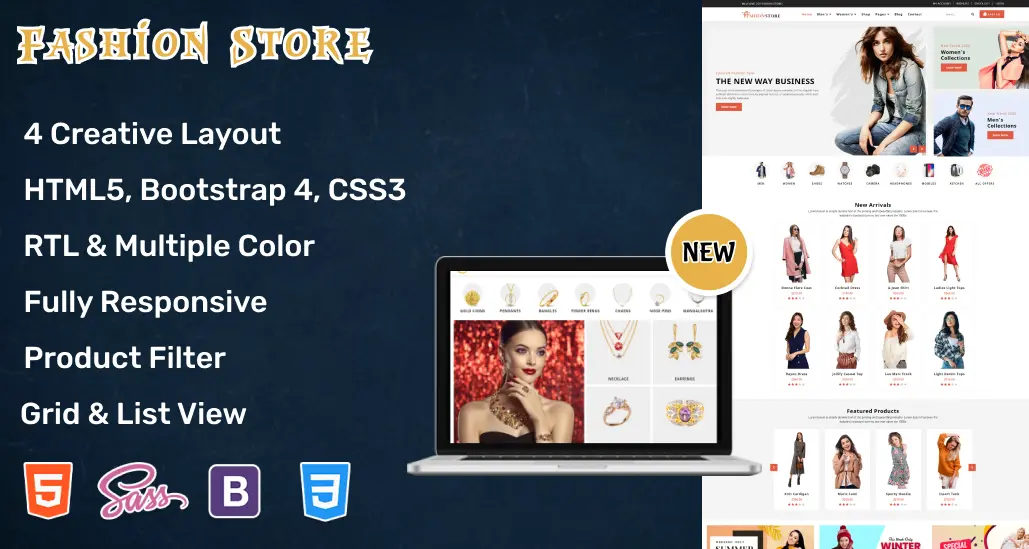
For teams looking for a good, production-ready foundation to start off with, the Fashion Store E-commerce HTML Template from AllClone Script is a solid foundation worth checking out.
It is not presented as a “plug and play theme.” Rather, it is presented as a modulated front-end system. The homepage design allows for campaign-driven hero areas, curated collection grids, and promotional banners, among other features, while maintaining its core structure.
Product detail pages are designed to handle:
-
Size and color variant logic
-
Image zoom features
-
Tabbed product descriptions
-
Related product sections
-
Review-driven trust signals
Developers can use the file system organization and clean HTML, which are well-suited for smooth integration with the back-end system. It is suitable for headless commerce, CMS, or API-based systems with minimal changes.
The most outstanding advantage is that production is predictable. This means that instead of having to build each structural element from scratch, there is already a foundation that is "tuned" for fashion-focused e-commerce. This model is suitable for web design companies, freelance UI/UX designers, and front-end developers who are building e-commerce storefronts.