BTC - Bitcoin
 USDTERC20 - USDT ERC20
 ETH - Ethereum
 BNB - Binance
 BCH - Bitcoin Cash
 DOGE - Dogecoin
 TRX - TRON
 USDTTRC20 - USD TRC20
 LTC - LiteCoin

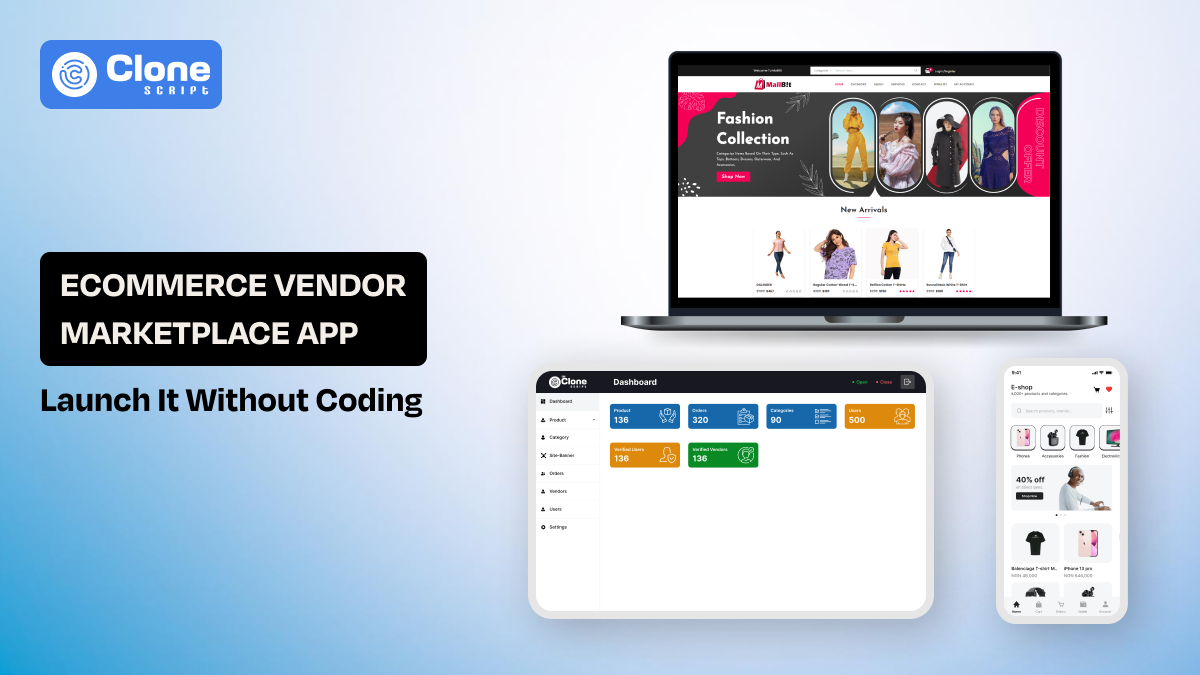
How to Launch a E-commerce Vendor Marketplace App Without Coding Using Clone Script
Look at Amazon, Flipkart, and Walmart business websites and apps, how proactively they designed for every stakeholder, customers, merchants (sellers or vendors), and admins. But building those web applications requires a huge amount of capital invest somewhere around $50k to $5 million.
But if an entrepreneur is looking to launch a multi-vendor e-commerce marketplace app without coding, it can be done with the mentioned cost by 30-40%. This includes UX research, UI layouts, front-end development, back-end integration, and the deployment cycle.
This guide explains how to use a ready-made solution like AllClone Script’s e-commerce Clone Script to accelerate your launch without compromising marketplace functionality.
Understanding e-commerce Vendor Marketplace Apps
Before selecting tools to launch a marketplace without coding, you must clearly understand the structural foundation of a true multi-vendor marketplace. This is not a basic e-commerce store with multiple product listings. It is a layered system where vendors, buyers, and administrators operate within defined roles.
Each layer must function independently while remaining connected through transaction logic, commission automation, and workflow controls. If these components require heavy customization, you are moving into full development.
-
Vendor Side
The vendor layer drives your supply engine and must be operationally independent. It should include:
-
Vendor account creation with approval or verification controls.
-
Product uploads with images, descriptions, pricing, and categories.
-
Inventory management to prevent overselling.
-
Order management dashboard for tracking purchases and fulfillment.
-
Earnings and commission tracking with transparent breakdowns.
Vendors need clarity and autonomy. They must view sales performance, manage stock levels, and process orders without admin intervention. If vendors struggle to understand commissions or payouts, trust is affected quickly. It’s not recommended.
A structured marketplace system ensures vendors operate confidently while the platform retains commission control automatically.
-
Buyer Side
The buyer layer determines revenue flow and platform credibility. It must deliver simplicity, speed, and trust through:
-
Product browsing across organized categories.
-
Search and filtering for faster product discovery.
-
Secure checkout with encrypted payment processing.
-
Order tracking for post-purchase transparency.
-
Review system to maintain quality standards.
Buyers expect a frictionless shopping experience. Complicated navigation or unclear payment processes directly reduce conversion rates. Do not ever try it. Focus on secure transactions that build trust, while reviews improve vendor accountability.
Without these structured elements, your marketplace becomes difficult to scale. A well-built infrastructure ensures customer confidence and repeat purchasing behavior.
-
Admin Side
The admin layer controls governance, revenue, and ecosystem stability. It must include the following:
-
Vendor approval workflows to maintain quality control.
-
Commission configuration tools for flexible revenue models.
-
Dispute handling mechanisms to resolve conflicts efficiently.
-
Platform analytics for sales and vendor performance tracking.
-
Category management for structured expansion.
Admins need centralized visibility over transactions and vendor behavior. For example, commission logic should be configurable without manual recalculation. Then, dispute resolution must be systematic to protect brand credibility.
If these components demand heavy customization, you enter complex development.
Two Ways to Build a Marketplace Without Coding
Entrepreneurs looking to launch a marketplace with a builder generally follow one of two paths. Both eliminate traditional back-end development, but they differ significantly in configuration effort, scalability, and operational control. Choosing the right approach depends on your technical comfort level, launch timeline, and long-term growth vision.
Option 1: Generic No-Code Builders
These platforms are useful as you can have a ready-to-use website and apps to start a business. You can use Bubble, Softr, and Glide tools as they provide visual interfaces where you assemble workflows manually. These tools are flexible and allow customization, but flexibility comes with responsibility.
To build a functional no-code multi-vendor marketplace, you must configure:
-
Vendor registration logic
-
Role-based access controls
-
Product submission workflows
-
Commission calculation rules
-
Order tracking systems
This approach works well for founders who have an in-house web development team to handle designing logical flows and connecting multiple components. However, mistakes in workflow structuring can create operational inefficiencies later.
Option 2: Production-Ready Clone Scripts
This is where AllClone Script’s e-commerce Clone Script becomes strategically effective.
Instead of assembling modules individually, you deploy a pre-structured marketplace architecture that already includes:
-
Built-in multi-vendor system
-
Dedicated admin dashboard
-
Automated commission engine
-
Integrated order management logic
-
Secure checkout infrastructure
Configuring complex workflows from scratch is not required. You can start with a system engineered specifically for marketplace operations.
This can reduce configuration time, technical trial and error, operational risk, and dependency on third-party integrations.
If your priority is speed-to-market, structured monetization, and scalable vendor onboarding, clone scripts provide stronger execution. You focus on growth, vendor acquisition, and marketing, not back-end assembly.
For entrepreneurs serious about building a revenue-ready marketplace efficiently, this approach offers a more controlled and predictable path.
Why Choose AllClone Script’s e-commerce Clone Script?
When your objective is to launch a marketplace, the decision is not just about convenience. It is about operational structure. Many entrepreneurs underestimate the complexity of vendor logic, commission handling, and multi-role access control. That is where a purpose-built solution becomes important.
AllClone Script’s e-commerce Clone Script delivers a ready-made multi-vendor marketplace infrastructure specifically designed for founders who want:
-
Faster deployment without months of back-end setup
-
Reduced technical dependency on developers
-
Structured commission automation from day one
-
Scalable vendor onboarding without rebuilding workflows later
Instead of configuring separate plugins, payment logic, and admin layers, you start with a system engineered for marketplace functionality.
Core Functional Modules Included in App
The script includes essential components required for a production-ready marketplace:
-
Vendor registration module with controlled access
-
Admin approval workflow to maintain quality standards
-
Commission management system for automated revenue calculation
-
Product and category controls for structured organization
-
Order tracking system for both vendors and buyers
-
Mobile-responsive interface to support modern commerce behavior
Each module is integrated into a unified architecture. That integration eliminates the fragmentation commonly seen in generic no-code setups.
E-commerce Marketplace App Launch Steps With White-label Solution
Here is a proper structure to follow when launching the marketplace app.
Step 1: Validate Your Marketplace Niche
No platform compensates for weak positioning. Market structure precedes technology.
You can choose high-probability niches that are specific in scope, underserved by dominant platforms, and community-driven or relationship-based.
Take the examples of regional organic food suppliers, independent fashion designers, local electronics resellers, and B2B industrial spare parts.
Avoid horizontal, generic categories. Competing with large players such as Amazon or eBay requires substantial capital, logistics infrastructure, and customer acquisition budgets.
With a focused niche, you can reduce vendor acquisition friction, lower customer acquisition cost, improve defensibility, and increase community loyalty.
This is the foundational step to never skip.
Step 2: Define Your Monetization Model
The niche is decided, but managing the finances is the most important task. Marketplace revenue is produced through strategy, not generated automatically.
Choose a structure aligned with vendor economics:
-
5–20% commission per sale
-
Vendor subscription fee
-
Featured listing upgrades
-
Transaction fees
-
Hybrid model
Flexible commission logic allows adjustment by vendor type or category, improving margin control and onboarding flexibility.
So, why are clear monetization policies required?
It helps to manage the vendor trust, financial predictability, and lower dispute rates.
Confusing fee structures reduce long-term platform credibility.
Step 3: Deploy Your Marketplace Infrastructure
Using the AllClone Script’s e-commerce Clone Script, you can install and configure the platform. Then, customize branding and set commission rates. After it, define categories and enable vendor roles.
This eliminates months of back-end architecture planning.
Traditional no-code builders require assembling plugins and workflows. Clone scripts, by contrast, already contain multi-vendor logic, commission automation, admin workflows, and order lifecycle management.
The architectural foundation is pre-built.
Step 4: Configure Payment Automation
Payment reliability defines marketplace legitimacy. Integrate trusted processors such as Stripe and PayPal. Allow split-payment logic to ensure automatic commission deduction, net vendor payouts, and transparent transaction records.
Manual reconciliation introduces operational issues and accounting risk. Automation is mandatory for scale.
Step 5: Vendor Acquisition Before Public Launch
A marketplace without vendors is structurally non-functional. Prioritize supply before demand.
The acquisition channels include direct outreach via LinkedIn, trade associations, and industry-specific WhatsApp groups, early adopter discounts, and reduced commission for the first 60 days.
Position the platform as an additional revenue channel with a lower-fee alternative. Approach as a niche-focused buyer network and a long-term growth partnership.
Supply precedes demand in marketplace economics.
Step 6: Optimize User Experience
Strong infrastructure for a vendor platform fails if the UX is inefficient. Prioritize the clean category architecture, fast checkout flow, transparent refund policies, vendor rating system, and
mobile responsiveness.
Mobile-first performance is non-negotiable. The majority of browsing and purchasing occurs via smartphones.
Retention is driven by convenience in every interaction of the app.
Step 7: Test Every Workflow
Reputation is fragile at launch. You have to validate the vendor registration flow, product upload process, commission deduction accuracy, order notification triggers, refund handling, and admin approval workflow.
Even minor system errors rapidly affect trust in a two-sided marketplace.
QA and Testing are not optional. It is structural risk management.
Step 8: Soft Launch Strategy
Avoid immediate public scaling for the app. Instead, you can launch with 20–50 vendors, invite controlled buyer groups, collect structured feedback, identify friction points, and iterate rapidly.
Early-stage iteration improves retention metrics and reduces churn before paid acquisition begins.
Marketplace App Marketing and Growth Strategy
After operational stability, growth becomes the primary objective. Expansion must be structured and metric-driven compared to reactive. A marketplace scales only when both supply and demand increase in balance.
Focus on aspects like measurable acquisition channels, vendor activation rates, buyer retention metrics, and transaction frequency.
Growth is not defined by traffic volume alone. It depends on liquidity, repeat purchases, and increasing lifetime value. Establish performance benchmarks early and monitor conversion funnels continuously.
Sustainable expansion requires disciplined experimentation, controlled marketing spend, and ongoing optimization of vendor participation and buyer engagement across the platform ecosystem.
Scaling Beyond MVP in Marketplace App
Post-validation scaling should prioritize operational efficiency before aggressive expansion. Growth should follow data-supported pathways such as:
-
Adjacent category expansion
-
Vendor referral incentive programs
-
Loyalty rewards for repeat buyers
-
Controlled geographic rollout
-
Progressive Web App performance upgrades
Each initiative must improve conversion rates or retention metrics. Avoid feature accumulation without measurable impact. Strengthen core workflows, payments, onboarding, and dispute handling before expanding externally.
Scaling is primarily process optimization rather than technical rebuilding. By reinforcing internal efficiency first, the marketplace becomes structurally prepared for higher transaction volumes and sustained ecosystem growth without operational breakdowns.
Realistic Launch Timeline for Marketplace App
A disciplined rollout can be completed within 45–60 days using structured infrastructure. The timeline should follow defined stages:
-
Week 1–2: Niche validation and vendor interviews
-
Week 3: Platform deployment and configuration
-
Week 4: Vendor onboarding
-
Week 5: Workflow and payment testing
-
Week 6: Controlled soft launch
Each phase must produce measurable outcomes before advancing. Testing commissions, notifications, and order flows protects credibility.
A phased strategy reduces operational risk and ensures early feedback integration. Speed is valuable only when paired with verification and structured execution checkpoints.
Who Should Use the AllClone Script?
This solution aligns with operators prioritizing structured deployment over custom engineering. Ideal users include:
-
Non-technical founders
-
Startup entrepreneurs validating niche ideas
-
Agencies delivering marketplace solutions
-
Regional commerce initiatives
-
Specialized B2B ecosystems
The system supports rapid implementation while maintaining professional workflow standards. It reduces technical dependency and accelerates time-to-market. Organizations focused on vendor acquisition, monetization clarity, and operational efficiency benefit most.
When the objective is controlled execution rather than experimental development, structured clone infrastructure provides a practical foundation for scalable marketplace operations.
Final Thoughts
Marketplace accessibility has expanded significantly. The technical barrier has decreased; strategic execution now defines outcomes. Sustainable platforms require:
-
Clear niche positioning
-
Transparent commission logic
-
Reliable payment automation
-
Balanced supply-demand growth
Large development teams and extended build cycles are no longer mandatory. However, infrastructure alone does not guarantee success. Founders must prioritize vendor relationships, liquidity management, and measurable growth systems. Structured clone technology removes engineering friction, enabling focus on execution quality.
In modern marketplace economics, discipline, positioning, and operational consistency determine long-term viability and competitiveness.