BTC - Bitcoin
 USDTERC20 - USDT ERC20
 ETH - Ethereum
 BNB - Binance
 BCH - Bitcoin Cash
 DOGE - Dogecoin
 TRX - TRON
 USDTTRC20 - USD TRC20
 LTC - LiteCoin

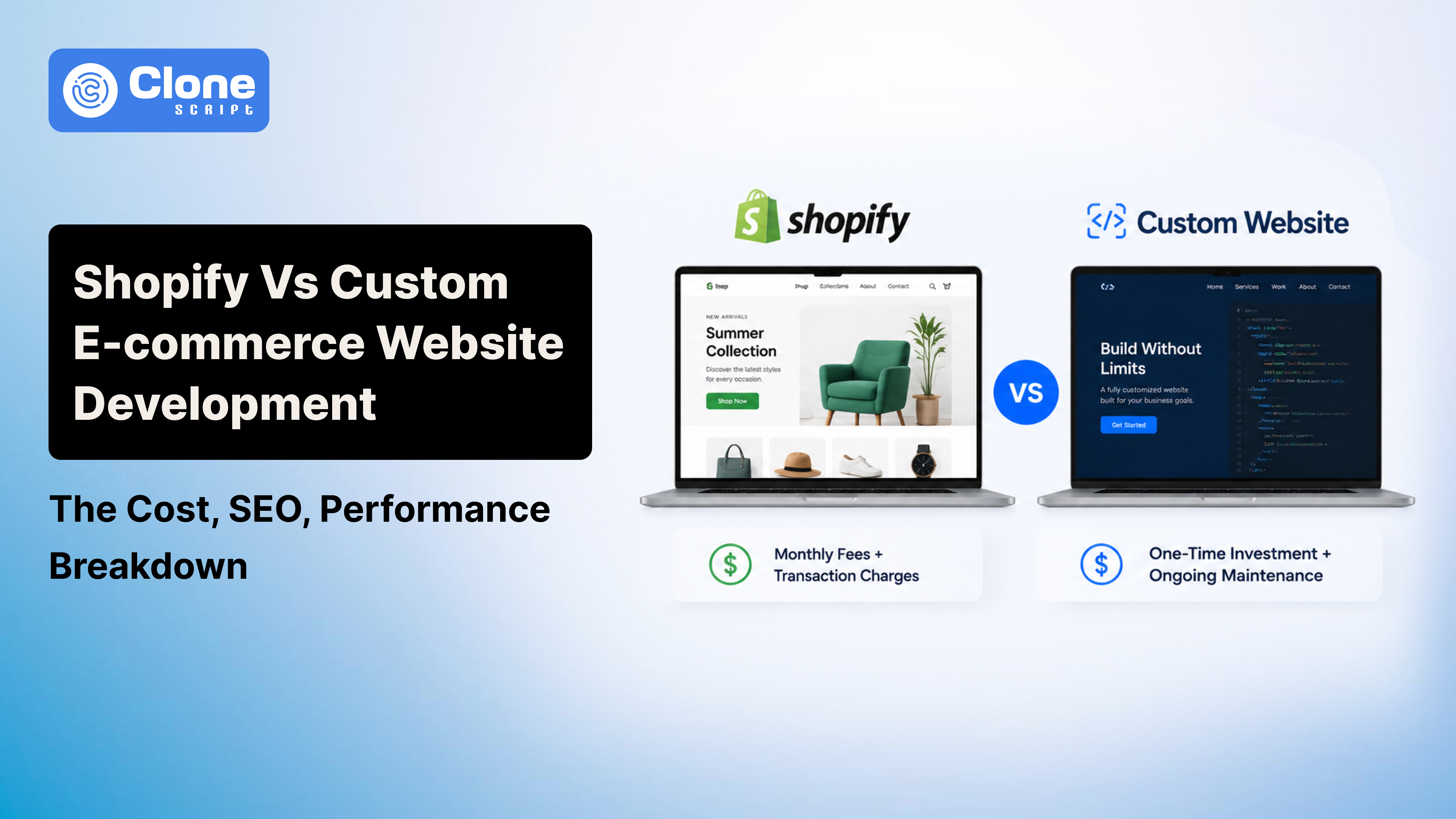
Shopify vs Custom eCommerce Website Development: The Cost, SEO, Performance Breakdown
At first, Shopify feels like the smartest business decision you have ever made. You choose a theme, upload products, install a few apps, and suddenly you are running an online store while feeling approximately 47% more entrepreneurial than the week before. For new businesses, that simplicity is hard to ignore.
Then the store starts growing.
One app becomes five. Five apps become fifteen. Suddenly, your “simple” e-commerce setup needs separate tools for SEO, subscriptions, reviews, upsells, abandoned cart recovery, inventory syncing, email marketing, and shipping automation. Your monthly software bill quietly grows large enough to make you stare at the dashboard in silence for a few seconds.
That is usually the moment business owners start searching for Shopify vs custom website comparisons.
Because the real challenge is not launching an online store anymore. It is figuring out whether your business is scaling efficiently or just stacking monthly subscriptions on top of other monthly subscriptions while hoping the checkout page still loads fast enough to keep customers from leaving.
Why Shopify Works So Well for Early-Stage Businesses
There is a reason Shopify dominates the SaaS e-commerce market.
For new businesses, speed matters more than architectural perfection.
A founder launching a skincare brand, fashion store, or niche electronics shop usually wants to validate the market before investing heavily in technology. Shopify makes that process extremely accessible. The infrastructure is already managed, payment systems are integrated, themes are available immediately, and thousands of apps extend functionality without requiring custom development.
That convenience reduces the barrier to entry dramatically.
Instead of spending months building back-end systems, the business owner can focus on marketing, product sourcing, fulfillment, and customer acquisition. For companies with limited technical knowledge, this approach is often the smartest starting point.
The issue appears later, once growth introduces operational complexity.
Many businesses initially believe Shopify costs remain predictable because they focus only on the monthly subscription fee. In reality, the subscription is the smallest expense inside the ecosystem.
The Real Financial Cost of Running a Shopify Store
One of the biggest misconceptions surrounding Shopify is the idea that it remains “cheap” as a business scales. The platform itself may start affordably, but growing brands rarely operate using Shopify alone.
Most stores eventually build an ecosystem around the platform.
A business that starts with only a basic storefront adds apps for:
-
Email marketing
-
Loyalty systems
-
Subscriptions
-
Inventory management
-
Upselling
-
Reviews
-
Analytics
-
Search optimization
-
Shipping automation
-
Customer support
-
CRM synchronization
Individually, these subscriptions appear manageable. Together, they become a significant operational expense.
A mid-sized Shopify store generating healthy monthly revenue can easily spend between $2,000 and $5,000 per month across app infrastructure and operational tools alone.
For example, many scaling brands use:
-
Email automation platforms cost several hundred dollars monthly
-
Subscription billing tools charge based on customer volume
-
Inventory synchronization apps connected to warehouses or suppliers
-
Product personalization engines
-
Upsell and conversion optimization software
-
SEO tools and structured data applications
-
ERP or CRM integration middleware
At a lower scale, these expenses may feel acceptable because they are tied to growth. But once annual revenue crosses seven figures, the recurring costs begin stacking aggressively.
A business processing $1 million annually may spend over $60,000 per year maintaining its Shopify ecosystem once subscriptions, transaction fees, development retainers, and operational tools are included.
This is where the total cost of ownership conversation becomes important.
Shopify Transaction Fees Become a Serious Revenue Drain
Platform transaction costs are often underestimated because they scale gradually with revenue.
At smaller sales volumes, percentage-based fees feel insignificant. However, once businesses process millions in annual transactions, those percentages turn into large recurring deductions from profit margins.
Businesses using external payment gateways on Shopify may encounter additional platform transaction fees ranging from roughly 0.5% to 2%, depending on plan structure and payment configuration.
That may not sound alarming initially.
But consider a store generating $3 million annually in online sales. Even a 1% platform-related transaction cost represents $30,000 every year before considering payment processor charges.
Over three years, that becomes nearly six figures, leaving the business purely in platform-related revenue sharing.
For many founders, this becomes the moment they start researching custom e-commerce website design cost comparisons more correctly.
What Businesses Are Actually Paying for With Custom Development
Custom development discussions become distorted online because people compare a fully engineered platform against a simple template-based storefront.
They are not equivalent products.
A properly developed e-commerce platform includes:
-
Back-end architecture
-
Database systems
-
Security implementation
-
Performance optimization
-
CMS integration
-
ERP and CRM synchronization
In other words, businesses are not purchasing “a website.” They are investing in proprietary operational infrastructure.
This is why custom development pricing varies dramatically.
-
A smaller custom storefront with standard functionality may cost between $15,000 and $40,000.
-
Mid-level scalable systems with advanced integrations often range from $50,000 to $120,000.
-
Enterprise-grade ecosystems involving complex workflows, international operations, or marketplace functionality can exceed several hundred thousand dollars.
The upfront investment is undeniably higher than SaaS onboarding costs.
However, many businesses fail to compare those costs against long-term recurring SaaS overhead.
That changes the financial equation entirely.
The Three-Year Cost Difference Changes the Conversation
Short-term comparisons usually favor Shopify because the initial entry cost is low. Long-term comparisons often produce a different outcome.
Imagine a growing e-commerce business generating roughly $2 million annually in revenue.
Over three years, the company may spend:
-
Over $80,000 on Shopify Plus subscriptions
-
More than $100,000 on apps and middleware
-
Tens of thousands in transaction-related costs
-
Ongoing development retainers for maintenance and troubleshooting
-
Additional performance optimization expenses
Combined, the operational overhead can exceed $300,000 within three years.
Now compare that against a custom platform costing approximately $120,000 to build initially, with lower recurring infrastructure costs afterward. Even after maintenance, hosting, security monitoring, and ongoing feature development, the total three-year expense may remain significantly lower than maintaining a heavily customized SaaS ecosystem.
This is why many scaling brands stop viewing custom development as “expensive” and start viewing it as infrastructure ownership.
Instead of renting increasingly expensive functionality forever, the company owns its operational platform directly.
Performance Problems Increase as Shopify Stores Grow
One of the least discussed issues inside the Shopify ecosystem is performance degradation caused by app dependency.
Shopify itself is not inherently slow. The performance problems usually emerge because growing businesses continuously install third-party solutions to compensate for platform limitations.
Each app introduces additional scripts, external API requests, tracking systems, and front-end assets into the storefront.
Eventually, the store becomes overloaded with:
-
Render-blocking JavaScript
-
Third-party tracking pixels
-
Duplicate functionality
-
Excessive HTTP requests
-
Bloated DOM structures
The result is slower page speed, particularly on mobile devices.
This directly affects conversion rates.
Modern e-commerce performance is tightly connected to Google’s Core Web Vitals metrics. Slow-loading storefronts increase bounce rates, reduce add-to-cart completion, and lower advertising efficiency. Even a one-second delay in mobile load speed can reduce conversion performance noticeably.
For businesses spending aggressively on paid acquisition, performance inefficiencies become extremely expensive.
This is one reason why larger brands increasingly move toward headless e-commerce architecture and custom frontend systems.
Why Custom Platforms Perform Better at Scale
Custom e-commerce websites are developed around the business itself instead of adapting the business to platform restrictions.
That distinction matters technically.
With custom systems, developers can eliminate unnecessary scripts, optimize front-end rendering pipelines, reduce server requests, and build native functionality directly into the platform instead of relying on external apps.
The storefront becomes leaner, faster, and easier to optimize.
This creates advantages in:
-
Mobile responsiveness
-
Conversion optimization
-
SEO performance
-
Checkout speed
-
User experience consistency
For stores handling large traffic volumes, these improvements directly affect revenue generation.
Shopify Checkout Flexibility Has Real Limitations
Checkout optimization becomes increasingly important as businesses scale.
A small improvement in checkout conversion rates can produce massive revenue increases for high-volume stores. However, many Shopify businesses eventually discover that core checkout customization remains limited unless they move into enterprise-level plans or external workarounds.
This becomes problematic for businesses requiring:
-
Advanced B2B pricing
-
Dynamic checkout flows
-
Product configuration systems
-
Conditional shipping logic
-
Multi-location inventory routing
-
Complex taxation structures
-
Subscription-heavy workflows
In many cases, businesses end up restructuring their operational processes to fit the software instead of designing the software around the business.
Custom platforms remove that limitation entirely.
Businesses can create checkout systems aligned directly with their operational model rather than adapting to generalized SaaS workflows.
That flexibility becomes valuable for wholesalers, manufacturers, subscription brands, marketplaces, and businesses operating across multiple regions.
SEO Flexibility Is Another Major Difference
Technical SEO rarely receives enough attention during platform discussions, but it becomes extremely important once businesses start investing heavily in organic growth.
Shopify handles basic SEO adequately for smaller stores. However, larger operations run into structural limitations involving URL architecture, metadata flexibility, content hierarchy, and schema implementation.
For example, Shopify uses predefined URL structures like:
-
/products/
-
/collections/
-
/pages/
While these are manageable initially, they reduce flexibility for advanced content architecture and programmatic SEO strategies.
Custom platforms allow complete control over:
-
URL hierarchy
-
Schema markup
-
Crawl prioritization
-
Metadata generation
-
Internal linking systems
-
Content taxonomy
-
Dynamic rendering strategies
This becomes especially important for businesses building large editorial ecosystems alongside product catalogs.
As search competition increases in e-commerce, technical SEO control becomes a measurable competitive advantage.
When Does a Custom Website Actually Make Sense?
Not every business needs custom development.
For startups, local brands, or businesses validating a product idea, Shopify remains one of the best launch solutions available. It reduces risk, shortens deployment timelines, and simplifies operational management.
However, the economics begin changing once operational complexity increases.
Businesses usually start considering migration when they experience:
-
Rapidly increasing app expenses
-
Performance bottlenecks
-
Checkout restrictions
-
ERP integration problems
-
SEO limitations
-
Rising platform transaction costs
-
Dependency on third-party workarounds
At that stage, continuing to patch operational problems inside a SaaS environment sometimes becomes more expensive than building a system designed specifically for the business.
Final Verdict: Do Shopify Useful or Custom Website Consider?
The Shopify vs custom website decision is ultimately about business maturity and operational priorities.
Shopify is exceptional for fast launches, lean teams, and businesses that value simplicity over deep customization. For early-stage e-commerce brands, it remains one of the strongest platforms available.
But scaling businesses eventually reach a point where recurring SaaS costs, technical limitations, app dependency, and operational inefficiencies begin affecting profitability.
That is where custom e-commerce website development becomes strategically valuable.
The conversation is no longer about “which platform is good.” It becomes a question of whether the business benefits more from convenience or ownership.
For companies planning aggressive long-term growth, proprietary infrastructure often provides stronger flexibility, lower long-term operational costs, and better scalability than remaining dependent on increasingly complex SaaS ecosystems.