BTC - Bitcoin
 USDTERC20 - USDT ERC20
 ETH - Ethereum
 BNB - Binance
 BCH - Bitcoin Cash
 DOGE - Dogecoin
 TRX - TRON
 USDTTRC20 - USD TRC20
 LTC - LiteCoin

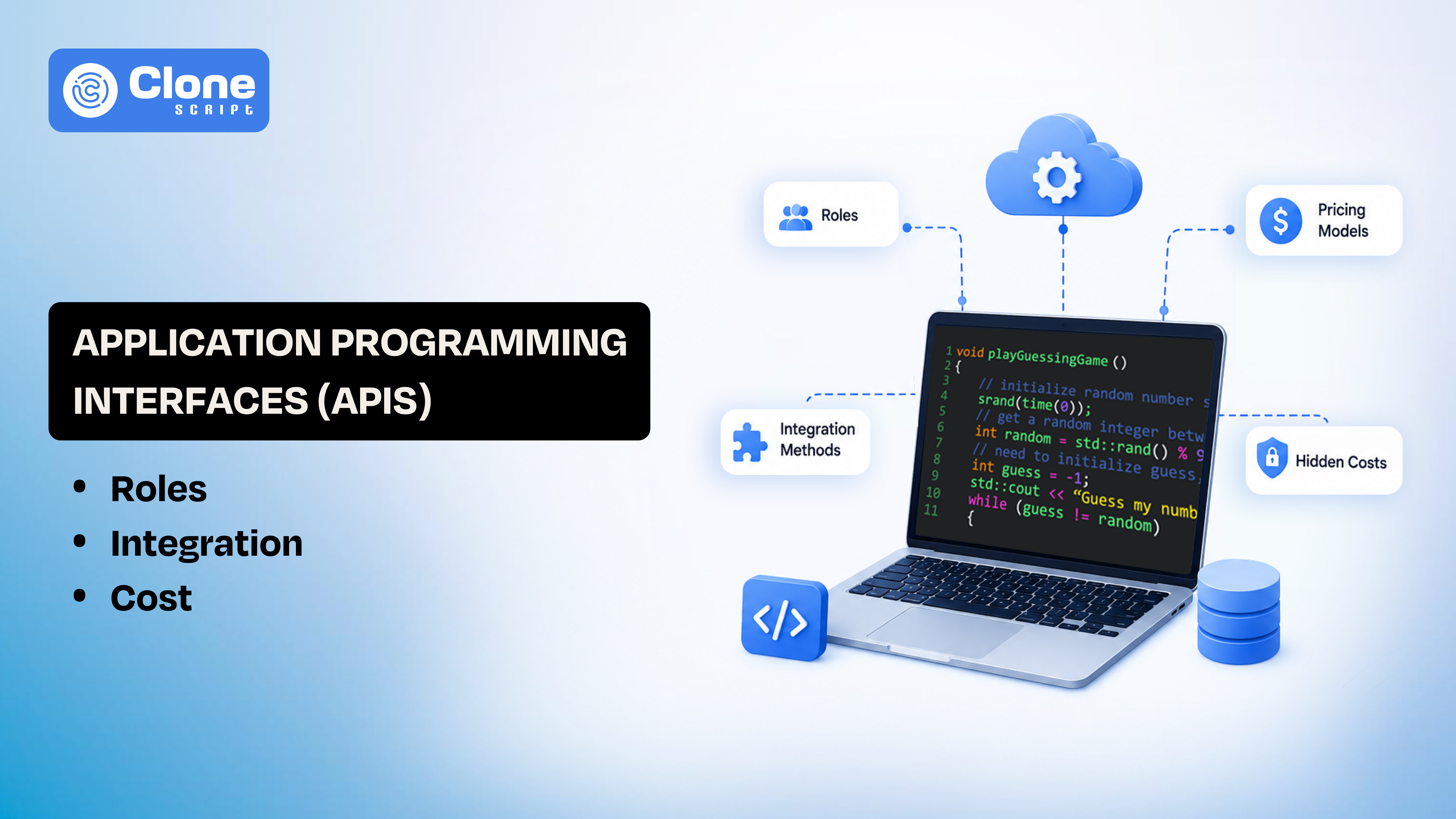
Application Programming Interfaces (APIs): Roles, Integration, and Cost
In modern digital systems, Application Programming Interfaces (APIs) have become the main operational aspect.
-
80% of the internet traffic now involves API-driven communication in some form.
Even when you book a taxi ride on a mobile app, process payment on PayPal, or connect CRM like HubSpot to a marketing website, APIs make those interactions possible behind the scenes.
Most of the businesses are choosing API-first strategies to scale faster. Also, the integration becomes easier and standardized.
This guide describes the evolving role of Application Programming Interfaces (APIs), how integration works at scale, and what businesses should expect when planning API-related investments now.
What Are Application Programming Interfaces (APIs)?
Application Programming Interfaces (APIs) are pre-defined protocols that enable software systems to communicate with each other securely. Here, two applications work: One uses APIs to request services, and the second one exchanges data and triggers actions across platforms. This makes APIs the invisible infrastructure behind modern digital experiences.
But what is the proof of that?
According to recent developer ecosystem studies, API-driven architectures can reduce software integration timelines by nearly 40%, making them essential for businesses focused on speed and scalability.
Why APIs Matter in Modern Software Development
APIs are critical because they:
-
Accelerate development cycles by reusing existing services
-
Improve scalability through modular architecture
-
Enable third-party integrations without rebuilding infrastructure
-
Support automation across internal and external systems
-
Reduce operational redundancy through standardized workflows
These advantages make Application Programming Interfaces central to cloud platforms, SaaS products, fintech systems, healthcare apps, and e-commerce ecosystems.
Real-World Example of API Usage
A food delivery app is a clear example of API orchestration in action. To complete one customer order, multiple APIs may work simultaneously:
-
Payment API for transaction processing
-
Location API for real-time tracking
-
Messaging API for order notifications
-
Restaurant management API for inventory updates
This interconnected workflow happens within seconds, creating a seamless user experience.
The Strategic Role of APIs
Beyond technical functionality, APIs have become business enablers. They allow organizations to launch faster, adapt to market demands, and build connected digital ecosystems.
Understanding what APIs are and how they work is the first step toward evaluating their integration requirements and overall investment value.
Strategic Roles of Application Programming Interfaces (APIs) in Business and Software Ecosystems
Think only the API connects the software? No, it’s not. Today, APIs function as strategic business assets that shape digital transformation, product scalability, and service innovation.
Organizations no longer treat APIs as back-end tools.
Research from enterprise technology reports shows that businesses with mature API strategies launch new digital services significantly faster than those relying on traditional integration models. This shift has positioned APIs at the center of modern business growth.
Core Business Roles of APIs
APIs contribute to organizational success in several measurable ways:
-
Enable digital partnerships by connecting external platforms and services
-
Support faster product development through reusable architecture
-
Drive operational automation across departments and workflows
-
Create monetization opportunities through API-based products
-
Improve customer experience with seamless cross-platform functionality
These functions make APIs essential for both startups and enterprise ecosystems.
APIs as Revenue Drivers
For many companies, APIs are revenue channels. Not just operational tools. Businesses monetize APIs through:
-
Subscription-based access models
-
Usage-based pricing structures
-
Partner integrations and reseller programs
-
Premium developer ecosystems
A strong example is cloud software providers that offer APIs as part of their platform infrastructure, enabling third-party developers to build complementary services.
Internal vs External API Value
Different API types serve different strategic purposes. There are two types: 1. Internal and 2. External.
-
Internal APIs
These APIs are useful for:
-
Improve communication between in-house systems
-
Support microservices architecture
-
Reduce duplicated development effort
-
External APIs
These APIs are beneficial for:
-
Connect customers, partners, and vendors in one place
-
Expand service reach
-
Strengthen ecosystem collaboration
The distinction matters because each model influences scalability, governance, and cost planning.
Why Strategic API Thinking Matters
Organizations that align API strategy with business goals achieve stronger agility and lower integration friction. Instead of isolated software systems, they create connected environments where data flows efficiently across products and stakeholders.
That strategic role makes Application Programming Interfaces (APIs) foundational to sustainable digital growth in 2026 and beyond.
API Integration Explained: How Systems Connect at Scale
API integration is the process of linking multiple software applications so they can exchange data and perform actions automatically. In large-scale digital environments, integration is what transforms standalone tools into connected ecosystems. Without it, businesses face fragmented workflows, manual processes, and inconsistent user experiences.
Industry studies estimate that organizations using mature integration strategies can improve operational efficiency by over 30%, largely through automation and faster data synchronization.
What API Integration Actually Does
At its core, API integration allows systems to:
-
Share data in real time across platforms
-
Trigger automated workflows based on events
-
Reduce manual intervention in repetitive tasks
-
Maintain consistency between connected applications
-
Support scalability as digital ecosystems grow
This makes integration essential for SaaS products, enterprise systems, mobile applications, and cloud-based infrastructures.
Common Types of API Integrations
Different business needs require different integration models.
1. Third-Party Integrations
It is used to connect external services such as payment gateways, CRM tools, analytics platforms, or communication systems.
2. Internal System Integrations
This enables departments or microservices within the same organization to exchange data efficiently.
3. Partner Integrations
These APIs are designed for secure collaboration between businesses, vendors, or service providers.
Each model affects architecture design, security requirements, and long-term maintenance costs.
How API Integration Works at Scale
Large-scale integration environments often include:
-
API gateways for request management
-
Middleware layers for data transformation
-
Authentication systems for secure access
-
Monitoring tools for performance visibility
-
Rate limiting controls to manage usage load
These layers ensure reliability when thousands or millions of API calls occur daily.
Key Challenges Businesses Face
Even well-designed integrations can introduce complexity, with these common issues:
-
Legacy system compatibility issues
-
Data format mismatches
-
Security vulnerabilities
-
Versioning conflicts
-
Hidden infrastructure costs
These factors directly impact both deployment timelines and operational budgets.
Why Integration Strategy Matters
Successful API integration is about designing scalable, resilient workflows that support business growth. Business that prioritize integration architecture early reduces future technical debt and improve long-term adaptability. Only connecting systems is not enough.
API Development Models and Architecture Choices
Selecting the right API model is one of the most important decisions in software planning.
Why?
The architecture determines:
-
How efficiently systems communicate
-
How scalable the platform becomes
-
How much the business will spend on maintenance over time
A poorly chosen model can increase latency, complicate integrations, and raise operational costs.
As API usage expands across industries, businesses are moving toward architecture-first decision-making instead of treating API design as a secondary development task.
Major API Development Models Considered for Integration
Different use cases require different API structures. There are three models currently used by developers: 1. REST, 2. GraphQL, and 3. gRPC.
-
REST APIs
REST remains the most widely adopted model due to its simplicity and flexibility.
This is best for:
-
Web and mobile applications
-
Public-facing APIs
-
Standard CRUD operations
Advantages of REST APIs:
-
Lightweight communication
-
Broad developer familiarity
-
Easy scalability
-
GraphQL APIs
GraphQL allows clients to request only the exact data they need.
This model is best for:
-
Data-heavy applications
-
Frontend-driven platforms
-
Multi-device ecosystems
GraphQL advantages:
-
Reduces over-fetching
-
Improves performance efficiency
-
Flexible query structure
-
gRPC APIs
gRPC uses high-performance remote procedure calls for low-latency communication.
This is best for:
-
Microservices environments
-
Real-time systems
-
High-throughput enterprise applications
grPC advantages:
-
Faster data exchange
-
Strong contract enforcement
-
Efficient binary serialization
Choosing the Right Architecture
The correct API architecture depends on business objectives, technical complexity, and expected scale.
| Model | Strength | Cost Consideration |
|---|---|---|
| REST | Broad compatibility | Lower initial cost |
| GraphQL | Query efficiency | Higher setup complexity |
| gRPC | Performance optimization | Advanced implementation needs |
This choice directly influences development timelines and future infrastructure investment.
Public vs Private vs Composite APIs
Beyond communication style, APIs are also categorized by access and purpose.
-
Public APIs serve external developers or customers
-
Private APIs support internal systems and workflows
-
Composite APIs combine multiple service calls into one request
Each type affects governance, documentation standards, and security requirements.
Why Architecture Decisions Impact Cost
Research shows that architecture inefficiencies can increase API lifecycle expenses by up to 25% over several years. Choosing a model based only on short-term convenience often leads to higher scaling costs later.
A strategic architecture decision creates long-term flexibility, reduces technical debt, and ensures the API remains adaptable as business demands evolve.
What Does API Development and Integration Cost in 2026?
The cost of building and integrating Application Programming Interfaces (APIs) in 2026 depends less on coding hours and more on architectural complexity, scalability requirements, and long-term operational demands. Businesses often underestimate how infrastructure, security, testing, and support influence total investment.
Current market benchmarks show that API projects can range from a few thousand dollars for simple integrations to six-figure budgets for enterprise-grade ecosystems.
API Cost by Complexity Level
The scope of the API determines pricing more than the technology itself.
-
Simple APIs cost $5,000 to $20,000.
These kinds of APIs are best suited for basic CRUD operations, internal tools, and single-service integrations.
Its typical characteristics are limited endpoints, standard authentication, and minimal business logic.
-
Mid-Level APIs cost $20,000 to $75,000.
These APIs are best suited for SaaS platforms, customer-facing products, and multi-service connectivity.
The characteristics for mid-level APIs are: advanced workflows, third-party integrations, and custom data processing.
-
Enterprise APIs cost $75,000 to $250,000+.
These APIs are best suited for large-scale platforms, regulated industries, and mission-critical systems.
Enterprise typical characteristics are high concurrency support, strict compliance requirements, and dedicated monitoring infrastructure.
Key Cost Factors in API Projects
Several variables shape total spending, including:
-
Architecture model (REST, GraphQL, gRPC)
-
Integration depth across services
-
Security requirements such as OAuth or zero-trust models
-
Documentation standards for developers
-
Testing and quality assurance scope
-
Deployment environment (cloud, hybrid, on-premise)
These factors have a larger financial impact than raw development effort.
Team Structure and Pricing Impact
Who builds the API also affects the budget.
-
Freelancers: They offer lower cost and limited scalability.
-
Agencies: With balanced expertise and project support.
-
In-house teams: It’s a high long-term investment with strong control.
A senior API engineer in global markets can command rates between $80 and $200 per hour, depending on specialization.
Hidden Budget Considerations
Beyond launch costs, businesses should plan for:
-
Maintenance updates
-
Infrastructure scaling
-
API versioning
-
Incident response systems
-
Compliance audits
Industry reports suggest that annual maintenance can consume 15% to 25% of the original build cost.
Why Total Cost of Ownership Matters
The smartest budgeting approach is not based on launch price alone. Application Programming Interfaces (APIs) should be evaluated through long-term value, operational resilience, and scalability potential.
In 2026, the most cost-effective APIs are the ones designed to grow without expensive rework. Not the cheapest to build.
Hidden Costs Businesses Often Overlook in API Development
Many organizations budget for API development but fail to account for the expenses that emerge after deployment. This creates a misleading perception of affordability. In reality, long-term API success depends on ongoing investment in security, monitoring, updates, and support.
The post-launch operational costs can represent up to 40% of total API lifecycle spending, far more than many businesses initially estimate.
-
Security and Compliance Expenses
Security is one of the most underestimated API cost drivers. Businesses need to invest in:
-
Authentication frameworks such as OAuth 2.0 or JWT
-
Encryption protocols for data transmission
-
Rate limiting and abuse prevention tools
-
Compliance audits for regulations like GDPR, HIPAA, or PCI-DSS
These layers are essential, especially for finance, healthcare, and SaaS platforms handling sensitive data.
-
Monitoring and Incident Management
An API without visibility becomes a liability. For that, operational monitoring requires:
-
Uptime tracking tools
-
Real-time performance dashboards
-
Error logging systems
-
Alerting mechanisms for failures or latency spikes
As API traffic scales, these systems become critical for maintaining reliability and user trust.
-
Documentation and Developer Support
Poor documentation increases onboarding friction and support requests. High-performing APIs require:
-
Interactive developer portals
-
SDK libraries
-
Version-specific guides
-
Troubleshooting resources
Well-documented APIs reduce implementation errors and improve adoption rates, but they require dedicated maintenance effort.
-
Versioning and Backward Compatibility
As products evolve, APIs must change without breaking existing integrations. This involves:
-
Maintaining multiple versions simultaneously
-
Migration planning for clients
-
Compatibility testing across environments
Version control adds complexity that many teams fail to budget for early.
-
Infrastructure Scaling Costs
As usage grows, so does infrastructure demand. Hidden scaling expenses include:
-
Higher cloud bandwidth consumption
-
Database performance optimization
-
Load balancing services
-
Geographic redundancy for global users
These costs rise significantly under high-traffic conditions.
Why These Costs Matter
Ignoring hidden expenses leads to underfunded systems and technical debt. The true value of Application Programming Interfaces (APIs) comes from sustainable performance, not just initial deployment.
Businesses that plan for the full lifecycle cost build more resilient, scalable, and future-ready API ecosystems.
API Pricing Models for Third-Party Services
Not all Application Programming Interfaces (APIs) are built in-house. Many businesses rely on third-party APIs for payments, messaging, mapping, analytics, and AI capabilities. Selecting a pricing model that aligns with projected usage and business scalability.
Why Pricing Models Matter
A low entry cost can become expensive at scale.
Businesses overlook how pricing tiers change as API demand increases. An API that appears affordable during launch may create substantial recurring expenses once user activity grows.
Understanding pricing frameworks helps avoid budget shocks and improves vendor selection.
| Model | Description | Examples | When It Fits Best |
|---|---|---|---|
| Flat Fee / Subscription | Fixed recurring charge | Stripe Billing plans, Plaid | Predictable, steady usage |
| Per-Unit / Usage-Based | Pay per call, message, or token | Twilio (per SMS), OpenAI (tokens), Google Maps | Variable or high-volume needs |
| Tiered | Volume discounts across brackets | Many SaaS APIs | Growing usage |
| Credit-Based | Prepaid credits for consumption | Some data/enrichment APIs, Google Maps | Flexible budgeting |
| Freemium | Free tier with limits, then paid | AWS, GitHub, Twilio | Testing and low-volume starters |
| Outcome-Based | Charged on results (e.g., successful actions) | Emerging on some platforms | Performance-aligned value |
Long-Term Cost Perspective
Industry trends show that API subscription and usage fees can exceed initial integration costs within two to three years. This makes pricing model evaluation essential during early planning.
The most effective API strategy balances functionality, cost predictability, and vendor flexibility, ensuring third-party services remain assets, not financial liabilities.
How to Reduce API Costs Without Sacrificing Performance
These ways are helping you save such an amount to be spent on the unnecessary aspects in the software development lifecycle.
-
Start with an MVP-First Strategy
Reducing API expenses begins with a controlled development scope.
Instead of building every possible endpoint at launch, businesses should prioritize essential functionality first. This MVP-first approach minimizes overengineering and ensures investment is tied to validated demand rather than assumptions.
-
Build Reusable API Components
Cost efficiency improves when teams design modular systems.
Shared authentication layers, reusable service logic, and standardized response formats reduce duplicate work across multiple projects. Over time, this lowers maintenance effort and speeds up future development cycles.
-
Use Managed Gateways and Automation
Operational costs can be reduced through managed API gateways and automation tools.
These solutions handle traffic routing, security enforcement, and monitoring at scale without requiring large in-house teams. Automation also improves consistency and reduces manual oversight.
-
Choose Vendors with Long-Term Pricing in Mind
Third-party APIs should be evaluated beyond entry-level pricing. Businesses must compare usage thresholds, overage fees, and scalability terms before integration. A low-cost provider today may become expensive as demand increases.
The most sustainable Application Programming Interfaces (APIs) are structured for growth, balancing immediate savings with long-term operational resilience.
Future Trends in APIs: AI, Automation, and Composable Systems
Before integrating such Application Programming Interfaces into your app or web system, you have to know these trends.
-
AI APIs Are Reshaping Software Economics
Artificial intelligence is changing how Application Programming Interfaces (APIs) are priced, consumed, and scaled. Unlike traditional subscription-based APIs, many AI services now follow token-based pricing models tied directly to computational usage. This creates more flexible but less predictable cost structures for businesses.
A recent example is OpenAI, which expanded its enterprise API offerings with pricing tied to model complexity and token consumption. This reflects a broader industry shift toward usage-based billing, especially in generative AI and automation services.
-
Event-Driven Architectures Are Replacing Traditional Workflows
Modern digital ecosystems increasingly rely on event-driven APIs instead of simple request-response models. These systems react instantly to triggers such as payments, user actions, or system alerts.
This approach improves:
-
Real-time responsiveness
-
Operational efficiency
-
Scalability in distributed environments
Industries such as logistics, fintech, and IoT now depend heavily on event-driven integration.
-
Composable Systems Support Faster Innovation
Businesses are also adopting composable architectures, where APIs function as modular building blocks rather than fixed infrastructure.
This enables organizations to:
-
Integrate specialized services quickly
-
Replace components without full system rebuilds
-
Launch products faster with lower development overhead
The future of Application Programming Interfaces is defined by adaptability. Businesses that choose AI APIs, automation-first workflows, and composable systems will be better positioned for long-term digital growth.
Conclusion
Application Programming Interfaces (APIs) have evolved into strategic assets that drive connectivity, automation, and scalable growth. From architecture choices to pricing models and future AI-driven trends, understanding API roles, integration methods, and total cost helps businesses build resilient digital ecosystems designed for long-term efficiency.
Did you know that over 90% of developers rely on APIs, yet many businesses still underestimate their long-term operational costs? Do you want to do so?
FAQS
What is an API and how does it work?
An API acts as a bridge between software systems, enabling secure communication through requests, responses, and predefined protocols.
What is the difference between REST and GraphQL APIs?
REST uses fixed endpoints for resources, while GraphQL allows flexible queries for specific data requirements.
How secure are APIs?
API security depends on authentication, encryption, rate limiting, and continuous monitoring against vulnerabilities and misuse.
What are the hidden costs of API integration?
Hidden costs include compliance, scaling infrastructure, documentation upkeep, monitoring systems, and long-term maintenance.
Which industries rely most on APIs?
Finance, healthcare, e-commerce, SaaS, logistics, and AI-driven platforms rely heavily on APIs for connected operations.
Why are APIs important for businesses?
APIs accelerate innovation, enable automation, improve scalability, and create revenue opportunities through digital ecosystems.
How long does API integration take?
Simple integrations may take weeks, while enterprise-grade systems often require months, depending on complexity.
Can small businesses benefit from APIs?
Yes. APIs help small businesses automate workflows, integrate tools, and scale operations without heavy infrastructure investment.