BTC - Bitcoin
 USDTERC20 - USDT ERC20
 ETH - Ethereum
 BNB - Binance
 BCH - Bitcoin Cash
 DOGE - Dogecoin
 TRX - TRON
 USDTTRC20 - USD TRC20
 LTC - LiteCoin

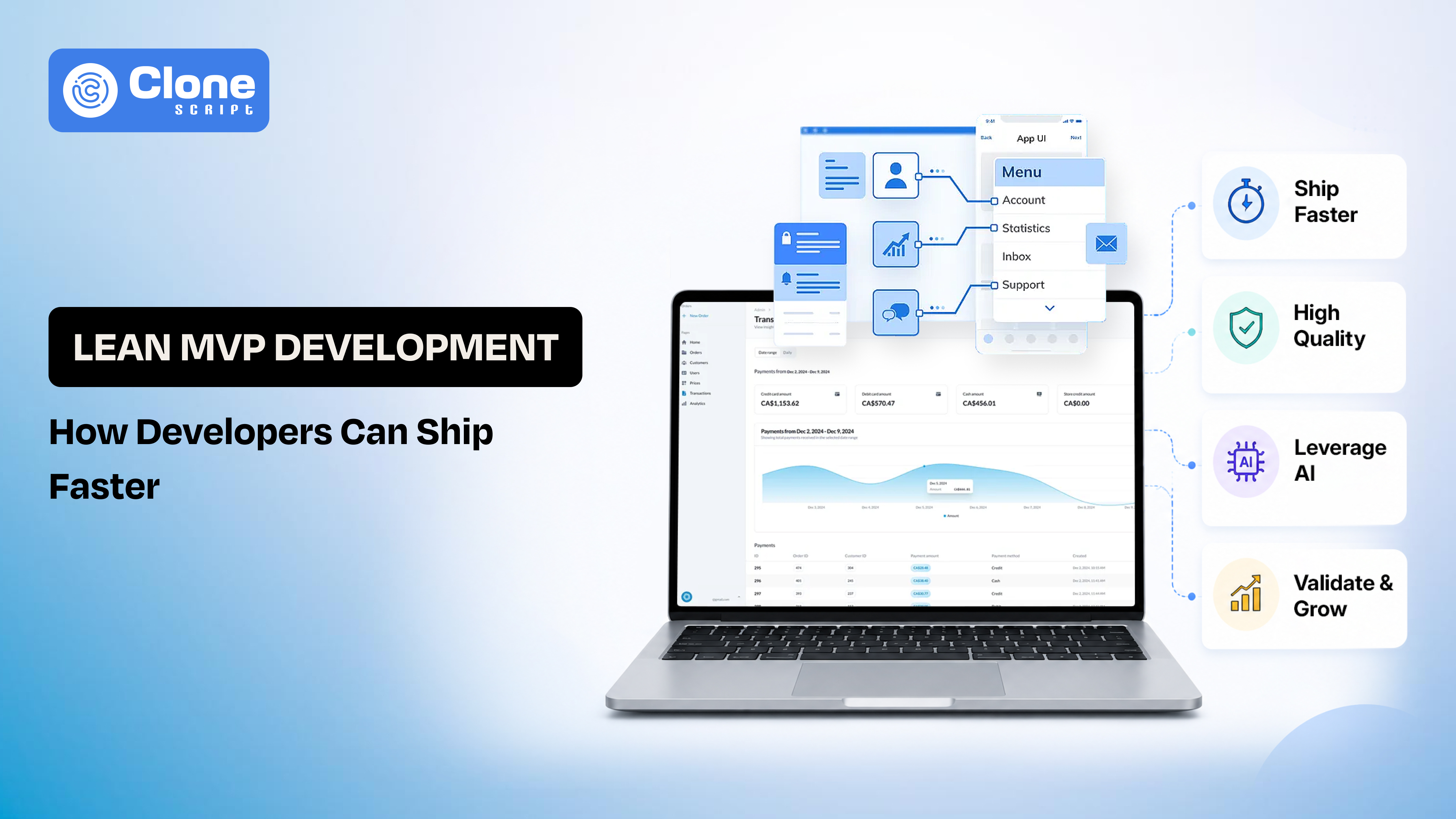
Lean MVP Development: How Developers Can Ship Faster in 2026
In software product development, speed matters and becomes a competitive advantage. Teams validating real market conditions found their products are top on the list of customers and drive revenue.
On the other hand, 35% of startups suffer from burnout and shut down operations due to market need fit. This insight was found by CB Insights. Now, one thing: Start validating the product before building it through UI and UX design, full-stack development, and deployment.
The option is Lean MVP (Minimum Viable Product) development. It addresses this by focusing on rapid experimentation, minimal feature sets, and real user feedback. In 2026, developers who ship faster and learn faster consistently outperform those who prioritize perfection over progress.
Let’s First Understand: What Is Lean MVP Development?
It’s a kind of methodology that focuses on making the smallest possible product version to deliver a measurable and prominent user value.
Don’t think that incomplete software is recognized as a lean MVP product. However, to prioritize the functionality that directly solves a specific problem.
When did the concept of Lean MVP originate?
It originates from The Lean Startup. This emphasizes the importance of validated learning over assumptions. In this case, developers must move away from feature-heavy builds and instead focus on a single core user action.
A Lean MVP typically includes:
-
A clearly defined user problem.
-
One primary feature solves it.
-
Basic usability to support interaction.
-
A feedback mechanism to gather insights.
Just prototyping the web product with static or limited functionality can’t be a successful MVP. For that, you have to launch it to real users who usually use it. This distinction is important because real-world usage provides behavioral data that internal testing cannot replicate.
AI revolutionizes MVP production.
In 2026, to develop Lean MVP, AI integration in workflows matters. From it, teams accelerate coding, testing, and deployment. The methodology minimizes effort and maximizes learning per unit of time. This shift has made Lean MVP a foundational strategy for modern product teams.
Billion Dollar Question: Why Traditional Minimum Viable Product Approaches Fail Today
They rely on outdated practices that no longer align with modern market dynamics. One of the most common issues is over-engineering early in the process. Software developers often design scalable architectures, leading to wasted time and resources.
Research from McKinsey & Company indicates that up to 45% of product features are rarely used. This reflects poor prioritization during initial website development stages.
Key reasons for failure include:
-
Feature Temptation: Stakeholders continuously add non-essential features. They do not validate what’s important, but expand the scope beyond.
-
Delayed Launch Cycles: Development teams wait for a polished product instead of releasing early versions for feedback.
-
Weak Feedback Systems: Depending on internal testing rather than real user behavior limits actionable insights.
-
Slow Iteration: Traditional workflows involve long release cycles, making it difficult to adapt quickly.
Additionally, data from GitLab shows that high-performing teams deploy updates multiple times per day. On the other hand, slower teams release weekly or less. This gap highlights an inefficiency.
What does modern MVP development require? A shift toward speed, adaptability, and continuous learning, rather than static planning and delayed execution.
The Lean MVP Framework Developers Should Follow
A clear framework gives the developer focus. The MVP development process in 2026 will have a clear structure, while also allowing for fluidity, with validation being the main point of reference throughout the entire development process.
-
Establish the Core Problem: Establish a pain point for the user. Do not think in terms of broad ideas; think in terms of specific, high-impact issues.
-
Establish the Minimum Viable Feature Set: Find only the smallest number of features that will add value. This will create speed in development and validation.
-
Select a Speed Optimized Stack: Utilize contemporary tools (e.g., serverless back-ends and prebuilt authentication systems) that allow the developer to minimize setup time.
-
Build Quickly and Launch: Aim to release in weeks, not months. Developers must have early access to users.
-
Collect and Analyze Feedback: Use analytic tools to monitor user behavior and identify areas for improvement.
This stepwise process is created to lower the level of uncertainty, thus creating a reference point for development decisions using actual, real-world data.
At no point will an assumption be made. Software app developers will achieve a significant reduction in time-to-market with this process, along with increasing the relatedness of the product.
Role of AI in Lean MVP Development
The development of web applications is heavily influenced by artificial intelligence. Artificial intelligence in the development of applications and their design has reduced the time required for testing. It is not only an improvement but a necessity for the development of apps in 2026 and beyond.
Some examples of ways that AI assists developers are GitHub Copilot, which helps generate code snippets, recommend logic structures, and automate repetitive tasks.
According to various studies, these tools can improve the efficiency of application development by 55%, allowing the development team to focus on solving the problem rather than coding manually.
Areas in which AI contributes to the development of applications are as follows:
-
Code Generation: Automatically create components, APIs, and back-end logic.
-
UI/UX Design: Generate layouts and prototypes based on simple prompts.
-
Testing & Debugging: Identify errors and recommend fixes as they happen.
-
Content Creation: Create onboarding flows, microcopy, and documentation.
The integration of AI into the workflow reduces the length of the development cycle from months to weeks. Thus, facilitating the process of validating concepts and allows teams to incorporate user feedback very quickly.
In addition, AI promotes greater experimentation by supporting rapid iterations that allow for continued experimentation through a continuous learning process.
Lean Minimum Viable Product Real-World Example: Dropbox
An example of Lean MVP implementation is that of Dropbox.
Instead of developing a complete product immediately, Dropbox produced an explanatory video about how its product would function. This validated Dropbox’s core idea without investing a lot of money in development since they could later build out a complete product if there was sufficient demand.
Dropbox was able to accomplish this because once the product was validated, they received thousands of signups for early access, which confirmed there was a need for their product and that they could go ahead with production once they had validated their market.
Three lessons learned from Dropbox's experience:
-
Validation Before Development: Validation of demand before committing to building the full product.
-
Low-Cost Experimentation: Only used minimal resources to verify their product.
-
User Interest as a Metric: Users signing up for early access served as a strong validation of demand in the market.
Another example of Lean MVP implementation is Airbnb.
In the beginning, Airbnb manually connected hosts and guests rather than automating the connection. Using the concept of “fake back-end”, they were able to gather feedback from both hosts and guests, enabling them to iterate upon and enhance their model.
The above examples show that the success of Lean MVPs is not related as much to the technical complexity of those MVPs as it is to strategic validation and the efficiency of the execution of the Lean MVP.
Developers can benefit from these types of models to lower risk and accelerate the development of a product market fit.
Metrics to Measure a Minimum Viable Product Success
According to Forrester, data-driven decision-making can result in conversion rate increases of up to 20%.
When measuring the success of a Lean MVP, you should focus on metrics that will indicate how well users actually engaged with the product and how well it delivered value. Seeing page views or downloads does not really provide a good measure of success.
Some of the most important metrics include:
-
Activation Rate: This can measure the percentage of users who performed the primary action, indicating a user's value of the product.
-
Retention Rate: A measurement of whether or not users return after their initial interaction with the product. A high retention rate indicates that the product is relevant.
-
Time to Value (TTV): Measures the amount of time required for a user to have the product deliver them value. A short TTV leads to increased satisfaction.
-
Quality of User Feedback: Information received from users about the product through direct user feedback is qualitative and cannot be captured through just analytics.
According to Mixpanel, retention is one of the strongest predictors of achieving product-market fit. If a product cannot retain users, it will likely be very difficult to scale, even with initial traction.
By focusing on these metrics, developers can use this information to help them make better decisions on what to enhance, what to change, and what to add in each iteration of product development.
This will help them continue to improve their product by ensuring they are still creating products that really meet the needs of their users.
Avoid These Red Flags in Minimum Viable Product Development
MVP development can have a lot of red flags when a developer has access to better tools and frameworks. But oftentimes these red flags stem from not following Lean principles and from the misalignment of priorities.
Key Mistakes:
-
Building for Scale Too Soon: Developing an overly complex architecture without validation will cause a longer time to build. There is no benefit or value to the product early on.
-
Not Using Data to Inform User Behavior: Making assumptions about the user instead of collecting data can lead to poor product decisions.
-
Over-Designing the Interface: Over-spending on UI and user experience without confirming the functioning style will needlessly delay the time to market.
-
The Delayed Launch: Creating a perfect product is impossible, and so delays in launching for that reason will have an adverse effect on obtaining feedback and learning.
-
Non-Focused Development: Trying to solve multiple problems at once leads to ineffective solutions and reduced effectiveness.
These red flags could be very damaging to companies in rapidly changing markets where timing is required in order to achieve market success. Delays in product launches will ultimately lead to lost opportunities and increased competition.
In order to avoid these red flags, software developers need to create a mental approach of being speed-oriented, clear, and flexible. Each development decision should be assessed based on how that decision provides for faster validation and greater user understanding. Lean MVP development requires the greatest level of discipline in the use of these guidelines to be successful.
Conclusion
Developing a lean MVP changes everything about how products are developed and later sold to customers. Rather than trying to create a fully functional product, we focus on creating validated value as quickly as possible. With rapidly changing user expectations in business, competitors will define success by how quickly they learn and adjust compared to others.
By 2026, the most successful developers will not necessarily be the ones who produce the most code but rather the ones who make the best decisions with the least amount of effort. Lean MVP development offers the right framework to enable developers to create products more quickly, intelligently, and impactfully.