BTC - Bitcoin
 USDTERC20 - USDT ERC20
 ETH - Ethereum
 BNB - Binance
 BCH - Bitcoin Cash
 DOGE - Dogecoin
 TRX - TRON
 USDTTRC20 - USD TRC20
 LTC - LiteCoin

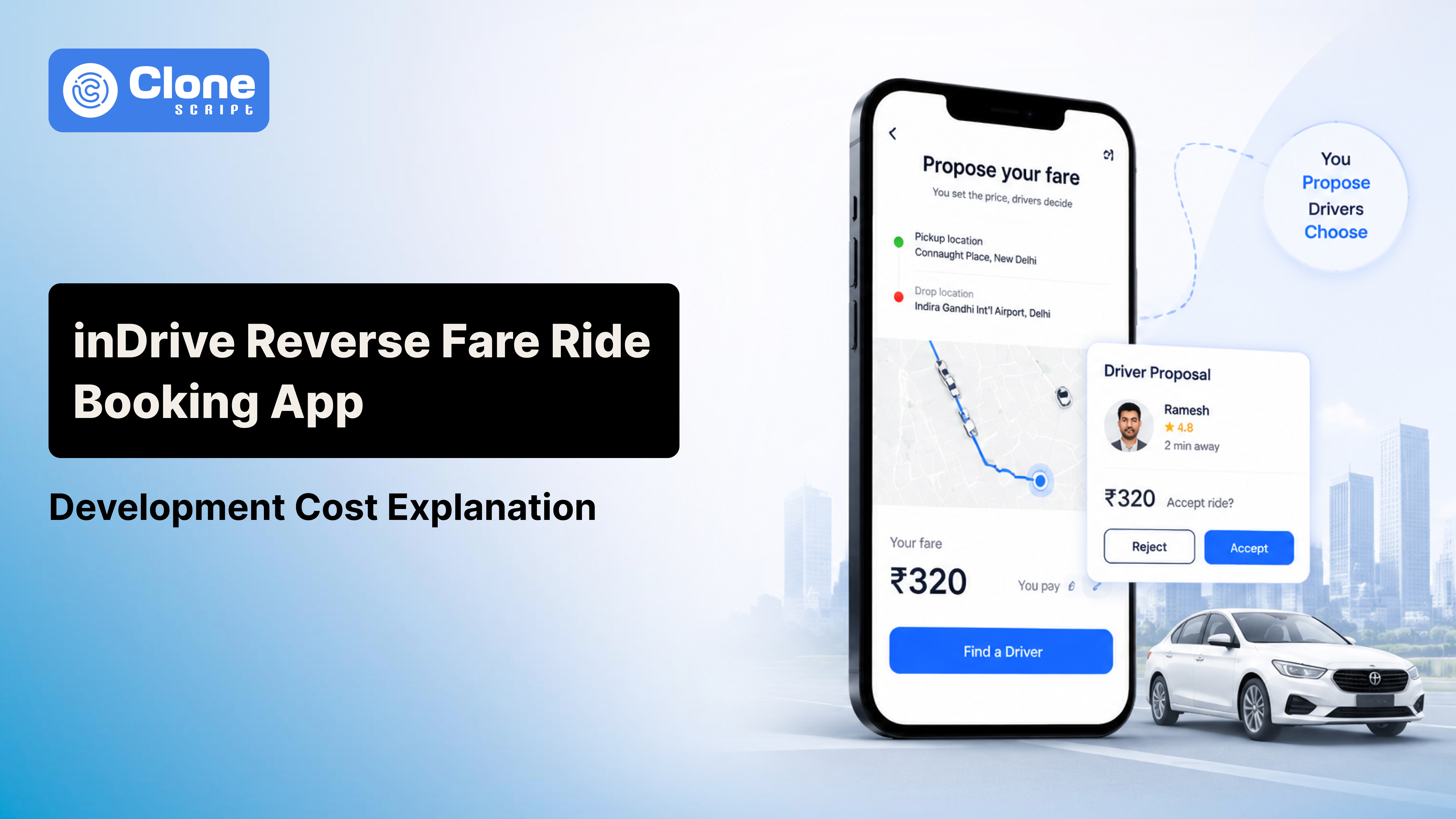
inDrive Reverse Fare Ride Booking App Development Cost Explanation
When opening Uber or Ola, maybe Rapido, one thing you notice: as a user, you enter the pickup and drop location for ride booking, the app automatically calculates the fare, and finally, the driver accepts the trip. No fare negotiation that works.
inDrive disrupted that formula.
Instead of forcing passengers to accept algorithm-generated pricing, inDrive lets users propose what they want to pay. Sounds interesting. Drivers can accept, reject, or negotiate. That single shift changes both the customer experience and the technical architecture behind the product.
And that’s exactly why founders searching for inDrive reverse fare ride booking app development cost often discover that this is not a typical taxi app project.
If you're planning to launch a mobility startup, build a regional cab marketplace, or digitize an existing transport business, this guide explains the actual numbers, technical considerations, and budget expectations behind building an inDrive-style platform.
Why Entrepreneurs Are Interested in the inDrive Model
Ride-hailing is still one of the most attractive on-demand business categories.
The reason is simple: transportation remains a daily-use problem, and users are already comfortable solving it through apps.
But user behavior has changed.
Many customers dislike surge pricing, opaque fare calculations, and platforms that leave them with little control over pricing decisions.
That’s where inDrive found its opportunity.
Instead of a system saying, “Your ride costs $18. Take it or leave it,” users participate in the pricing process.
For founders researching to build an app like inDrive, that pricing flexibility feels like a compelling market differentiator.
It’s especially attractive in:
-
Price-sensitive regions
-
Emerging mobility markets
-
Countries with a taxi-fragmented structure
-
Cities where local transport remains unorganized
This is one reason searches for how much it costs to develop apps like inDrive have increased.
How the Reverse Fare Model Actually Works
At first glance, the concept seems straightforward.
A passenger opens the app, enters the destination, and proposes a fare.
Nearby drivers receive the request.
They can:
-
Accept the offer
-
Ignore it
-
Submit a counteroffer
The passenger then chooses the preferred driver.
Simple for users.
Not simple for mobile app developers.
A standard ride-booking app uses a mostly one-directional flow.
A reverse fare taxi app development model introduces live negotiation logic, event synchronization, state management, timeout handling, and concurrency controls.
That technical difference matters.
Because it directly affects the ride booking app development cost.
Why Building an inDrive Clone Costs More Than Expected
A lot of founders assume this is just another Uber clone.
It isn’t.
A standard Uber-like product mainly solves:
-
Ride request routing
-
Fare calculation
-
Driver dispatch
-
Payment collection
An inDrive clone app development project has to solve all of that, plus negotiation.
That means additional engineering complexity around:
-
Bid submission workflows
-
Counter-offer handling
-
Live communication between riders and drivers
-
Driver selection logic
-
Request expiration
-
Fallback routing
This is exactly why the reverse bidding ride booking app development cost is often higher than expected.
The negotiation layer isn’t a cosmetic feature.
It’s a core product engine.
Market Opportunity: Is the Business Worth It?
Before discussing cost, the business case matters.
The global ride-hailing market continues to expand aggressively, driven by smartphone adoption, digital payments, urbanization, and app-first transportation behavior.
This makes on-demand taxi app development attractive, but only if the business model fits the target geography.
An inDrive-style platform works particularly well when users:
-
Are highly price-conscious
-
Dislike surge pricing
-
Prefer negotiation-based structures
-
Already use informal transportation systems
In South-Asian markets like India, Vietnam, Thailand, Nepal, and Bhutan, the reverse fare ride booking app is perfect.
In developed markets, algorithmic pricing often wins due to convenience.
In flexible pricing markets, inDrive-style negotiation can outperform.
So if you're considering custom taxi booking app development, validate the market first.
Because product-market fit matters more than code quality.
Features Required for inDrive-like App Development
This is where many startup budgets go wrong.
They underestimate the scope.
A real feature required for an inDrive-like app build includes three products, not one:
-
Rider application
-
Driver application
-
Admin management system
That’s before infrastructure.
-
Rider App Experience
The rider's side needs more than booking.
A polished product usually includes account creation, live location detection, destination selection, fare proposal, bid comparison, trip tracking, payment handling, notifications, and support tools.
Without this, the experience feels incomplete.
For any serious bid-based taxi booking app, trust and speed are critical.
If negotiation takes too long or the interface feels clunky, users abandon the app.
-
Driver App Requirements
Driver experience often gets less attention than it should.
That’s a mistake.
Supply-side retention determines marketplace survival.
A production-ready driver app needs:
-
Onboarding
-
KYC verification
-
Vehicle registration
-
Request notifications
-
Bid acceptance workflows
-
Counter-offer tools
-
Navigation
-
Earnings management
-
Payout visibility
This is where the custom ride-hailing app development price starts increasing.
Because drivers aren’t passive participants.
They actively negotiate.
That changes UX design and back-end logic significantly.
-
Admin Control System
No mobility platform survives without strong operational visibility.
A serious admin dashboard usually manages:
-
Driver approvals
-
User accounts
-
Trip monitoring
-
Disputes
-
Commission structures
-
Payout management
-
Support escalation
-
Fraud detection
-
Analytics
A startup choosing cheap taxi app development services discovers too late that weak admin tooling creates operational chaos.
Technology Stack That Impacts Cost
There’s no universal stack.
But common architecture choices affect delivery speed and long-term cost.
For front-end mobile app development, most startups choose Flutter or React Native to reduce launch cost.
Native apps like iOS and Android offer performance benefits, but significantly increase the budget.
Back-end infrastructure often relies on Node.js or NestJS for real-time event handling.
For data storage:
-
PostgreSQL handles transactional consistency
-
Redis supports caching and live state
-
MongoDB helps with flexible metadata
Real-time negotiation usually requires WebSockets or Socket.io.
Maps integration often uses Google Maps or Mapbox.
Payment infrastructure depends on geography. Stripe works well internationally. Razorpay is common in India.
AWS remains a typical cloud deployment choice.
These technical decisions shape the overall taxi booking app development cost.
How Much Does It Cost to Build an App Like inDrive?
Now the question founders actually care about:
How much does it cost to build an app like inDrive?
The short answer?
It depends heavily on the scope.
But realistic estimates look like this.
-
MVP Build
If you're launching a validation-focused MVP with essential functionality, expect: $25,000 to $60,000.
This typically covers:
-
Rider app
-
Driver app
-
Admin panel
-
Authentication
-
Booking flow
-
Bidding
-
Live trip tracking
-
Notifications
-
Payment basics
This is a reasonable taxi app MVP development cost range for outsourcing teams in cost-efficient regions.
US or Western European agencies can easily charge 2x–4x more.
-
Growth-Stage Product
If your goal is stronger UX, scalability, analytics, and retention tooling. The budget range has to be $60,000 to $120,000.
This range often includes:
-
In-app chat
-
Advanced wallet systems
-
Referral logic
-
Masked calling
-
Richer analytics
-
Better reporting
-
Stronger admin operations
This is a practical inDrive clone app cost estimate for serious startups.
-
Enterprise Platform
For multi-city deployment with production scalability. The budget is $120,000 to $300,000+.
At this level, you're solving:
-
Infrastructure scaling
-
Performance optimization
-
Security hardening
-
Compliance
-
Advanced fraud systems
-
Operational automation
This is where the cost to develop a bid-based taxi booking platform becomes a strategic investment, not just a development expense.
Why MVP Strategy Matters in Reverse Fare Daily Transportation Platform
Founders often ask whether they should build the full platform immediately.
Usually, no.
The smarter move is validation.
A lean MVP helps answer critical business questions:
-
Will drivers accept negotiated pricing?
-
Will riders trust the bidding process?
-
How fast does matching occur?
-
What acquisition channels work?
-
What churn patterns emerge?
Jumping directly into enterprise custom taxi booking app development often wastes capital before product-market fit exists.
That’s why taxi app MVP cost planning matters more than chasing full-feature perfection.
Uber Clone vs inDrive Clone: Which Costs More?
This comparison matters.
An Uber clone focuses on automation.
Fare logic is centralized.
The system decides pricing.
Driver matching is relatively straightforward.
An inDrive-style product adds marketplace negotiation.
That means:
-
More realtime logic
-
More edge cases
-
More interaction states
-
Higher back-end complexity
So yes, reverse fare taxi app development generally costs more than a traditional Uber-style MVP.
But the product can also differentiate more strongly in certain regions.
Hidden Costs Founders Miss in Reverse Fare Ride Booking App
Development quotes rarely tell the whole story.
The biggest hidden expenses include:
-
API Costs: Maps APIs cost more because they can become expensive fast, especially at scale.
-
Infrastructure Scaling: Real-time systems demand a stronger backend architecture.
-
Maintenance: Annual maintenance commonly runs 15–25% of the original build cost.
-
Security: Fraud prevention becomes mandatory in transport marketplaces.
-
Compliance: Local transport regulations can force unexpected implementation changes.
These hidden factors affect the final ride booking app development company proposal more than many founders expect.
Should You Buy a Clone Script Instead?
Some founders compare custom development against prebuilt products.
Clone scripts look cheaper.
But they usually create technical debt.
Common problems with the ready-made solutions are:
-
Poor architecture
-
Weak scalability
-
Security vulnerabilities
-
Bad code quality
-
Generic UX
-
Limited customization
These issues are faced only when a non-reputable or unreliable clone script provider is contacted.
All Clone Script, like premium-clone script providers, manage the entire development efficiently and professionally. Our car rental platform script is ready to use, and we can offer a completely customized solution to you.
If you're serious about growth, professional taxi app development services usually outperform cheap templates.
Conclusion
Building an inDrive-style product is not impossible.
But it isn’t cheap either.
A negotiation-based mobility platform introduces engineering complexity that standard taxi apps simply don’t have.
If your target market supports flexible pricing, the business opportunity can be strong.
But success depends on validating economics, not just launching software.
A lean MVP may be enough to test demand.
A production-grade rollout requires serious capital.
If you're budgeting realistically, an app like inDrive development cost typically starts around MVP validation levels and climbs quickly as scalability, security, and operations mature.
For startups, the smartest path is rarely the biggest build.
It’s the most strategically validated one.