BTC - Bitcoin
 USDTERC20 - USDT ERC20
 ETH - Ethereum
 BNB - Binance
 BCH - Bitcoin Cash
 DOGE - Dogecoin
 TRX - TRON
 USDTTRC20 - USD TRC20
 LTC - LiteCoin

How Much Does It Cost to Build a Ride Booking Mobile App Like Uber in 2026?
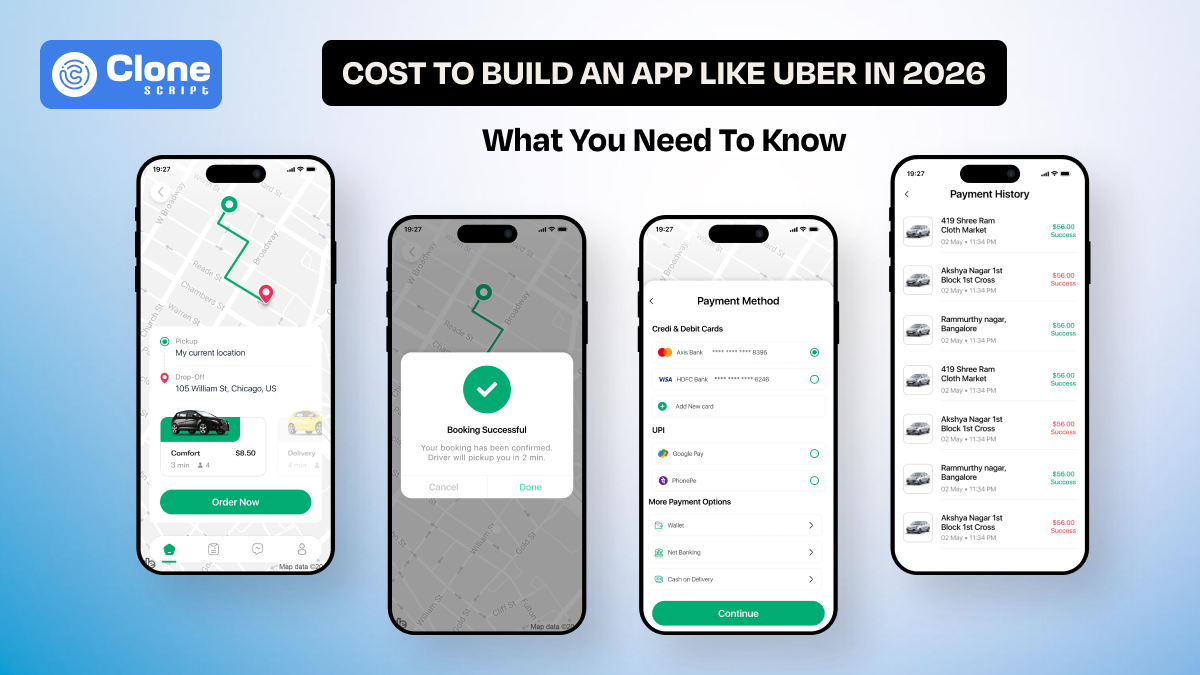
The cost to build an app like Uber in 2026 is not only a simple development estimate, such as 8 weeks to 30 weeks. It is a strategic investment decision shaped by infrastructure complexity, regulatory requirements, AI integration, and long-term scalability planning.
When we look at a decade ago, in early 2014s to 2015s, launching a secure ride-hailing map meant integrating maps, payments, and driver matching. Today, mobility platforms operate as high-performance digital ecosystems.
As user expectations increase and competition intensifies, development costs reflect far more than UI design or back-end coding. They reflect the engineering required to deliver reliability under high transaction volume.
This guide provides a structured, realistic breakdown of Uber app development cost in 2026, including feature-based pricing, infrastructure investment, maintenance expenses, and cost-efficient alternatives for founders entering the mobility industry.
Understanding the Core Business Model of an Uber-Like App in 2026
An app modeled after Uber Technologies, Inc. operates as a multi-sided marketplace that monetizes real-time mobility transactions. Its core business model revolves around connecting riders and drivers through algorithm-driven matching while generating revenue via commission per ride, dynamic pricing margins, and service fees. The technology layer is functional and a revenue infrastructure.
At its foundation, the platform includes three synchronized components:
-
Rider application
Through the rider mobile application, users can book a ride, real-time driver tracking, estimate fares automatically, make digital payments, and manage their trip history. Here, fast response time directly impacts customer retention and ride frequency.
-
Driver application
This app provides trip alerts, navigation support, earnings tracking, availability toggling, and performance ratings to drivers. Implementing efficient dispatch algorithms maximizes driver utilization and platform commissions.
-
Admin dashboard
This solution is not publicly available as a rider and driver application, but only fleet management businesses can have access. They control commission structures, onboarding verification, pricing rules, dispute management, and operational analytics.
Each layer supports marketplace liquidity, operational efficiency, and revenue scalability, key drivers influencing total ride-hailing app development cost.
Cost to build an app like Uber in 2026 (detailed breakdown)
The Uber app cost for 2026 depends on strategic intent.
Are you validating a local market, preparing for regional expansion, or engineering a national mobility network? Development budgets scale according to back-end complexity, automation depth, and infrastructure resilience.
Below is a structured breakdown based on realistic global development benchmarks.
-
MVP Version (Market Validation Stage) estimated cost range is $25,000 to $50,000.
An MVP focuses on operational testing within a single city, such as New York (in the USA) or Rio de Janeiro (Brazil). It includes essential ride-booking functionality, GPS-based driver tracking, a basic payment gateway, and a simplified admin panel.
When it comes to commission logic in this app, it is often semi-automated, and the infrastructure is configured for moderate traffic, like under 1000 users/month.
This version is designed to test demand, optimize acquisition strategy, and validate unit economics. However, it is not built for high concurrency or rapid geographic expansion. Its objective is controlled experimentation, not large-scale deployment.
-
A mid-level scalable platform may cost around $50,000 to $120,000.
At this stage, the platform transitions from validation to growth readiness. The back-end architecture becomes more robust, supporting automated commission structures, multiple payment integrations, push notifications, and enhanced UI/UX. That’s why it costs $50,000 to $120,000.
So, where does the investment go? It shifts toward performance optimization, database structuring, and system reliability. This level supports increasing ride volume and prepares the business for multi-city operations in a country single state, or a region.
-
Enterprise-level Uber clone costs are $120,000 to $300,000+.
Enterprise mobility platforms are engineered for national or multi-city expansion. In it, the development phase includes AI-powered route optimization, dynamic surge pricing engines, fraud detection systems, cloud auto-scaling infrastructure, and advanced analytics dashboards. As a result, the cost is $120,000 to $300,000+.
This capital has been invested in infrastructure development that enables the system to process high transaction volumes with real-time synchronization. At this level, reliability, scalability, and operational automation become the primary cost drivers.
Feature-based cost estimation for the Uber app.
The Uber clone app cost depends heavily on the feature engineering depth. Below is a concise explanation of each proper feature.
Core features are estimated to cost around $15,000 to $30,000.
This is the list of primary features available in the Uber app.
-
User Authentication: This feature is deployed for a secure login system enabling user registration, identity verification, and protected account access.
-
Real-Time Tracking: Through this feature, GPS-powered location tracking displays live driver movement and route updates instantly.
-
Payment Integration: To accept the payments, an integrated digital payment system supporting cards, wallets, automated fare calculation, and settlements.
-
Push Notifications: This feature allows instant alerts informing users about ride status, driver arrival, and payment confirmations.
-
Ratings & Reviews: To know about the service, a two-way feedback system ensures service quality control and driver performance monitoring.
Advanced features are estimated at $20,000 to $60,000.
Take a look at these latest features to add in ride-hailing app.
-
Dynamic Pricing Algorithm: This feature automates surge pricing, adjusts fares based on demand, traffic, and driver availability.
-
Incentive Management System: It includes structured bonus logic rewarding drivers based on ride volume or performance.
-
In-App Wallet: Adding a digital wallet storing credits, refunds, and promotional balances helps to manage seamless transactions.
-
Trip Scheduling: Using this pre-booking feature allows users to schedule rides for future time slots.
-
Data Analytics Module: This feature provides dashboard analytics tracking revenue trends, ride frequency, and operational performance.
Infrastructure components costs for $15,000 to $50,000.
This is what the basic infrastructure cost investment is for a fleet management app.
-
Cloud Configuration: The scalable cloud environment setup supports auto-scaling, uptime reliability, and performance optimization.
-
Database Optimization: Structured database architecture ensuring fast queries and high-volume transaction handling.
-
Security Encryption: This includes data protection protocols that encrypt user information, payments, and authentication credentials.
-
API Architecture: A back-end communication framework allowing seamless interaction between apps and servers.
The type of features you prioritize in the Uber ride booking app development decides whether spending $20,000 enough or if you need additional budget for it.
Key Factors That Influence the Uber App Development Cost
Uber app development is shaped by architectural decisions, infrastructure selection, and compliance requirements. Each strategic choice affects both upfront development expenses and long-term operational sustainability.
-
Platform Strategy
Choosing between native and cross-platform development significantly impacts cost structure.
Building separate native applications for iOS and Android requires independent codebases, platform-specific optimization, and QA cycles. This increases development hours and overall budget.
On the other hand, cross-platform frameworks like Flutter and React Native reduce development effort by offering shared codebases. This approach can lower initial costs by 20–30%. You can also ask development teams to use the taxi booking Flutter template that comes with UI design and source code.
However, performance-intensive features such as real-time tracking and background processing must be evaluated carefully before selecting this route.
-
Real-Time GPS and Mapping
Location tracking is the operational core of any ride-hailing system. Integration with mapping services such as Google Maps requires API configuration, route rendering logic, and continuous synchronization between driver and rider devices.
Beyond development effort, API usage generates ongoing costs. As ride volume increases, mapping requests scale proportionally, impacting monthly operational expenses.
-
Payment Architecture
Payment infrastructure in 2026 extends beyond simple card processing. Modern mobility platforms require multi-currency support, automated driver payouts, digital wallet systems, and transaction auditing.
Compliance with PCI-DSS standards adds additional development layers for encryption, tokenization, and fraud detection. These regulatory safeguards increase both development time and operational expenditure.
-
Cloud Infrastructure
Scalable ride-sharing apps depend on cloud providers such as Amazon Web Services, Google Cloud, or Microsoft Azure.
Web infrastructure costs fluctuate based on traffic surges, database query loads, storage requirements, and real-time synchronization demands. Auto-scaling environments improve reliability and uptime but require higher cloud budgeting.
It’s a fact that cloud architecture decisions directly influence long-term scalability and cost predictability.
-
Security and Compliance Standards
Regulatory compliance is mandatory in 2026 mobility markets. Data encryption protocols, secure authentication mechanisms, regional data residency regulations, and fraud monitoring systems typically increase total development cost by 10–20%.
Security is not an optional enhancement layered on after launch of the ride-hailing app. It must be integrated into the back-end architecture from the beginning to avoid costly rework.
In mobility platforms handling financial transactions and sensitive user data, foundational security is not different from the total development cost.
Uber App Development Technology Stack Required
Selecting the right technology stack directly influences performance, scalability, security, and long-term maintenance cost. In mobility platforms, the stack must support real-time data synchronization, high transaction throughput, and seamless user experience across devices.
Below is a structured overview of the core technologies typically used in 2026 ride-hailing development.
-
Front-end Technologies
Front-end technologies and frameworks determine how efficiently the rider and driver applications perform across devices.
-
Flutter / React Native
These cross-platform frameworks enable developers to write a shared codebase for iOS, Android, and the web. They reduce development time and cost while maintaining near-native performance. For startups prioritizing speed-to-market and cost efficiency, cross-platform frameworks are often the preferred choice.
-
Swift / Kotlin
These native languages are used for iOS and Android development, respectively. Native apps provide superior performance, smoother animations, and better device-level optimization. However, they require separate development cycles, increasing overall cost.
-
Back-end Technologies
The back-end development manages ride matching, payment processing, data synchronization, and system logic.
-
Node.js
This is ideal for real-time applications due to its event-driven architecture. Node.js handles high concurrency efficiently, making it suitable for ride dispatch systems.
-
Django
A robust framework built on Python, known for rapid development and built-in security features. It is suitable for scalable mobility platforms requiring a structured architecture.
-
Laravel
A PHP-based framework offering clean syntax and strong back-end capabilities. It works well for structured marketplace platforms with moderate concurrency requirements.
-
Database & Infrastructure
Mobility platforms require capable databases for handling high-volume transactions and real-time updates.
-
PostgreSQL
This is a powerful relational database ideal for structured transactional systems and financial record management. After all, maintaining security is a top priority for fleet management service providers.
-
MongoDB
A NoSQL database optimized for flexible data structures and high-speed read and write operations. This is required for multi-city operational ride-hailing platforms.
-
Amazon Web Services, Google Cloud, Microsoft Azure
These cloud providers offer scalable infrastructure, auto-scaling environments, load balancing, and global deployment capabilities. Infrastructure selection significantly impacts performance reliability and operational cost predictability.
A well-aligned technology stack ensures that the ride-hailing platform remains scalable, secure, and operationally efficient as user demand grows.
Uber App Development May Take 3 - 12+ Months to Complete.
The development timeline is a direct cost variable. The longer the build cycle, the higher the engineering overhead, QA iterations, infrastructure testing, and project management expenses.
-
MVP Development Timeline is 3–4 Months.
An MVP typically requires three to four months when built by a structured team. This phase focuses on essential ride-booking workflows, basic GPS tracking, payment gateway integration, and a minimal admin dashboard.
The objective is operational validation. Development effort remains controlled because infrastructure is configured for moderate user traffic and limited geographic coverage.
-
Scalable Platform Timeline (5–8 Months)
A growth-ready mobility platform generally requires five to eight months. Additional time is allocated for back-end optimization, database structuring, automated commission logic, push notifications, and performance stress testing.
This stage involves deeper quality assurance cycles to ensure the system can handle increased ride volume without latency or failure.
-
Enterprise-Level Timeline (8–12+ Months)
Enterprise mobility solutions often require eight to twelve months or more. The extended timeline supports AI-based pricing logic, fraud detection systems, multi-city architecture, auto-scaling cloud environments, and advanced analytics modules.
Longer timelines increase team size requirements, DevOps costs, and comprehensive security audits that directly influence total development investment.
Cost Comparison: Custom Uber App vs Clone Script
Choosing between full custom app development and a structured clone solution is a strategic capital decision. The right choice depends on market ambition, funding capacity, and long-term scalability plans.
Below is a practical comparison to support informed decision-making.
|
Factor |
Custom Development |
Mobility Clone Script |
|---|---|---|
|
Initial Cost |
$50,000 – $300,000+ depending on scope |
Lower upfront investment |
|
Development Time |
6–12+ months, including testing cycles |
Faster deployment (weeks, not months) |
|
Scalability |
Depends entirely on backend architecture quality |
Pre-structured architecture built for scaling |
|
Customization |
Full architectural control |
Flexible back-end with configurable modules |
Maintenance |
High ongoing DevOps and engineering dependency |
Structured support and predictable updates |
When Custom Development Makes Sense
Custom development is appropriate if you are building a highly differentiated mobility model along with substantial funding and long-term technical resources. If you require proprietary algorithms or deep system control and plan national or global expansion from the outset.
However, custom builds carry higher financial exposure. Extended development timelines delay market entry, and architectural miscalculations can result in expensive rework.
When a Mobility Clone Script Is the Smarter Decision
For startups entering regional or niche mobility markets, a structured clone solution offers practical advantages like reduced capital risk, faster time-to-market, proven booking and commission infrastructure, and lower development dependency.
Instead of allocating $40,000+ to back-end architecture alone, founders can launch with pre-made systems and focus on customer acquisition and operational efficiency.
Strategic Decision Framework
Before deciding, evaluate the available development budget, target market size (single city vs multi-city), time-to-market urgency, technical team availability, and long-term ownership strategy. The decision should align with capital strategy, scalability roadmap, and operational capacity.
Conclusion
The cost to build an app like Uber in 2026 ranges from $25,000 for a basic MVP to over $300,000 for enterprise-grade platforms. The wide range reflects differences in architecture depth, scalability goals, and regulatory compliance.
The critical question is not simply “How much does it cost?” but “What level of infrastructure does your growth strategy require?”
Custom development offers full flexibility but increases financial exposure. Structured mobility solutions reduce upfront investment and expansion potential.
In mobility technology, sustainable scalability matters more than initial launch speed.
FAQs
-
Is building an Uber-like app profitable in 2026?
Yes, profitability is achievable in 2026 if unit economics, driver supply, demand density, and operational efficiency are optimized.
-
What are the ongoing maintenance and operational costs?
Annual maintenance typically equals 15–25% of development cost, covering servers, updates, security patches, API usage, and support.
-
How can I reduce the cost to build an app like Uber?
Launch with an MVP, use cross-platform development, limit early features, and consider scalable clone infrastructure to reduce the cost.
-
What is the minimum budget required to start?
A basic MVP typically requires $25,000–$50,000, depending on feature scope and development region. It includes the basic features having in a Uber app.
-
What are the main revenue models for ride-hailing apps?
There are four types of ways: 1. commission per ride, 2. surge pricing margins, 3. driver subscriptions, and 4. in-app advertising generate primary revenue streams.