BTC - Bitcoin
 USDTERC20 - USDT ERC20
 ETH - Ethereum
 BNB - Binance
 BCH - Bitcoin Cash
 DOGE - Dogecoin
 TRX - TRON
 USDTTRC20 - USD TRC20
 LTC - LiteCoin

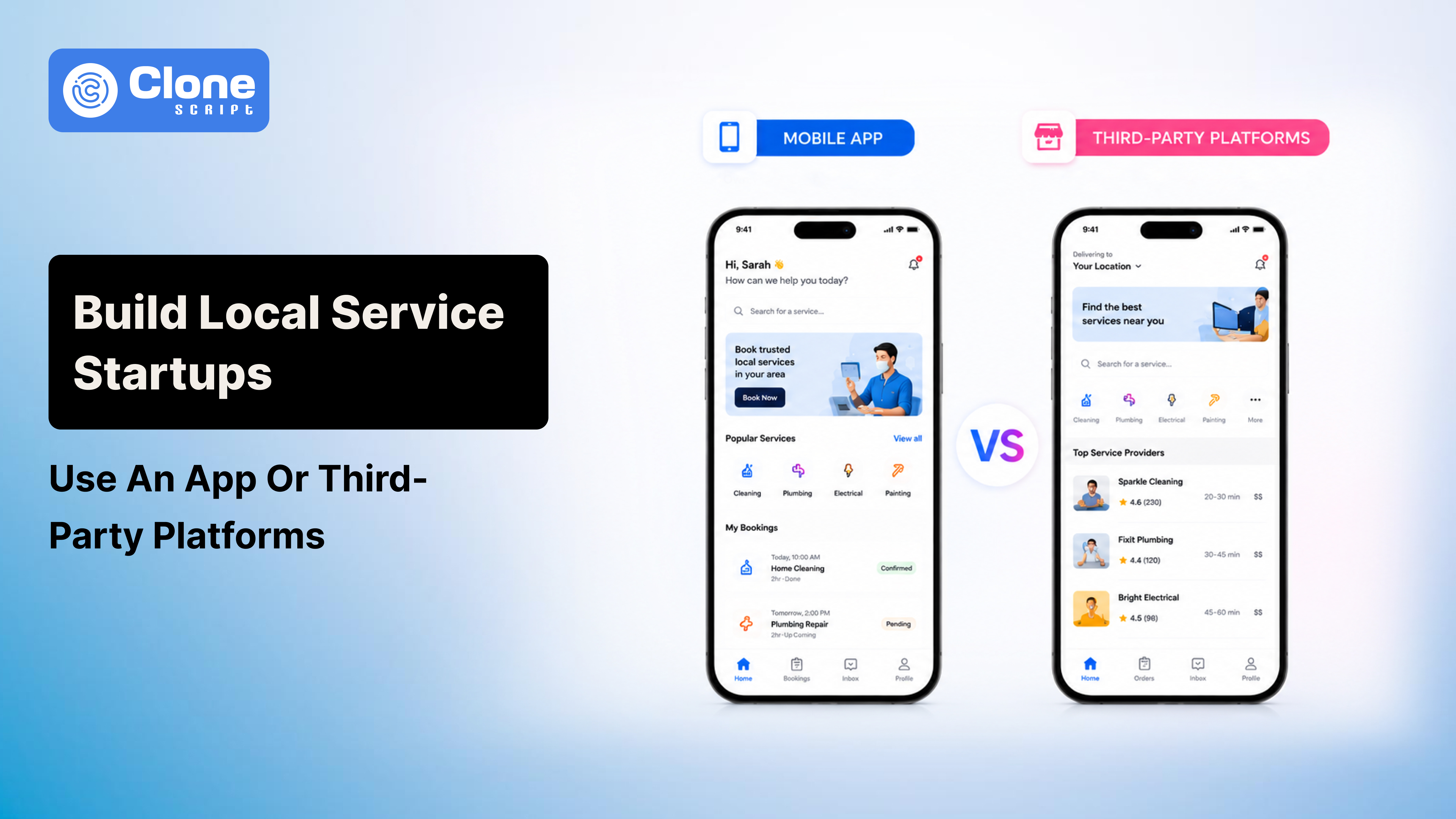
Should Local Service Startups Build an App or Use Third-Party Platforms First
If you’re building a local service startup today, there’s a high chance this question has already come up in your planning discussions:
Should we build our own mobile app, or should we rely on third-party platforms first?
It’s a practical question, not a branding question.
For founders launching a home service startup, a beauty-on-demand business, a repair service company, a healthcare booking solution, a pet care marketplace, or any location-based service model, this decision can influence growth speed, margins, customer ownership, and long-term scalability.
This is the real local service startup mobile app vs third-party platform debate.
Despite what many development agencies may suggest, there isn’t a universal answer.
Some businesses waste months and significant capital trying to develop their own app before proving demand. Others become too dependent on marketplaces and discover too late that scaling a business on rented customer relationships is expensive.
The smarter move depends on where your business is today.
Let’s break it down properly.
Why This Decision Matters More Than Most Founders Think
At first glance, choosing between a service business mobile app and marketplaces looks like a technology decision.
It isn’t.
It’s a growth strategy decision.
Because what you’re really deciding is:
-
How will customers discover you?
-
Who owns the customer relationship?
-
What will your customer acquisition cost look like?
-
Can you retain customers profitably?
-
How scalable is your marketplace business model?
-
Will margins improve over time or reduce?
For local services, these questions matter more than product aesthetics.
A beautifully UI and UX designed app with no repeat users is not an asset.
Likewise, high marketplace visibility with unsustainable marketplace commissions can quietly damage unit economics.
That’s why founders need to think beyond “app vs platform” and look at business fundamentals.
Know Third-Party Platforms for Local Service Businesses.
Before comparing options, let’s define what we mean.
Third-party platforms for local service businesses are existing marketplaces where businesses connect with customers through someone else’s ecosystem.
Examples include:
-
Urban Company
-
Thumbtack
-
TaskRabbit
-
Practo
-
Rover
-
Housecall Pro marketplace directories
-
Zomato
This is the classic marketplace business model.
The platform handles discovery, booking infrastructure, payment trust, and in many cases, customer support.
For early-stage startups, this feels attractive for one simple reason: You get immediate market access.
Instead of spending months on local service app development, you can start testing demand almost immediately.
That’s why many founders begin with a startup marketplace strategy.
But that doesn’t automatically make it the right long-term decision.
Why Third-Party Platforms Work So Well in Early Stages
There’s a reason marketplaces continue to attract startups.
They solve several painful early-stage problems at once.
-
Faster Go-to-Market Execution
If speed matters, marketplaces usually win.
Launching your own booking app for a service business requires:
-
Back-end architecture
-
Account systems
-
Scheduling logic
-
Service-providing onboarding workflows
-
Booking management tools
-
Payment gateway setup
-
Notification systems
Even lean MVP builds take time.
A marketplace eliminates most of that complexity.
Instead of building infrastructure, you focus on delivering service.
That matters when you’re still validating demand.
-
Lower Initial Investment
One of the biggest reasons founders delay their own app vs marketplace decisions is cost.
A complete local service business app is not cheap.
Approximate ranges:
-
No-code MVP: $3,000–$12,000
-
White-label implementation: $8,000–$25,000
-
Cross-platform MVP: $20,000–$60,000
-
Custom native product: $60,000+
And development is only the beginning.
You also need:
-
Bug fixes
-
Infrastructure
-
Updates
-
Analytics
-
Performance optimization
-
Compliance work
That’s before acquiring a single customer.
Marketplaces reduce that risk.
-
Existing Demand and Built-In Lead Generation
Customer acquisition is hard.
That’s not an opinion. It’s one of the most expensive realities in startup growth.
Platforms already have user traffic.
That means immediate lead generation creates opportunities.
If someone searches for plumbing, salon services, AC repair, or dog walking, they’re already in buying mode.
That solves an early visibility problem most startups struggle with.
Without that traffic, your independent app still needs acquisition channels.
And those channels cost money.
-
Trust Infrastructure Already Exists
Trust is a major barrier in local services.
People hesitate before inviting strangers into their homes.
This is especially true for:
-
Cleaning
-
Repair services
-
Beauty appointments
-
Child care
-
Pet care
-
Healthcare visits
Marketplaces reduce hesitation through:
-
Reviews
-
Ratings
-
Verification
-
Refund policies
-
Dispute handling
For unknown startups, borrowing that trust can accelerate conversions.
-
Better Demand Validation
A common founder mistake is building too early.
The question isn’t simply whether startups should build a mobile app.
The real question is: Have you validated repeat customer demand?
A marketplace helps test:
-
Pricing appearance
-
Booking frequency
-
Geography performance
-
Customer behavior
-
Cancellation patterns
-
Retention signals
That makes it a useful validation environment.
The Hidden Costs of Third-Party Dependency
Now the uncomfortable part.
Marketplaces help early growth, but they come with strategic limitations.
And these limitations become more serious as your business grows.
-
Marketplace Commissions Kill Margins
This is often the first pain founders feel.
Platforms charge:
-
Listing fees
-
Booking fees
-
Promotional placements
-
Success commission
-
Subscription access
These commission fees reduce profitability immediately.
A startup operating on already thin service margins can struggle here.
For example:
A cleaning business earning 25% gross margin can quickly lose meaningful profit after platform deductions.
This is where marketplace vs own platform becomes a financial discussion.
-
You Don’t Own Customer Relationships
This is one of the biggest strategic disadvantages.
On many marketplaces, you cannot fully:
-
Access the customer's contact details
-
Build remarketing campaigns
-
Personalize retention journeys
-
Control the relationship lifecycle
That means you don’t fully own customer data.
And if you don’t control customer relationships, your customer retention strategy becomes weaker.
Repeat revenue becomes harder to engineer.
-
Platform Dependency Risk Is Real
This is not hypothetical.
Platform dependency risk shows up when:
-
Ranking algorithm changes
-
Fees increase
-
The category competition grows
-
Policies shift
-
Accounts face suspension
If 80% of your revenue depends on someone else’s marketplace rules, you don’t fully control growth.
That’s operational fragility.
-
Weak Brand Differentiation
On marketplaces, users compare options quickly.
Usually based on:
-
Price
-
Availability
-
Star ratings
-
Speed
Your actual brand becomes secondary.
That’s dangerous if you’re trying to build long-term positioning.
A startup selling premium convenience cannot succeed if customers only see price comparisons.
When Building Your Own App Starts Making Sense
This is where the conversation shifts.
An owned app is not automatically smarter.
But under the right conditions, it becomes strategically useful.
Let’s examine why.
-
Customer Ownership Changes Economics
A branded service business mobile app gives direct access to customer behavior.
You can track:
-
Booking patterns
-
Usage frequency
-
Service preferences
-
Cancellation trends
-
Campaign responses
That improves retention and monetization.
More importantly, it enables direct customer acquisition over time.
Instead of repeatedly paying intermediaries, you nurture repeat behavior internally.
That changes economics significantly.
-
Repeat Bookings Become Easier
Many local services depend on recurring demand.
Examples include:
-
Monthly cleaning
-
Recurring grooming
-
Health consultations
-
Maintenance visits
-
Beauty memberships
In these businesses, repeat bookings matter more than first bookings.
Apps reduce friction by making re-engagement simple.
One-tap rebooking beats forcing customers to search marketplaces repeatedly.
-
Push Notifications Improve Lifecycle Marketing
One major app advantage is push notifications.
These enable proactive engagement:
-
Maintenance reminders
-
Promotional offers
-
Subscription renewals
-
Seasonal campaigns
-
Abandoned booking recovery
This helps retention.
It’s particularly useful when customer timing matters.
-
Operational Automation Improves Scale
As businesses grow, manual coordination becomes expensive.
A secured on-demand service app can improve operational automation through:
-
Automated dispatch
-
Technician routing
-
Status tracking
-
Digital invoices
-
Automated confirmations
-
Internal escalation workflows
This reduces administrative overhead.
-
Brand Loyalty Becomes an Actual Asset
One of the biggest differences between using marketplaces and owning your own product is brand memory.
When customers book through marketplaces, they often remember the platform, not the service provider.
That weakens long-term differentiation.
A dedicated brand loyalty app changes that.
Instead of being one option in a comparison list, your startup becomes the destination.
That matters in categories where convenience and repeat behavior drive growth.
Think about businesses like:
-
Recurring laundry pickup
-
Home deep cleaning subscriptions
-
At-home beauty memberships
-
Pet care plans
-
Maintenance packages
-
Recurring health check consultations
These are not one-time transactions.
They’re relationship-driven businesses.
Relationship-driven businesses benefit from ownership.
But Building an App Too Early Is a Common Founder Mistake
Now for the reality check.
Apps are not magic growth engines.
Plenty of startups spend heavily on product development and discover that customers still don’t come.
That happens because building technology does not solve distribution.
Let’s understand the risks.
-
App Development ROI Can Be Unclear
This is where founders often underestimate complexity.
Yes, owning a product sounds strategically smart.
But what about app development ROI?
If customer acquisition remains expensive, a branded app may simply become a costly asset with low engagement.
You need to ask:
-
How many active monthly users do we realistically expect?
-
How many customers will actually download an app?
-
What is the retention rate?
-
Will repeat usage justify investment?
Without strong answers, development can become premature spending.
-
App Store Discovery Is Harder Than Founders Assume
Many founders assume launching an app creates visibility.
It doesn’t.
App store discovery is difficult unless your brand already has awareness.
Customers don’t usually browse app stores searching for unknown local service providers.
That means app distribution still requires marketing.
And marketing costs money.
This is why many startups overestimate app-led acquisition.
-
Download Friction Can Hurt Conversion
Apps create friction.
Even if your product is excellent, customers must:
-
Install the app
-
Create an account
-
Verify details
-
Learn navigation
-
Trust your brand
For one-time or urgent services, this can hurt conversion rates.
Imagine a customer needing an electrician immediately.
They’re more likely to use an existing platform than install a new app.
That’s why app-first strategies fail in some categories.
-
Ongoing Maintenance Is a Permanent Commitment
Technology is never “done.”
A real local service app development effort requires:
-
Bug fixes through QA and Testing
-
Performance monitoring
-
OS compatibility updates
-
Security patches
-
UX iteration
-
Analytics management
And if your startup scales, complexity increases.
The app becomes an operational product, not a one-time build.
That means engineering costs never truly disappear.
Mobile App vs Marketplace Platform: Direct Comparison
Here’s a realistic founder-level comparison of mobile app vs marketplace platform decisions.
| Factor | Mobile App | Third-Party Platform |
|---|---|---|
| Launch Speed | Slower | Fast |
| Upfront Cost | High | Low |
| Branding Control | Full | Limited |
| Customer Ownership | Strong | Weak |
| Retention Potential | High | Moderate |
| Repeat Revenue | Better | Restricted |
| Discovery | Difficult | Easier |
| Dependency Risk | Low | High |
| Operational Flexibility | Strong | Limited |
| Profit Margins | Better long-term | Lower |
| Scalability | Strong | Moderate |
This is the real own app vs marketplace comparison.
Neither option is universally superior.
Your goals matter.
When Third-Party Platforms Are the Smarter Choice
For many startups, marketplaces are the practical first step.
They make sense when:
-
You’re Still Validating Demand
If your assumptions are unproven, avoid overbuilding. A service marketplace startup often benefits from faster experimentation.
-
Budget Is Limited
If capital is tight, preserving cash matters more than product ownership.
-
Customer Acquisition Channels Are Weak
If you don’t yet know how to acquire customers independently, marketplaces provide distribution.
-
Your Business Model Is Transactional
If customers are unlikely to return often, ownership may matter less.
Examples:
-
One-time repairs
-
Emergency services
-
Low-frequency home fixes
When Building a Mobile App Makes More Sense
A dedicated appointment booking platform or branded app becomes stronger when repeat usage is central.
That includes businesses where customer relationships compound.
Examples are as follows:
-
Subscription-Based Services
If customers book monthly, ownership becomes valuable.
Examples:
-
Cleaning subscriptions
-
Salon memberships
-
Recurring maintenance
-
High Customer Lifetime Value Businesses
If customer lifetime value is strong, acquiring users directly becomes more economical.
-
Operationally Complex Services
A custom booking management system can improve efficiency. This matters when coordination complexity increases.
-
Loyalty-Driven Categories
If convenience creates habit, apps become a useful retention infrastructure.
The Hybrid Strategy Most Smart Startups Actually Follow
In practice, many successful founders don’t choose extremes.
They sequence growth.
This is often the smartest startup digital strategy.
A practical model looks like this:
Phase 1: Marketplace Validation
Use third-party ecosystems to test demand. The goals are to prove willingness to pay, understand retention, identify high-performing locations, and validate service economics.
Phase 2: Owned Website Funnel
Build a conversion-focused website. Start direct bookings. Reduce dependency gradually.
Phase 3: Progressive Web App
A progressive web app can be a smart intermediate step. There are benefits like lower development cost, mobile-friendly UX, faster deployment, and no app store dependency.
For many startups, this solves enough usability challenges without requiring native development.
Phase 4: Full App Ownership
Once retention economics are proven, a full local service business app becomes logical.
Now you have data, not assumptions.
What About White-Label Apps?
There’s a difference between a white-label app and custom development.
Some founders use a white-label app instead of custom development.
This can accelerate launch.
Pros of white-label:
-
Lower cost
-
Faster deployment
-
Prebuilt infrastructure
-
Reduced technical complexity
-
Limited customization
-
Dependency on vendor architecture
-
Scaling constraints
A white-label option works best as a transitional step, not always a permanent strategic foundation.
A Practical Decision Framework for Founders
Still unsure?
Use this checklist.
Choose Third-Party Platforms If:
-
You need speed
-
Demand is unproven
-
Acquisition channels are weak
-
The budget is constrained
-
Repeat customer behavior is uncertain
Choose an Owned App If:
-
Customers book repeatedly
-
Retention drives profit
-
Margins justify ownership
-
Brand differentiation matters
-
Direct engagement is strategically important
Choose Hybrid If:
-
Validation is done
-
Marketplace costs are increasing
-
Repeat users are growing
-
Direct traffic acquisition is becoming realistic
For many founders, hybrid is the most balanced answer.
FAQs
-
Is a mobile app necessary for a startup?
No. Not every startup needs an app. The decision depends on business model, retention economics, and acquisition strategy.
-
Should startups build a mobile app early?
Only if strong repeat behavior already exists. Otherwise, early development can become wasted spend.
-
What is better: marketplace vs own platform?
If speed matters, marketplaces often win. If ownership and retention matter, owned platforms become stronger.
-
Is a progressive web app enough?
In many cases, yes. A progressive web app can deliver booking functionality without native app complexity.
-
How risky is platform dependency?
Serious enough to monitor. Platform dependency risk becomes more dangerous as revenue concentration increases.