BTC - Bitcoin
 USDTERC20 - USDT ERC20
 ETH - Ethereum
 BNB - Binance
 BCH - Bitcoin Cash
 DOGE - Dogecoin
 TRX - TRON
 USDTTRC20 - USD TRC20
 LTC - LiteCoin

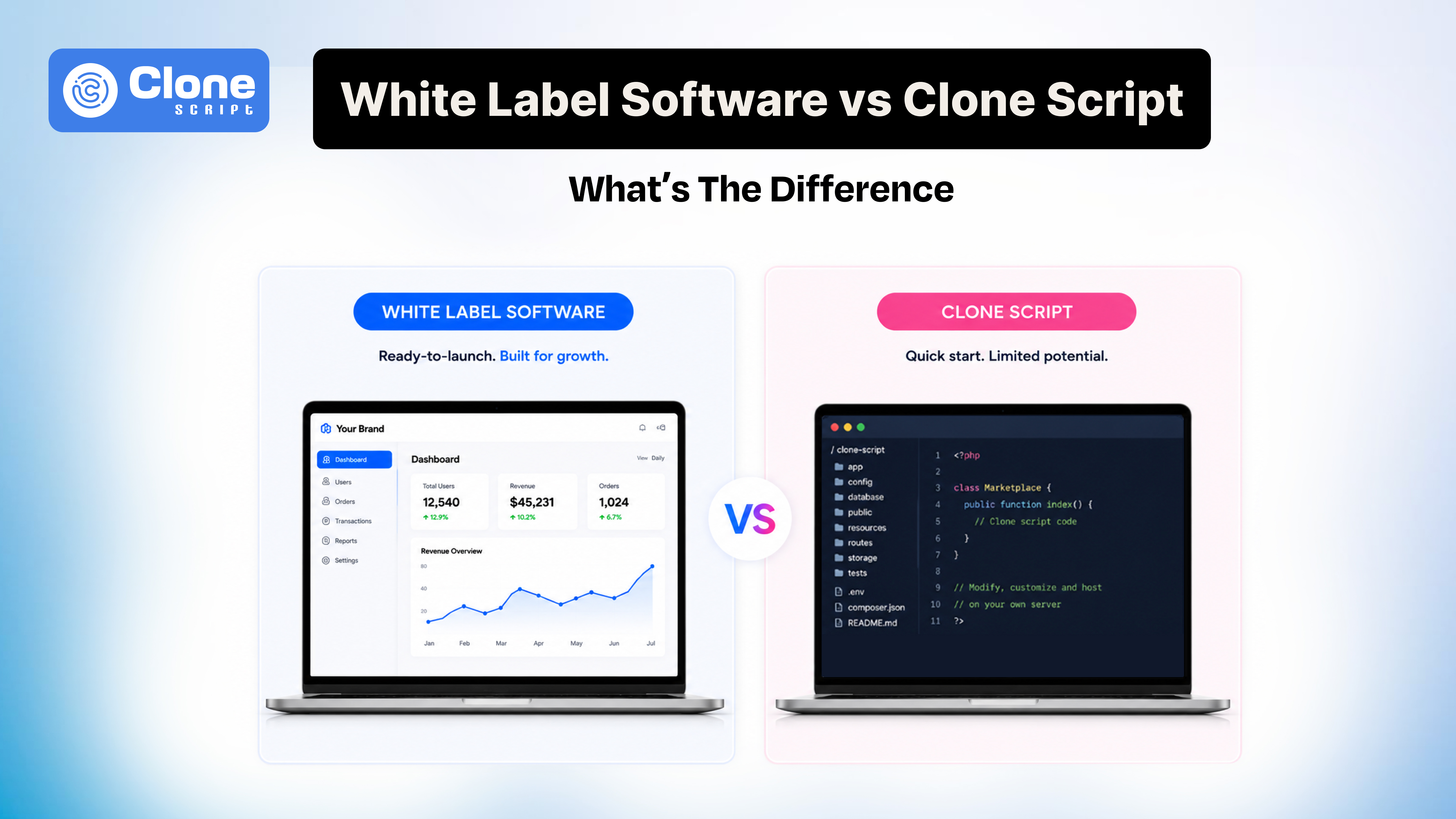
White Label Software vs Clone Script: What’s the Difference to Make a Decision
If you’re planning to launch a software business, you’ve probably come across two terms repeatedly: white-label software and clone scripts.
At first glance, they look almost identical.
Both promise faster launches. Both claim lower development costs compared to building from scratch. Both offer ready-made functionality that helps businesses get to market quickly.
So naturally, most buyers ask: What’s the actual difference?
The short answer?
A lot.
And choosing the wrong option can quietly become one of the most expensive business decisions you make.
A cheap clone script may look like a smart shortcut until scalability issues start appearing. A premium white-label solution may seem expensive upfront until you realize how much engineering time and operational risk it saves.
This isn’t just a technical decision.
It’s a business model decision.
In this guide, we’ll describe the real difference between white-label software and clone scripts, compare costs, scalability, customization, support, and long-term business value, so you can make the right decision.
White Label Software vs Clone Script: Quick Answer
If you want the fastest answer before diving deeper:
-
Choose white-label software if you want a professionally built, customizable, scalable product you can launch under your own brand.
-
Choose a clone script if your goal is low-cost MVP validation or rapid testing with limited upfront investment.
But that simplified answer doesn’t tell the full story.
Because the “better” option depends entirely on what you’re trying to build.
Let’s break it down.
What Is White Label Software?
White-label software is a pre-built software product created by a development company that allows businesses to rebrand and launch it as their own solution.
Think of it like buying a fully constructed house and redesigning the interiors to match your brand.
The structure already exists.
You don’t need to build the plumbing, electrical systems, or foundation from zero.
You customize what matters to your business.
For example, companies commonly use white-label software for:
-
Food delivery platforms
-
Taxi booking apps
-
Multi-vendor marketplaces
-
Cryptocurrency exchanges
-
eLearning platforms
-
SaaS CRM systems
-
Appointment booking platforms
Instead of investing months (or years) into development, you start with an existing architecture.
That’s why white-label software has become popular among startups, agencies, and entrepreneurs looking to reduce time-to-market.
Key Characteristics of White Label Software
Most white-label platforms include:
-
Custom branding capabilities
-
Admin dashboard access
-
Feature customization
-
Deployment support
-
Software updates
-
Technical maintenance
-
Licensing agreements
-
Vendor support
The biggest selling point?
Speed with structure.
You launch faster without sacrificing engineering quality.
What Is a Clone Script?
A clone script is a ready-made software script designed to replicate the core functionality of an existing successful platform.
For example:
-
Uber clone script
-
Airbnb clone script
-
Amazon clone script
-
Fiverr clone script
-
Netflix clone script
-
Binance clone script
The business logic is simple:
“If this business model already works, replicate it faster.”
That makes clone scripts attractive for entrepreneurs who want to enter proven markets quickly.
Instead of building a ride-sharing app from scratch, you buy an Uber clone.
Instead of engineering an e-commerce marketplace platform, you purchase an Amazon clone.
Sounds efficient.
And sometimes it is.
But there’s an important difference between replicating functionality and building a sustainable business platform.
That distinction becomes obvious as your business grows.
White Label Software vs Clone Script: The Core Difference
The easiest way to understand the difference is this:
White-label software is designed as a reusable commercial product. Clone scripts are designed to imitate an existing platform model.
That difference impacts everything:
-
Code quality
-
Flexibility
-
Vendor support
-
Scalability
-
Ownership
-
Security
-
Customization
-
Maintenance costs
One is usually built for structured commercialization.
The other is often built for rapid replication.
That doesn’t automatically make clone scripts bad.
It just means they solve different business problems.
White Label Software vs Clone Script Comparison Table
Here’s the side-by-side breakdown.
| Feature | White Label Software | Clone Script |
|---|---|---|
| Purpose | Commercial branded deployment | Functional replication |
| Development Quality | Usually structured and professionally engineered | Highly vendor-dependent |
| Customization | Moderate to extensive | Often limited or costly |
| Branding | Full branding support | Basic branding changes |
| Deployment Speed | Fast | Very fast |
| Technical Support | Usually included | Often inconsistent |
| Software Updates | Vendor-managed | May require separate payment |
| Scalability | Designed for business growth | Can become restrictive |
| Security Standards | Better in established products | Highly inconsistent |
| Licensing | Commercial licensing model | Often, the code purchase/license mix |
| Long-Term Maintenance | Lower operational burden | Higher technical dependency |
At a glance, clone scripts look attractive because of speed and price.
But software buying decisions rarely end at purchase.
That’s where the real comparison starts.
Cost Comparison: The Number Most Buyers Get Wrong
This is where most businesses make reactive decisions.
A clone script looks dramatically cheaper.
Typical pricing:
-
Clone script: $500–$10,000
-
White label software: $5,000–$50,000+
So naturally, many founders think:
“Why spend 10x more?”
Because the purchase price is not the ownership cost.
And that’s where bad decisions happen.
-
The Hidden Cost of Clone Scripts
A cheap clone script may require:
-
Architecture fixes
-
Code cleanup
-
Payment integration work
-
Bug fixing
-
Mobile optimization
-
Server performance tuning
-
Security patching
-
Third-party API adjustments
That initial $2,000 purchase can quickly become a $20,000 technical project.
Especially if the codebase is poorly structured.
And many are.
-
White Label Software Cost Reality
White-label software costs more because you’re paying for:
-
Tested architecture
-
Documentation
-
Deployment workflows
-
Support systems
-
Maintenance processes
-
Upgrade availability
-
Product maturity
That higher upfront investment often reduces long-term operational costs. White-label apps have hidden costs that have to be paid for.
The key question isn’t:
“Which option is cheaper today?”
It’s:
“Which option becomes more expensive over 12–24 months?”
That’s the better business metric.
Customization: Where Things Get Expensive Fast
Customization sounds simple until engineering gets involved.
This is where the practical gap between white-label software and clone scripts becomes obvious.
-
White Label Software Customization
Good white-label platforms are intentionally designed for modification.
That usually means easier access to:
-
Branding changes
-
Custom workflows
-
API integrations
-
Language localization
-
UI enhancements
-
Monetization adjustments
-
Admin permissions
This doesn’t mean unlimited freedom.
Licensing may still apply.
But the architecture is often designed with commercial customization in mind.
-
Clone Script Customization
This depends entirely on code quality.
And that’s risky.
Common problems include:
-
Tightly coupled logic
-
Undocumented code
-
Outdated frameworks
-
Hardcoded workflows
-
Poor folder structure
-
Dependency conflicts
This makes even “simple” changes expensive.
Changing the onboarding flow might take days.
Adding payment logic could require core rewrites.
That destroys the speed advantage clone scripts initially promised.
Scalability: The Dealbreaker Most Startups Ignore
Launching software is easy.
Scaling software is hard.
A platform handling 100 users behaves very differently from one handling 50,000.
Real business growth introduces:
-
Concurrent user load (called latency)
-
Database management
-
Payment transaction volume
-
API request spikes
-
Reporting complexity
-
Media storage scaling
-
Notification traffic
This is where architecture matters.
-
White Label Software Scalability
Established white-label platforms often include:
-
Modular architecture
-
Scalable API layers
-
Optimized databases
-
Cloud deployment readiness
-
Caching systems
-
Performance monitoring support
Not all vendors deliver this.
But mature providers usually think beyond launch.
-
Clone Script Scalability Problems
Not optimized clone scripts often struggle with the following:
-
Inefficient queries
-
Duplicated code
-
Unstable integrations
-
Server bottlenecks
-
Poor caching
-
Rigid architecture
Everything works in demos.
Until real traffic arrives.
That’s why many startups rebuild clone-script products later.
Security: Not Optional in White-Label and Clone Script
Security discussions often get skipped during buying decisions.
That’s a mistake.
Especially if your platform handles:
-
Payments
-
Customer accounts
-
Financial data
-
Business records
-
Messaging
-
Subscriptions
-
White Label Software Security
Professional vendors usually maintain:
-
Authentication layers
-
Patch management
-
API protection
-
Validation controls
-
Encryption standards
-
Dependency updates
That doesn’t guarantee perfection.
But operational maturity helps.
-
Clone Script Security Risks
The risks of lower-cost scripts often contain:
-
Outdated libraries
-
Weak admin access control
-
Poor input validation
-
Insecure API exposure
-
Vulnerable authentication flows
A security incident costs far more than software licensing.
Cheap software becomes expensive fast when trust is damaged.
Support and Maintenance in White Label and Clone Script
Software isn’t a one-time purchase.
It’s an ongoing operational asset.
That means maintenance matters.
-
White Label Software
Most established vendors provide:
-
Onboarding assistance
-
Issue support
-
Patch updates
-
Version upgrades
-
Deployment guidance
-
Technical documentation
This reduces execution risk.
-
Clone Scripts
Support quality varies wildly in the clone scripts.
Some vendors help.
Others disappear post-sale.
Many charge extra for:
-
Installation
-
Bug fixes
-
Updates
-
Migration help
-
Feature changes
If support isn’t clearly documented, assume risk exists.
Which One Should You Choose?
There’s no universal answer.
It depends on your business model.
-
Choose White Label Software If:
You want:
-
A serious commercial launch
-
Faster execution with less technical risk
-
Support-backed deployment
-
Scalability potential
-
Stronger long-term reliability
-
Better investor confidence
Best for:
-
Startups with growth plans
-
Agencies
-
SaaS founders
-
Digital businesses
-
Established entrepreneurs
-
Choose Clone Script If:
You need:
-
Rapid market validation
-
Ultra-low upfront spend
-
Quick experimentation
-
Proof-of-concept deployment
Best for:
-
MVP testing
-
Temporary launches
-
Experimental business ideas
-
Technical founders are comfortable rebuilding later
Conclusion
White-label software and clone scripts are often treated as interchangeable.
They aren’t.
One prioritizes structured business deployment.
The other prioritizes rapid replication.
If your only goal is launching fast at the lowest possible cost, a clone script may be enough.
If your goal is building a scalable software business with fewer technical surprises, white-label software is usually the stronger decision.
The smartest buyers don’t ask:
“Which one costs less?”
They ask:
“Which one aligns with how I plan to grow?”
That’s the question that actually matters.
Looking for a Faster Way to Launch? All Clone Script Offers Both Paths
If building software from scratch doesn’t make financial or operational sense, buying a ready-made solution can dramatically shorten your time to market.
That’s where All Clone Script fits.
Whether you need a clone script to validate a business idea quickly or white-label software to launch a scalable branded platform, we offer both routes depending on your growth strategy.
-
For founders testing MVPs, our clone script marketplace provides pre-built solutions based on proven business models.
-
For businesses focused on long-term commercialization, white-label products like car rental software, eCommerce platforms, and hotel booking solutions offer a stronger launch foundation with branding and customization flexibility.
If speed, lower development costs, and faster execution are priorities, All Clone Script gives businesses a practical shortcut to market.
Contact us to get your digital platform live with the help of our expertise we have.