BTC - Bitcoin
 USDTERC20 - USDT ERC20
 ETH - Ethereum
 BNB - Binance
 BCH - Bitcoin Cash
 DOGE - Dogecoin
 TRX - TRON
 USDTTRC20 - USD TRC20
 LTC - LiteCoin

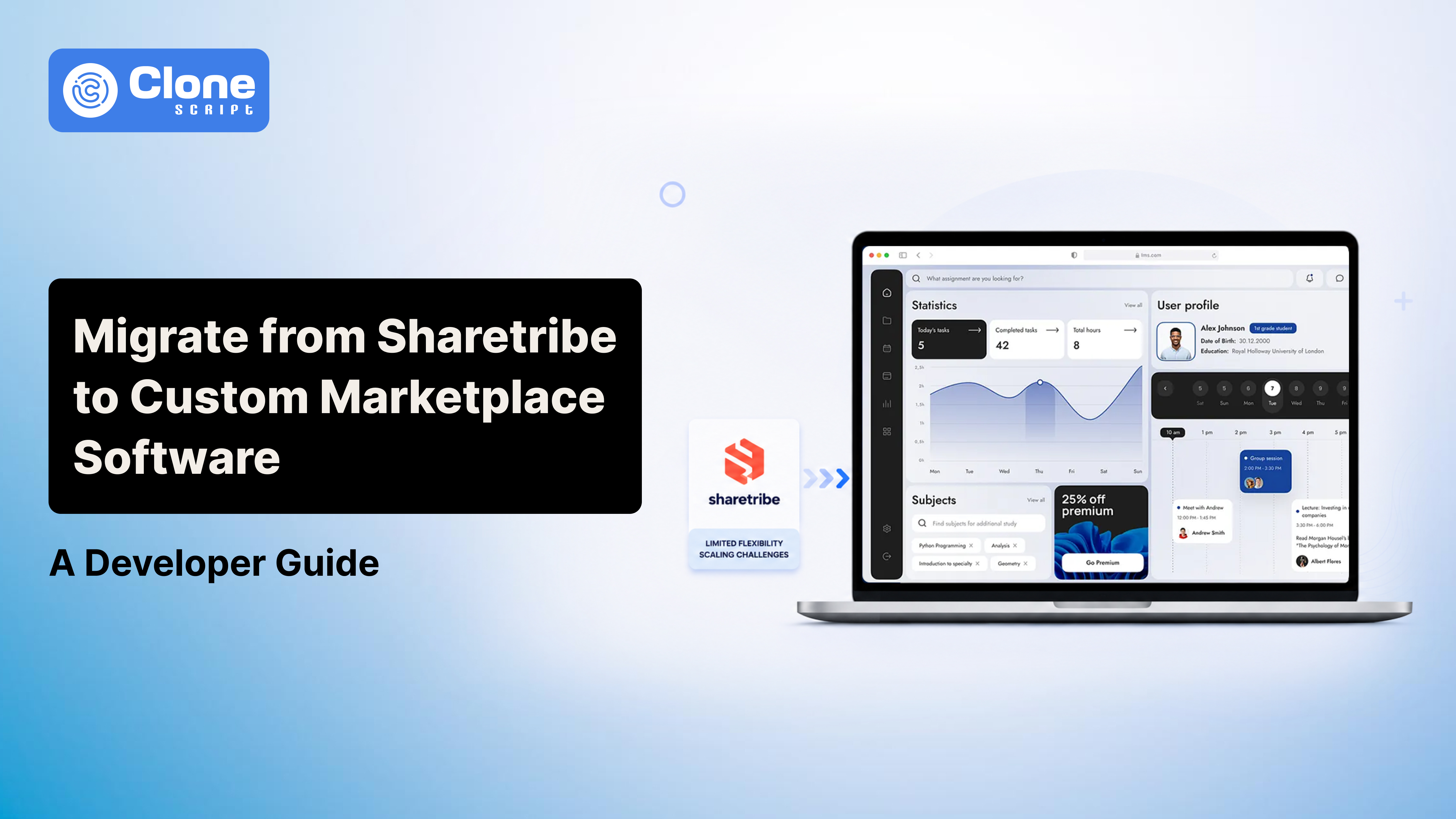
How to Migrate from Sharetribe to Custom Marketplace Software
“Is the idea culprit behind marketplace platforms' failures?” You asked your team. But the failures happen when the infrastructure cannot support operational growth. That is why many founders who initially launch on Sharetribe eventually move toward custom marketplace software development.
The global online marketplace industry is expanding rapidly.
See the statistics:
-
According to Statista, global e-commerce marketplace sales are projected to cross trillions in annual revenue over the next few years,
-
B2B digital marketplaces are becoming a primary procurement channel for enterprise buyers.
-
At the same time, Gartner research shows enterprise software buyers increasingly expect API-driven integrations, personalized workflows, and scalable infrastructure from marketplace ecosystems.
This creates a major challenge for growth-stage marketplace businesses.
A marketplace that initially needed:
-
Basic vendor onboarding
-
Standard commissions
-
Product listings
-
Simple booking systems
Eventually starts requiring:
-
Complex billing logic
-
Enterprise workflows
-
Multi-role permissions
-
Advanced search infrastructure
-
AI-driven recommendations
-
Third-party integrations
That is usually the moment when marketplace founders start evaluating Sharetribe migration strategies.
This guide explains how to migrate from Sharetribe to custom marketplace software using real operational insights, scalability considerations, architecture planning, and marketplace growth data instead of generic migration advice.
Why Growing Marketplaces Outgrow Sharetribe
Most founders choose Sharetribe because it accelerates marketplace validation.
Launching a marketplace from scratch can take 8–14 months, depending on complexity. While no-code and low-code marketplace platforms reduce launch timelines significantly.
According to Forrester Research, businesses adopting rapid application platforms reduce initial development cycles by nearly 50%.
That advantage matters during the MVP phase.
However, marketplace growth changes infrastructure requirements much faster than most founders expect.
A study from McKinsey & Company found that digital platform businesses achieving high growth typically expand operational complexity within the first 24 months through:
-
Additional monetization layers
-
Geographic expansion
-
Enterprise onboarding
-
Integration ecosystems
-
Mobile-first customer behavior
-
Data-driven personalization
This is where Sharetribe limitations begin appearing.
For example, SaaS marketplaces often need:
-
Subscription lifecycle management
-
Usage-based billing
-
Tenant-level permissions
Meanwhile, LMS marketplaces require:
-
Certification workflows
-
Cohort systems
-
Instructor management
-
Content-access hierarchies
These are back-end operational requirements, not just feature requests.
As a result, founders start building operational workarounds outside the platform. Over time, those workarounds create technical debt, inefficient workflows, and slower product iteration cycles.
That is usually the real reason businesses migrate to custom marketplace development.
The Operational Problems That Trigger Marketplace Migration
Most marketplace migrations are not caused by design dissatisfaction. They happen because operational systems become difficult to scale.
-
Research from Stripe shows businesses lose measurable revenue when transaction systems create friction during onboarding, checkout, or vendor payouts.
In marketplace ecosystems, that problem compounds quickly because both buyers and sellers are affected simultaneously.
One of the biggest migration triggers is workflow rigidity.
Modern marketplaces increasingly require:
-
Escrow payment systems
-
Milestone-based transactions
-
Dynamic commissions
-
Multi-currency operations
-
Subscription + commission hybrid models
-
Automated vendor payouts
For example, finance marketplaces often require compliance-driven workflows such as:
-
KYC verification
-
Risk scoring
-
Audit logging
-
Transaction monitoring
Similarly, B2B procurement marketplaces may require:
-
Department-based approvals
-
Contract billing
-
SLA management
-
Enterprise account hierarchies
A report from Deloitte found that 64% of enterprise digital transformation projects fail to scale efficiently when legacy or restrictive platforms limit workflow flexibility.
That problem applies directly to marketplace infrastructure.
As marketplaces grow, founders realize they are adapting business operations to platform limitations instead of building infrastructure around customer requirements.
That operational mismatch slows product innovation and creates long-term scalability issues.
This is why custom marketplace software becomes less of a “premium option” and more of a business continuity investment.
Why Custom Marketplace Software Supports Scalability Better
Custom marketplace development gives businesses ownership over platform architecture, operational workflows, and infrastructure scalability.
That matters because marketplace businesses scale differently from traditional SaaS products.
According to Andreessen Horowitz, marketplace growth creates compound infrastructure complexity because platforms must simultaneously manage:
-
Buyer experience
-
Vendor experience
-
Transaction systems
-
Search relevance
-
Trust infrastructure
-
Data relationships
Every additional user group increases operational dependencies.
Custom marketplace software allows businesses to optimize systems specifically around those dependencies.
For example, large-scale service marketplaces often implement:
-
Real-time availability systems
-
AI-driven vendor matching
-
Geo-location search infrastructure
-
Dynamic pricing algorithms
Meanwhile, SaaS marketplaces may need:
-
API orchestration
-
Product provisioning engines
-
Integration marketplaces
-
Workspace-level permissions
This level of customization is difficult to maintain efficiently inside standardized marketplace frameworks.
Performance is another major factor.
-
Google research shows that mobile conversion rates can decline by up to 20% when page load times increase by even a few seconds.
Marketplace businesses handling large product inventories or service directories need optimized database queries, caching systems, and scalable search infrastructure.
Custom marketplace platforms allow engineering teams to:
-
Optimize back-end development performance
-
Reduce infrastructure bottlenecks
-
Improve API response times
-
Scale independently across services
That infrastructure flexibility becomes a competitive advantage as marketplace operations grow.
How to Plan a Sharetribe Migration Properly
One of the biggest misconceptions about Sharetribe migration is that it is primarily a front-end website rebuilding project.
It is not.
Successful marketplace migration starts with operational analysis and infrastructure planning.
-
According to IBM Research, poorly planned software migrations are among the leading causes of unexpected operational downtime during digital transformation initiatives.
The primary reason is incomplete dependency mapping.
Before migration begins, businesses should audit three core areas.
-
Marketplace Workflow Architecture
Document the following workflows:
-
Vendor onboarding flows
-
Transaction lifecycles
-
Messaging systems
-
Role permissions
-
Approval chains
-
Subscription models
This reveals where the current platform creates operational friction.
-
Infrastructure Dependencies
Most marketplaces rely on multiple external systems, including:
-
CRM platforms
-
Analytics tools
-
Notification services
-
Marketing automation systems
-
ERP integrations
A missing integration dependency during migration can disrupt business operations immediately.
-
Marketplace Data Relationships
Marketplace data is highly interconnected.
Businesses must preserve relationships between:
-
Users and transactions
-
Listings and vendors
-
Orders and invoices
-
Reviews and service histories
Research from Accenture shows data inconsistency is one of the top causes of customer trust loss during platform migrations.
That is why migration planning matters more than interface redesign.
Choosing the Right Marketplace Architecture
Architecture decisions determine whether a marketplace scales efficiently or accumulates technical debt.
Many founders underestimate how critical this stage is.
-
According to Gartner, organizations that align infrastructure architecture with business growth models achieve significantly better scalability outcomes than businesses focused only on feature delivery.
The right marketplace architecture depends on operational complexity.
-
Monolithic Marketplace Architecture
This approach works well for:
-
Smaller marketplaces
-
Lean engineering teams
-
Faster deployment cycles
-
Predictable operational workflows
Monolithic systems simplify development initially, but scaling individual services becomes harder over time.
-
Microservices Marketplace Architecture
Large marketplaces increasingly adopt microservices because they allow independent scaling across operational systems.
Examples include separating:
-
Payments
-
Notifications
-
Search systems
-
User authentication
-
Reporting services
This improves:
-
Fault isolation
-
Infrastructure scalability
-
Deployment flexibility
-
Performance optimization
Netflix and Amazon popularized microservices because operational scale eventually demands service independence.
-
Headless Marketplace Architecture
Headless systems separate back-end logic from front-end presentation layers.
This architecture is becoming common in:
-
SaaS marketplaces
-
Enterprise commerce ecosystems
-
Multi-platform marketplace businesses
Benefits include:
-
API-first scalability
-
Omnichannel support
-
Faster frontend iteration
-
Mobile-first optimization
The architecture decision should reflect future operational goals, not temporary development convenience.
Why Search Infrastructure Becomes a Marketplace Growth Factor
Search systems are no longer simple filtering tools.
In large marketplaces, search directly impacts revenue.
-
According to Baymard Institute, poor marketplace search experiences contribute heavily to user abandonment and lower conversion rates.
Users increasingly expect personalized discovery experiences similar to Amazon, Airbnb, and Uber.
Modern marketplaces require infrastructure capable of supporting:
-
Semantic search
-
AI-powered recommendations
-
Behavioral ranking
-
Geo-based discovery
-
Dynamic availability filtering
-
Vendor quality scoring
For example, an AaaS (Agent as a Service) marketplace may recommend tools based on:
-
Existing integrations
-
Company size
-
User behavior
-
Workflow compatibility
An LMS marketplace may personalize recommendations using:
-
Skill progression
-
Certification paths
-
Learning history
A finance marketplace may prioritize providers based on:
-
Risk categories
-
Compliance status
-
Regional availability
These systems require backend-level control over indexing, ranking logic, caching, and data processing pipelines.
Custom marketplace software enables development teams to optimize search infrastructure specifically for marketplace behavior instead of relying on generalized platform search systems.
That becomes increasingly important as inventory, vendors, and customer interactions scale.
The Biggest Mistakes Businesses Make During Migration
Research from KPMG shows that large-scale digital transformation projects fail most because businesses underestimate operational transition complexity.
Marketplace migration is no different.
One common mistake is rebuilding everything simultaneously.
That creates unnecessary risk across:
-
Transactions
-
Vendor onboarding
-
Customer support
-
Search systems
-
Payment processing
Successful marketplaces usually migrate incrementally.
For example:
-
Back-end systems first
-
Payment infrastructure second
-
Vendor dashboards third
-
Front-end modernization later
This phased migration approach allows continuous testing while minimizing operational disruption.
Another major mistake is underestimating internal operational requirements.
Founders often focus heavily on customer-facing interfaces while ignoring internal systems such as:
-
Moderation dashboards
-
Reporting infrastructure
-
Vendor management systems
-
Financial reconciliation tools
-
Compliance monitoring
According to PwC research, operational inefficiencies become one of the largest hidden scaling costs in digital platform businesses.
Finally, many businesses choose development teams without marketplace-specific expertise.
Marketplace engineering differs significantly from traditional SaaS development because it involves:
-
Multi-party transactions
-
Trust systems
-
Vendor ecosystems
-
Supply-demand balancing
-
Search economics
Without marketplace experience, technical teams often underestimate infrastructure complexity.
All Clone Script: Development Partner for Custom Marketplace Software
As marketplace businesses scale, operational requirements become more complex than standard marketplace builders can efficiently support. All Clone Script works with businesses looking to build tailored marketplace ecosystems with greater architectural flexibility and operational control.
We develop custom solutions for:
-
B2B marketplace platforms
-
SaaS product ecosystems
-
Service aggregation platforms
-
Learning management marketplaces
-
Multi-vendor commerce systems
Our core strengths include:
-
Advanced workflow customization
-
Enterprise-ready marketplace architecture
-
Subscription and payment gateway integration
-
Vendor lifecycle management
-
Mobile-first marketplace experiences
-
Front-end API-driven platform connectivity with back-end
This allows businesses to build marketplace infrastructure aligned with long-term scalability, performance optimization, and evolving customer requirements.
Final Thoughts
Migrating from Sharetribe to custom marketplace software is not simply a technical upgrade. It is an infrastructure evolution driven by business scale. For early-stage startups, Sharetribe provides clear advantages. But marketplace growth changes operational requirements rapidly.
That is why many successful marketplace companies eventually transition toward custom marketplace development.
The goal is not customization for its own sake.
The goal is operational flexibility, scalability, and long-term platform control.
When marketplace infrastructure aligns with a business growth strategy, product innovation becomes significantly easier.
In competitive industries like SaaS, LMS, fintech, and B2B commerce, that flexibility often becomes the difference between scaling efficiently and struggling with platform limitations.