BTC - Bitcoin
 USDTERC20 - USDT ERC20
 ETH - Ethereum
 BNB - Binance
 BCH - Bitcoin Cash
 DOGE - Dogecoin
 TRX - TRON
 USDTTRC20 - USD TRC20
 LTC - LiteCoin

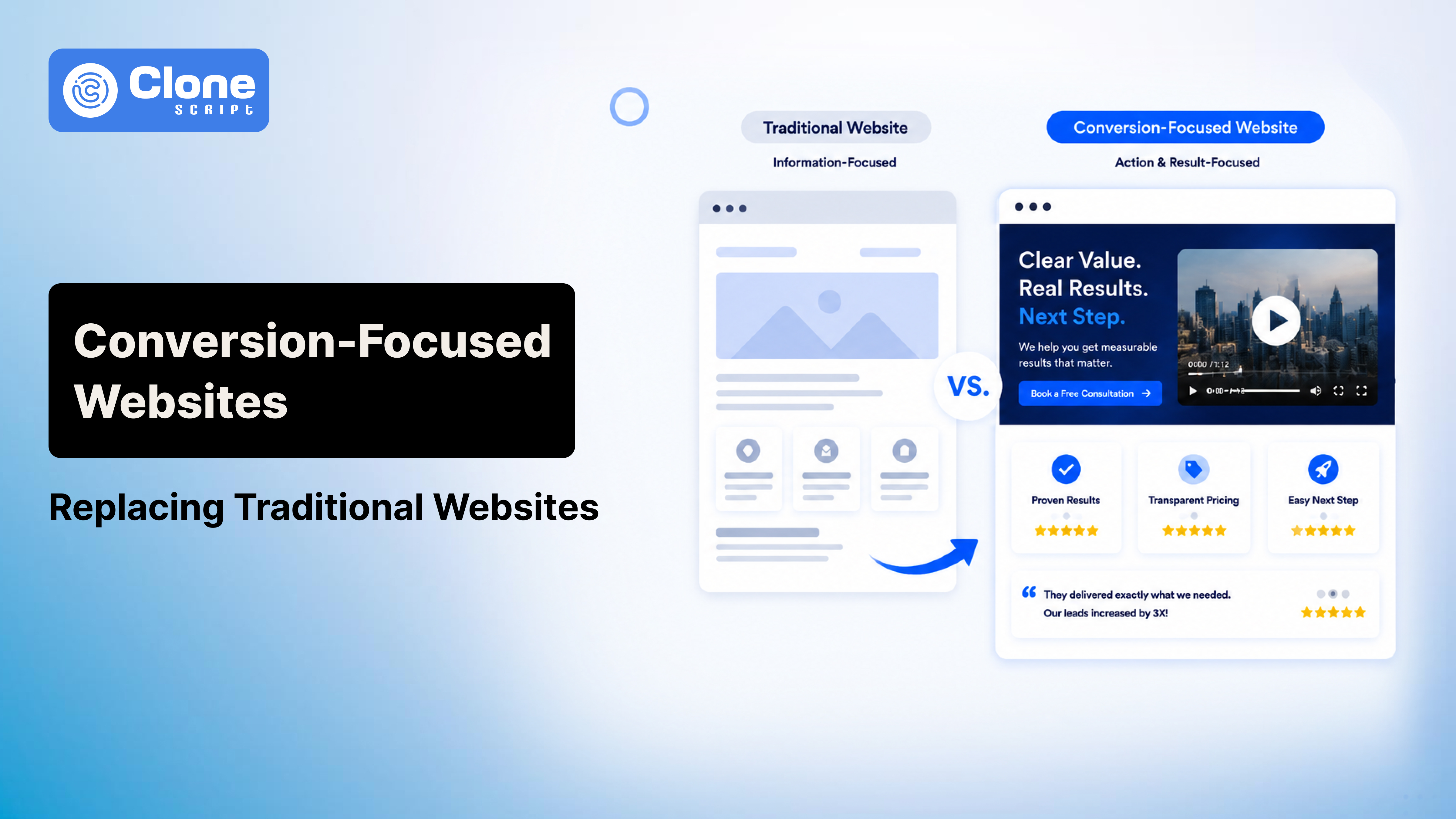
Why Conversion-Focused Websites Are Replacing Traditional Websites
A business website can attract thousands of visitors and still struggle to generate leads.
The problem isn't traffic. It's uncertainty.
Most traditional websites were built to share information. Modern buyers already have information. They compare options on Google, read reviews, and use AI tools (Google AI Mode, AI Overviews, Gemini Chat, ChatGPT) before visiting a website.
Research shows that 75% of users judge a company's credibility based on website experience. A visitor does not arrive looking for another homepage. They arrive looking for proof, trust, pricing expectations, results, or a reason to move forward.
By the time someone lands on your page, they're looking for confidence, not another company description.
This creates a growing gap between what businesses want visitors to do and what visitors need to believe before taking action.
That gap explains why conversion-focused websites are replacing traditional websites. The goal is no longer more traffic. The goal is turning existing traffic into customers.
The Traditional Website Model Is Breaking Down
A strange thing is happening across industries.
Businesses are investing more money into SEO, paid ads, and content marketing, yet many are seeing little improvement in lead generation.
The issue isn't website traffic.
It's what happens after the click.
Traditional websites were built for visitors who wanted information. Modern buyers arrive with information already in hand. They've compared competitors, checked reviews, watched videos, and even asked AI tools for recommendations.
By the time they land on your website, they're looking for one thing: confidence.
This creates what we call the 80/20 Website Problem.
Many business websites spend 80% of their space talking about the company and only 20% helping visitors make a decision.
A homepage highlights company history.
A buyer wants proof.
A service page lists features.
A prospect wants outcomes.
An About page shares achievements.
A visitor wants a reason to trust you.
Every unanswered question increases uncertainty. Every uncertainty reduces conversions.
That's why traditional websites struggle to generate leads despite attracting visitors.
The businesses winning today understand a different reality. A website is no longer a digital brochure. It's a decision-making tool.
Traffic gets people through the door.
Confidence turns them into customers.
That shift explains why conversion-focused websites are replacing traditional websites across almost every competitive industry.
Why More Website Traffic No Longer Guarantees More Leads
Many businesses celebrate a traffic increase.
The dashboard shows more visitors. Rankings improve. Marketing reports look healthy.
Then reality arrives.
Lead generation barely moves.
This creates what we call the Traffic-to-Revenue Disconnect.
Website traffic measures attention. Revenue measures decisions.
The two are not the same.
A visitor searching for information behaves differently from a visitor ready to buy. Traditional websites treat both visitors identically. Conversion-focused websites guide each visitor toward a specific next step.
That's why a website with 2,000 targeted visitors can outperform another with 20,000 untargeted visits.
The real question is not:
"How many people visited my website?"
The better question is:
"How many visitors moved closer to becoming customers?"
Look at your own website.
Can visitors quickly find proof, pricing expectations, case studies, testimonials, or a clear contact path?
If the answer is no, more traffic will simply expose the same conversion problem to a larger audience.
This is where many businesses waste marketing budgets. They keep investing in SEO, content marketing, and advertising while ignoring the page experience responsible for turning visitors into leads.
Traffic creates opportunities. That’s a 100% fact.
Conversion-focused websites turn opportunities into revenue. Remember that.
The Rise of AI Search Is Accelerating This Shift
Something important changed in search.
People no longer visit websites to find basic answers.
They ask AI tools, read AI Overviews, compare options instantly, then visit a website when they're close to making a decision.
That changes the role of a business website completely.
A few years ago, websites competed for attention.
Today, they compete for trust.
This creates what we call the Last Click Advantage.
The last click is no longer the beginning of the customer journey. It's one of the final steps before an inquiry, demo request, consultation booking, or purchase.
That means every website visitor is becoming more valuable.
A traditional website treats these visitors like researchers. It explains the company, lists services, and hopes visitors figure out the next step.
A conversion-focused website removes uncertainty immediately. It shows results, builds trust, answers objections, and makes the next action obvious.
Here's a simple test.
Imagine a potential customer arrives after comparing three competitors and researching solutions for days.
Will your website help them decide within minutes?
Or will it force them to keep searching?
The businesses gaining more leads from the same website traffic understand this shift.
Information attracts visitors.
Trust closes decisions.
In the age of AI search, the websites that reduce doubt will outperform the websites that simply provide information.
What Makes a Website Conversion-Focused?
Take two websites offering the same service.
One receives a visitor and says, "Here's who we are."
The other says, "Here's how we solve your problem."
The second website usually wins.
That's the difference between a traditional website and a conversion-focused website.
Most websites are built around pages.
High-converting websites are built around decisions.
Every section, button, headline, testimonial, and form has a purpose: moving visitors one step closer to becoming customers.
This creates the Decision Path Framework.
A visitor should never wonder:
-
What does this company do?
-
Can they solve my problem?
-
Why should I trust them?
-
What should I do next?
When those questions remain unanswered, conversion rates drop.
When those questions are answered quickly, lead generation improves.
A conversion-focused website usually contains four essential elements:
-
Clear Value Proposition: Visitors understand the benefit within seconds.
-
Trust Signals: Case studies, reviews, client results, certifications, or success stories reduce hesitation.
-
Strategic Calls-to-Action: Every important page guides visitors toward a logical next step.
-
Low-Friction Experience: Simple navigation, fast loading speeds, and easy contact options remove barriers.
Review your own website.
If visitors need multiple clicks to understand your value, trust your expertise, or contact your team, the website is creating friction instead of conversions.
The strongest websites don't ask visitors to figure things out.
They guide decisions before doubts have time to grow.
Your Website Might Be Creating Work for Your Sales Team
Here's a pattern many businesses never notice.
A prospect visits the website.
Instead of contacting the company, they schedule another meeting internally.
They ask colleagues for opinions.
They compare vendors again.
They search for reviews.
They revisit competitors.
The buying decision gets delayed.
Not because the service is expensive.
Not because the solution is wrong.
Because the website failed to eliminate uncertainty.
Every unanswered question creates additional work.
Work for the buyer.
Work for the sales team.
Work for customer support.
Work that shouldn't exist.
A strong website shortens decision cycles.
A weak website extends them.
This becomes expensive when you look at lead generation.
The more effort required to understand your offer, evaluate your credibility, or estimate potential results, the lower the likelihood of conversion.
That's why businesses with similar website traffic can experience completely different sales outcomes.
One website helps visitors move forward.
The other sends visitors back into research mode.
Look at your own website.
After reading your homepage, could a prospect confidently explain why your company is a better choice than competitors?
If not, your sales team is likely answering questions your website should have answered already.
The best conversion-focused websites don't just generate leads.
They reduce the amount of convincing required after the lead arrives.
The Most Expensive Website Metric Is the One Nobody Tracks
Ask a business owner how their website is performing.
The answer usually sounds familiar:
-
Monthly website traffic
-
Google rankings
-
Form submissions
-
Click-through rates
Useful numbers.
Wrong focus.
The metric that matters most rarely appears in reports:
How many potential customers left without taking action?
Think about it.
A visitor spends three minutes on your website.
Views multiple pages.
Reads your services.
Checks pricing.
Then leaves.
Analytics records a visit.
The business loses an opportunity.
This silent exit happens thousands of times across business websites every month.
The problem becomes bigger as customer acquisition costs increase. More companies are paying for SEO, PPC advertising, social media marketing, and content marketing. Every visitor has a cost attached to them.
When a website fails to convert that attention into inquiries, consultations, or sales, marketing spend becomes less efficient.
That's why conversion-focused websites look beyond traffic metrics.
They focus on visitor intent.
What stopped the prospect?
What information was missing?
What created hesitation?
What prevented action?
These questions reveal more than any traffic report.
Businesses that answer them usually don't need more visitors first.
They need a better path from interest to decision.
Because losing 90% of visitors is normal.
Never understanding why they left is expensive.
Your Competitors Aren't Taking Your Customers. Your Website Is Sending Them Away.
Most lost deals don't end with a customer choosing a competitor.
They end with a customer delaying a decision.
That's a critical difference.
When buyers feel uncertain, they rarely reject an option immediately.
They postpone.
They bookmark the website.
They tell themselves they'll come back later.
They open another tab.
Then life gets busy.
The decision disappears.
This behavior costs businesses far more revenue than direct competition.
Research on consumer decision-making consistently shows that uncertainty increases decision delay. The harder a choice feels, the more likely people are to avoid making it.
Now look at most traditional websites.
Visitors encounter vague service descriptions.
No clear pricing expectations.
No explanation of what happens after contact.
No evidence of likely outcomes.
No reason to act today instead of next month.
The website unintentionally encourages delay.
Conversion-focused websites attack delay directly.
They reduce unanswered questions.
They clarify the next step.
They help visitors estimate effort, risk, timeline, and results.
This changes the conversation from:
"Should I keep researching?"
to
"Should I start now?"
That's a powerful shift.
Many businesses believe they are losing customers to competitors.
In reality, they're losing customers to indecision.
And indecision is a website problem long before it becomes a sales problem.
Why High-Converting Websites Make Buying Feel Safer
People buy when the potential reward outweighs the perceived risk.
Simple.
Yet most business websites spend their time increasing perceived reward while ignoring perceived risk.
They promise growth.
Better results.
Higher ROI.
Faster delivery.
More leads.
The visitor sees those promises and immediately starts calculating risk.
-
What if this doesn't work?
-
How much time will this require?
-
Will I regret this decision?
-
What happens after I submit the form?
-
Is this company actually capable of delivering?
This internal conversation determines more purchasing decisions than most businesses realize.
That's why two companies with similar services can generate vastly different conversion rates.
One company sells benefits.
The other removes fear.
Look closely at websites that consistently generate qualified leads.
They don't just showcase success stories.
They explain processes.
They define timelines.
They show real outcomes.
They answer uncomfortable questions before prospects ask them.
In other words, they reduce perceived risk.
This is especially important for high-ticket services such as web development, software development, digital marketing, consulting, and B2B solutions, where buyers have more to lose from a bad decision.
A useful website audit question is:
What worries a potential customer before contacting you?
If your website doesn't answer that concern, it becomes another reason to leave.
People rarely buy because they're convinced.
They buy because they're no longer worried enough to wait.
The Best Website Doesn't Always Win the Business
A surprising number of businesses lose leads before a prospect ever speaks to sales.
Not because the website looks outdated.
Not because the service is inferior.
Because the value is difficult to quantify.
Imagine two agencies offering similar website development services.
The first agency says:
"We build fast, responsive, custom websites."
The second says:
"Our clients use these websites to increase lead generation and reduce customer acquisition costs."
Both may deliver identical work.
One sounds like an expense.
The other sounds like an investment.
That's where many traditional websites struggle.
They describe deliverables.
Buyers evaluate outcomes.
A prospect doesn't wake up wanting a new website.
They want more inquiries.
More sales.
Better conversion rates.
Higher revenue.
The website is simply the vehicle.
This disconnect creates a hidden problem.
When visitors cannot connect your service to a business result, price becomes the easiest point of comparison.
The conversation shifts from value to cost.
That's a dangerous position in competitive markets.
Review your main service pages.
How much content explains what you do?
How much content explains the financial, operational, or growth impact of what you do?
The answer reveals why some businesses attract price-sensitive leads while others attract decision-makers.
Features explain the solution.
Outcomes justify the investment.
Why Most Website Redesigns Fail
A company decides its website needs help.
The homepage gets redesigned.
New colors are introduced.
Animations become smoother.
The layout looks modern.
Six months later, lead generation hasn't changed.
This happens more than most businesses realize.
The reason is simple.
Most website redesign projects focus on appearance while the real problem lives inside the buying journey.
Visitors rarely leave because a button is blue instead of green.
They leave because critical questions remain unanswered.
Can this company solve my problem?
What results can I expect?
How long will this take?
Why should I trust them?
A redesign that ignores these questions is like renovating a store while keeping the same sales process.
The building improves.
Revenue doesn't.
This is why some businesses launch beautiful websites and still struggle with conversion rates.
The design changed.
The decision-making experience didn't.
Before investing in website development, audit the customer journey first.
Identify where prospects hesitate.
Find the information they search for before contacting your team.
Review sales calls, customer objections, and frequently asked questions.
Those insights reveal more than any design trend.
A successful website redesign is not about looking different.
It's about making decisions easier.
When businesses focus on buyer behavior before visual design, website traffic becomes far more valuable because more visitors turn into qualified leads.
The C.O.N.V.E.R.T Framework: A Simple Way to Evaluate Any Website
Most website audits fail for one reason.
They focus on technical details before addressing buyer behavior.
Page speed matters.
SEO matters.
Design matters.
None of them matter if visitors don't move closer to a decision.
That's why conversion-focused websites can be evaluated using a simple framework: C.O.N.V.E.R.T.
-
C - Clarity
Within five seconds, a visitor should understand what you do, who you help, and the outcome you deliver.
Confusion kills momentum.
-
O - Objections
Every buyer has concerns before taking action.
Price.
Timeline.
Results.
Risk.
A strong website answers objections before they become sales objections.
-
N - Navigation
People don't visit websites to explore.
They visit to find something specific.
Important pages should be accessible without making visitors search for them.
-
V - Validation
Claims create interest.
Proof creates trust.
Case studies, testimonials, client success stories, certifications, and measurable results help prospects move forward with confidence.
-
E - Engagement
A website should encourage action.
Demo requests, consultation bookings, free audits, or contact forms give visitors a clear next step.
-
R - Relevance
Different visitors have different intentions.
A first-time visitor needs education.
A ready-to-buy prospect needs reassurance.
Your website should serve both.
-
T - Tracking
Many businesses track website traffic.
Few track decision points.
Monitor inquiry rates, booked calls, qualified leads, and customer acquisition metrics.
Those numbers reveal whether the website is helping the business grow.
A website doesn't need to score perfectly in every category.
But weaknesses become visible quickly.
The more gaps you find, the more opportunities you have to improve conversions without increasing traffic.
How to Audit Your Website in 10 Minutes
Forget heatmaps, analytics dashboards, and lengthy website audits for a moment.
Open your homepage and pretend you've never seen your business before.
Now start a timer.
In the first 10 seconds, answer this question:
What problem does this company solve?
If the answer isn't obvious, prospects are experiencing the same confusion.
Next, look for proof.
Not promises.
Proof.
Can you immediately find client results, testimonials, case studies, reviews, or recognizable brands you've worked with?
If proof is buried three pages deep, trust is arriving too late.
Now find the next step.
Can a visitor easily book a consultation, request a quote, schedule a demo, or contact your team?
Many websites unintentionally create issues by making visitors search for the action they want people to take.
Then review your content.
Count how many times the website talks about the company versus the customer.
A simple rule applies:
The more your website focuses on your business, the harder it becomes for visitors to see themselves in the solution.
Finally, ask one question:
Why should someone choose you instead of the next website they visit?
If the answer isn't visible within a few scrolls, your website has a positioning problem.
You don't need a complex website audit to uncover conversion issues.
You need fresh eyes and honest answers.
Most businesses discover their biggest conversion problems in less than 10 minutes.
Conclusion
A decade ago, a website's primary job was to provide information.
Today, information is everywhere.
Information is no longer the advantage.
Reducing uncertainty is.
That's why conversion-focused websites are replacing traditional websites across industries.
The future of website design isn't about adding more pages, features, or visual effects.
It's about creating a smoother path between interest and action.