BTC - Bitcoin
 USDTERC20 - USDT ERC20
 ETH - Ethereum
 BNB - Binance
 BCH - Bitcoin Cash
 DOGE - Dogecoin
 TRX - TRON
 USDTTRC20 - USD TRC20
 LTC - LiteCoin

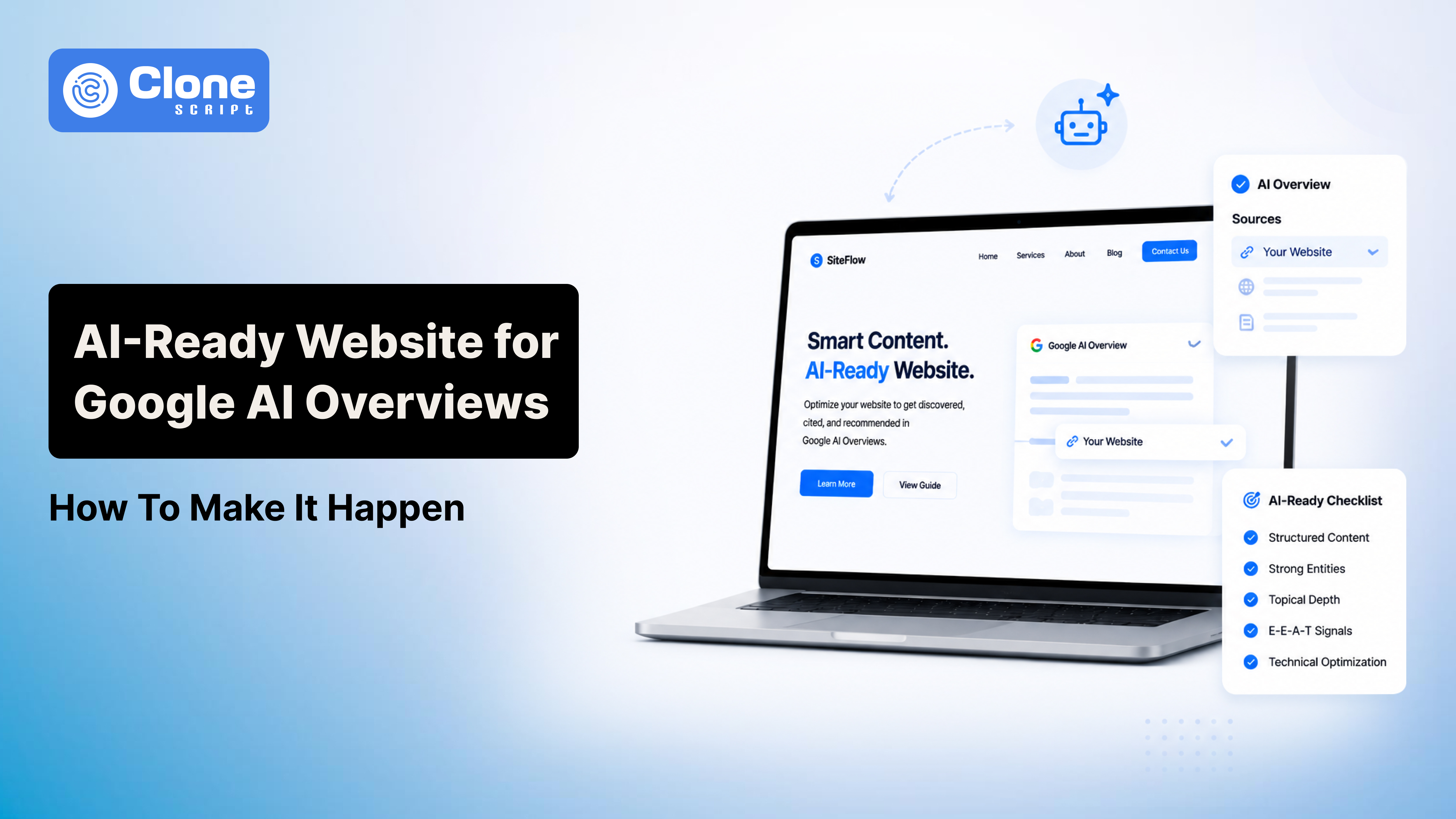
How to Make Your Website AI-Ready for Google AI Overviews
For nearly two decades, SEO followed a familiar formula.
Create content. Build backlinks. Rank higher. Get clicks.
Then, something happened that changed that formula. On May 14, 2024, Google launched Google AI overviews (known as Search Generative Experience) in the United States. By October 2024, its rollout expanded to over 100 countries.
Today, users can receive complete answers directly inside search results without clicking any website. Instead of ranking a single page, Google's AI generates a response by combining information from multiple sources and displaying citations alongside the answer.
This creates a new challenge for website owners.
A page can rank #1 and still receive fewer clicks than before. Meanwhile, another page ranking lower may be cited repeatedly inside AI-generated responses.
The question is no longer: "How do I rank higher?"
The question is: "How do I become a source Google's AI trusts enough to cite?"
The websites winning in AI search are not necessarily publishing more content. They are publishing content that is easier to understand, easier to verify, and easier to extract.
In this guide, you'll learn exactly how to make your website AI-ready and increase your chances of appearing in Google AI Overviews.
The Biggest Misconception About Google AI Overviews: It's a Part of Featured Snippets.
Most people assume AI Overviews work like featured snippets.
The assumption is simple:
"If I rank first, Google will use my content."
That's not always true.
AI Overviews are designed to answer a question, not reward a ranking position.
Google's AI frequently combines information from several websites to create a response. Instead of selecting a single page, it identifies useful information blocks, verifies them against multiple sources, and generates an answer.
This explains why:
-
A page ranking #7 can be cited.
-
A page ranking #2 can be ignored.
-
Smaller niche websites sometimes appear alongside major publishers.
Google isn't searching for the highest-ranking page.
It's searching for the most useful answer.
That means websites must optimize for answer extraction rather than rankings alone.
Here, look at the results we got on Google search with the query “How does solar energy work?”

The Rise of Answer SEO: The New Era Rolling Out
Traditional search works like this:
User Query → Ranking Algorithm → Search Results
AI search works differently:
User Query → Information Retrieval → Answer Extraction → AI Response
This difference matters.
Google's AI isn't evaluating your article as a whole.
So, what does that mean? Your mind asks the question.
It often evaluates individual sections, paragraphs, and answer blocks.
Imagine publishing a 3,000-word guide.
Only three paragraphs may contain the information Google considers valuable enough to cite.
Everything else becomes supporting content.
That's why many well-ranked pages never appear inside AI Overviews.
Their content is written for readers but not structured for extraction.
The Extractable Content Framework: A Polished Version
One of the biggest opportunities in AI SEO is creating content that's easy for machines to understand.
Most articles follow this pattern:
-
Introduction
-
Background
-
Explanation
-
Conclusion
AI systems prefer something different.
Every important section should include:
1. Direct Answer: Answer the question immediately.
2. Context: Explain why the answer matters.
3. Evidence: Support claims with examples, screenshots, data, or research.
4. Actionable Insight: Give readers something they can apply.
For example, instead of writing: "Schema markup is important for SEO."
Write the following:
"Schema markup helps search engines understand relationships between content elements, but websites earning AI Overview citations typically combine schema with topical authority and strong content structure."
The second version provides context and insight. That's the type of information AI systems are more likely to extract.
You Wrote an Optimized Blog, But That’s Generic Content. Still, It Is Losing Visibility.
One of the biggest mistakes content marketers make is publishing content that says exactly what everyone else is saying.
Stop there. You’re wasting resources behind that with this approach to rank in AIO.
Search for almost any SEO topic, and you'll see hundreds of articles repeating:
-
Focus on quality content
-
Build backlinks
-
Improve E-E-A-T
-
Add schema markup
The problem is that none of this information is unique.
Google's AI already has access to thousands of versions of the same advice.
To stand out, your content must contribute something new.
That doesn't mean inventing facts.
It means adding:
-
Original observations
-
Case studies
-
Research findings
-
Screenshots
-
Industry experience
-
Unique examples that are easy to understand
The easiest way to think about this is simple:
If AI can generate your article without your experience, competitors can too.
If your content contains original knowledge, it becomes significantly harder to replace.
Why Entity SEO Matters More Than Keywords: It Fulfills User Intent.
Keyword research and optimization still matter.
But Google's understanding of content has evolved beyond keywords alone.
Today, search engines increasingly rely on entities.
An entity can be:
-
A company
-
A person
-
A product
-
A service
-
A technology
-
A location
For example, Google doesn't only understand the keyword "AI SEO."
It also understands related entities such as:
-
Google AI Overviews
-
Large Language Models
-
Search Generative Experience
-
Search Console
-
Generative Engine Optimization
When your website consistently publishes content around related entities, Google develops stronger confidence in your expertise.
This strengthens topical authority.
More importantly, it strengthens trust.
Trust plays a major role in AI-generated search experiences.
On Google, we searched the query “how does Semrush calculate AI visibility” and got the result below.

The Content Structure AI Systems Prefer to Present Information
Most of the advice on how to rank in Google AI overview is written like essays.
AI systems prefer answer blocks.
-
Instead of asking a question, then explaining it through long information for the answer, skip that way.
-
Use a question first; prefer to answer directly with supporting evidence, examples, and a takeaway.
This second structure creates independent information blocks that make sense even when removed from the rest of the article.
Think of every heading as a potential featured snippet.
If a paragraph can stand on its own and fully answer a question, it becomes easier for AI systems to use.
Why First-Hand Experience Is Becoming a Competitive Advantage
The internet is flooded with AI-generated content. The number is roughly 57%.
As a result, credibility is becoming increasingly important.
Anyone can publish generic advice. You, we, and everybody.
Fewer websites can provide proof.
That's why original evidence matters more than ever.
Examples include:
-
Search Console screenshots
-
Traffic comparisons
-
Technical experiments
-
Survey results
-
Customer case studies
Imagine two articles discussing Core Web Vitals.
The first explains what they are.
The second shows:
-
Before score
-
After score
-
Changes implemented
-
Results achieved
Which article feels more trustworthy?
Which article provides more value?
The second.
Evidence creates authority.
Authority increases trust.
Trust improves citation potential.
Here, look at the Google Search Console highlighting Impressions, Clicks, and Visibility trends.

Building Topical Authority Instead of Chasing Keywords
Many businesses still create isolated articles targeting slight keyword variations.
For example:
-
AI SEO
-
AI Search SEO
-
SEO for AI Search
-
AI Ranking SEO
These articles often overlap heavily.
A better approach is to create topic clusters.
How to create a topical authority for website content?
There are certain steps to be followed:
-
First, create the pillar page. The example is “AI Search Optimization.”
-
Now, you have to write supporting articles that contain the following topics:
-
Google AI Overviews Guide
-
Entity SEO Explained
-
AI Citation Optimization
-
Generative Engine Optimization
-
AI Search Analytics
This strategy demonstrates topic depth and expertise.
Google increasingly rewards websites that comprehensively cover a subject instead of publishing disconnected content.
Technical SEO Still Matters to Rank in AI Overview
Despite all the excitement around AI search, technical SEO remains essential.
Before Google can cite your content, it must:
-
Discover it
-
Crawl it
-
Index it
-
Understand it
This means technical fundamentals remain important.
Focus on:
-
Site Speed: Fast websites improve user experience and accessibility.
-
Crawlability: Ensure search engines can access important content.
-
Internal Linking: Connect related pages to strengthen topical relationships.
-
Mobile Optimization: Most AI-assisted searches occur on mobile devices.
-
Indexation: Verify critical pages are indexed.
Technical SEO won't guarantee AI citations.
But poor technical SEO can absolutely prevent them from ranking your content, even if it's written correctly and answers every question.
The Truth About Schema Markup Never Spoke.
Schema markup is helpful.
It's just not a magic solution.
Many businesses believe adding FAQ Schema or Article Schema automatically increases AI Overview visibility.
It doesn't.
Schema helps search engines understand content structure.
It does not make weak content valuable.
Think of a schema as a translator.
It helps Google interpret information.
But the quality of that information still determines whether it gets used.
Use schema to improve clarity, not as a substitute for expertise.

The AI Citation Optimization Framework
If rankings are no longer the only goal, what should businesses optimize for?
Citations.
Content appearing inside AI-generated answers usually shares five characteristics.
-
Clear: The answer is easy to understand.
-
Concise: The information is direct and focused.
-
Verifiable: Claims are supported by evidence.
-
Authoritative: The source demonstrates expertise.
-
Unique: The content provides something competitors don't.
Before publishing any article, review it against these five criteria.
The more boxes you check, the stronger your citation potential becomes.
The Future of SEO Belongs to Trusted Sources
Historically, SEO focused on pages.
AI search focuses on sources.
Google increasingly evaluates:
-
Topic coverage
-
Entity relationships
-
Expertise
-
Authority
-
Trustworthiness
The question is no longer:
"How do I rank this page?"
The better question is:
"How do I become a trusted source on this topic?"
That mindset shift changes everything.
The websites that succeed in AI search won't necessarily publish the most content.
They'll publish the most useful content.
The most trustworthy content.
The most evidence-backed content.
And the easiest content to extract.
Conclusion
Google AI Overviews are changing how information is discovered online.
Traditional SEO remains important, but ranking alone is no longer enough.
To make your website AI-ready, focus on:
-
Creating extractable answers
-
Building topical authority
-
Strengthening entity signals
-
Publishing original evidence
-
Improving technical foundations
-
Optimizing for citations, not just rankings
In the AI era, visibility belongs to sources that help search engines answer questions with confidence.
The goal isn't simply to rank.
The goal is to become the answer.