BTC - Bitcoin
 USDTERC20 - USDT ERC20
 ETH - Ethereum
 BNB - Binance
 BCH - Bitcoin Cash
 DOGE - Dogecoin
 TRX - TRON
 USDTTRC20 - USD TRC20
 LTC - LiteCoin

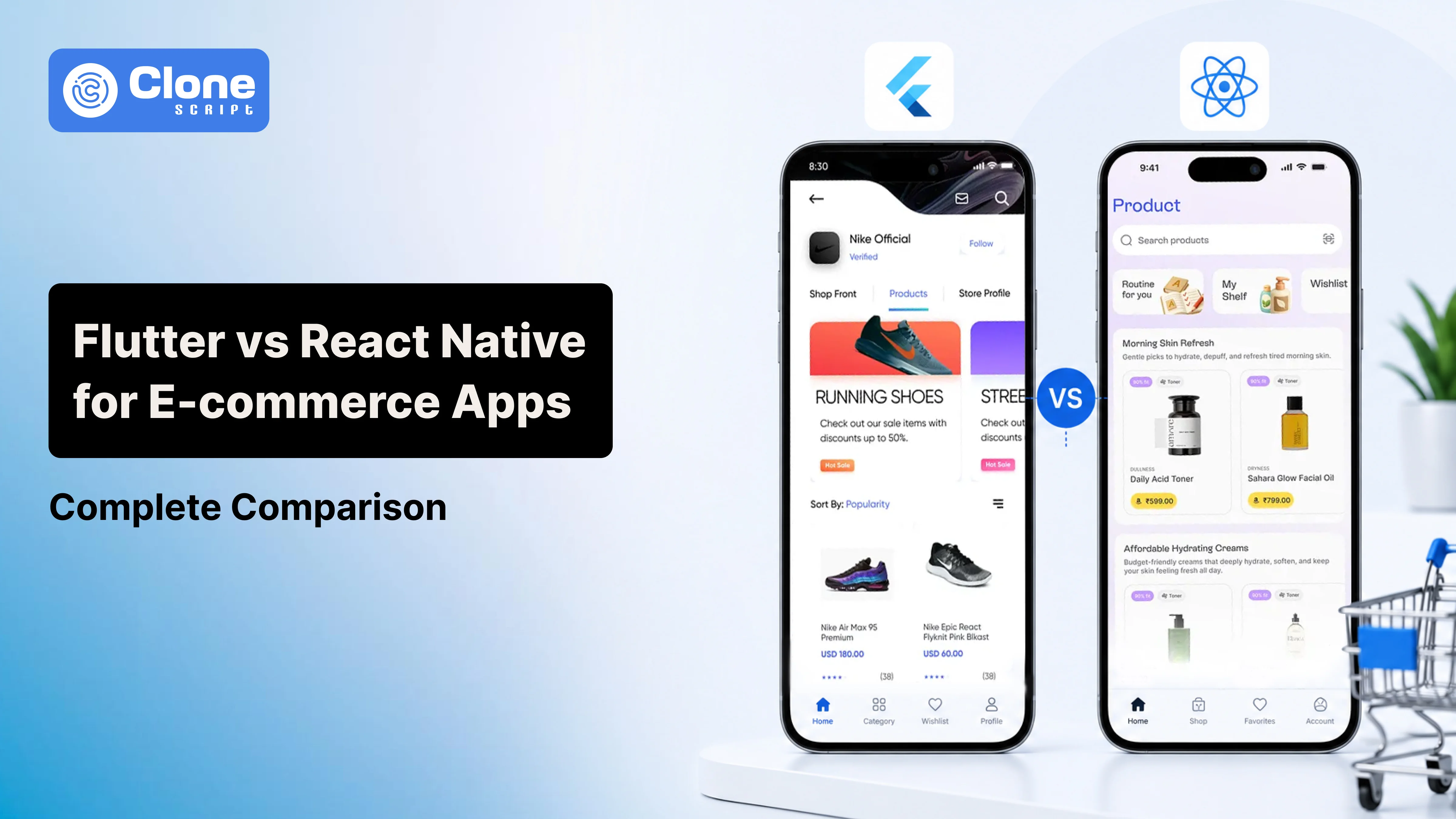
Flutter vs React Native: Choose the Best Framework for E-commerce Apps
Choosing between Flutter and React Native is one of the biggest decisions in the app development stack when building an e-commerce app. Both frameworks let you create Android and iOS apps from a single codebase. Your development time can be reduced from multiple hours to fewer, and costs are also saved.
However, they aren't built for the same business goals.
-
Choose Flutter if you want high performance, smooth animations, and a fully customized shopping experience.
-
Choose React Native if you need faster development, have an existing React team, or want access to a larger JavaScript ecosystem.
This guide compares Flutter and React Native for e-commerce apps based on performance, development cost, UI, scalability, security, and business value so you can confidently choose the right framework.
Flutter vs React Native: Quick Comparison
| Feature | Flutter | React Native |
|---|---|---|
| Developer | Meta | |
| Programming Language | Dart | JavaScript |
| Performance | 5/5 | 4.5/5 |
| UI Customization | 5/5 | 4/5 |
| Development Speed | 4/5 | 5/5 |
| Community Support | Growing | Very Large |
| Hiring Developers | Moderate | Easy |
| Best For | Custom, high-performance apps | Fast MVPs & scalable business apps |
Quick Recommendation: If your app depends on rich visuals and smooth performance, go with Flutter. If your priority is faster development and easier hiring, React Native is often the better choice.
Flutter is an open-source framework.
Flutter is Google's open-source framework for building cross-platform mobile apps using Dart.
Instead of relying on native UI components, Flutter renders everything itself. This gives developers greater control over design and helps create a consistent experience across Android and iOS.
Why Businesses Choose Flutter
-
High-performance mobile apps
-
Beautiful and consistent UI
-
Smooth animations
-
Excellent for branded shopping experiences
-
Single codebase for multiple platforms
Best for: Fashion, luxury retail, grocery delivery, and apps with highly customized interfaces.
What Is React Native?
React Native is Meta's cross-platform framework that uses JavaScript and React to build mobile applications.
It uses native UI components, making it a popular choice for businesses that already have React web developers or want to launch products quickly.
Why Businesses Choose React Native
-
Huge JavaScript ecosystem
-
Easier developer hiring
-
Strong community support
-
Reusable React knowledge
Best for: Startups, marketplaces, SaaS platforms, and businesses with existing React teams.
Flutter vs React Native: Feature
Both Flutter and React Native can build high-quality e-commerce apps, but they excel in different areas. The right choice depends on your business goals, budget, and long-term growth plans.
| Feature | Flutter | React Native |
|---|---|---|
| Performance | 5/5 | 4/5 |
| UI & Design | 5/5 | 4/5 |
| Development Speed | 4/5 | 5/5 |
| Learning Curve | Moderate | Easy |
| Community Support | Growing Fast | Very Large |
| Third-Party Libraries | Good | Excellent |
| Maintenance | Easy | Moderate |
| Scalability | Excellent | Excellent |
Takeaway: Flutter leads in performance and design. React Native offers faster development and a larger developer ecosystem.
Flutter vs React Native: Performance
Performance is one of the biggest factors for an e-commerce app. Faster apps improve user experience, reduce cart abandonment, and increase conversions.
-
Flutter Performance
Flutter uses its own rendering engine to deliver smooth animations and consistent performance across devices. This becomes important in the mobile app development process.
Advantages
-
Fast app startup
-
Smooth scrolling for large product catalogs
-
Excellent animation performance
-
Consistent UI on Android and iOS
-
Handles complex interfaces with ease
Best for: Shopping apps with custom designs, product animations, and interactive user experiences.
-
React Native Performance
React Native delivers strong performance for most e-commerce applications by using native UI components.
While it performs well for standard retail apps, complex animations or graphics-heavy screens may require additional optimization.
Advantages
-
Fast enough for most business apps
-
Native user experience
-
Efficient for standard shopping workflows
-
Easy integration with existing React projects
Best for: MVPs, marketplaces, and business-focused retail applications.
Performance Winner
| Business Need | Recommended Framework |
|---|---|
| Smooth animations | Flutter |
| Large product catalog | Flutter |
| Standard shopping app | React Native |
| High-performance UI | Flutter |
| Fast MVP launch | React Native |
Verdict: If your e-commerce app focuses on premium user experience and visual performance, Flutter has the edge. For businesses that need to launch quickly with reliable performance, React Native remains a solid choice.
Flutter vs React Native: User Interface and User Experience
A great shopping experience keeps customers engaged and encourages repeat purchases. That's why UI and UX play a major role in choosing the right framework.
-
Flutter UI
Flutter gives developers complete control over every screen. There is an easy way to build unique and visually appealing shopping experiences.
Ideal for
-
Fashion stores
-
Luxury brands
-
Beauty products
-
Furniture apps
-
Lifestyle marketplaces
-
React Native UI
React Native uses native components to offer users a familiar look and feel on both Android and iOS devices.
Ideal for
-
Online marketplaces
-
Food delivery apps
-
SaaS platforms
-
B2B commerce apps
-
General retail stores
Verdict: Choose Flutter if branding and visual experience are your priorities. Choose React Native if you want a familiar native interface with faster development.
Flutter vs React Native: Development Speed & Cost
For most businesses, the goal isn't just to build an app. It’s to launch quickly without exceeding the budget. Development speed and overall cost are key factors when choosing between Flutter and React Native.
1. Development Speed
Both frameworks use a single codebase for Android and iOS that can reduce development time compared to native or hybrid app development.
-
Flutter
Flutter comes with a rich collection of pre-built widgets to create custom screens without relying on many third-party libraries.
Why Flutter is Fast
-
Single codebase for multiple platforms
-
Built-in UI components
-
Hot Reload for instant updates
-
Fewer platform-specific changes
Best for: Businesses building feature-rich or highly customized e-commerce apps.
-
React Native
React Native speeds up development through its large ecosystem of libraries and reusable React components.
If your team already works with React.js, they can transition to React Native with minimal learning.
Why React Native is Fast
-
JavaScript is widely known
-
Large collection of ready-to-use packages
-
Easy code sharing with React web projects
-
Faster onboarding for developers
Best for: Startups, MVPs, and businesses with existing React expertise.
Verdict: React Native helps businesses launch faster, while Flutter shines when creating unique shopping experiences.
2. Flutter vs React Native: Development Cost
The total cost of an e-commerce app depends on development, maintenance, hiring, and future updates. Not just the initial build.
-
Flutter Development Cost
Flutter is a cost-effective choice for businesses planning a feature-rich e-commerce app with long-term growth in mind. Its single codebase and consistent UI reduce maintenance and platform-specific development.
Estimated Costs
| Project Type | Estimated Cost |
|---|---|
| MVP E-commerce App | $700-$10,000 |
| Medium-Complexity App | $10,000-$20,000 |
| Enterprise E-commerce App | $20,000-$50,000+ |
| Flutter Developer Rate | $35-$120/hour |
Why Choose Flutter?
-
Lower long-term maintenance costs
-
Fewer platform-specific issues
-
Faster updates across Android and iOS
-
Excellent ROI for feature-rich apps
Consideration: Flutter developers are in high demand, so hiring experienced Dart developers may cost more in some regions.
-
React Native Development Cost
React Native is the more affordable option for startups and businesses that need to launch quickly. Its large JavaScript ecosystem makes it easier to find developers and accelerate development.
Estimated Costs
| Project Type | Estimated Cost |
|---|---|
| MVP E-commerce App | $10,000-$30,000 |
| Medium-Complexity App | $30,000-$70,000 |
| Enterprise E-commerce App | $70,000-$100,000+ |
| React Native Developer Rate | $30-$110/hour |
Why Choose React Native?
-
Lower initial development costs
-
Easier developer hiring
-
Faster team scaling
-
Extensive third-party libraries
Consideration: Apps with advanced native features may require additional platform-specific development, which can increase maintenance costs.
Bottom Line: If you're launching a startup or validating an idea, React Native can help reduce upfront costs. If you're building a scalable e-commerce platform with a strong focus on performance and long-term maintenance, Flutter often provides better value over the product's lifecycle.
Flutter vs React Native: Scalability
As your business grows, your app should handle more users, products, and transactions without compromising performance.
-
Flutter
Flutter is designed to support large, feature-rich applications with consistent performance. Pick if your priority for growth.
Ideal for
-
Large product catalogs
-
Heavy traffic during sales
-
Advanced search and filtering
-
Custom shopping experiences
-
Enterprise retail apps
-
React Native
React Native also scales well, especially when combined with a strong back-end architecture and cloud services.
It works well for businesses that expect steady growth and frequent feature updates.
Ideal for
-
Startups
-
Online marketplaces
-
Multi-vendor platforms
-
Subscription-based businesses
-
SaaS applications
Verdict: Both frameworks are scalable. Choose Flutter for performance-intensive, design-focused apps, and React Native for fast-growing businesses that value rapid development and easier hiring.
Flutter vs React Native: Third-Party Integrations
An e-commerce app depends on more than just a great user interface. Integrations with payment gateways, analytics, CRM systems, shipping providers, and push notifications are essential for delivering a seamless shopping experience.
Both Flutter and React Native support a wide range of integrations, but their ecosystems differ in maturity and flexibility.
-
Flutter Integrations
Flutter offers official plugins and a growing ecosystem that covers most e-commerce requirements. It integrates well with Google's services and popular third-party platforms.
Common Flutter Integrations
-
Stripe and PayPal payments
-
Firebase Authentication
-
Firebase Cloud Messaging (Push Notifications)
-
Google Analytics
-
Google Maps
-
Social Login (Google, Apple, Facebook)
-
Razorpay
-
Shopify APIs
-
WooCommerce APIs
-
REST & GraphQL APIs
Best For: Businesses building custom shopping experiences with modern cloud-based services.
-
React Native Integrations
React Native has one of the largest plugin ecosystems, thanks to its JavaScript foundation. Most popular e-commerce services already provide React Native-compatible libraries.
Common React Native Integrations
-
Stripe and PayPal
-
Firebase
-
Razorpay
-
Shopify SDK
-
WooCommerce APIs
-
Twilio
-
Segment Analytics
-
Google Maps
-
OneSignal Push Notifications
-
Social Authentication
Best For: Businesses that need quick integrations using existing JavaScript libraries.
Verdict: Both frameworks support the integrations needed for modern e-commerce apps. However, React Native has a slight advantage due to its larger JavaScript ecosystem and broader selection of third-party libraries.
Flutter vs React Native: Security
Security is a top priority for e-commerce apps. Customers trust your platform with personal information, payment details, and order history, which is essential for strong security practices in apps.
Both Flutter and React Native support enterprise-grade security when implemented correctly.
-
Flutter Security Features
-
Secure API communication with HTTPS
-
JWT and OAuth authentication
-
Secure local storage
-
Biometric authentication
-
SSL certificate pinning
-
Firebase App Check support
Ideal for: Businesses handling sensitive customer data and secure payment workflows.
-
React Native Security Features
-
OAuth and JWT authentication
-
Secure storage using Keychain and Keystore
-
Biometric login
-
SSL certificate pinning
-
Multi-factor authentication support
-
Secure payment gateway integration
Ideal for: Businesses integrating with enterprise authentication systems and existing security infrastructure.
Verdict: Security depends more on implementation than the framework itself. With proper development practices, both Flutter and React Native can power secure, enterprise-grade e-commerce applications.
Flutter vs React Native: Which Is Easier to Hire Developers For?
Hiring the right developers affects both your budget and app project timeline.
-
Flutter Developers
Flutter's popularity has grown rapidly, but experienced Dart developers are still less common than JavaScript developers.
Pros
-
Strong expertise in custom UI
-
High demand for enterprise projects
-
Growing global talent pool
Consider if: Your project requires advanced UI customization and long-term product development.
-
React Native Developers
React Native benefits from the world's largest JavaScript developer community for faster and more affordable recruitment.
Pros
-
Large global talent pool
-
Easier hiring process
-
Faster onboarding
-
Ideal for scaling development teams
Consider if: You need to expand your team quickly or already have React developers.
Verdict: If hiring speed and developer availability are important, React Native has the advantage. If your focus is building a premium, long-term product with a highly customized experience, investing in Flutter developers can deliver strong long-term value.
Flutter vs React Native: Real-World Use Cases
The best framework depends on your business goals, budget, and the type of e-commerce app you're building. Here are some common scenarios to help you decide.
-
Choose Flutter
Flutter is the better choice when your app relies on performance, custom UI, and a premium shopping experience.
Best for:
-
Fashion & apparel stores
-
Luxury retail brands
-
Grocery delivery apps
-
Furniture & home décor apps
-
High-performance enterprise retail apps
Why Flutter?
-
Smooth animations and transitions
-
Highly customizable UI
-
Consistent performance across devices
-
Better suited for feature-rich applications
-
Choose React Native
React Native is ideal for businesses that want to launch quickly, reduce hiring costs, and leverage the JavaScript ecosystem.
Best for:
-
Startup MVPs
-
Multi-vendor marketplaces
-
Subscription-based apps
-
B2B commerce platforms
-
Businesses with an existing React team
Why React Native?
-
Faster development
-
Easier developer hiring
-
Extensive third-party libraries
-
Lower upfront investment
Conclusion
Both Flutter and React Native are excellent choices for e-commerce app development. The right framework depends on your priorities rather than a universal "winner." Evaluate your business goals, technical requirements, available budget, and in-house expertise before making the final decision.