BTC - Bitcoin
 USDTERC20 - USDT ERC20
 ETH - Ethereum
 BNB - Binance
 BCH - Bitcoin Cash
 DOGE - Dogecoin
 TRX - TRON
 USDTTRC20 - USD TRC20
 LTC - LiteCoin

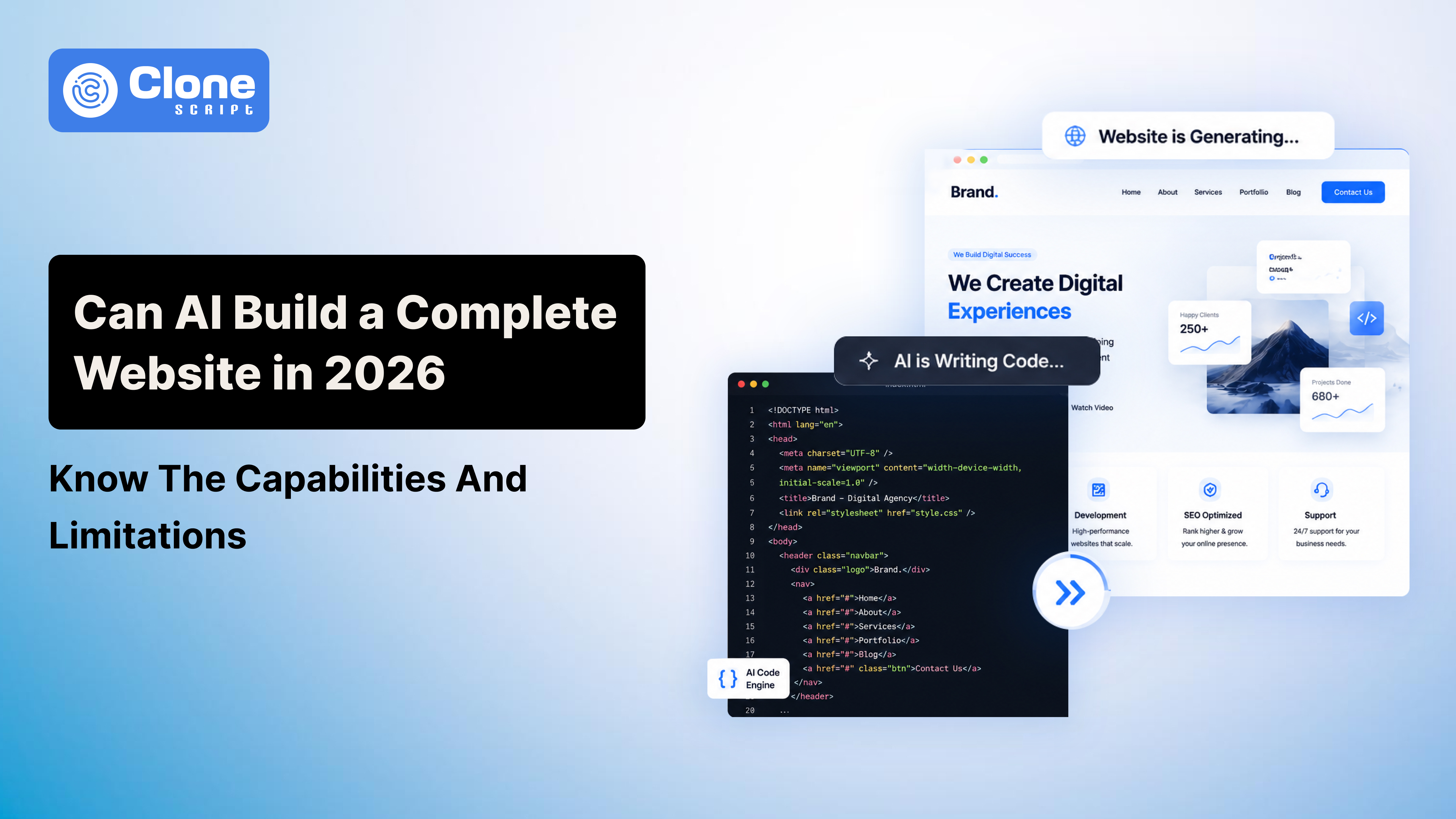
Can AI Build a Complete Website in 2026? Know the Capabilities and Limitations
A startup founder types a prompt into an AI website builder:
"Create a SaaS website with a homepage, pricing page, blog, contact form, and user dashboard."
A few minutes later, the website is live.
The design looks modern. The navigation works. The pages are responsive. The dashboard appears functional. Everything looks good, then what happened?
At first glance, it feels like web development has changed forever.
This is exactly the promise driving the rapid growth of AI website builders.
-
Market researchers estimate the global AI-powered website builder market will grow from approximately $3.24 billion in 2026 to more than $17 billion by 2035. The demand is being fueled by businesses looking to launch websites faster, reduce development costs, and eliminate technical barriers.
-
At the same time, AI adoption inside software development has become nearly universal. Google's 2025 DORA report found that 90% of technology professionals now use AI in their work, while more than 80% report productivity gains.
These numbers explain why many business owners are asking a simple question:
Can AI Build a Complete Website Without Developers?
The short answer is yes and no.
AI can already generate layouts, write code, create content structures, produce images, generate databases, and even deploy applications. However, a complete website is far more than a collection of pages connected by navigation links.
The difference between a website and a production-ready digital product is where most AI discussions become misleading.
A landing page is not a SaaS platform.
A portfolio site is not an eCommerce business.
A functioning prototype is not a scalable application.
In this guide, we'll examine what AI website development can realistically accomplish in 2026, where it performs surprisingly well, where it consistently struggles, and what businesses should understand before replacing human developers with AI tools.
Why AI Website Builders Are Exploding in Popularity?
The rise of AI website creation tools is not happening by trend.
Three major forces are driving adoption.
-
Businesses Want Faster Launches
Traditional website development can take weeks or months.
A typical project often involves:
-
Discovery sessions
-
Wireframing
-
Front-end development
-
Back-end development
-
Content creation
-
Testing
-
Deployment
For startups and small businesses, that process is expensive and slow.
AI website builders promise to compress that timeline into hours.
Instead of hiring a designer, developer, copywriter, and SEO specialist separately, users can generate an initial version through a single prompt.
-
Development Costs Continue to Rise
Hiring experienced developers has become increasingly expensive.
A basic business website may cost hundreds or thousands of dollars through freelancers, while custom SaaS platforms often require significantly larger budgets.
AI tools are positioning themselves as a low-cost alternative.
This affordability is particularly attractive to startups validating new ideas and small businesses entering digital markets.
-
AI Coding Capabilities Have Improved Intentionally
The quality gap between AI-generated code and human-written code has narrowed considerably.
Modern AI systems can now:
-
Generate React applications
-
Build responsive interfaces
-
Create APIs
-
Generate database schemas
-
Write documentation
-
Produce test cases
As a result, AI is becoming a legitimate development assistant rather than simply a content generation tool.
What Does a "Complete Website" Actually Mean?
One of the biggest mistakes in discussions about AI web development is failing to define the word complete.
Many AI website builders showcase impressive landing pages.
But a complete website includes far more than visual design.
-
Front-end Experience
The front-end website development includes everything users interact with directly.
This covers:
-
Navigation
-
Responsive layouts
-
User interfaces
-
Forms
-
Accessibility
-
User experience
AI performs extremely well here.
Modern tools can generate professional-looking interfaces faster than many junior developers.
-
Back-end Infrastructure
The back-end development powers the website behind the scenes.
This includes:
-
Business logic
-
Authentication
-
Payment processing
-
Data handling
This layer is substantially more difficult for AI to manage reliably.
-
Database Architecture
Many AI-generated websites create databases automatically.
The challenge is not creating tables.
The challenge is creating database structures that remain maintainable as thousands or millions of users interact with the application.
Poor architecture decisions can create scalability issues that are difficult to fix later.
-
Security
Security remains one of the largest weaknesses in AI-generated websites.
A secure application requires:
-
Authentication controls
-
Authorization management
-
Input validation
-
Data protection
-
Vulnerability testing
Generating working code and generating secure code are two very different tasks.
-
SEO Infrastructure
A website that cannot be discovered through search engines has limited business value.
Technical SEO includes:
-
Crawlability
-
Indexability
-
Internal linking
-
Schema markup
-
Page performance
-
Metadata
Many AI-generated websites satisfy basic SEO requirements but fail to create the topical authority and strategic optimization needed to compete in search results.
-
Scalability
A website serving 100 visitors is very different from a platform serving 100,000.
Scalability considerations include:
-
Server architecture
-
Database optimization
-
Caching strategies
-
Performance monitoring
These decisions typically require human expertise.
When people ask whether AI can build a complete website, these are the systems they are really asking about.
And this is where the conversation becomes much more interesting.
What AI Can Build Surprisingly Well in 2026?
Despite the skepticism surrounding AI website development, dismissing the technology would be a mistake.
AI has already become exceptionally good at several parts of the web development process.
The key is understanding where its strengths begin and where they end.
-
Landing Pages and Marketing Websites
This is currently AI's strongest use case.
Modern AI website builders can generate:
-
SaaS landing pages
-
Agency websites
-
Product launch pages
-
Event websites
-
Business websites
-
Lead generation websites
In many cases, the visual quality is comparable to website templates created by professional designers.
AI tools understand modern design patterns such as:
-
Hero sections
-
Social proof blocks
-
Feature grids
-
Testimonials
-
Pricing tables
-
FAQ sections
-
Call-to-action placements
For startups validating a new product idea, this capability can reduce launch timelines from weeks to hours.
-
Front-end Development
AI has become remarkably effective at front-end coding.
Platforms can now generate:
-
Responsive layouts
-
React components
-
Navigation systems
-
Dashboards
-
Forms
-
Interactive UI elements
This is particularly useful because front-end development often involves repetitive implementation work.
Instead of spending days building standard interface components, developers can focus on customization and optimization.
-
MVP Development
A minimum viable product does not require perfect architecture.
It requires enough functionality to validate market demand.
AI performs well when generating:
-
Booking systems
-
Internal tools
-
Directories
-
Customer portals
-
Basic SaaS dashboards
For founders testing a concept, AI can significantly reduce development costs.
-
Content Generation
Website creation involves more than code.
Every page requires content.
AI can accelerate:
-
Service page drafts
-
Product descriptions
-
FAQs
-
Blog outlines
-
Metadata
However, content quality still depends heavily on editing and subject matter expertise.
Publishing AI-generated copy without human review often creates thin, generic content that struggles to rank.
Where AI Still Fails in Real Production Environments?
This is where many marketing claims begin to fall apart.
Generating a website is not the same as operating a business-critical platform.
-
Complex Business Logic
AI performs best when patterns are predictable.
It struggles when business rules become complicated.
Examples include:
-
Insurance quoting systems
-
Healthcare portals
-
Financial applications
-
Enterprise workflows
-
Marketplace platforms
These systems require thousands of interconnected decisions that extend far beyond code generation.
A small error can have serious consequences.
-
Long-Term Maintainability
One of the most overlooked problems with AI-generated websites is maintainability.
The code often works.
The problem is that future developers must maintain it.
Common issues include:
-
Duplicate components
-
Inconsistent naming conventions
-
Poor file structures
-
Excessive dependencies
-
Weak documentation
The result is technical debt.
Technical debt does not appear on launch day.
It appears six months later when the business needs new features.
-
Strategic UX Decisions
AI can generate interfaces.
It cannot reliably understand customer psychology.
A successful website requires decisions about:
-
User journeys
-
Conversion paths
-
Trust signals
-
Information hierarchy
-
Purchase behavior
These decisions are driven by research, experience, and testing.
AI can assist.
It cannot replace the process.
Can AI Build an SEO-Friendly Website?
This is the question most businesses should ask.
A website that cannot generate traffic is rarely a good investment.
Unfortunately, this topic is missing from most AI website builder reviews.
What AI Handles Well for SEO
Modern AI-generated websites often include:
-
Meta titles
-
Meta descriptions
-
XML sitemaps
-
Responsive design
-
Basic schema markup
These elements satisfy entry-level SEO requirements.
For small websites, that may be enough initially.
Where SEO Problems Begin
The challenge is that ranking on Google requires far more than technical basics.
Many AI-generated websites produce pages that are technically optimized but strategically weak.
Common issues include:
-
Thin Content
AI frequently generates content that sounds informative but lacks unique insights.
Google increasingly rewards:
-
Original expertise
-
Real-world experience
-
First-hand observations
-
Proprietary data
Generic content struggles to compete.
-
Weak Topical Authority
Ranking often depends on demonstrating expertise across an entire subject area.
For example, a website targeting "AI website development" might need supporting content covering:
-
AI coding tools
-
Website builders
-
Web design trends
-
Technical SEO
-
UX optimization
-
Website security
AI rarely creates comprehensive topical clusters automatically.
-
Poor Internal Linking
Many AI-generated websites create disconnected pages.
Strong SEO requires:
-
Contextual links
-
Topic hubs
-
Content clusters
-
Strategic authority flow
Without these elements, ranking becomes more difficult.
Why Core Web Vitals Is The Hidden SEO Risk?
Many businesses assume AI-generated websites are automatically optimized.
That assumption can be dangerous.
Core Web Vitals remain important ranking signals.
The three metrics include:
-
Largest Contentful Paint (LCP)
-
Interaction to Next Paint (INP)
-
Cumulative Layout Shift (CLS)
AI-generated websites sometimes perform well because modern frameworks are optimized.
However, they can also generate:
-
Excessive JavaScript
-
Unused CSS
-
Bloated dependencies
-
Inefficient rendering
The result is slower performance.
A website that looks impressive can still fail technical SEO audits.
This is why performance testing remains essential before launch.
What Security Risks Most AI Website Builder Reviews Ignore?
Security receives far less attention than it deserves.
Yet it may be the most important factor for businesses handling customer data.
-
Common Security Concerns
AI-generated applications may include:
-
Weak authentication flows
-
Inadequate input validation
-
Misconfigured permissions
-
API exposure risks
-
Dependency vulnerabilities
These problems may not be visible during testing.
They often emerge after deployment.
-
Compliance Challenges
Businesses operating in regulated industries face additional concerns.
Requirements may include:
-
GDPR compliance
-
Data retention policies
-
Consent management
-
Access controls
AI can assist with implementation.
Responsibility still belongs to the business.
A generated website is not automatically compliant.
AI Website Builders vs Professional Developers Comparison
Understand the differences between making a website through AI and choosing a web developer:
| Category | AI Website Builders | Professional Developers |
|---|---|---|
| Speed | Excellent | Moderate |
| Cost | Low | Higher |
| Initial Design | Strong | Strong |
| Customization | Limited | Excellent |
| Security | Moderate | Strong |
| SEO Strategy | Basic | Advanced |
| Scalability | Limited | Strong |
| Maintenance | Variable | Strong |
| Business Strategy | Weak | Strong |
The comparison reveals an important reality.
AI excels at execution.
Humans excel at strategy.
The most successful projects increasingly combine both.
AI accelerates development.
Developers guide decisions.
The Final Verdict
Can AI build a complete website in 2026?
For simple projects, the answer is increasingly yes.
But businesses should not confuse a working website with a production-ready digital product.
The moment requirements involve advanced SEO or complex business logic.
Human expertise becomes essential.
The most realistic view is that AI is not replacing web developers.
It is replacing portions of web development work.
Businesses that understand this distinction will benefit the most.
Instead of asking whether AI can build a complete website, a better question is:
How much of the website development process should AI handle, and where does human expertise create the greatest value?
In 2026, that balance not complete automation is what separates successful AI-powered websites from those that struggle after launch.