BTC - Bitcoin
 USDTERC20 - USDT ERC20
 ETH - Ethereum
 BNB - Binance
 BCH - Bitcoin Cash
 DOGE - Dogecoin
 TRX - TRON
 USDTTRC20 - USD TRC20
 LTC - LiteCoin

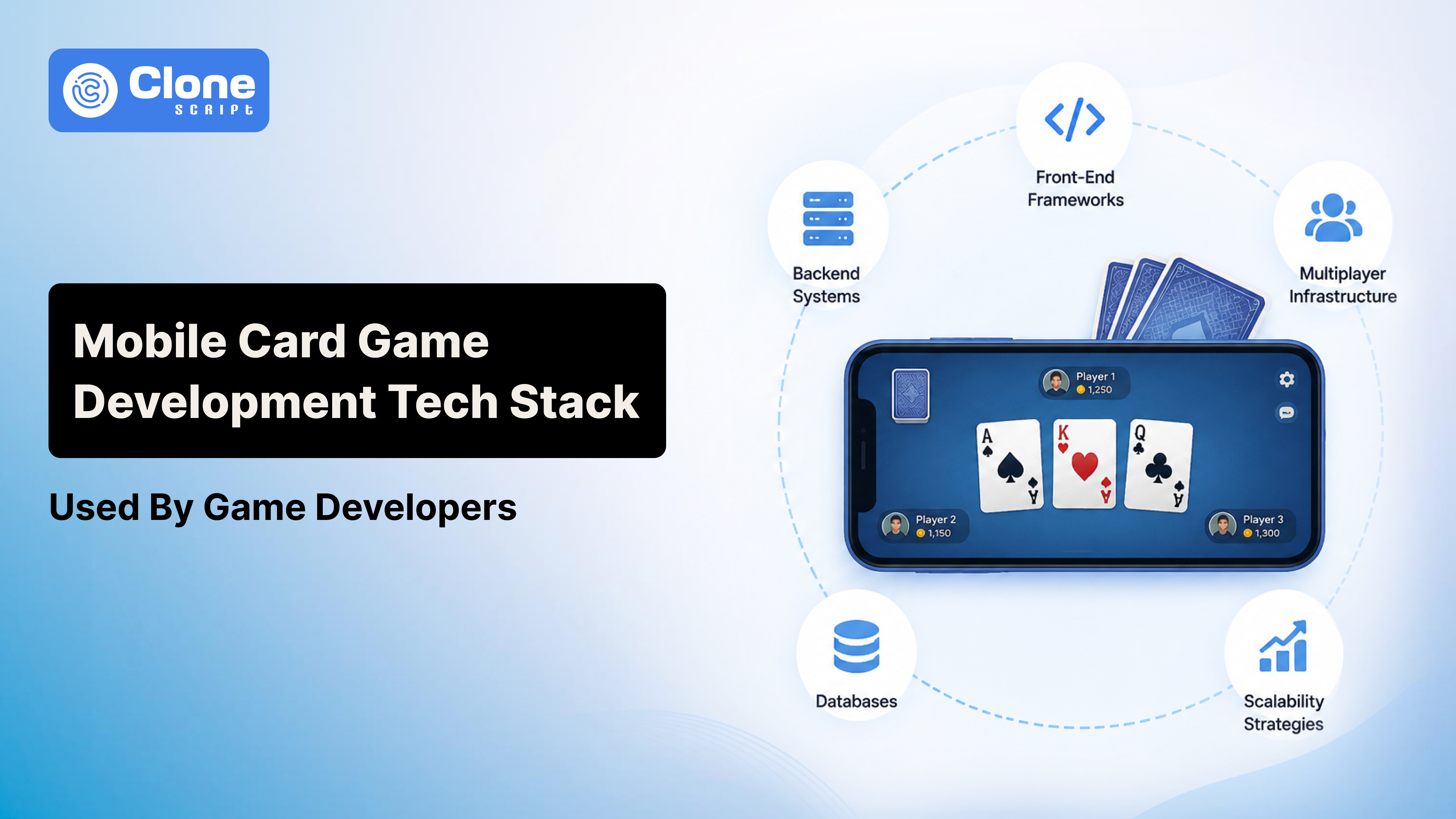
Mobile Card Game Development Tech Stack Used by Developers
A card game can look deceptively simple from the outside. Players see cards, animations, leaderboards, and multiplayer matches. Developers see something very different.
Behind every successful poker, rummy, solitaire, or collectible card game app development sits a technology stack responsible for processing millions of game actions, synchronizing players in real time, preventing cheating, and maintaining smooth gameplay across devices.
The challenge is that there is no single technology stack that works for every card game.
The technologies used for a casual solitaire app are very different from those required to support a multiplayer poker platform handling thousands of concurrent players.
Before choosing frameworks, databases, or cloud infrastructure, developers must first understand the technical challenges they are solving.
Why Technology Stack Selection Matters More Than Ever
The mobile gaming industry continues to expand at a wide scale. Planning mobile game UI is not just enough.
Recent industry reports estimate that the global mobile gaming market will exceed $137 billion in 2026 and continue to grow steadily throughout the decade. Mobile games now account for more than half of global gaming revenue, making the market increasingly competitive.
That growth has changed player expectations.
A card game launched in 2018 could survive with basic matchmaking and limited multiplayer features. Today's players expect:
-
Real-time multiplayer gameplay
-
Cross-device progression
-
Live tournaments
-
Personalized rewards
-
Fast matchmaking
-
Cloud saves
-
Social features
Every one of those features depends on technology choices.
Developers are no longer selecting frameworks based only on development speed. They are choosing technologies that can support long-term scalability without requiring expensive architectural changes later.
The Biggest Mistake Many Card Game Startups Make
Many teams choose technologies based on what is easiest to build.
This is risky.
Experienced developers choose technologies based on what will still work after growth.
That difference becomes important very quickly.
A startup might launch a multiplayer card game with a lightweight back-end architecture. Everything performs well with a few hundred users.
Then downloads increase.
Player activity rises.
More matches run simultaneously.
Server requests multiply.
Suddenly, the original infrastructure becomes the biggest obstacle to growth.
Instead of developing new features, teams spend months rebuilding systems that should have been planned earlier.
Common problems include:
-
Server overload
-
Multiplayer synchronization issues
-
Rising cloud expenses
-
Security vulnerabilities
-
Slow matchmaking
The technology stack becomes a business decision, not just an engineering decision.
Understanding the Core Layers of a Card Game Technology Stack
Successful card games rely on multiple technologies working together.
Each layer solves a different problem.
-
Front-end Layer
The game app’s front-end controls everything players see.
This includes:
-
Card animations
-
Menus
-
Visual effects
-
Game boards
-
User interactions
A poorly optimized front-end can make gameplay feel slow even when back-end systems perform well.
-
Back-end Layer
The back-end manages game logic.
Its responsibilities include:
-
User authentication
-
Matchmaking
-
Rewards
-
Leaderboards
-
Player progression
Most multiplayer card games depend heavily on back-end performance because every action must be validated and synchronized.
-
Database Layer
Databases store critical information such as:
-
Match history
-
Rankings
-
Rewards
-
User accounts
-
Inventory systems
As player numbers increase, database performance becomes increasingly important.
-
Multiplayer Infrastructure
This layer handles real-time communication between players and servers.
Without a strong multiplayer infrastructure, competitive card games quickly develop latency and synchronization problems.
Why Unity Continues to Dominate Mobile Card Game Development
When developers discuss mobile game development technologies, Unity almost always enters the conversation.
There is a reason for that.
Unity currently powers more than 70% of mobile games and remains one of the most widely adopted game development platforms in the industry.
Its popularity is not simply about brand recognition.
Unity solves several development challenges simultaneously.
-
Cross-Platform Development
Instead of maintaining separate Android and iOS projects, developers can use a shared codebase.
This significantly reduces:
-
Development time
-
Maintenance costs
-
QA workloads
Your game will be ready with a more promising approach.
-
Strong 2D Game Development Support
Many card games rely on sophisticated animations rather than advanced 3D graphics.
Unity's 2D systems allow developers to build responsive card interactions without excessive complexity.
-
Large Asset Ecosystem
One reason development studios favor Unity is the Asset Store.
Developers can access:
-
Multiplayer plugins
-
UI frameworks
-
Animation systems
-
Visual effect packages
This shortens production timelines significantly.
-
Scalability
A small card game MVP can launch on Unity and later expand into tournaments, competitive multiplayer systems, and LiveOps infrastructure without requiring a complete technology migration.
That flexibility is one reason Unity remains dominant in mobile gaming.
When Flutter Makes More Sense Than Unity
Despite Unity's popularity, not every card game needs a game engine.
This is where Flutter becomes attractive.
Flutter is increasingly used for lightweight card game applications because it combines fast development with strong interface performance.
Developers often choose Flutter when building:
-
Solitaire apps
-
Casual card games
-
Early-stage prototypes
The biggest advantage is development speed.
Teams can build Android and iOS applications from a single codebase while maintaining a native-like user experience.
Flutter also reduces operational complexity.
For startups validating a concept, this can be more important than advanced game-engine functionality.
However, Flutter becomes less practical when real-time multiplayer systems and advanced game mechanics become central to the product.
Back-end Technologies That Keep Multiplayer Card Games Running
Players rarely think about back-end systems.
They notice immediately when those systems fail.
Most frustrations in multiplayer games originate from back-end problems rather than front-end issues.
Examples include:
-
Match disconnections
-
Delayed actions
-
Reward failures
-
Leaderboard inaccuracies
This is why back-end architecture matters so much.
-
Node.js
Node.js remains one of the most common back-end technologies in multiplayer gaming.
Its event-driven architecture allows developers to process large numbers of simultaneous player actions efficiently.
This becomes important when:
-
Players join matches
-
Cards are distributed
-
Game states update
-
Tournament rounds begin
Real-time responsiveness is one of Node.js's strongest advantages.
-
Java Spring Boot
Many enterprise gaming platforms prefer Java because of its stability.
It performs well in environments requiring:
-
High concurrency
-
Strong security
-
Long-term maintainability
While development can be slower compared to Node.js, Java often becomes attractive as gaming platforms mature.
-
.NET
.NET continues to be used for high-performance gaming ecosystems.
Large organizations choose it because of its scalability and enterprise-grade architecture.
The choice between Node.js, Java, and .NET usually depends on long-term business requirements rather than technical trends.
Multiplayer Infrastructure: The Challenge Most Teams Underestimate
Building a multiplayer card game is much harder than connecting two players to a shared room.
Every action must remain synchronized across devices.
Even small inconsistencies can affect fairness.
This becomes especially important in games involving rankings, tournaments, or real-money mechanics.
According to Unity's Gaming Report, multiplayer mobile games generated significantly higher engagement and revenue compared to single-player experiences. Multiplayer titles also recorded stronger monthly active user performance.
This explains why developers invest heavily in multiplayer infrastructure.
-
Photon
Photon remains one of the most widely used multiplayer technologies for Unity-based games.
Developers use it to manage:
-
Match synchronization
-
Real-time communication
-
Multiplayer sessions
-
Room management
-
PlayFab
PlayFab provides back-end services specifically designed for games.
Its features include:
-
Matchmaking
-
Player accounts
-
Analytics
-
Live operations
-
Socket.IO
Teams building custom multiplayer systems often rely on Socket.IO.
This provides flexibility but requires more back-end expertise.
Database Technologies Behind Modern Card Game Platforms
Card games generate huge amounts of data.
Everything from player rankings to match records must be stored efficiently.
-
PostgreSQL
PostgreSQL remains a preferred choice for structured gaming data.
It works particularly well for:
-
Match histories
-
Ranking systems
-
User profiles
-
Transactions
-
Redis
Redis serves a different purpose.
Rather than storing permanent records, it handles real-time operations.
Developers frequently use Redis for:
-
Session management
-
Leaderboards
-
Match states
Its speed makes it ideal for multiplayer environments.
-
MongoDB
MongoDB provides flexibility when applications evolve rapidly.
Development teams often choose it when game features change frequently, and data structures require adaptability.
Many successful gaming platforms combine Redis with PostgreSQL or MongoDB rather than relying on a single database solution.
Cloud Platforms Used by Modern Gaming Companies
Infrastructure requirements grow quickly after launch.
A card game with thousands of active users requires far more than basic hosting.
This is where cloud platforms become essential.
-
AWS
Amazon Web Services remains the most widely used cloud platform in gaming.
Its popularity comes from:
-
Global infrastructure
-
Auto-scaling
-
Security tools
-
Analytics integrations
This cloud platform is preferable for its world-class facilities.
-
Google Cloud
Google Cloud is increasingly used for data-heavy gaming environments because of its analytics and machine-learning capabilities.
-
Microsoft Azure
Azure remains popular among organizations already invested in Microsoft's ecosystem.
Cloud platforms allow developers to scale infrastructure as player demand increases rather than investing heavily up front.
Technology Stacks Developers Use for Different Card Game Types
Different card games require different technical foundations.
-
Solitaire Applications
In solitaire applications, the typical stack is Flutter, Firebase, and SQLite. The primary goal is fast development and low infrastructure costs.
-
Poker Platforms
For poker game development, the stack includes Unity, Node.js, Redis, PostgreSQL, and AWS. The goal is real-time gameplay and anti-cheat protection.
-
Rummy Applications
Rummy apps use Unity, Photon, Redis, and AWS. The primary goal is to ensure continuous multiplayer synchronization.
-
Collectible Card Games
In collectible card game development, the stack used includes Unity, PlayFab, PostgreSQL, and AWS. The intention is to manage inventory, progression systems, and LiveOps support.
Conclusion
Technology decisions influence every stage of mobile card game development.
The front-end affects player experience. The back-end controls game logic. Multiplayer infrastructure determines responsiveness. Databases manage progression systems. Cloud platforms support scalability.
While Unity, Node.js, Redis, PostgreSQL, Photon, and AWS remain among the most commonly used technologies in 2026, there is no universal stack that fits every card game.
The strongest development teams focus less on trends and more on solving technical challenges that match their game's long-term goals.
In modern card game development, the right technology stack is not simply a development choice. It is one of the most important product decisions a company can make.