BTC - Bitcoin
 USDTERC20 - USDT ERC20
 ETH - Ethereum
 BNB - Binance
 BCH - Bitcoin Cash
 DOGE - Dogecoin
 TRX - TRON
 USDTTRC20 - USD TRC20
 LTC - LiteCoin

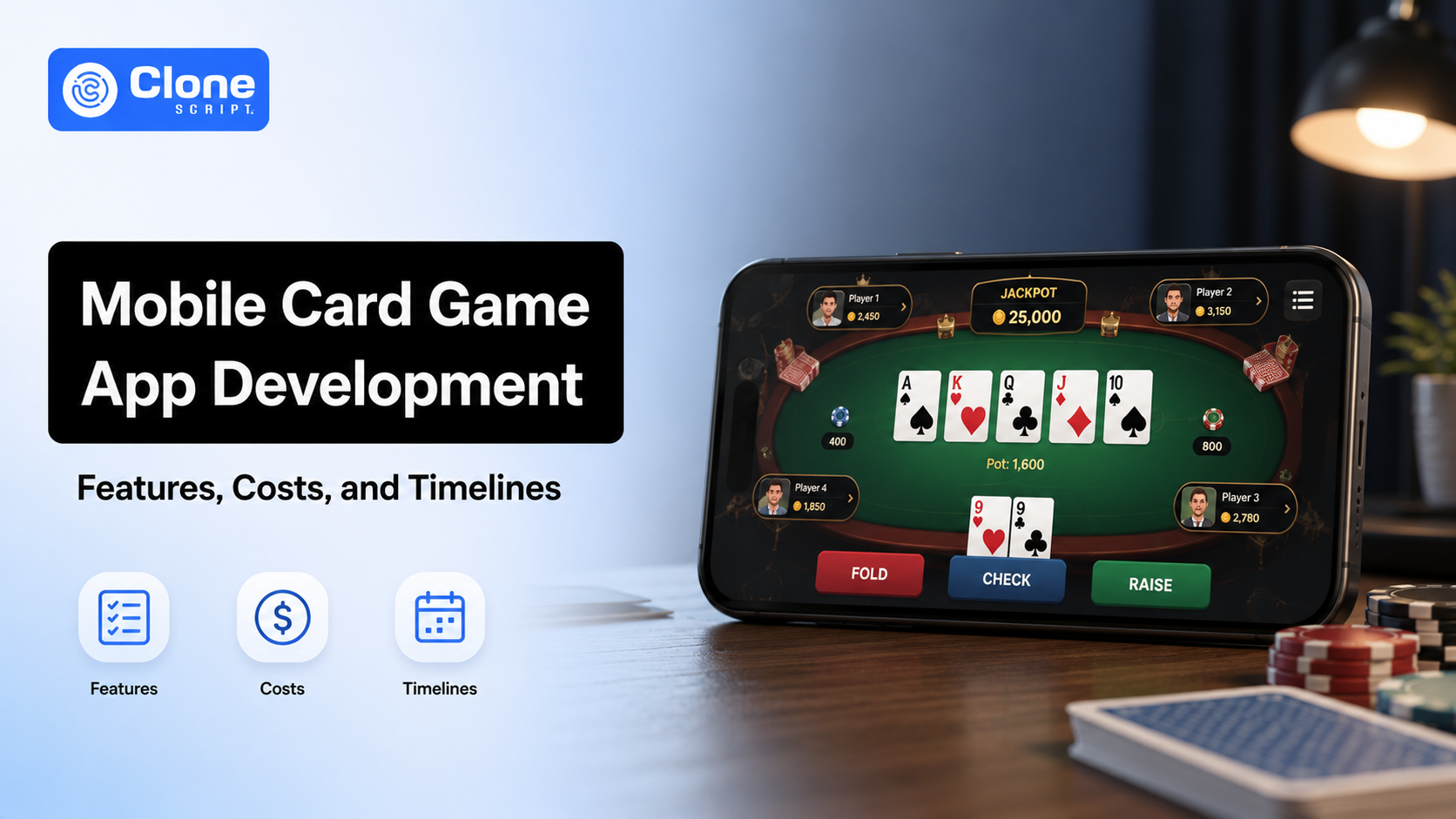
Mobile Card Game App Development: Features, Costs, and Timelines
Mobile card games remain one of the most profitable mobile gaming categories in 2026 because they combine accessibility, replayability, and scalable monetization. Unlike trend-based genres, card games sustain long-term engagement through strategic gameplay, social competition, and frequent content updates that keep players invested over time.
The market opportunity continues to grow as global mobile users seek quick, skill-based entertainment across casual and competitive formats. This creates strong demand for both classic card experiences and innovative multiplayer concepts designed for modern audiences.
For startups and entrepreneurs, mobile card game app development offers a practical entry point into gaming. There is a lower production complexity compared to large-scale games, which makes it easier to launch, test, and scale profitably.
Validate Your Card Game App Idea Before Development.
Before investing in card game app development, validate whether your idea solves a real market demand. A structured validation process should answer one question: Will players choose your app over existing alternatives? Furthermore, you have to follow these aspects:
-
Choose Your Game Model.
Selecting the right game type defines your business direction.
-
Solitaire: Best for casual users and ad-driven revenue models
-
Poker: Strong for competitive communities and tournament-based earnings
-
Rummy: Popular in skill-based gaming markets with high retention potential
-
Fantasy / CCG: Supports long-term engagement through collection systems
-
PvP Strategy Card Games: Appeals to niche audiences seeking tactical gameplay
Each model demands different mechanics, monetization strategies, and infrastructure.
-
Validate Market Demand
Use evidence, not assumptions, to ensure the game you develop is interesting to players.
-
Study competitor reviews to identify missing features
-
Analyze ranking trends in app stores
-
Test audience interest through landing pages or surveys
-
Build a small prototype for early feedback
-
MVP Validation Checklist
Before app development, confirm these aspects through a minimum viable product:
-
Clear target audience
-
Unique gameplay advantage
-
Scalable monetization plan
-
Strong early user interest
-
Feasible development scope
If these signals are weak, refine the concept before committing to full production.
Features to Prioritize for a Card Game App
A successful card game app depends less on flashy visuals and more on the systems that keep gameplay fair, smooth, and rewarding. Feature planning for a card game should begin with the product’s core loop, which players repeatedly do, and then expand into engagement and growth systems.
-
Core Gameplay Features
These form the technical aspect of the app.
-
Game rules engine: Enforces logic, scoring, and win conditions
-
Deck logic and shuffling: Ensures fairness and unpredictability
-
Turn-based mechanics: Maintains pacing and gameplay flow
-
Matchmaking: Pairs players based on skill or availability
Without these systems, even a well-designed concept will struggle to deliver a reliable experience.
-
Player Engagement Features
Retention comes from layered motivation. Consider the following to add:
-
Leaderboards: Create competition and status visibility
-
Tournaments: Encourage recurring participation
-
Rewards systems: Reinforce progression through bonuses
-
Daily quests: Build habit loops
-
Social chat: Strengthens community interaction
These features extend session frequency and lifetime value.
-
Advanced Features
Add these after core stability is proven.
-
AI opponents for solo play
-
Cross-platform multiplayer for wider reach
-
Live events for seasonal engagement
-
Anti-cheat systems for competitive trust
But there is one more thing to know: the must-have features and nice-to-have features in the card game. Take a look at this table.
| Must-Have | Nice-to-Have |
|---|---|
| Rules engine | AI opponents |
| Matchmaking | Cross-platform play |
| Rewards system | Live events |
| Secure back-end | Cosmetic customization |
| Daily progression | Social chat |
Your game logic will clarify which features to add and which to add later.
5 Steps of Mobile Card Game Development Process
A structured development process prevents delays, budget overruns, and technical rework. In mobile card game app development, execution should follow a staged workflow where each phase validates the next. Skipping steps often leads to costly corrections later.
-
Planning and Prototyping
App prototyping with the planning phase defines scope, audience, and business objectives. Note these aspects:
-
Identify your target player segment
-
Prioritize core features for MVP
-
Map monetization pathways
-
Create a prototype to test usability
Early prototypes reveal design flaws before engineering begins.
-
Game Design and Wireframing
Card game design focuses on user interaction and game balance. Focus on these:
-
Build screen flows and card layouts
-
Define onboarding experience
-
Establish progression systems
-
Test gameplay logic visually
Strong wireframes reduce ambiguity for front-end developers to match the functionality.
-
Front-end Development
This stage builds the player-facing experience and is prominent for:
-
Gameplay interactions
-
Animations and transitions
-
Responsive UI across devices
-
Real-time feedback systems
Performance optimization should begin with front-end app development, not after launch.
-
Back- end and Multiplayer Infrastructure
The back-end maintains scalability and has to be maintained properly:
-
Player accounts and authentication
-
Matchmaking systems
-
Rewards and progression storage
-
Server-side logic for fairness
Back-end infrastructure choices directly affect future growth capacity.
-
QA Testing and Soft Launch
Before the full release of the card game on the Google Play Store and App Store, ensure these:
-
Test balance and stability
-
Identify bugs across devices
-
Run soft launch in limited markets
-
Analyze retention and monetization data
This phase for QA and testing turns assumptions into measurable product insights.
Card Game Design Considerations That Improve Retention
Retention is rarely driven by gameplay alone. Players stay when the experience feels intuitive, satisfying, and mentally rewarding over repeated sessions. In card games, design decisions directly influence whether users return daily or uninstall after the first week.
-
UX for Long Session Play
Card games often involve extended play sessions, so interface comfort matters. Follow these conditions:
-
Keep controls reachable and uncluttered
-
Use a clear visual hierarchy for cards, actions, and scores
-
Minimize unnecessary taps between turns
-
Ensure readability across screen sizes
Poor usability increases fatigue and shortens engagement time.
-
Card Animation and Responsiveness
Interaction feedback shapes perceived quality. Then, consider these aspects:
-
Fast animations maintain momentum
-
Smooth transitions reduce confusion
-
Tactile effects make actions feel deliberate
-
Low latency strengthens competitive confidence
Well-tuned responsiveness improves emotional satisfaction.
-
Balancing Simplicity vs Depth
New players need immediate clarity, but long-term users require strategic layers.
-
Easy onboarding for first-time users
-
Gradual introduction of mechanics
-
Hidden complexity that unfolds over time
This balance supports both acquisition and mastery.
-
Retention Psychology in Game Design
Effective retention systems rely on behavioral triggers and identify the following.
-
Progress tracking for visible achievement
-
Time-limited challenges for urgency
-
Reward streaks for habit formation
-
Social ranking for competitive motivation
Design should encourage return behavior without overwhelming players.
How Much Does Mobile Card Game App Development Cost?
For an MVP app, the spend range is $5 to $25k, and a mid-level multiplayer app could cost around $25k to $60k. Making advanced, scalable card game, the cost reaches to $60k to $150k+.
Budget planning is one of the most important decisions in mobile card game app development. Costs vary based on complexity, multiplayer requirements, design quality, and long-term scalability. The key is aligning investment with the business stage rather than overbuilding too early.
For startups, the smartest path is often an MVP that validates demand before larger expansion.
What does each tier typically include?
-
MVP card game budget is $5k to $25k.
In this budget range, the core gameplay loop is available with a basic UI/UX. Also, there is limited multiplayer or AI support to enhance the gameplay. The essential monetization setup helps make revenue.
-
The mid-level multiplayer app cost is $25k to $60k.
This kind of game usually comes with a real-time or advanced turn-based system. Social features and progression layers make the experience memorable. In this budget, the game is optimized with improved art and animations and stronger back-end support.
-
Advanced card game available with $60k–$150k+.
You can get cross-platform compatibility with tournament ecosystems. The live operations support and enterprise-grade infrastructure are managing the entire platform.
The biggest budgeting mistake is assuming launch costs represent total investment. A card game app is a long-term product, not a one-time build. Development budget should account for future iteration, scaling, and market adaptation, not just initial release.
What Impacts Development Costs?
The total cost of building a solitaire or poker card game app depends on more than feature count. Strategic decisions made early in the project can significantly raise or reduce long-term expenses.
Key Cost Factors
-
Platform Choice
-
iOS only: Lower initial scope, faster release
-
Android only: Broader reach in many markets
-
Cross-platform: Reduced development time, shared codebase
Platform strategy affects testing complexity and maintenance workload.
-
Multiplayer Complexity
-
Turn-based systems are less resource-intensive
-
Real-time interactions require a stronger synchronization architecture
The more competitive the gameplay, the higher the development demand.
-
Back-end Architecture
Scalable cloud infrastructure increases upfront investment but prevents issues later.
-
Authentication systems
-
Data storage
-
Matchmaking services
-
Analytics pipelines
-
Art and Animation
Custom illustrations, effects, and polished transitions can become major budget components. You have to allocate it differently to manage the app.
-
Security and Compliance
Anti-fraud measures, payment protection, and regional legal requirements add operational costs to the development. Plan it before the coding starts.
Hidden Costs Often Overlooked
-
Maintenance: Ongoing updates and bug fixes
-
Server costs: Scaling with active users
-
Live ops: Events, balancing, seasonal updates
-
User acquisition: Paid campaigns and retention tools
These hidden costs exceed original projections. Planning for them early creates a more sustainable business model.
Timeline to Build a Card Game App
A realistic timeline helps founders manage expectations, budget cycles, and launch planning. In poker or solitaire-like card game app development, schedules vary based on feature scope, team size, and technical complexity. However, most MVP projects follow a predictable sequence.
Recommended Timeline Breakdown
| Phase | Estimated Duration |
|---|---|
| Discovery | 2–4 weeks |
| Design | 3–6 weeks |
| Development | 10–20 weeks |
| Testing | 3–5 weeks |
| Launch Prep | 2–4 weeks |
Total timeline: 4–7 months for a typical MVP.
What Happens in Each Phase
-
Discovery
In this phase, first, the business planning has started with audience research and technical scoping. This phase defines what should be built.
-
Design
Once the first step is complete, the design work is initiated through wireframes, interaction flows, and visual systems. Design aligns gameplay with user behavior.
-
Development
This phase covers the full-stack card game development workflow from front-end engineering to back-end setup. There is also multiplayer integration that can be done. This is the longest and most resource-heavy stage.
-
Testing
The bug fixing, performance validation, and balance adjustments have been done in the card game app testing. Quality assurance protects launch reputation.
-
Launch Prep
The final step is to store assets for the card game app on the Play Store. Then, its marketing setup comes into play for getting users on board. Analytics integration is useful for making such a decision on gameplay.
A rushed launch weakens early retention.
Projects with advanced multiplayer systems or live operations layers may require additional time. The most effective teams treat timeline planning as iterative rather than fixed, allowing room for feedback-driven improvements.
How Card Game Apps Make Money: 5 Monetization Models
Revenue generation in a card game app depends on designing monetization into the product from the start, not adding it later as an afterthought. The strongest apps create multiple income streams that align with player behavior rather than interrupt it.
Monetization Models
-
In-App Purchases
In this model, players are ready to spend on card packs, cosmetic skins, boosters, and premium decks. In-app purchases integration in a card game works best when they enhance the experience without breaking the balance.
-
Ads
Digital advertising of a new card game will be effective for casual games with high session volume. There are such options for ads, including rewarded video ads, interstitial placements, and optional bonus incentives. Ads should feel integrated, not disruptive.
-
Subscription Passes
Recurring monthly revenue can be generated through exclusive rewards, faster progression, and premium events. Subscriptions improve long-term cash flow.
-
Tournament Fees
Competitive players often pay for entry into prize-based events organized in the card game. This can be helpful to increase interest in the new game.
-
Virtual Currency Economies
This revenue model for a card game creates internal spending loops that support engagement and monetization simultaneously. The virtual currencies in the gameplay will encourage players to spend on.
Hybrid Monetization Strategy
For startup profitability, hybrid models outperform single-source revenue.
A practical structure may include:
-
Ads for non-paying users
-
Subscriptions for loyal players
-
Cosmetic purchases for engaged spenders
This broadens earning potential while reducing dependence on one channel.
The key is balance. Monetization should strengthen the player experience, not create pay-to-win frustration. Sustainable revenue comes from perceived value, not aggressive extraction.
Biggest Risks in Card Game App Development
Many products fail despite strong concepts because operational weaknesses surface after launch. Identifying these risks early improves survival and long-term profitability.
-
Poor Retention Loops
If players do not have a reason to return, growth stalls quickly. Common causes include:
-
Weak progression systems
-
Repetitive gameplay
-
Limited rewards
Retention must be designed intentionally, not assumed.
-
Pay-to-Win Imbalance
Monetization that creates unfair advantages damages trust.
Players may tolerate spending incentives, but they reject systems where payment overrides skill. Competitive integrity is essential for long-term engagement.
-
High Acquisition Costs
Marketing expenses can exceed projected revenue if targeting is inefficient.
-
Expensive ad campaigns
-
Poor conversion funnels
-
Low lifetime value
Without sustainable acquisition economics, scaling becomes difficult.
-
Weak Matchmaking
Unbalanced matches frustrate both beginners and experienced users. Focusing on poor pairing leads to faster churn and lower session quality.
-
Scaling Failures
Infrastructure problems during growth can damage a reputation.
-
Server crashes
-
Lag issues
-
Unstable multiplayer environments
The biggest mistake is addressing these risks only after launch. Strong planning, testing, and live analytics reduce exposure before problems become costly. In card game app development, risk prevention is more valuable than post-release recovery.
How to Launch and Market Your Card Game App
A strong product does not guarantee traction. In a mobile card game, the launch strategy determines whether the app gains momentum or disappears in a crowded market.
-
Soft Launch Strategy
A soft launch allows teams to test performance in limited regions before scaling globally.
Key goals include:
-
Measuring retention rates
-
Identifying monetization gaps
-
Validating user behavior
-
Optimizing onboarding flow
This stage provides real-world data without full-market risk.
-
App Store Optimization
Visibility in app stores depends on discoverability.
Focus on these aspects:
-
Keyword-rich titles and descriptions
-
High-converting screenshots
-
Persuasive preview videos
-
Localized listings for target markets
App Store Optimization improves organic installs over time.
-
Paid User Acquisition
Use targeted campaigns to reach high-intent players by following:
-
Gaming ad networks
-
Retargeting strategies
Acquisition should be tied to measurable lifetime value.
-
Influencer and Streamer Promotion
Gaming creators help establish trust and community faster than traditional ads. Focus on partnering with niche influencers whose audiences align with your genre.
-
Retention and Live Events
Post-launch growth depends on keeping users engaged.
-
Seasonal challenges
-
Limited-time tournaments
-
Loyalty rewards
Sustained engagement reduces churn and increases monetization.
Successful launches are not single events. They are ongoing systems built around feedback, iteration, and community expansion.
Should You Build From Scratch or Use Ready-Made Solutions?
One of the earliest strategic decisions in card game app development is whether to build a custom product or use a ready-made framework. The right choice depends on your budget, timeline, and long-term business goals.
-
Custom Development
This option is the best for businesses aiming to create a differentiated product.
Advantages
-
Full ownership of the codebase
-
Unlimited customization
-
Stronger brand identity
-
Better scalability for future expansion
Challenges
-
A higher upfront cost
-
Greater technical complexity
Custom builds are ideal when long-term growth matters more than speed.
-
White-Label Solutions
This option is the best for rapid market entry or concept validation.
Advantages
-
Faster deployment
-
Lower initial investment
-
Prebuilt functionality
-
Reduced technical burden
Challenges
-
Limited customization
-
Dependency on vendor roadmap
-
Scalability constraints
White-label solutions work well for MVP testing but may restrict future flexibility.
For startups, the decision should align with the business stage. Validate quickly if uncertainty is high. Build custom only when the model proves sustainable.
Choosing a Mobile Card Game Development Partner
The success of your project depends heavily on who builds it. A development partner shapes technical decisions, delivery timelines, and long-term scalability. Choosing the wrong team can increase costs, delay launch, and weaken product quality.
All Clone Script can be the right development company for your card game creation. We have expertise in card app designing, front-end, back-end development, and deployment. We also help you with Google Play Store and App Store submission with a proper revision.
These additional details also help you to consider the developers for the card game.
-
Questions to Ask Agencies
Before signing any agreement or hiring a card game app developer, evaluate expertise through targeted questions.
-
Have you developed multiplayer or gaming apps before?
-
What technology stack do you recommend for this project?
-
How do you handle post-launch support and maintenance?
-
Can you provide measurable outcomes from past projects?
-
What is included in your quoted budget?
Specific answers reveal operational maturity.
-
Red Flags to Watch
Some warning signs indicate future project risk.
-
Unrealistically low pricing
-
Vague timelines
-
No structured development roadmap
-
Limited gaming-specific portfolio
-
Poor communication during early discussions
If clarity is missing before the contract, it will worsen during execution.
-
Budget-Fit Evaluation
A strong partner aligns with your stage of growth.
-
Startups need lean MVP-focused execution
-
Scaling businesses need infrastructure expertise
-
Enterprise teams require security and compliance readiness
The best card game development team balances cost efficiency with strategic thinking.
A capable development partner should understand both product delivery and business viability. Technical execution matters, but commercial awareness often determines whether the app becomes profitable.