BTC - Bitcoin
 USDTERC20 - USDT ERC20
 ETH - Ethereum
 BNB - Binance
 BCH - Bitcoin Cash
 DOGE - Dogecoin
 TRX - TRON
 USDTTRC20 - USD TRC20
 LTC - LiteCoin

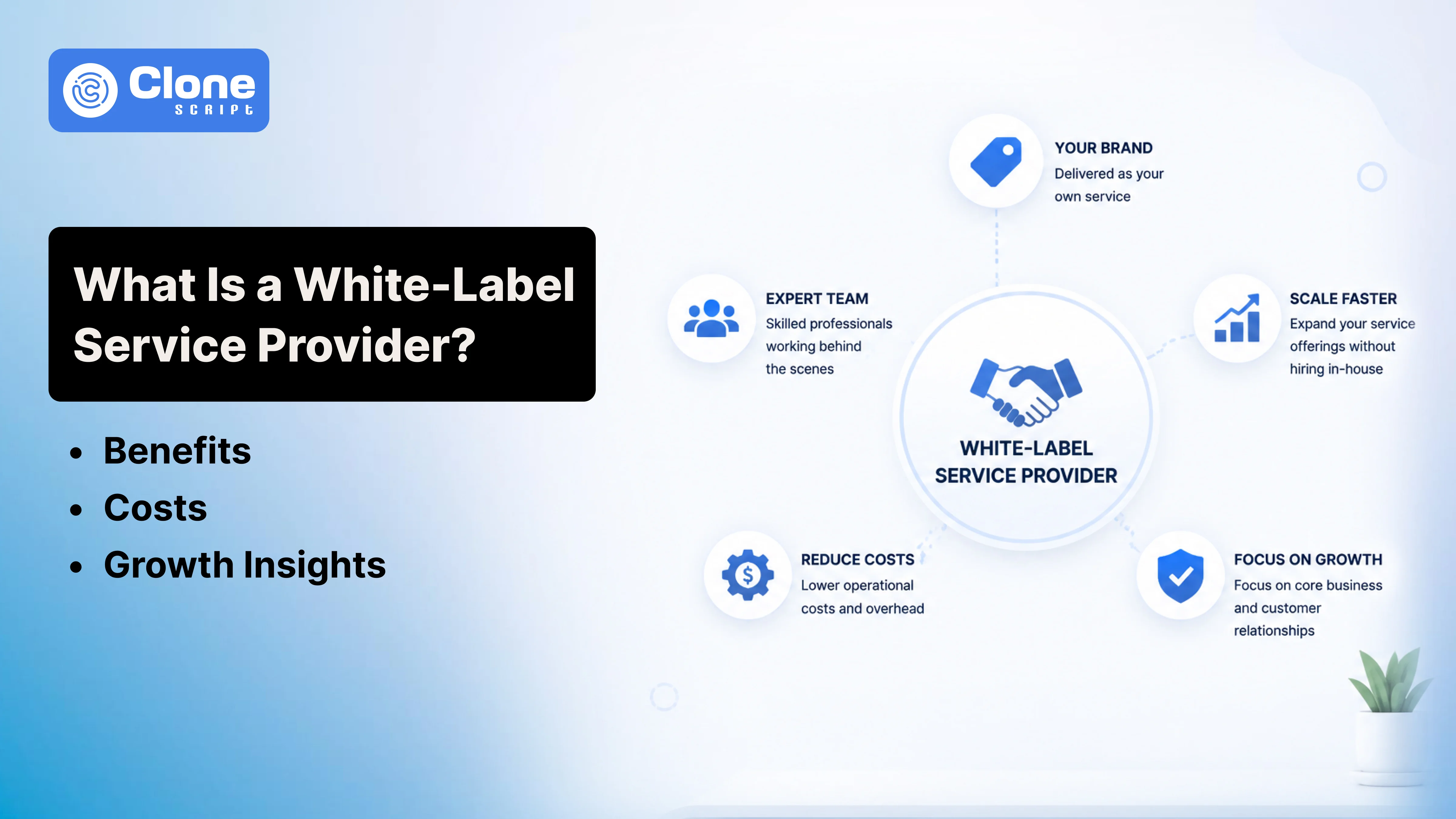
What Is a White-Label Service Provider? Explore a Way to Manage Business
Winning new clients is rarely the biggest challenge for growing businesses as of now.
Delivering every service clients request is.
As customer expectations increase, businesses are expected to offer everything from software development and digital marketing to design, consulting, and support services.
But hold on.
Expanding into each area requires investment, specialized talent, and operational resources that many companies cannot justify.
This reality has made white-label partnerships a common growth strategy across multiple industries. Instead of building new capabilities from scratch, businesses can utilize existing expertise and bring new services to market faster.
The question is no longer whether white-label services exist. The real question is when they make sense, what they cost, and how to choose the right provider without compromising quality.
White-Label Service Provider Definition
A white-label service provider is a company that delivers products or services on behalf of another business while remaining invisible to the end customer.
The client sees your brand, communicates with your team, and receives the final deliverable under your company name. Behind the scenes, however, the actual work is performed by a specialized partner.
How Does a White-Label Partnership Work?
Think of it this way: a digital agency sells SEO services to its clients. The clients believe the agency has an in-house SEO department. In reality, a white-label SEO company is handling keyword research, content optimization, technical audits, and reporting.
The arrangement works because each party focuses on what it does best.
The business acquiring clients concentrates on sales, customer relationships, and brand building. The white-label partner focuses on execution and delivery.
This model is confused with traditional outsourcing, but there is an important difference.
In a standard outsourcing arrangement, the service provider may interact directly with the client or operate as a separate entity. In a white-label partnership, the provider stays in the background while the reseller maintains ownership of the customer relationship.
That distinction matters because customer relationships are usually more valuable than the service itself.
Today, white-label partnerships extend far beyond marketing services. Software development firms, SaaS companies, mobile app providers, fintech platforms, eCommerce businesses, and consulting agencies regularly use white-label partners to expand their offerings without building every capability internally.
For many businesses, white-labeling is not a cost-cutting tactic. It is a way to test new markets, launch services faster, and generate additional revenue without taking on the risk of building a new department from scratch.
In Which Situation Is a White-Label Service Provider Helpful?
Businesses rarely look for white-label partners on day one. The need usually appears when growth starts exposing operational limitations.
-
When Customer Demand Outpaces Internal Capacity
According to a Deloitte Global Outsourcing Survey, nearly 70% of businesses outsource primarily to reduce costs. Many also use external partnerships to improve flexibility and scalability.
The reason is simple. Client demand can grow much faster than an internal team.
Imagine a web development agency that suddenly receives requests for SEO, PPC management, and content marketing. Building separate departments for each service could take months and require significant investment. A white-label provider allows the agency to start delivering immediately instead of delaying projects or turning clients away.
-
When Hiring Specialists Becomes Expensive
The cost of hiring skilled professionals continues to increase across technical and digital industries.
For example, recruiting a senior software developer, SEO strategist, or digital marketing manager involves recruitment fees, onboarding expenses, software subscriptions, benefits, and training costs. In many markets, replacing a skilled employee can cost between 50% and 200% of their annual salary.
White-label partnerships eliminate much of that upfront investment because the expertise already exists within the provider's team.
-
When Speed Creates Competitive Advantage
Research from McKinsey has repeatedly shown that companies that move faster than competitors are more likely to capture market opportunities and customer attention.
The challenge is that building a new service internally can take several months before it becomes profitable.
A white-label partnership shortens that timeline. Instead of spending months creating processes and assembling teams, businesses can focus on sales and customer acquisition while an experienced partner handles delivery.
-
When Businesses Want to Test New Revenue Streams
Launching a new service always involves uncertainty.
Many businesses assume demand exists, invest heavily in staffing and infrastructure, and then discover the market opportunity was smaller than expected.
White-label providers reduce this risk by allowing businesses to validate demand before making long-term commitments. If the service performs well, the company can later build an internal team with greater confidence.
-
When Growth Starts Affecting Profit Margins
Growth is not always profitable growth.
A company that doubles its clients but also doubles its payroll, management workload, and operational costs may see little improvement in overall profitability.
White-label partnerships help businesses scale more efficiently because they can increase service capacity without expanding internal headcount at the same rate.
This is one reason why agencies, SaaS companies, software firms, and consulting businesses continue to adopt white-label models as part of their long-term growth strategy.
When to Avoid a White-Label Service Provider
White-label services can help businesses scale faster, but they are not a perfect solution for every situation.
In fact, many businesses eventually move certain operations in-house because control, expertise, and long-term profitability become more important than flexibility.
-
When Your Business Depends on Specialized Expertise
A white-label model works best when services follow a proven process. It becomes more difficult when your competitive advantage comes from unique knowledge or highly specialized expertise.
According to a PwC survey, 87% of executives believe distinctive capabilities are essential for maintaining a competitive advantage. If your business is known for a unique approach, relying heavily on an external provider may affect what makes your brand valuable.
In these cases, building internal expertise often delivers better long-term results.
-
When You Need Complete Control Over Client Deliverables
Not every project can be standardized.
Enterprise software development, custom fintech solutions, and large-scale consulting projects often require constant communication between decision-makers and delivery teams.
While a white-label partner can handle execution, every additional layer of communication increases the risk of misunderstandings. Research from the Project Management Institute (PMI) has shown that ineffective communication contributes to project failure in nearly one-third of projects.
For businesses managing complex client requirements, direct control is worth the additional investment.
-
When Your Service Volume Is Consistently High
White-label partnerships are cost-effective during the early stages of growth.
However, the economics can change as project volume increases.
If a business delivers hundreds of projects each year, recurring white-label fees can eventually exceed the cost of maintaining an in-house team. At that stage, many companies choose a hybrid approach where core services are handled internally while external partners support overflow demand.
-
When Customer Experience Is Your Highest Priority
A recent study by PwC found that 32% of customers would stop doing business with a brand after just one bad experience.
The challenge is that customers never see the white-label provider. They only see your company.
If deadlines are missed, quality drops, or communication becomes inconsistent, your reputation absorbs the impact. Not the provider's.
This is why businesses that rely heavily on customer loyalty and long-term relationships should carefully evaluate every white-label partner before signing an agreement.
-
When Dependency Becomes a Business Risk
One of the biggest mistakes companies make is becoming overly dependent on a single provider.
If pricing changes, service quality declines, or the partnership suddenly ends, business operations can be disrupted almost overnight.
White-label partnerships should support business growth, not become the foundation of the entire business model.
The strongest companies use white-label providers strategically. They experience external expertise where it creates efficiency and continue to build internal capabilities that strengthen their long-term position in the market.
How to Choose the Right White-Label Service Provider
Most businesses don't lose money because they choose an expensive white-label provider. They lose money because they choose one that cannot support growth.
The biggest mistake is evaluating providers based on service offerings alone. Almost every white-label company claims to offer quality delivery, fast turnaround times, and dedicated support. The real difference becomes visible only after projects start scaling.
-
Look for Delivery Capacity, Not Just Expertise
A provider may complete one project but struggle with twenty. Before partnering, understand how many projects they handle each month, how their teams are structured, and whether they have enough resources to support future growth.
-
Examine Their Client Retention
Long-term client relationships often reveal more than testimonials.
If businesses continue working with the same provider for years, it usually indicates consistent delivery, reliable communication, and dependable quality. A provider constantly replacing clients may signal operational issues behind the scenes.
-
Test Their Process Before Committing
Instead of signing a long-term agreement immediately, start with a small project.
This approach allows you to evaluate communication speed, quality standards, revision handling, and delivery timelines under real working conditions. Many businesses discover partnership issues during the first project rather than after onboarding multiple clients.
-
Assess Business Risk, Not Just Pricing
A low-cost provider can become expensive if missed deadlines, quality issues, or communication failures lead to lost clients.
Since customer experience directly impacts retention, the safest choice is often the provider with the most reliable process rather than the lowest quote.
The strongest white-label partnerships are built on predictability. When a provider consistently delivers quality work, scales with demand, and protects your client relationships, they become a growth asset rather than just another vendor.
How Much Does It Cost to Partner With a White-Label Service Provider?
The cost of partnering with a white-label service provider varies based on the service, project complexity, and level of expertise required. However, it is significantly lower than building and maintaining an in-house team.
For example, hiring a software developer in the U.S. can cost between $80,000 and $150,000 per year, while a digital marketing specialist may earn $60,000 to $100,000 annually. These figures do not include recruitment costs, employee benefits, training, software subscriptions, and management overhead.
In contrast, white-label providers typically charge through project-based pricing, monthly retainers, or dedicated resource models. A white-label SEO campaign may range from $500 to $3,000 per month, while web or mobile app development projects can range from $5,000 to $50,000 or more, depending on requirements.
The Real Cost Calculation
The smarter question is not, "How much does a white-label provider cost?" but rather, "How much would it cost to build the same capability internally?"
According to the Society of Human Resource Management, replacing an employee can cost between 50% and 200% of their annual salary. For growing businesses, avoiding these hiring and retention costs is the biggest financial advantage of white-label partnerships.
Ultimately, the right provider should generate more value and revenue than the cost of the partnership itself.
How Is All Clone Script Different From Other White-Label Service Providers?
Many white-label providers offer similar promises regarding faster development, lower costs, and customizable solutions.
The difference usually comes down to execution, industry experience, and long-term support.
What makes All Clone Script stand out is its focus on delivering ready-to-launch business solutions instead of simply providing source code. We have completed more than 350 projects, served 250+ clients, and delivered solutions across 60+ countries, demonstrating experience across multiple business models and industries.
Some key differentiators include:
-
Wide Industry Coverage: Solutions are available for industries such as taxi booking, grocery delivery, handyman services, eCommerce, pet management, and other on-demand business models.
-
Customization and Scalability: Businesses can customize features, workflows, and branding based on their operational requirements rather than using rigid templates.
-
Server Installation Support: The team provides installation assistance, reducing technical barriers during deployment.
-
App Store and Play Store Submission Assistance: Support extends beyond development to help businesses launch their applications successfully.
-
Ongoing Updates and Technical Support: Regular product improvements and post-purchase support help businesses maintain platform performance over time.
-
Years of Market Experience: With more than 7 years in the industry and a growing customer base, we have built solutions based on proven business models rather than experimental concepts.
For businesses looking to launch a new platform quickly, the advantage is not just obtaining a white-label solution. It is gaining access to a development partner that has already worked with multiple industries, business models, and deployment scenarios.
Contact us for a complete discussion on what your business needs and how we can help.