BTC - Bitcoin
 USDTERC20 - USDT ERC20
 ETH - Ethereum
 BNB - Binance
 BCH - Bitcoin Cash
 DOGE - Dogecoin
 TRX - TRON
 USDTTRC20 - USD TRC20
 LTC - LiteCoin

What is an AI Agent and How Does it Work: Everything You Need to Know
A few years ago, software could only do exactly what it was programmed to do. For example, a customer submitted a support request, then a support executive read it and offered the solution. Today, AI agents are becoming important. These agents are designed to analyze the request, collect information from systems, and offer the best course of action automatically.
This shift is one reason AI agents have become a major topic across industries.
-
Automation workflows?AI agent can handle.
-
Assisting customers? Agents are capable.
-
Generating content? They will manage.
-
Support decision-maing? They can do it.
The best part of these agents are they’re not traditional automation tools that only follow fixed rules. AI agents can adapt to different situations and work toward specific goals. If you want to utilize artificial intelligence effectively working for understanding AI agents is important.
How Does an AI Agent Work?
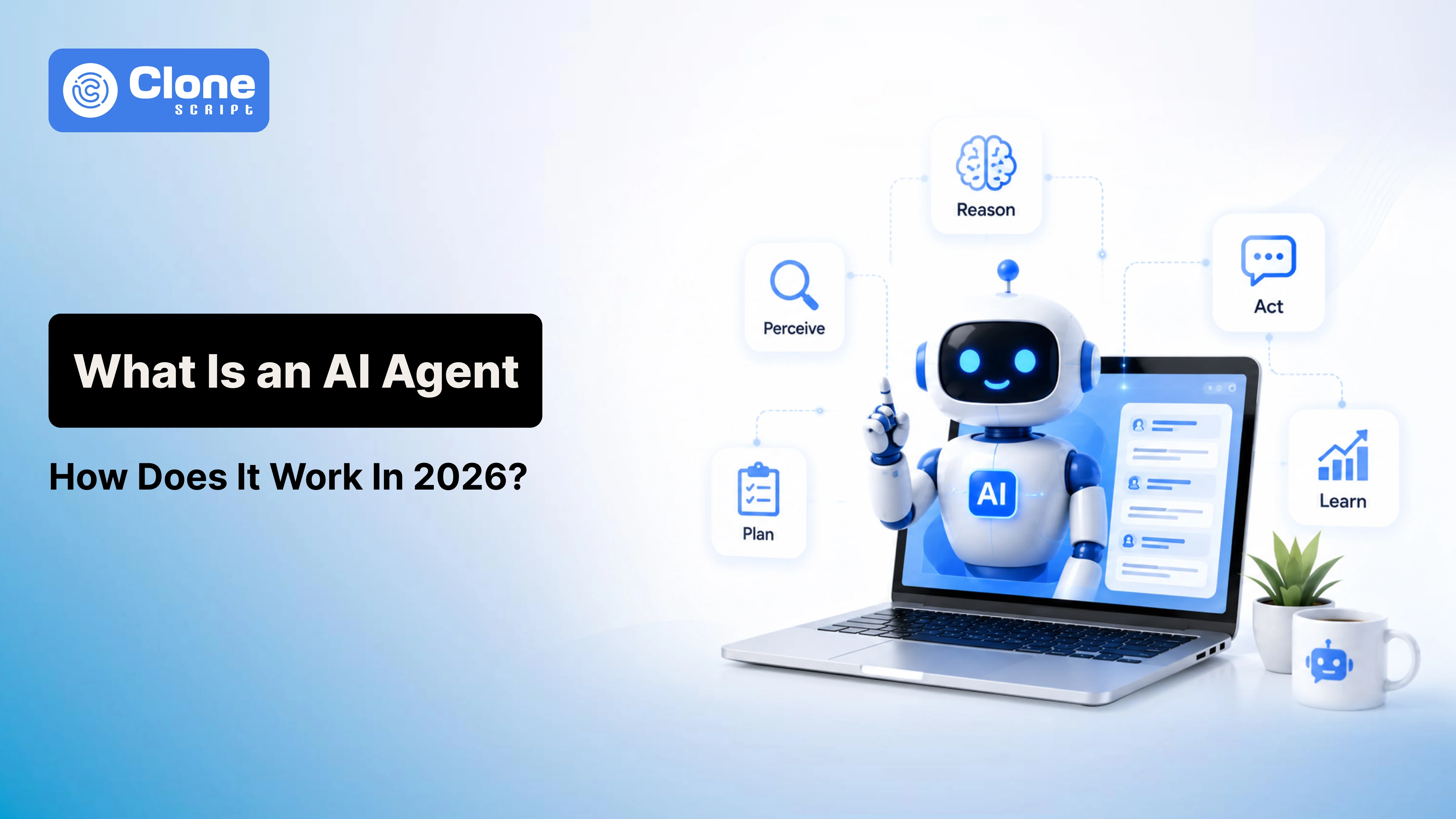
An AI agent follows a structured process to complete tasks. It gathers information, understands the context, makes decisions, takes action, and improves its performance through feedback and experience. Here is the process:
-
Perception: Gathering Information
The first step is collecting data. This is the foundation of AI agents. They can receive information from user inputs, databases, business applications, websites, documents, or connected systems. This information helps the agent understand the situation before taking action.
-
Processing and Understanding
After collecting data, the AI agent analyzes it to identify user intent and relevant details. Here, natural language processing (NLP) technology is helpful to understand requests in a way that goes beyond simple keyword matching.
-
Decision Making
In the third step, the request is understood, and now the agent evaluates possible solutions. It follows predefined goals, rules, or learned patterns to determine the most appropriate action for the situation.
-
Action Execution
After selecting an action, the AI agent performs the task. This may include answering a question, generating content, updating records, sending notifications, or triggering workflows in connected systems.
-
Learning and Improvement
Many AI agents improve over time by analyzing feedback and outcomes. This allows them to refine their responses, make better decisions, and deliver more accurate results as they gain experience.
AI Agent Key Components to Consider in Development
Every AI agent depends on several core components that help it understand information, make decisions, and complete tasks. Together, these elements allow the agent to operate effectively and achieve its intended goals.
-
Goals and Objectives
Goals define what an AI agent is designed to accomplish. Whether it is resolving customer queries or automating business processes, every action is guided by a specific objective.
-
Memory
Memory allows an AI agent to retain important information from previous interactions. This helps it provide more relevant responses and maintain context during ongoing tasks.
-
Knowledge Base
A knowledge base stores the information an AI agent uses to answer questions and make decisions. This can include company documents, databases, policies, product information, and other resources.
-
Planning System
The planning system helps the agent determine the steps needed to achieve a goal. Instead of reacting to a single request, it can organize actions in a logical sequence.
-
Decision Engine
The decision engine evaluates available information and chooses the most appropriate action. It acts as the reasoning layer that helps the agent respond to different situations.
-
Action Layer
The action layer allows the AI agent to interact with external systems. It can send messages, update records, generate reports, schedule appointments, or perform other tasks required to complete its objective.
Types of AI Agents Used in A Real Workflow
There are five types of AI agents: 1. Simple Reflex, 2. Model-Based, 3. Goal-Based, 4. Utility-Based, and 5. Learning.
Some follow simple rules, while others can learn from experience and adapt to changing situations. Understanding their types helps explain how they are used across various industries.
-
Simple Reflex Agents
Simple reflex agents respond to specific conditions using predefined rules. They are designed not to store past information or consider future outcomes. For example, a thermostat automatically turns on cooling when the temperature exceeds a set limit.
-
Model-Based Agents
These agents maintain an internal understanding of their environment. This allows them to make decisions based on both current information and past observations. Navigation systems use this approach to suggest efficient routes.
-
Goal-Based Agents
Goal-based agents evaluate different actions and select the one most likely to achieve a specific objective. A delivery management system that chooses the fastest route to complete deliveries is a common example.
-
Utility-Based Agents
These types of agents compare multiple outcomes and choose the option that delivers the highest value. For instance, an investment platform may evaluate risk and return before recommending financial decisions.
-
Learning Agents
Learning agents improve their performance through experience and feedback. They continuously refine their actions based on previous results. AI-powered customer support systems use learning capabilities to provide more accurate responses over time.
Real-World AI Agent Examples
AI agents are not only used in research projects or experimental tools. Businesses across different industries use them to automate tasks, improve efficiency, and deliver better user experiences.
-
Customer Support Agents
Many companies use AI agents to handle common customer questions, track orders, process service requests, and provide instant assistance. This reduces response times and allows support teams to focus on more complex issues.
-
Virtual Assistants
Digital assistants can manage schedules, set reminders, retrieve information, and perform routine tasks through voice or text commands. They help users save time and stay organized throughout the day.
-
Content and Productivity Agents
Content teams increasingly use AI agents in multiple tasks: researching topics, generating outlines, summarizing information, and assisting with drafting. These tools help streamline repetitive tasks while supporting productivity.
-
Financial Analysis Agents
Financial institutions use agents to analyze market data, identify trends, assess risks, and generate insights. This helps professionals make faster and more informed decisions.
-
Healthcare Support Agents
Healthcare organizations use AI agents to assist with appointment scheduling, patient inquiries, medical documentation, and administrative workflows. This improves operational efficiency and reduces manual workloads.
-
AI Coding Assistants
Developers use AI agents to suggest code, identify errors, explain technical concepts, and automate repetitive programming tasks. These capabilities help accelerate software development and troubleshooting processes.
Benefits of Using AI Agents in Workflow Management
The growing adoption of AI agents is driven by their ability to handle tasks that traditionally required significant human effort. By combining automation with decision-making capabilities, they help organizations operate more efficiently and respond faster to changing demands.
-
Increased Automation
AI agents can perform repetitive tasks such as data entry, customer support, scheduling, and information retrieval with minimal human involvement. This allows teams to focus on higher-value activities.
-
Faster Decision-Making
By analyzing large amounts of information in seconds, these agents can provide recommendations and take action more quickly than manual processes. This speed is particularly valuable in customer service, finance, and operations.
-
24/7 Availability
Unlike human teams, AI agents can operate around the clock. They can respond to customer inquiries, monitor systems, and manage workflows at any time without interruption.
-
Improved Scalability
As business demands grow, AI agents can handle increasing workloads without requiring proportional increases in staffing. This makes it easier for organizations to expand their operations.
-
Better Customer Experience
AI agents can deliver faster responses, personalized recommendations, and consistent support. These capabilities help improve customer satisfaction and engagement.
-
Cost and Productivity Benefits
By reducing manual effort and streamlining workflows, AI agents can lower operational costs, helping employees complete tasks more efficiently. The result is improved productivity across multiple departments.
Challenges and Limitations of Using AI Agents in Tasks
While AI agents offer many advantages, they are not without limitations. Businesses should understand these challenges before integrating AI agents into critical workflows or customer-facing operations.
-
Data Quality Issues
AI agents depend on the information they receive. If the data is outdated, incomplete, or inaccurate, the agent may produce incorrect results or make poor decisions.
-
Security and Privacy Concerns
Many AI agents process sensitive business and customer information. Organizations must implement proper security measures and data protection practices to reduce potential risks.
-
Inaccurate Responses
Even advanced AI agents can occasionally generate incorrect information or misunderstand user intent. For this reason, human oversight remains important, especially for high-stakes decisions.
-
Limited Context Awareness
Some AI agents may struggle with highly complex situations, unusual requests, or scenarios that fall outside their training and knowledge sources.
-
Ethical Considerations
Businesses must ensure AI agents operate fairly, transparently, and responsibly. Bias in training data or decision-making processes can lead to unintended outcomes.
-
Need for Human Supervision
AI agents can automate many tasks, but they are not a complete replacement for human expertise. Regular monitoring helps maintain accuracy, compliance, and overall system performance.
Understanding these limitations allows organizations to deploy AI agents more effectively and achieve better long-term results.
AI Agents vs Traditional Chatbots: Differences to Know
Although AI agents and traditional chatbots may appear similar, their capabilities are significantly different. Traditional chatbots are designed to answer predefined questions, while AI agents can understand context, make decisions, and perform actions to achieve specific goals.
| Feature | Traditional Chatbots | AI Agents |
|---|---|---|
| Responses | Follow predefined scripts | Generate dynamic responses |
| Context Awareness | Limited | Higher contextual understanding |
| Decision Making | Rule-based | Goal-oriented and adaptive |
| Task Execution | Primarily answers questions | Can perform actions and complete tasks |
| Learning Ability | Minimal or none | Can improve through feedback and data |
| System Integration | Limited integrations | Connects with multiple tools and platforms |
For example, a traditional chatbot may provide information about a product when asked. An AI agent can go further by checking inventory, processing an order, scheduling delivery, and updating the customer on the order status.
Businesses that need basic customer support find chatbots sufficient. However, organizations looking to automate workflows, streamline operations, and handle more complex interactions are increasingly adopting AI agents because of their broader capabilities.
Conclusion
AI agents represent a significant step beyond traditional software and chatbots. Only simply responding to commands, but they can also understand information, evaluate options, make decisions, and perform tasks with minimal human involvement. This combination of intelligence and automation is what makes AI agents valuable across modern business operations.
FAQs
-
What is the main purpose of an AI agent?
An AI agent helps achieve specific goals by analyzing information, making decisions, and performing actions automatically. This reduces the need for constant human intervention.
-
How is an AI agent different from a chatbot?
A chatbot mainly answers questions, while an AI agent can understand context, make decisions, interact with systems, and complete tasks on behalf of users.
-
Can AI agents learn from experience?
Some AI agents can improve through feedback and historical data. They refine responses and decision-making processes to deliver more accurate outcomes over time.
-
What industries benefit most from AI agents?
Healthcare, finance, e-commerce, education, logistics, and SaaS companies commonly use AI agents to automate workflows, improve efficiency, and enhance customer experiences.
-
Are AI agents helpful?
With their thinking power and answering model, AI agents reduce repetitive tasks for employees. Employees can focus on productivity, and the rest will be handled by the agent.