BTC - Bitcoin
 USDTERC20 - USDT ERC20
 ETH - Ethereum
 BNB - Binance
 BCH - Bitcoin Cash
 DOGE - Dogecoin
 TRX - TRON
 USDTTRC20 - USD TRC20
 LTC - LiteCoin

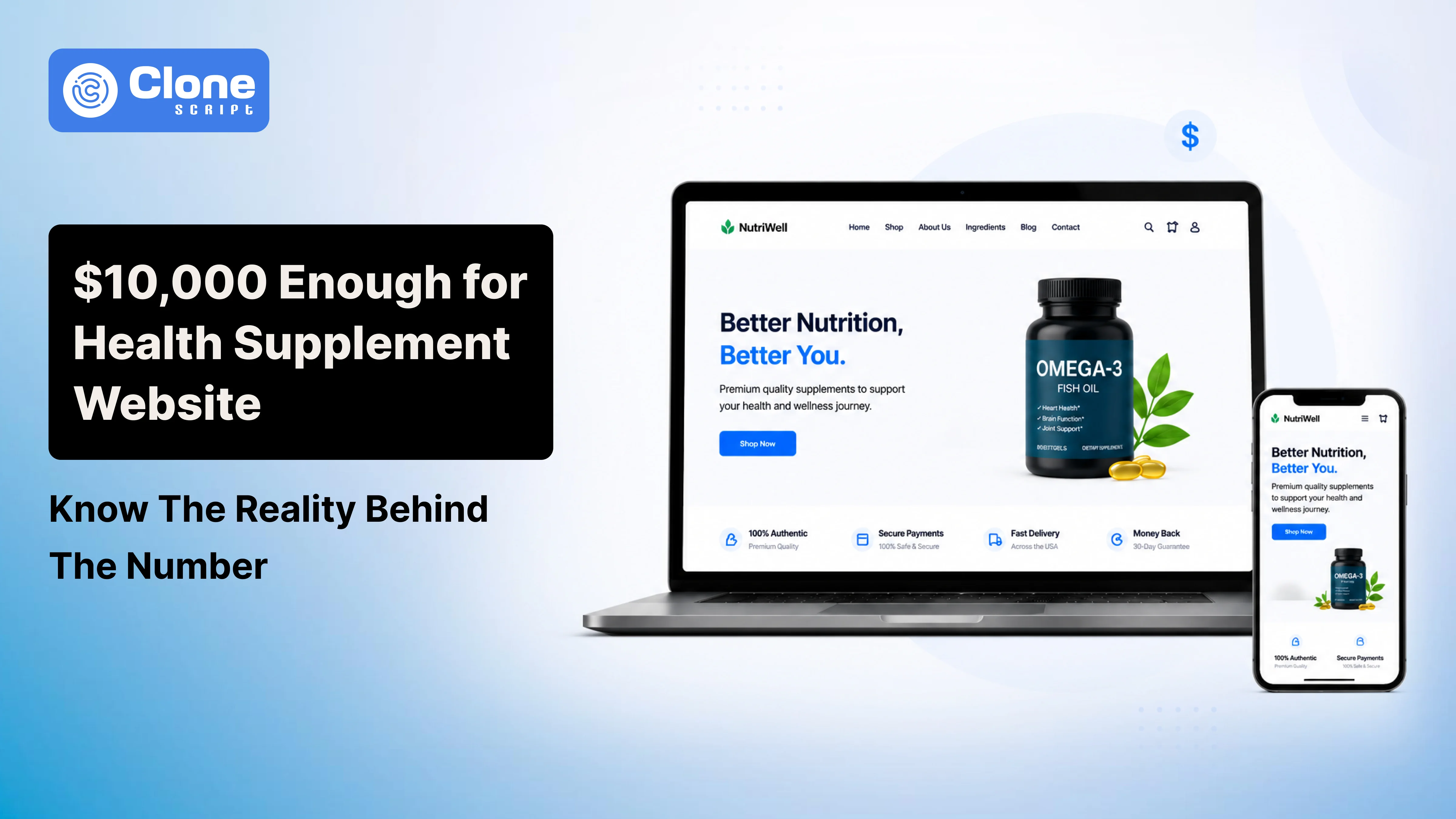
Health Supplement Website: Is $10,000 Enough to Develop a Professional Platform
In e-commerce, shopping in every industry looks similar, like fashion, electronic gadgets, and daily essentials. But when it comes to health supplements, everything has changed.
Consumers buy vitamins, protein powders, probiotics, collagen products, and wellness supplements online every day, every minute. What once depended heavily on retail shelves now increasingly depends on direct-to-consumer digital experiences.
The numbers explain why.
-
The global dietary supplements market exceeded $209 billion in 2025 and is projected to surpass $431 billion by 2033, according to Grand View Research.
Online supplement sales are growing rapidly as consumers shift toward digital purchasing, subscriptions, personalized wellness plans, and mobile commerce.
For supplement startups, the opportunity is massive.
The challenge is figuring out whether a realistic budget can support a professional ecommerce platform.
One of the most common questions founders ask is:
Can you build a professional health supplement website for $10,000?
The answer is yes. But only under specific conditions.
In this guide, we'll break down exactly where the money goes, what features matter most, and where supplement brands often underestimate costs.
Why Supplement Brands Need More Than a Basic Ecommerce Website
Many founders assume a supplement website is just another online store development.
It isn't.
Health and wellness businesses operate in one of the most trust-sensitive industries online.
Customers aren't simply buying products.
They're buying confidence.
Research from multiple industry reports shows consumers increasingly prioritize ingredient transparency, scientific backing, product quality, and brand credibility when purchasing supplements.
That means your professional supplement-providing website must do more than display products.
It needs to communicate:
-
Scientific credibility
-
Manufacturing standards
-
Third-party testing
-
Ingredient sourcing
-
Customer trust signals
-
Regulatory compliance
Think about what a poorly designed supplement website can do. It instantly reduces conversion rates. Even if the supplements, like protein powders and collagen products, are of excellent quality.
What Makes a Supplement Website Look Professional?
The word "professional" gets used frequently in website development proposals, but few agencies explain what it actually means.
A professional supplement platform typically includes the following components.
-
Mobile-First Design
Mobile traffic now accounts for more than 60% of global web traffic, and ecommerce brands frequently see even higher percentages. Some reports estimate that mobile generates over 70% of ecommerce traffic.
If your website is difficult to navigate on a smartphone, you're losing potential revenue before users even reach checkout.
Professional supplement websites prioritize:
-
Fast loading speed
-
Thumb-friendly navigation
-
Simplified checkout
-
Mobile product pages
That doesn’t matter if you’re launching a new health supplement brand or moving from a local shop to online. When your website offers the experience a user wants, then it’s your chance to get leads and convert them into ordering a protein powder or healthy vitamins.
Considering supplement website design trends helps make a future-ready platform where customers feel secure and can trust.
-
Subscription Functionality
Many supplement businesses rely on repeat purchases from customers.
Customers buying multivitamins, probiotics, protein powder, or collagen products often reorder monthly because they need to maintain their fitness.
Ordering the products through a single flat amount is sometimes costly for them. Then, introducing a subscription facility to purchase supplements can do two things primarily:
-
Increase customer lifetime value
-
Create predictable revenue streams
This feature alone can improve business economics.
-
Trust Elements
Think that your website looks good enough to convert, but the one aspect missing from it is trust.
Look, in supplement purchases, customers are always in a worried mood and think “does this product help me?” or “I have to face worse situations by consuming it?”
To solve this, successful online health supplement selling websites display:
-
Customer reviews to know previous experiences and how it can change flexibility.
-
Laboratory certifications to explain that there is no interference to prove false claims.
-
GMP compliance information helps to know about the strict quality standards that are maintained.
-
Ingredient transparency is a must to be presented on the product page.
-
Scientific references are important to prove that there is no contamination or that artificial tastes have not been added.
-
Secure payment badges are needed for an online purchase completion with enhanced functionality.
Trust directly affects conversions in health-related industries.
-
Educational Content
Leading supplement brands invest heavily in content marketing.
Product pages alone rarely generate sustainable organic traffic.
Offering genuine, helpful content that can relate to customers’ issues and problems helps them to get instructions easily to resolve them.
Most successful brands build:
-
Write health blogs on their websites
-
Offer a complete ingredient guide
-
Publish research-backed articles
-
Add wellness resources
-
FAQ hubs
This content supports SEO while building authority.
Health Supplement Website Development Cost Breakdown
Now, let's look at where development budgets typically go.
-
UI/UX Design
This is the first stage of development: a quality-graded website user interface and user experience design. The costs generally range between $1,500–$4,000.
This includes:
-
Homepage design
-
Product pages
-
Mobile optimization
-
User journey planning
-
Checkout flow design
Note that custom branding significantly increases costs. You can use a pre-built health supplement Figma web UI design template and save this cost by 50- 60%. To customize it, you have to hire a web designer, unless you have an in-house design team.
-
Ecommerce Development
Development usually consumes the largest portion of the budget. This estimated cost is $3,000–$8,000. You have to be prepared to spend the amount by smartly managing the budget.
This covers:
-
Store setup
-
Product architecture
-
Customer accounts
-
Checkout system
-
Order management
E-commerce platform choice has a major impact on pricing.
-
Product Data Setup
Many businesses underestimate this expense. Then figure out where the mistake happened, but the website is good to explore. Product catalog management is the most important aspect of an e-commerce business. The cost range is $500–$2,000.
Tasks include:
-
Product uploads
-
Variant management
-
Ingredient information
-
Product descriptions
-
Images
-
Category structure
Stores with dozens or hundreds of SKUs require significant setup time to manage products.
-
Compliance and Legal Pages
Supplement businesses face stricter requirements than many ecommerce categories. To handle that, you have to allocate a budget of $300–$1,500.
Typical requirements include:
-
Privacy policy
-
Terms and conditions
-
Disclaimer pages
-
FDA disclosure statements
-
Return policies
Health-related claims require careful wording to avoid regulatory issues.
-
SEO Foundation
Marketing your supplement products through a website is required initial SEO setup that costs $500-$2,500. Despite the dominance of AI-powered search and shopping, traditional website SEO is still maintaining its importance.
This includes:
-
Site architecture
-
Meta data
-
Technical SEO
-
Schema implementation
-
Internal linking structure
Skipping search engine optimization practice during development creates larger expenses later.
-
Testing and Optimization
Once the website is ready for production, designing and coding including front-end and back-end, it comes to QA and testing. The estimated cost is $500-$1,500.
QA and Testing includes:
-
Browser compatibility
-
Mobile responsiveness
-
Checkout functionality
-
Performance audits
-
Security checks
This phase is frequently overlooked by budget-conscious startups.
Can You Really Build a Professional Supplement Website for $10,000?
The short answer is yes.
But expectations matter.
A $10,000 budget works best for:
-
New supplement brands
-
Small product catalogs
-
Direct-to-consumer launches
-
Shopify-based stores
-
Standard subscription models
A typical $10,000 allocation might look like this:
| Category | Budget |
|---|---|
| Design | $2,000 |
| Development | $4,000 |
| Product Setup | $1,000 |
| SEO Setup | $1,000 |
| Testing | $1,000 |
| Miscellaneous | $1,000 |
Under this model, businesses can launch a highly functional ecommerce website without excessive custom development.
However, certain features quickly push costs beyond the $10,000 range.
What about e-commerce platforms? Are they proper enough to have a website look and features like famous supplement brands? Let’s find out.
Shopify vs WooCommerce vs Custom Development
Platform selection determines both upfront and long-term costs.
-
Shopify
Shopify is the first choice of e-commerce startups. Because it offers the advantages:
-
Faster launch
-
Lower development cost
-
Built-in ecommerce tools
-
Reliable hosting
But there are limitations you may face:
-
Monthly fees
-
App dependency
-
Less customization
In Shopify, a supplement brand website development typical launch cost $5,000–$15,000.
-
WooCommerce
Shopify is a good option, but when the brand needs flexibility, WooCommerce can be a choice. Its advantages are:
-
Open-source ecosystem
-
Greater customization
-
Lower software costs
Limitations in WooCommerce:
-
More maintenance
-
Hosting management required
WooCommerce store development: a typical launch costs $7,000–$20,000.
-
Custom Development
When your brand is scaling, skip those platforms and go for custom ecommerce website development.
Its advantages are:
-
Complete flexibility
-
Custom functionality
-
Better long-term scalability
Limitations:
-
Higher upfront cost
-
Longer development cycles
The launch cost in branded website development is $25,000–$100,000+.
For most startups, custom development is unnecessary during the first growth stage.
Hidden Costs Most Supplement Businesses Ignore
This is where many budgets fail.
The website launches successfully.
Then, unexpected expenses begin appearing.
-
Hosting: Website hosting annual cost is $100–$3,000+, and it depends on traffic volume and platform.
-
Third-Party Applications: Common supplement store apps include subscription management, reviews, email marketing, loyalty programs, and upsell systems. Combined monthly expenses often exceed several hundred dollars.
-
Product Photography: Professional supplement imagery can cost $500–$5,000+. High-quality visuals significantly affect conversion rates.
-
Content Marketing: The supplement industry is highly competitive. Publishing authoritative content becomes essential for organic growth. Many brands spend thousands monthly on writing blog content, SEO campaigns, link building, and video content. Ignoring content marketing often limits long-term growth potential.
Managing these costs helps your website maintain the standards of great services customers expect.
Real Budget Scenarios for Supplement Website Development
There are three kinds of choices you have:
Scenario 1: Startup Supplement Brand
In this, the budget will remain untouched at $10,000.
It includes:
-
Shopify store
-
Premium theme
-
20 products
-
Basic SEO
-
Subscription functionality
The result is that you can get a professional launch-ready website.
Scenario 2: Growth-Stage Brand
Here, the budget for e-commerce website development is $25,000.
It Includes:
-
Advanced product filtering
-
Loyalty program
-
Subscription optimization
-
Enhanced SEO architecture
The result is stronger customer retention and scalability.
Scenario 3: Enterprise Supplement Business
The budget for a multiple-product handling website is $50,000+.
It includes:
-
Custom platform
-
ERP integration
-
Inventory automation
-
Multi-country support
-
Advanced analytics
You can experience enterprise-level ecommerce infrastructure.
Factors That Increase Website Development Costs
Several variables significantly affect project pricing.
-
Product Catalog Size
A store with 20 products differs from one with 500 products.
More products mean:
-
More pages
-
More content
-
More filters
-
More management systems
Having multiple products to manage requires more functionality, which adds costs.
-
Subscription Complexity
Simple monthly subscriptions are relatively affordable.
Personalized wellness plans, bundled subscriptions, and custom dosage programs require more development.
-
Integrations
Connecting can add substantial development costs:
-
CRM systems
-
Inventory software
-
Shipping platforms
-
Marketing automation tools
If not, the integrated website will not perform as customers expect.
-
International Expansion
Selling globally introduces the following:
-
Currency support
-
Tax management
-
Regional compliance
Each requirement increases project scope.
Is $10,000 Enough for Your Supplement Business?
For many startups, yes.
A carefully planned budget can absolutely deliver a professional supplement ecommerce website capable of generating revenue.
However, founders often make one mistake.
They assume website development is the entire investment.
In reality, launch is only the beginning.
The brands winning market share today invest beyond development into:
-
Content marketing
-
SEO
-
Conversion optimization
-
Subscription growth
-
Customer retention
-
Trust-building initiatives
This is especially important as the supplement industry continues expanding worldwide.
-
Multiple market forecasts estimate global supplement revenues will exceed $400 billion within the next decade as preventive healthcare and wellness purchasing continue growing.
The opportunity is vital and bigger for businesses operating in this industry that want to get an advantage.
But success belongs to brands that combine product quality with a professional digital experience.
Conclusion
A $10,000 budget is enough to launch a professional health supplement website if you focus on essential ecommerce functionality, mobile optimization, subscription capabilities, and trust-building elements.
It is not enough for enterprise-level customization, advanced integrations, or large-scale automation.
For most emerging supplement brands, the smarter strategy is launching with a lean but professional platform, validating market demand, and investing in advanced functionality as revenue grows.
The goal isn't building the most expensive supplement website.
The goal is to build a website that earns trust, converts visitors, and supports long-term growth.