BTC - Bitcoin
 USDTERC20 - USDT ERC20
 ETH - Ethereum
 BNB - Binance
 BCH - Bitcoin Cash
 DOGE - Dogecoin
 TRX - TRON
 USDTTRC20 - USD TRC20
 LTC - LiteCoin

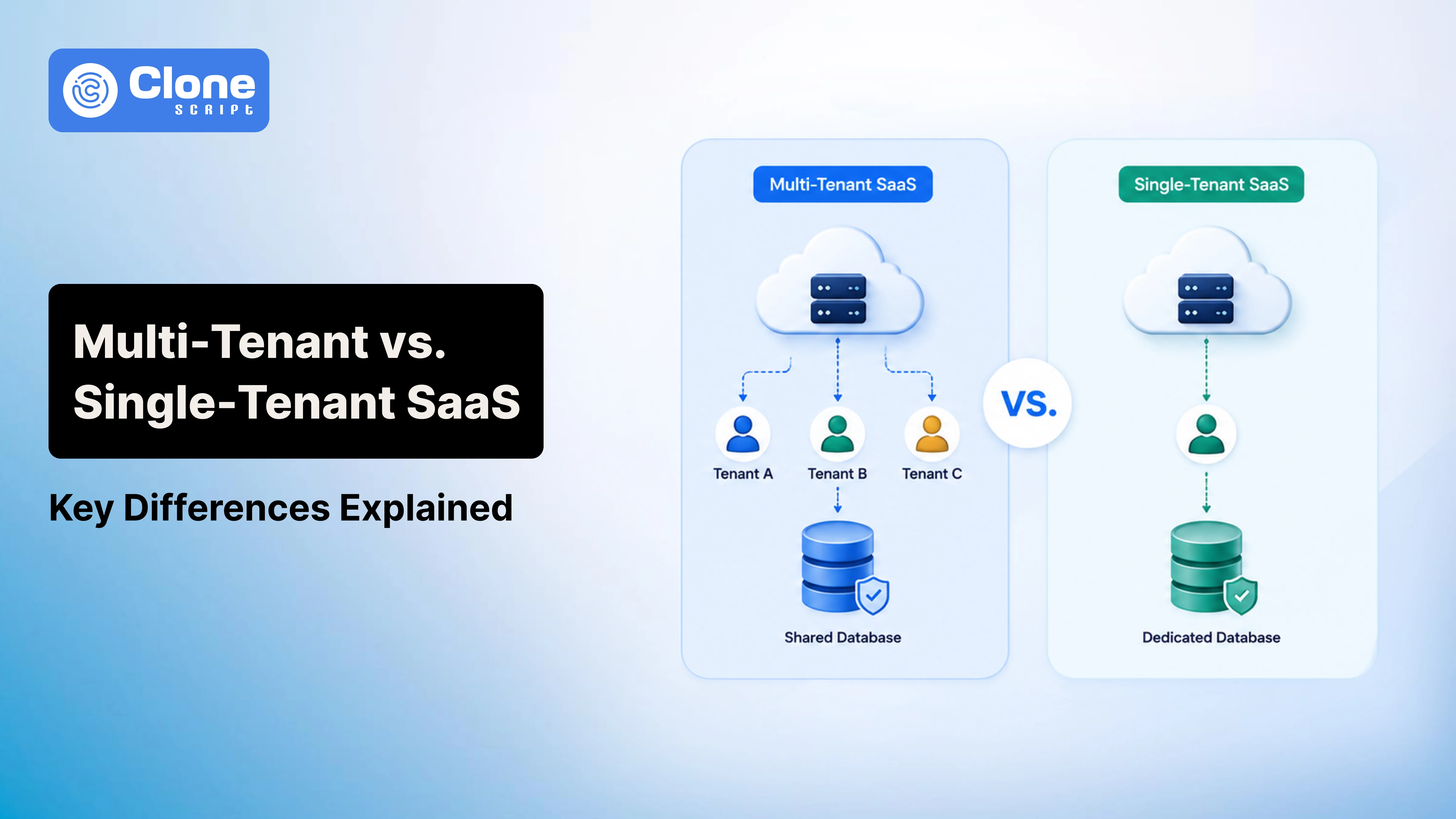
Multi-Tenant vs. Single-Tenant SaaS: What Separates Them from Each Other
In the modern age of business, Software-as-a-Service (SaaS) applications have become the foundation. They range from customer relationship management (CRM) and project collaboration to eCommerce platforms, HR, and healthcare systems. Users focus on features and user experience. Once architectural decision significantly influences how a SaaS platform performs: whether it uses a multi-tenant or single-tenant architecture.
Choosing the right tenancy model affects much more than where customer data is stored. It impacts application scalability, infrastructure costs, security, customization, maintenance, compliance, disaster recovery, and future growth.
This guide explains Multi-Tenant vs. Single-Tenant SaaS from first principles. You'll learn how each architecture works, where each model excels, along with their technical differences, database strategies, cloud deployment approaches, real-world examples, and practical guidance. So you can select the right architecture based on your business requirements.
First, let’s understand the basics.
What Is Tenant Architecture in SaaS?
In SaaS, a tenant is an individual customer or organization that uses the application independently from other customers. Each tenant has its own users, settings, business data, permissions, and workflows while accessing the same software platform.
Think of a modern apartment building:
-
The building represents the SaaS application.
-
Each apartment represents a tenant.
-
Every apartment has different occupants and belongings.
-
Common infrastructure such as elevators, electricity, and security systems may be shared depending on the building design.
Similarly, SaaS platforms determine whether customers share infrastructure or receive dedicated environments.
Tenant architecture defines how a SaaS platform manages:
-
Application instances
-
Compute resources
-
Databases
-
Storage
-
Network isolation
-
User authentication
-
Security boundaries
-
Software updates
A well-designed tenancy model helps software providers deliver consistent performance. They have to balance operational efficiency, customer isolation, and long-term scalability. This architectural decision is typically made during the early stages of SaaS development because changing it later requires significant infrastructure redesign.
What Is Single-Tenant SaaS?
A single-tenant SaaS architecture gives every customer its own dedicated application environment. This means each organization receives separate computing resources, databases, storage, and dedicated application instances.
Although multiple customers use the same software product, they never share the underlying infrastructure.
For example, if three enterprises subscribe to the same HR management platform, each company operates within an independent environment that is isolated from the others. Updates, configurations, and databases remain separate throughout the system.
How Does Single-Tenant Architecture Work?
A typical single-tenant deployment includes:
-
Dedicated application instance
-
Dedicated virtual machine or container
-
Separate database
-
Independent storage
-
Isolated backups
-
Separate monitoring and logging
This model offers strong isolation because one tenant's workload cannot directly affect another's system performance.
Best Use Cases for Single-Tenant SaaS
Single-tenancy is commonly adopted in industries where security, compliance, and customization outweigh infrastructure costs.
Examples include:
-
Enterprise ERP platforms
-
Government digital services
-
Healthcare management systems
-
Defense software
-
Insurance platforms
-
Private CRM deployments
Organizations operating under regulations such as HIPAA, PCI DSS, SOC 2, or GDPR often prefer single-tenant deployments because dedicated environments simplify compliance and auditing.
What Is Multi-Tenant SaaS?
A multi-tenant SaaS architecture allows multiple customers to share the same application and infrastructure while keeping their data logically isolated.
Instead of creating separate environments for every customer, the SaaS provider runs a single application that serves many organizations simultaneously.
Customers never see each other's information because the application enforces tenant isolation through authentication, authorization, and database design.
This model has become the industry standard because it enables software providers to scale efficiently and minimizes infrastructure costs.
How Does Multi-Tenant Architecture Work?
A typical multi-tenant application shares:
-
Application servers
-
Compute resources
-
Storage systems
-
Network infrastructure
-
Monitoring services
Meanwhile, customer-specific information remains isolated using tenant identifiers, database schemas, or dedicated databases.
When a customer logs into the application, every request is associated with a unique tenant ID, ensuring only authorized records are displayed.
Multi-Tenant SaaS Examples
Many globally recognized SaaS platforms use multi-tenant architecture because it allows millions of customers to operate on a common platform.
Examples include:
-
Salesforce
-
Shopify
-
Slack
-
Microsoft 365
-
Notion
-
HubSpot
-
Canva
-
Zoom
Although these companies share infrastructure across customers, they implement sophisticated isolation mechanisms to maintain security, availability, and performance.
This approach enables providers to release updates once instead of deploying new versions separately for every customer, which can reduce operational complexity.
Single-Tenant vs. Multi-Tenant Architecture: The Core Differences
At first glance, both architectures deliver the same end product: a SaaS application accessible over the internet. The real difference lies in how the infrastructure, application, and customer data are organized behind the scenes.
| Feature | Single-Tenant SaaS | Multi-Tenant SaaS |
|---|---|---|
| Infrastructure |
Dedicated infrastructure for every customer |
Shared infrastructure across multiple customers |
| Application Instance | Separate application instance per tenant | One application instance serves many tenants |
| Database | Usually one dedicated database per tenant | Shared database, separate schemas, or hybrid database models |
| Resource Allocation | CPU, memory, and storage are dedicated | Resources are shared dynamically among tenants |
| Data Isolation | Physical or infrastructure-level isolation | Logical isolation through software controls |
| Customization | Extensive tenant-specific customization | Standardized customization within shared architecture |
| Performance | Consistent because resources are dedicated | Performance depends on effective resource management and scaling |
| Software Updates | Updates may be deployed tenant by tenant | Single deployment updates every customer simultaneously |
| Maintenance Effort | Higher because multiple environments must be managed | Lower due to centralized maintenance |
| Scalability | Scaling each tenant individually increases operational complexity | Horizontal scaling efficiently supports thousands of tenants |
| Infrastructure Cost | Higher due to dedicated resources | Lower because infrastructure costs are shared |
| Disaster Recovery | Individual backup and recovery strategies for each tenant | Centralized disaster recovery with tenant-level data restoration |
| Monitoring | Each tenant is monitored independently | Centralized monitoring with tenant-specific metrics |
| Compliance | Easier for industries requiring dedicated environments | Requires stronger logical isolation and compliance controls |
The choice between these models affects development, deployment, maintenance, scalability, and long-term operational costs. The following comparison highlights the major technical differences.
How the Architectures Differ in Practice?
Imagine two companies purchasing the same accounting SaaS platform.
With a single-tenant deployment, each company receives:
-
A separate application server
-
A dedicated database
-
Independent storage
-
Individual backups
-
Custom configurations
If one customer's workload suddenly spikes, it does not affect any other customer because resources are not shared.
In a multi-tenant deployment, both companies use the same application infrastructure. Their requests are processed by shared servers, but every query includes a tenant identifier that ensures users can only access their organization's data. This shared model significantly reduces infrastructure requirements and maintains data separation.
Which Architecture Is Easier to Scale?
Scalability is one of the biggest reasons modern SaaS providers adopt multi-tenancy.
-
Single-tenant architecture is tough to scale.
With single-tenant architecture, onboarding every new customer typically requires provisioning additional infrastructure, configuring a new environment, and maintaining another application instance. As the customer base grows, infrastructure management becomes increasingly complex.
-
Scaling has not been a problem in the multi-tenant environment.
A multi-tenant architecture is designed for horizontal scalability. Instead of deploying a new environment for every customer, providers expand shared resources by adding servers, containers, or Kubernetes nodes. Load balancers distribute incoming traffic, allowing thousands or even millions of users to run on the same platform without creating isolated environments for each tenant.
This efficient resource utilization enables leading SaaS companies to scale rapidly and keep operational costs under control.
Which Model Is More Flexible?
The answer depends on what "flexibility" means for your business.
-
Single-tenant architecture offers greater flexibility for customer-specific customizations, integrations, infrastructure configurations, and security policies. It is well suited for enterprises with unique operational or regulatory requirements.
-
Multi-tenant architecture prioritizes operational efficiency and standardized deployments. While configuration options such as themes, user roles, workflows, and branding are typically supported, deep infrastructure-level customization is intentionally limited to maintain consistency across tenants.
For organizations that require highly tailored environments, single-tenancy provides more control. For SaaS providers focused on serving a broad customer base efficiently, multi-tenancy offers a more scalable and cost-effective foundation.
Multi-Tenant vs. Single-Tenant Database
The database architecture is one of the most critical design decisions in a SaaS application because it determines how customer data is stored, isolated, and managed. It directly impacts security, scalability, application performance, maintenance, compliance, and operational costs. There is no one-size-fits-all approach. SaaS providers typically choose between three database models based on their product goals, customer requirements, and expected growth.
1. Shared Database with Shared Schema
All tenants share the same database and tables, with each record linked to a unique Tenant ID. This is the most resource-efficient model and is commonly used by large-scale multi-tenant SaaS platforms serving thousands of customers.
Advantages
-
Lowest infrastructure costs
-
Efficient resource utilization
-
Centralized maintenance
-
Quick customer onboarding
-
Excellent horizontal scalability
Limitations
-
Requires strict application-level data isolation
-
Limited schema customization
-
Requires well-optimized queries to prevent one tenant's workload from affecting others
2. Shared Database with Separate Schemas
In this approach, tenants share the same database server but have separate schemas containing their own tables. It offers stronger logical isolation and remains more cost-effective than dedicated databases.
Advantages
-
Better data segregation
-
Easier tenant-level backups
-
Moderate customization
-
Simplified data management
Limitations
-
More complex administration
-
Schema migration challenges
-
Reduced efficiency as the number of tenants increases
3. Dedicated Database Per Tenant
Each tenant receives an independent database. This model popular for single-tenant SaaS and enterprise deployments that require greater control.
Advantages
-
Maximum data isolation
-
Enhanced security
-
Independent backups
-
Better performance tuning
-
Extensive customization
Limitations
-
Higher infrastructure and maintenance costs
-
Increased operational overhead
-
Greater reliance on automation for large-scale deployments.
Many modern SaaS providers also adopt a hybrid database architecture, where smaller customers use shared databases while enterprise clients receive dedicated databases. This approach balances cost efficiency, scalability, security, and compliance, making it suitable for platforms serving diverse customer segments.
Single-Tenant vs. Multi-Tenant in Cloud Computing
Cloud platforms such as Amazon Web Services (AWS), Microsoft Azure, and Google Cloud Platform (GCP) support both single-tenant and multi-tenant SaaS deployments. The choice depends on an application's security, performance, compliance, and scalability requirements rather than the cloud provider itself.
-
Single-Tenant Comes with the Sole Resources for the Organization.
In a single-tenant cloud architecture, each customer receives dedicated cloud resources, such as virtual machines (VMs), containers, storage, or even an isolated Kubernetes cluster. This provides greater control over infrastructure, simplifies compliance, and minimizes resource contention. However, it also increases infrastructure costs and operational complexity.
-
Multi-Tenant Cloud Architecture Brings All Users Under the Same Platform.
In contrast, a multi-tenant cloud architecture allows multiple customers to share cloud resources while keeping their data logically isolated. Technologies like Kubernetes, container orchestration, auto-scaling, and load balancing enable providers to efficiently distribute workloads across shared infrastructure. This model improves resource utilization and makes scaling significantly easier.
-
DevOps combines both cloud platforms.
From a DevOps perspective, multi-tenancy simplifies CI/CD pipelines because updates are deployed once for all customers. Single-tenancy often requires environment-specific deployments, monitoring, and maintenance, increasing administrative effort.
Regardless of the model, cloud-native practices such as Infrastructure as Code (IaC), automated monitoring, and disaster recovery planning remain essential for maintaining secure, scalable, and highly available SaaS applications.
Single-Tenant vs. Multi-Tenant Pros and Cons
Both architectures offer distinct advantages, and the right choice depends on your business priorities. The table below summarizes their strengths and trade-offs.
| Feature | Single-Tenant | Multi-Tenant |
|---|---|---|
| Security | Excellent data isolation and infrastructure control | Strong logical isolation with proper security implementation |
| Performance | Consistent due to dedicated resources | Efficient but may experience resource contention during peak loads |
| Customization | Extensive application and infrastructure customization | Limited to configurable features within the shared platform |
| Maintenance | Higher operational effort across multiple environments | Easier centralized maintenance and updates |
| Compliance | Better suited for strict regulatory requirements | Requires additional controls to meet compliance standards |
| Infrastructure Cost | Higher because each customer has dedicated resources | Lower due to shared infrastructure |
| Scalability | Scales tenant by tenant | Easily scales to thousands of customers |
| Software Updates | Updates managed separately for each tenant | Single deployment updates all tenants |
| Resource Utilization | Lower efficiency | Highly efficient resource sharing |
Cost Comparison: Which Is More Affordable?
Cost is a deciding factor when selecting a SaaS architecture. While multi-tenant SaaS generally offers lower operating costs, the overall expense should be evaluated using the Total Cost of Ownership (TCO), which includes infrastructure, maintenance, DevOps, and long-term scalability.
| Cost Factor | Single-Tenant | Multi-Tenant |
|---|---|---|
| Infrastructure | High | Low |
| Cloud Hosting | Higher due to dedicated resources | Lower through shared resources |
| DevOps Management | More complex | Centralized and simplified |
| Maintenance | Higher operational effort | Lower maintenance costs |
| Scaling Costs | Increases with each new customer | More cost-efficient at scale |
| Total Cost of Ownership | Higher | Lower |
Which SaaS Businesses Should Choose Single-Tenant?
Single-tenant architecture is best suited for businesses where security, regulatory compliance, predictable performance, and extensive customization are more important than minimizing infrastructure costs.
Industries that commonly benefit include:
-
Healthcare platforms handling electronic health records and HIPAA compliance.
-
Banking and financial services managing sensitive financial transactions and regulatory requirements.
-
Government agencies requiring isolated infrastructure and strict security controls.
-
Insurance companies processing confidential customer information.
-
Large enterprise software with complex integrations and organization-specific workflows.
-
Compliance-driven industries that must satisfy standards such as PCI DSS, GDPR, SOC 2, or ISO 27001.
Which SaaS Businesses Should Choose Multi-Tenant?
Multi-tenant architecture is ideal for businesses aiming to serve a large customer base while keeping operational costs low and scaling efficiently.
It is commonly used by:
-
Startups launching their first SaaS product.
-
Small and medium-sized businesses (SMBs) seeking affordable software solutions.
-
CRM and sales automation platforms serving thousands of organizations.
-
HR and payroll software supporting standardized business processes.
-
E-commerce platforms onboarding merchants quickly.
-
Project management and collaboration tools with shared feature sets.
-
Education and learning management systems (LMS) serving schools, universities, and training providers.
Can You Migrate Between Single-Tenant and Multi-Tenant?
Yes, but migrating between tenancy models is a significant architectural project rather than a simple infrastructure upgrade.
Organizations migrate from single-tenant to multi-tenant to reduce infrastructure costs, simplify maintenance, and support rapid customer growth. Conversely, some SaaS providers move enterprise customers to dedicated environments to meet compliance, security, or performance requirements.
The migration process may involve:
-
Redesigning the database architecture
-
Updating application logic for tenant isolation
-
Modifying deployment pipelines
-
Reconfiguring cloud infrastructure
Careful planning is also required to minimize downtime, validate data integrity, and ensure a seamless user experience. Successful migrations typically rely on phased deployments, automated testing, comprehensive backups, and rollback strategies to reduce operational risks.
Do Not Make These Common Mistakes When Choosing SaaS Tenancy.
Selecting the wrong tenancy model can create long-term technical debt and financial challenges. Common mistakes include:
-
Choosing an architecture based solely on initial development cost.
-
Ignoring industry-specific security and compliance requirements.
-
Designing a database without considering future scalability.
-
Failing to implement proper tenant isolation mechanisms.
-
Underestimating infrastructure and maintenance complexity.
-
Overengineering a startup product with unnecessary enterprise architecture.
-
Not planning for future migration as the business grows.
Evaluating both current and future business requirements helps prevent costly architectural changes later.
FAQs
-
Is single-tenant more secure than multi-tenant?
Single-tenant architecture generally provides stronger infrastructure isolation because each customer has dedicated resources. However, a well-designed multi-tenant application with proper encryption, access controls, and tenant isolation can also achieve a high level of security.
-
What is the difference between single-tenant and multi-tenant architecture?
The primary difference is resource sharing. Single-tenant architecture provides dedicated infrastructure and databases for each customer, while multi-tenant architecture allows multiple customers to share the same application and infrastructure with logical data isolation.
-
Can multi-tenant applications have separate databases?
Yes. Many multi-tenant SaaS platforms use a dedicated database for each tenant while sharing the same application layer. This hybrid approach offers stronger data isolation and retains many benefits of multi-tenancy.
-
Which architecture scales better?
Multi-tenant architecture generally scales more efficiently because new customers share existing infrastructure. Single-tenant architecture can also scale effectively, but it requires provisioning and managing separate environments for every tenant.
-
Can startups begin with single-tenant architecture?
They can, but it is rarely the most practical choice. Most startups adopt multi-tenant architecture to reduce infrastructure costs, simplify maintenance, and scale rapidly. Single-tenancy becomes more attractive when enterprise customers require dedicated environments or strict regulatory compliance.
Conclusion
There is no universally better choice between single-tenant and multi-tenant SaaS architecture. The right decision depends on your product goals, customer expectations, regulatory obligations, and long-term growth strategy.
Multi-tenancy offers excellent scalability, efficient resource utilization, and lower operational costs, making it the preferred choice for most modern SaaS products.
Single-tenancy, on the other hand, provides stronger isolation, greater customization, and simplified compliance for enterprise and highly regulated industries.
Before selecting a tenancy model, evaluate your expected customer base, security requirements, infrastructure budget, and future scalability plans to build a SaaS platform that remains efficient and sustainable as your business grows.