BTC - Bitcoin
 USDTERC20 - USDT ERC20
 ETH - Ethereum
 BNB - Binance
 BCH - Bitcoin Cash
 DOGE - Dogecoin
 TRX - TRON
 USDTTRC20 - USD TRC20
 LTC - LiteCoin

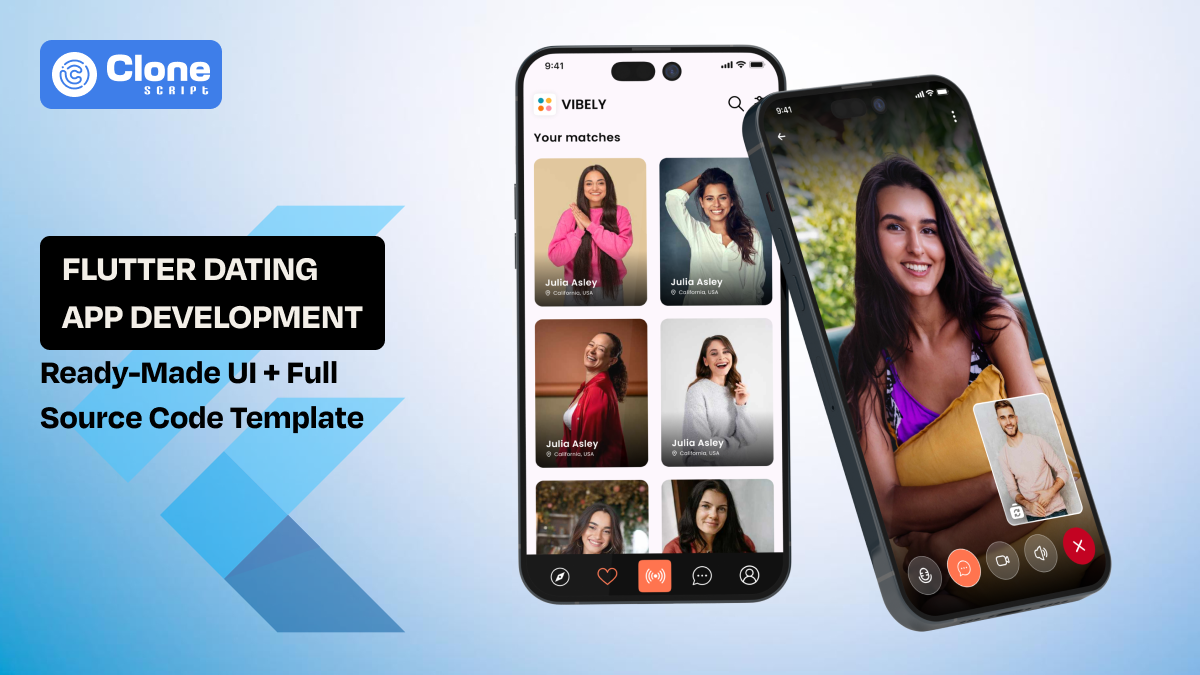
Dating App Development With Flutter UI and Source Code Template
When a client approaches you for a dating app, they rarely say, “Build me a simple MVP.” What they usually mean is:
-
Make it feel like Tinder
-
Include premium upgrades like Bumble.
-
Provide personality-driven matching similar to Hinge.
-
Ensure it passes App Store review on the first attempt
From a development standpoint, this translates into a complex system involving gesture-based UI, real-time communication, payment integration, moderation layers, and scalable back-end logic.
Building everything from scratch is possible, but rarely commercially efficient.
This is where a Flutter UI design plus a fully coded dating app template becomes strategically valuable. This is not a shortcut, but a structured development accelerator.
First, we clear up what a dating mobile app should look like in 2026.
The State of Dating Apps in 2026
The dating app market is mature, competitive, and tightly regulated. Users are more selective, and app stores enforce stricter privacy and subscription standards.
Modern platforms must deliver fluid swipe mechanics with optimized gesture detection and smooth animations. Even minor lag can reduce early-session engagement.
-
Real-time chat and video communication are expected. Messaging must sync instantly using a scalable infrastructure, while video requires stable bandwidth handling and efficient rendering.
-
Strong moderation systems, including reporting, blocking, and verification, are essential to prevent spam, bots, and abuse.
-
Subscription monetization must be transparent, secure, and compliant with store billing policies.
-
Personalization filters need efficient back-end queries to maintain performance.
-
Privacy controls such as encryption, consent flows, and account deletion are mandatory.
For developers, this demands optimized UI rendering, scalable back-end development systems, indexed database queries, and secure authentication. Building from scratch can take 3–6 months. A cross-platform dating app coded template significantly reduces that timeline.
Now, we have to understand the circumstances that allow dating app developers to choose Flutter over other technology stacks.
Why Flutter Remains a Strong Technical Choice
Flutter continues to dominate cross-platform development due to predictable performance and unified architecture.
-
Single Codebase Strategy
Flutter compiles to native ARM code for both Android and iOS. From it, you can maintain:
-
One repository
-
One UI logic layer
-
One state management system
Instead of managing separate Swift and Kotlin projects, developers operate within a unified Dart-based environment. This significantly reduces duplicated effort, prevents feature mismatches between platforms, and simplifies debugging.
When clients request feature updates or design adjustments, changes are applied once and reflected across both platforms. Over time, this lowers maintenance overhead and accelerates version releases.
-
Performance for Gesture-Heavy Interfaces
Dating apps are animation-driven products. Swiping, card stacking, match popups, and chat transitions require fluid motion rendering.
Flutter’s rendering engine ensures consistency across devices, including Android phones with limited hardware acceleration.
-
Back-end Integration Flexibility
Integrating an app with back-end systems through Flutter, you can do:
-
Firebase for authentication, real-time database, and push notifications
-
Custom REST APIs (Node.js / Laravel)
-
WebSocket servers for real-time chat
-
Payment SDKs
This flexibility allows developers to adapt to existing back-end ecosystems rather than forcing architectural changes. Whether a client prefers cloud-managed infrastructure or custom server logic, Flutter acts as a compatible front-end app development. This adaptability reduces integration risk and supports scalable app development.
People-First Design in Modern Dating Apps
A dating app in 2026 must go beyond swipe addiction. User trust and personalization are central.
-
Safety as a Core Feature
People only trust your dating app when they feel safe, and for that must implement:
-
Report and block systems that empower users to control their experience and prevent harassment.
-
Profile moderation support, whether manual review or AI-assisted filtering, helps detect fake accounts, inappropriate content, or spam behavior.
-
Data privacy controls ensure users understand what information is visible and how it is stored.
-
Age verification flows are especially important for compliance and protecting minors.
-
Intelligent Matching Experience
Users expect more than random swiping. They want to execute the following in a dating app:
-
Filtered search that allows users to refine discovery by age, location, or shared preferences.
-
Interest-based suggestions can increase relevance and reduce swipe fatigue.
-
Smart compatibility recommendations, even if maintained by basic scoring algorithms, improve match satisfaction.
A Flutter design and coded template must structurally support these flows, not just visually display cards.
-
Low Friction Onboarding
Onboarding drop-off rates are high in dating apps. If profile setup feels long or confusing, users abandon the process before reaching the core experience. The flow must be guided, progressive, and visually clear.
A Flutter front-end coded app template with structured onboarding screens reduces UX friction significantly by providing pre-built steps, logical navigation, and consistent input validation.
Feature Analysis of the Flutter Dating App Template
Unlike surface-level UI kits that only provide static screens, this Flutter dating app template functions as a coded, structured mobile application framework. That distinction matters.
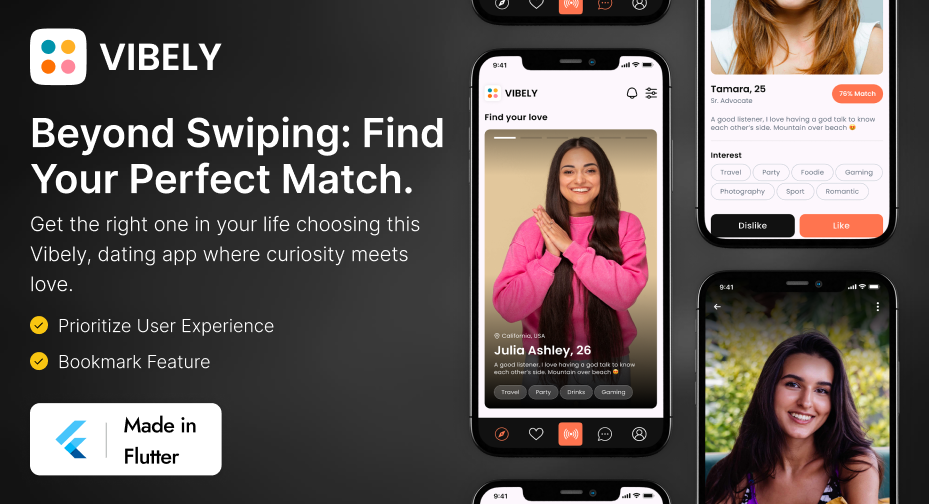
You’re not starting from loose design files or disconnected components. You’re starting from a functional architecture that reflects real dating app workflows, registration, swiping, matching, chatting, filtering, and monetization, already organized in production-style code.
Let’s know what this means from a practical development standpoint.
-
Structured Registration and Profile Setup
User acquisition begins at onboarding, and onboarding determines retention.
This template includes a multi-screen registration flow that mirrors how modern dating apps guide users through setup without overwhelming them. Take an overview of it.
-
Account creation flow
-
Profile editing interface
-
Image upload screens
-
Basic preference selection
Why does this matter technically?
In early-stage product builds, onboarding UI alone can consume 20–25% of sprint capacity. Forms, validation states, error handling, image pickers, and navigation logic require coordination.
With this template, you can do the following:
-
Screen hierarchy is already structured
-
Form layouts follow consistent design rules.
-
Navigation transitions are wired.
-
State management patterns are prepared.
That means you can immediately integrate these functions into your app:
-
OTP verification
-
Email confirmation flows
-
Back-end validation APIs
-
Social login (Google / Apple)
-
Progressive onboarding logic
You’re extending functionality, not rebuilding structure.
-
Swipe-Based Matching System
The swipe system is the emotional engine of a dating app.
If animations lag or gestures feel inconsistent, user trust drops instantly. In swipe-based products, micro-interactions define perceived quality.
The template includes the following:
-
Gesture recognition logic
-
Card stack animation layers
-
Like / dislike triggers
-
Match confirmation UI
Because Flutter uses the Impeller (formerly Skia) rendering engine, animations remain smooth across devices, even mid-range Android phones. That consistency is crucial for gesture-heavy experiences.
The swipe layer is not related to static data. It’s structured to allow dynamic back-end integration.
You can connect it to the following:
-
Firestore queries
-
Custom ranking algorithms
-
Geo-location filters
-
Machine learning match scoring
The UI logic remains stable while back-end intelligence evolves.
That flexibility is essential for scaling personalization over time.
-
Real-Time Chat Interface
Messaging systems are often the most underestimated development cost in dating apps.
Chat modules require real-time message sync, delivery status handling, scroll management, media handling, typing indicators, and notification triggers.
This template includes structured chat UI, message bubble components, typing indicator layouts, and call interface screens.
Using it, you can take advantage of the development of WebSocket integration, Firebase listeners, WebRTC configuration, and Message encryption logic.
The visual and interaction framework is already complete.
This reduces complexity in early product phases and helps teams ship MVP messaging faster without compromising structure.
-
Profile Filtering System
Modern users expect control. Basic swiping is no longer enough. People want filtered discovery and intentional matching.
The template includes a structured filter menu that supports age range selection, interest filters, and location preferences.
Why does this structure matter?
Filtering systems often fail because UI and back-end development logic aren’t aligned.
Here, the UI layer is modular. That means back-end query optimization can evolve independently, ranking logic can be adjusted without redesigning screens, and filter categories can expand easily.
For example, you can later add the following:
-
Lifestyle filters
-
Language preferences
-
Education level filters
-
Compatibility scores
The architecture supports expansion, and dating app developers prefer to work with it.
-
Subscription & Premium Logic Support
Monetization defines sustainability. Dating apps rely heavily on subscription models, boosts, unlimited swipes, profile visibility, and premium filters.
The template includes premium UI prompts, paid membership layout logic, and upgrade flow screens.
You will get integration-ready architecture for in-app purchases (iOS / Android), subscription validation, server-side receipt verification, and feature gating logic.
The UI for premium restrictions already exists. That reduces friction in building upgrade funnels and A/B testing monetization strategies.
-
Push Notification Integration Ready
Retention depends on re-engagement. New match alerts and incoming messages are the primary drivers of return sessions.
The template architecture supports new match alerts, message notifications, and activity updates.
Integration with Firebase Cloud Messaging becomes straightforward because the notification trigger structure already aligns with app flows.
You’re not adding notifications later as an afterthought. They’re embedded into the logic.
Advanced Implementation Strategy (Beyond Basic Setup)
Most developers stop after integrating back-end APIs. Advanced developers optimize further.
-
Intelligent Match Ranking
Basic filters, age, distance, and shared interests are no longer enough.
In 2026, users expect the app to understand their behavior, not just their stated preferences.
A modern dating product must evolve beyond static filtering and move toward dynamic compatibility scoring.
You can extend the template with behavioral scoring, swipe history tracking, and engagement frequency analysis.
These systems transform matching from reactive to predictive.
-
Moderation & Anti-Abuse Systems
Dating apps remain high-risk environments for spam, bots, and harassment.
Increased regulatory scrutiny means moderation is not optional. It is foundational.
A scalable dating app must integrate structured safety systems early.
Advanced integration should include image moderation APIs, behavioral anomaly detection, and automated flagging systems.
These can be helpful to protect both users and brand reputation.
-
Analytics & Growth Tracking
Without analytics, growth becomes guesswork.
Dating apps operate on tight retention margins. Small improvements in user experience can significantly impact revenue.
You should integrate event tracking to measure:
-
Swipe-to-match ratio
-
Chat initiation rate
-
Subscription conversion rate
These metrics reveal product health.
Dating App Development Workflow for Client Projects
Here’s a realistic project flow to follow.
-
Phase 1 Setup: It begins with installing the Flutter SDK, initializing the project repository, and configuring required dependencies. This ensures a clean, scalable foundation.
-
Phase 2 Back-end Configuration: This focuses on authentication setup, defining database collections, and implementing match query logic. Clear data architecture at this stage prevents scaling issues later.
-
Phase 3 UI Customization: App UI and UX design aligns the product with the client’s brand. Teams apply custom colors, update typography, and replace default assets to reflect the intended identity.
-
Phase 4 Feature Enhancement: It adds differentiation, integrating AI-based ranking logic, payment gateway integration, and moderation APIs.
-
Phase 5 Security Hardening: It includes encrypting API traffic, implementing rate limiting, and validating subscription receipts.
-
Phase 6: Testing & Deployment: It covers multi-device testing, store compliance preparation, and submission to app marketplaces.
A production-ready MVP typically takes 6–8 weeks with this structured approach.
Security & Compliance Requirements in Dating Apps
Dating platforms handle highly sensitive information, photos, private conversations, location data, and payment details. Security cannot be treated as a final checklist item; it must be integrated into the architecture from day one.
Ensure the following:
-
Secure authentication flows with token-based sessions and proper validation
-
Data encryption in transit using HTTPS and secure API communication
-
User data deletion options that comply with privacy regulations
-
Transparent subscription policies clearly explaining billing terms and renewals.
Users increasingly expect control over their data. Providing accessible privacy settings and clear account deletion workflows builds trust and reduces regulatory risk.
App marketplace review processes are particularly strict around subscription transparency and data privacy disclosures. Missing terms, unclear billing cycles, or weak privacy documentation often trigger rejections.
In many launches, compliance failures delay release timelines more than technical bugs. Prioritizing security and policy alignment early prevents costly last-minute revisions and protects long-term brand credibility.
Business Impact for Agencies and Freelancers
For agencies and independent developers, structured templates are not just technical assets; they are revenue multipliers.
From a business standpoint, templates improve:
-
Delivery speed
When foundational systems like onboarding, swiping, chat, and subscriptions are already built, teams spend less time on repetitive UI construction and more time on customization and strategic enhancements.
-
Profit margins
This shift directly improves margins. Fewer development hours are required per project, while pricing can remain aligned with full-product builds.
-
Project predictability
Predictability also improves sales confidence. Instead of quoting uncertain 4–6 month timelines, agencies can confidently propose 8–10 week delivery windows for a production-ready MVP with branding and backend integration. Shorter timelines reduce client hesitation, accelerate decision-making, and increase close rates during proposal stages.
-
Reusability across multiple clients
Over multiple projects, reusable architecture compounds efficiency, transforming one template investment into recurring revenue leverage.
Conclusion
Dating app development in 2026 requires balancing performance, security, monetization, personalization, and compliance.
A Flutter UI design and coded template does not eliminate engineering work. It eliminates redundant engineering work. It provides a structured base layer so developers can focus on differentiation, back-end logic, and growth optimization.
For client-driven projects, that distinction is important.