BTC - Bitcoin
 USDTERC20 - USDT ERC20
 ETH - Ethereum
 BNB - Binance
 BCH - Bitcoin Cash
 DOGE - Dogecoin
 TRX - TRON
 USDTTRC20 - USD TRC20
 LTC - LiteCoin

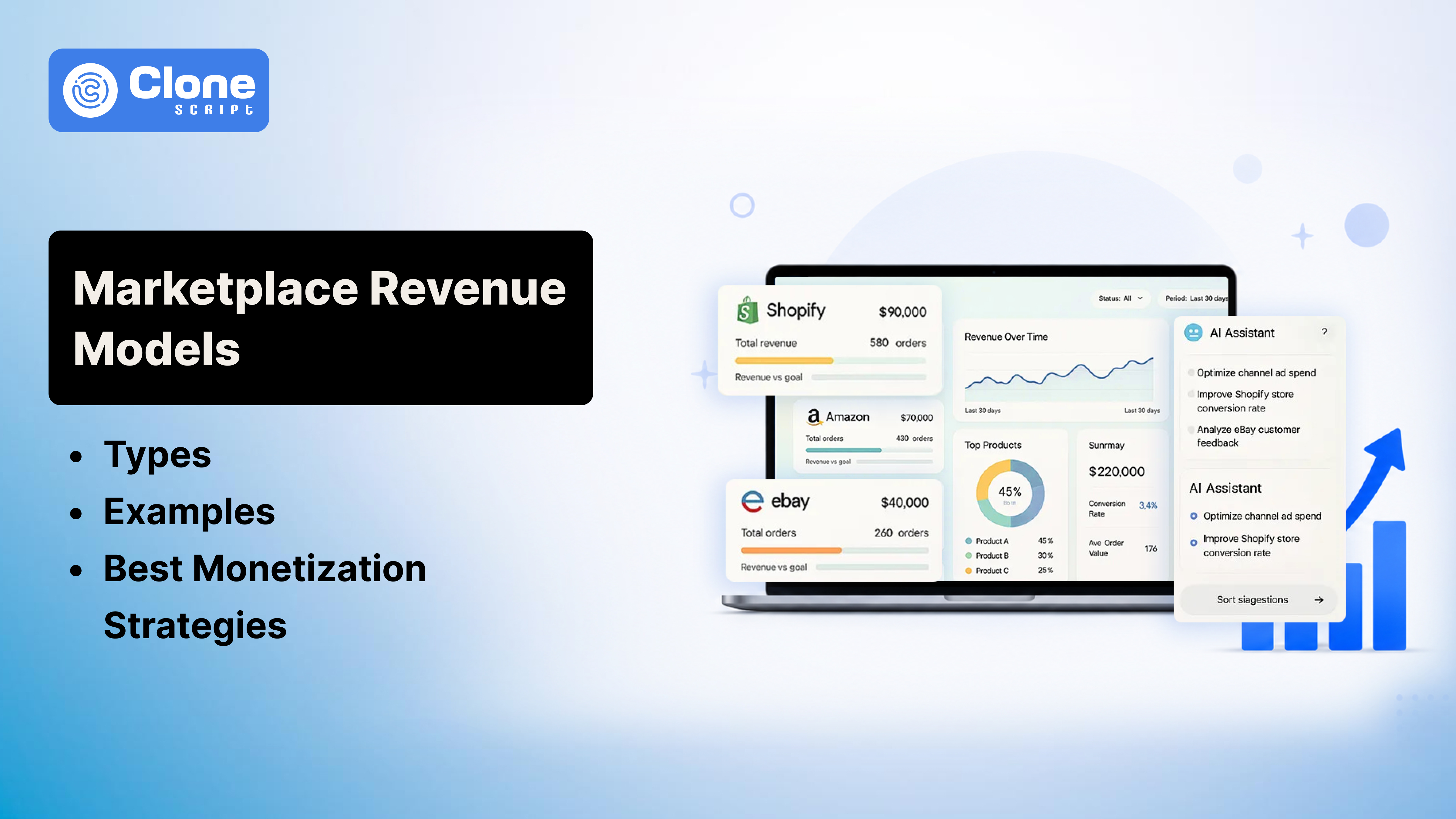
Marketplace Revenue Models: Types, Examples & Best Monetization Strategies
Online marketplaces are central to the digital economy. Platforms like Amazon.com and Etsy.com connect buyers and sellers globally, spanning both shopping and service-based sectors.
How do these platforms generate revenue? If you are considering launching a marketplace, it is important to understand the fundamental details of its monetization strategies.
This guide explores marketplace revenue models, their types, real-world examples, and effective monetization strategies. Understanding these models is essential for building a profitable and sustainable online marketplace.
What Are Marketplace Revenue and Models?
There are different ways online platforms earn income by facilitating transactions between buyers and sellers. These ways include:
-
Charging a fluctuating fee on every transaction value
-
Providing value-added services
-
A flat fee for subscription-based users
-
Offering premium membership programs
This is called marketplace revenue models.
You think it’s ok to have such models, but is it necessary to own the inventory? Not at all.
Take the example of Amazon, an e-commerce marketplace fulfill most of the people's online shopping needs. They provide a platform for third-party vendors or service providers.
The right choice of revenue model can help boost your platform’s profitability, attract more users, and provide scalable growth. Let’s dive into the types of revenue models that most marketplaces use today.
How Do Marketplaces Generate Revenue?
There are several online marketplaces to earn money. These methods vary based on factors like industry, target audience, and market size. Here are the most common marketplace revenue models:
-
Commission-Based Revenue Model
The commission-based revenue model is one of the most widely used strategies. Why?
There is a wealthier part of income that the marketplace can earn when the transaction happens.
Etsy and Amazon are the prime examples. They take a certain percentage cut of each sale made.
But hold on. This model only works when the sellers feel successful. That means the marketplace only gets money when its users make sales. Otherwise, not.
How It Works:
-
The platform manages the transaction between the buyer and seller.
-
A set of online marketplace commission (usually a percentage) is taken from the final sale price.
Example:
Amazon operates primarily on a commission model, taking a percentage of the sales made by third-party sellers on its platform. The marketplace commission fees vary by product category, but they typically range from 6% to 45%.
Why online marketplace commission effective?
-
No upfront costs for sellers.
-
Easy scalability for the marketplace.
-
Revenue is directly tied to platform success.
-
Subscription-Based Revenue Model
Introducing another used model in the online marketplace: subscription-based. Here, the platform charges a flat amount (including sellers or businesses) as a recurring fee. This model is particularly popular for marketplaces offering premium features or enhanced visibility to sellers.
How It Works:
-
Sellers or service providers pay a fee (usually monthly or annually) to list their products or access premium tools.
-
It can also include subscriptions for buyers to access exclusive content or services.
Example:
LinkedIn uses a subscription model for its premium services, such as LinkedIn Premium and LinkedIn Sales Navigator, which offer advanced features like InMail and insights into who viewed your profile.
Fiverr also offers a marketplace subscription service for its "Fiverr Pro" tier, providing freelancers with premium tools and better visibility.
Why recurring revenue model effective?
-
Predictable, recurring income stream.
-
Helps build customer loyalty and long-term relationships.
-
Good for marketplaces offering premium services or content.
-
Listing Fees Revenue Model
Despite the popularity of commission and subscription models, the listing fees are also considered a common choice. This revenue model is an ideal choice when sellers have to pay only for listing the products or services on the marketplace.
How It Works:
-
Sellers pay a fee to create and maintain listings.
-
Some marketplaces charge additional premium fees or feature paid listings that gain better visibility.
Example:
eBay charges a marketplace listing fee for each product a seller lists for sale. This fee varies based on the product category, the number of listings, and whether the seller wants their product to be featured.
Why are paid listings effective?
-
Ensures revenue generation regardless of sales.
-
Works well for marketplaces with many listings or products.
-
Adds an upfront cost that encourages sellers to ensure their listings are optimized.
-
Lead Generation Revenue Model
This model focuses on generating qualified leads for sellers, typically through a pay-per-lead or pay-per-action structure. It's a popular approach for service-based marketplaces.
How It Works:
-
The lead generation model connects sellers with potential buyers under a single platform.
-
Then, the marketplace charges sellers when they receive a lead or customer contact details.
Example:
HomeAdvisor generates revenue by providing leads to contractors and service professionals. Once a lead (a potential customer) contacts a professional, the marketplace charges the service provider for the lead.
Why are marketplace lead fees effective?
-
Generates revenue without requiring transactions.
-
Works well for service-based marketplaces with a strong customer base.
-
Sellers can track ROI on paid leads.
-
Advertising-Based Revenue Model
When talking about pay-per-click (PPC) ads, do you think of Google Ads or Meta Ads? No, it’s not like that.
Serving the marketplace to buyers and sellers, the advertising revenue model is the best choice. By displaying the ads from third-party companies or feature seller products through paid placements.
How It Works:
-
Advertisers pay the marketplace to display their ads, usually based on impressions (CPM) or clicks (CPC).
-
Marketplaces may offer promoted product listings or banner ads.
Example:
Google Shopping and Amazon Sponsored Products are proper examples where sellers pay to have their products featured in search results. Another example is that Etsy also offers promoted listings to boost visibility for certain sellers.
Why sponsored ads marketplace effective?
-
Monetizes high traffic volumes.
-
Allows advertisers to directly target marketplace users.
-
Non-intrusive, as users are accustomed to ads.
-
Freemium Revenue Model
Under the freemium model, users can access basic features for free, while paying for premium features or services. This model is particularly popular in digital and SaaS marketplaces.
How It Works:
-
Users can access the platform for free but must pay to unlock additional features, better exposure, or exclusive services.
-
It’s common for sellers to use a free basic account and pay for premium listings or enhanced tools.
Example:
Dropbox and LinkedIn both operate on freemium models. Dropbox offers free storage up to a certain limit, while LinkedIn offers free membership with paid upgrades for more visibility and features.
Why free-to-premium marketplace effective?
-
Encourages broad user adoption.
-
Converts free users to paying customers.
-
Scales easily as more users are added.
-
Hybrid Revenue Model
Some marketplaces use a hybrid revenue model, combining multiple monetization methods to diversify their income streams and cater to different types of users.
How It Works:
-
A combination of two or more revenue models is employed. For example, a platform might charge listing fees, take a commission on sales, and also offer premium subscriptions. For getting a diversified marketplace income, consider this model.
Example:
Amazon uses a hybrid model, charging sellers a commission on sales and listing fees, and also offering Amazon Prime subscriptions for both sellers and buyers. The platform also generates significant revenue from advertising.
Why is hybrid monetization effective?
-
Offers multiple ways to generate income.
-
Provides flexibility in pricing and service options.
-
Reduces dependence on a single revenue stream.
Knowing the marketplace revenue models is one part, and what is correct for your business is most important to note.
Key Considerations When Choosing a Marketplace Revenue Model
The subscription model, work or pay-per-click, gets more sign-ups to your marketplace, depending on some aspects:
-
Market Type
Understand whether your marketplace caters to B2B, B2C, or C2C. This will impact your decision.
Suppose you have a B2C marketplace choice, then subscription or commission-based models work perfectly rather than a free model.
On the other side, listing fees are chosen for C2C marketplaces because the products or services are listed on the platform.
-
Customer Needs
You can’t make only a supply-side favored platform. Consider what customers need to fulfill and why your marketplace is helpful.
Take an example, your e-commerce platform needs an audience of small businesses or individual sellers, then focus on a low-barrier entry point. This includes listing fees or a freemium model.
Alternatively, established brands may prefer a subscription-based model for more control and scalability.
-
Revenue Diversification
As your platform grows, consider adding new revenue streams. A hybrid model can provide a balanced approach, ensuring you don't rely on just one type of fee.
Conclusion
Choosing the right marketplace revenue model is essential to ensuring your platform's long-term success. Whether you opt for a commission-based model, a subscription service, or a hybrid approach, understanding how different models work will help you make the best decision for your marketplace's growth. Start by evaluating your market type, customer needs, and scalability potential, and choose a revenue model that aligns with your platform's goals.
With the right strategy, you can create a sustainable, profitable marketplace that becomes successful in the ever-evolving digital field.
FAQs
-
How do I decide which revenue model best fits my specific marketplace idea?
Choose a revenue model based on transaction frequency, user behavior, margins, and marketplace type. Match monetization with long-term scalability, retention, and buyer-seller engagement patterns.
-
Can I switch revenue models later if my initial choice doesn't work?
Yes, marketplaces often evolve from commissions to hybrid models including subscriptions, ads, SaaS tools, or payment fees as user growth and transaction volume increase.
-
What are the common pitfalls or mistakes founders make when choosing a revenue model?
Founders commonly overcharge early, ignore recurring revenue, copy competitors blindly, or choose monetization models misaligned with user behavior, retention, and marketplace economics.
-
What are the first concrete steps to implement a chosen revenue model?
Start by validating user willingness to pay, defining pricing structure, integrating payment systems, tracking take rates, and testing monetization with a limited user segment.
-
Which key metrics should I track to measure the success of my chosen revenue model?
Track GMV, take rate, customer acquisition cost, lifetime value, repeat transactions, churn rate, average order value, revenue growth, and vendor retention to evaluate marketplace monetization performance.