BTC - Bitcoin
 USDTERC20 - USDT ERC20
 ETH - Ethereum
 BNB - Binance
 BCH - Bitcoin Cash
 DOGE - Dogecoin
 TRX - TRON
 USDTTRC20 - USD TRC20
 LTC - LiteCoin

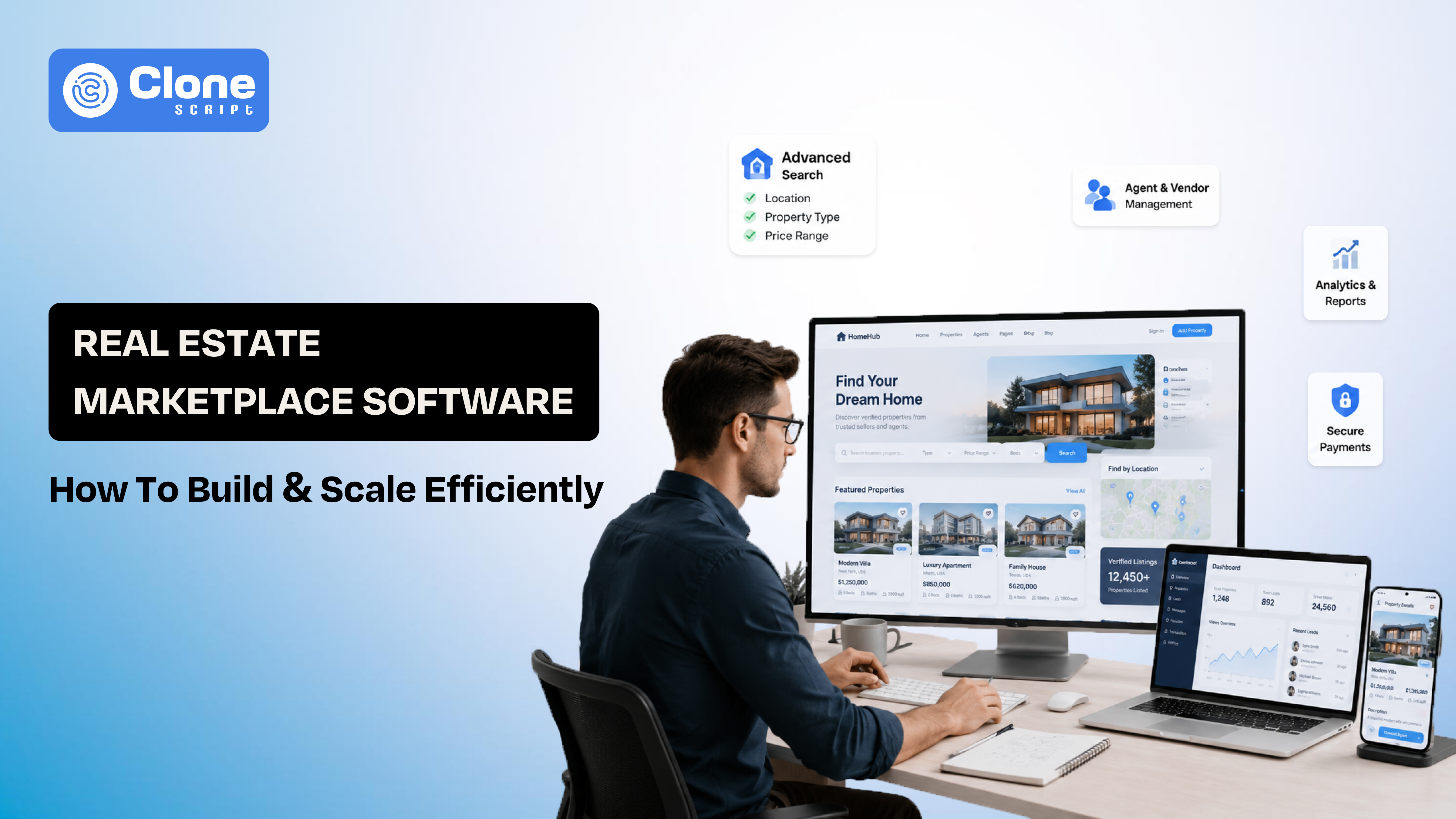
Real Estate Marketplace Software: How to Build & Scale Efficiently
Real estate has always been a high-stakes industry. Large transactions, fragmented stakeholders, and slow processes define the space.
But digital transformation is rewriting those rules. Buyers now expect instant discovery, transparent pricing, and seamless communication.
For startups, this creates a compelling opportunity. You don’t need to own property. You need to own the platform experience.
This is where Real Estate Marketplace Software becomes essential. It enables founders to build scalable ecosystems that connect demand and supply efficiently.
The real challenge is not launching. It’s launching fast and scaling without operational chaos.
Market Overview: Trends Driving PropTech Expansion
The global real estate industry is undergoing a structural shift driven by technology adoption and changing consumer expectations.
Recent data highlights this acceleration:
-
The global PropTech market is expected to surpass $90–100 billion by 2030.
-
More than 90% of buyers took information for property search through online platforms.
-
Mobile devices account for over 70% of real estate browsing sessions.
-
AI-driven property platforms are seeing 30–40% higher engagement rates.
Key Market Shifts
1. Digital-first buyer behavior: Users expect intuitive platforms with real-time filtering, map views, and personalized results.
2. Rise of platform ecosystems: Modern marketplaces integrate services like mortgages, legal assistance, and property inspections for complete solutions.
3. Fractional ownership models: Investors are entering real estate with smaller capital through shared ownership platforms.
4. Data-driven decision-making: AI in customer experience creates a new kind of facility for property searchers and listers. With modern tools that now assist users in evaluating price trends, rental yield, and future appreciation.
5. Trust and transparency demand: To purchase real estate, verified listings, reviews, and documentation are no longer optional; they’re expected.
What This Means for Startups
The barrier to entry has lowered, but expectations have increased. You’re not just building a platform. You’re building a decision-support system.
What is Real Estate Marketplace Software?
It is a multi-sided digital platform that facilitates interactions between property buyers, sellers, agents, and service providers. Unlike static listing websites, the software enables dynamic transactions and revenue generation.
Core Participants in the software:
-
Buyers and renters searching for properties
-
Property owners and developers listing assets
-
Agents managing listings and leads
-
Service providers (legal, financial, inspection)
Core Capabilities of real estate software
-
Support property listing and categorization
-
The existence of advanced search and filtering systems
-
Real-time communication tools to manage the conversations
-
Transaction and lead management system
-
Analytics dashboards for all stakeholders to track their actions
Marketplace Dynamics
A successful marketplace operates on these aspects:
-
Network effects mean that the more listings attract more users.
-
Liquidity is related to the ease of matching buyers and sellers.
-
Trust systems based on verification, reviews, and ratings.
This transforms your product into a scalable digital ecosystem. It becomes beyond a property directory.
A Unique Approach: AI-Powered Hyperlocal Marketplaces
Most platforms compete at scale, city-wide or national listings. But scale often reduces relevance.
A smarter strategy is building AI-driven hyperlocal marketplace software for real estate.
What Makes It Different
Instead of broad listings, the platform focuses on:
-
Micro-neighborhood insights where people like to find the villas, resorts, and houses.
-
Street-level pricing trends work perfectly for apartment renters to justify the cost.
-
Real-time demand and supply heatmaps help property listers manage the listing.
-
Personalized recommendations based on behavior
Practical Implementation
-
AI analyzes user preferences (budget, commute, lifestyle), then recommends what suits the user.
-
The system suggests “best-fit” neighborhoods, not just properties.
-
Predictive analytics estimate price appreciation and rental yield.
Example Output for Users
-
“Top 5 undervalued areas within 5 km”
-
“Properties with 8%+ rental yield potential”
-
“High-growth zones based on infrastructure projects”
Strategic Advantage
-
Due to AI systems, higher engagement rates can be noticed.
-
Better conversion ratios can be experienced from both property listers and renters.
-
Stronger user retention will be reported in the dashboard.
This approach turns your platform into a united property listing site.
Key Features Required in Property Managing Software
To compete in today’s PropTech landscape, your platform must function as a complete transactional ecosystem.
Below is a structured breakdown of must-have and advanced features across all stakeholders.
-
Buyer / Renter Features (Demand-Side Experience)
The buyer experience directly impacts engagement, retention, and conversion rates. Your platform should prioritize speed, personalization, and clarity.
Discovery & Search
-
Advanced search filters for location, price range, property type, amenities, and possession status.
-
Map-based browsing with geolocation and radius search.
-
Polygon search to draw custom areas on the map.
-
Nearby insights like schools, hospitals, transport, and lifestyle metrics.
Personalization & Tracking
-
Saved searches and auto-alerts for new listings
-
Recently viewed and recommended properties
-
Wishlist or favorites system
Property Evaluation
-
High-resolution images, video walkthroughs, and virtual tours
-
Floor plans and downloadable brochures
-
Price trends and historical data
-
EMI calculators and affordability estimators
Communication & Conversion
-
Secure in-app chat with agents and sellers
-
One-click inquiry and callback requests
-
Appointment scheduling for site visits
-
Document request and sharing system
Trust & Transparency
-
Verified property badges
-
Ratings and reviews for agents/sellers
-
Legal document previews (ownership, approvals)
-
Seller / Property Owner Features (Supply-Side Control)
Sellers need tools that simplify listing management while maximizing visibility and lead conversion.
Listing Management
-
Easy property upload with structured fields
-
Bulk listing upload for developers
-
Media management, including images, videos, and documents
-
Real-time listing status for active, pending, and sold
Visibility & Promotion
-
Featured listings and ad placements
-
SEO-friendly listing pages
-
Location-based promotion tools
Lead Management
-
Centralized lead dashboard
-
Lead qualification tags (hot, warm, cold)
-
Automated responses and follow-ups
-
Integration with CRM systems
Analytics & Insights
-
Listing views and engagement metrics
-
Conversion tracking from inquiries to visits
-
Pricing suggestions based on market data
Monetization Tools
-
Pay-per-listing options
-
Subscription plans for frequent sellers
-
Promotional upgrade options
-
Agent / Broker Features (Intermediary Layer)
Agents operate at scale and require efficiency, automation, and pipeline visibility. The software features have to support their roles.
Lead & Client Management
-
Unified lead inbox across listings
-
Client segmentation and tagging
-
Communication history tracking
Workflow Automation
-
Automated follow-ups via email/SMS
-
Task reminders and pipeline management
-
Appointment scheduling tools
Performance Tracking
-
Agent-specific dashboards
-
Deal tracking and commission insights
-
Conversion rate analytics
Collaboration Tools
-
Team access for agencies
-
Role-based permissions
-
Shared listing management
Mobility
-
Fully functional mobile app access
-
Push notifications for new leads and updates
-
Admin Panel (Platform Control Layer)
The admin panel is the backbone of your Real Estate Marketplace Software, ensuring smooth operations, compliance, and revenue tracking.
User & Listing Governance
-
User onboarding and KYC verification
-
Listing approval workflows
-
Content moderation tools
-
Role-based access control
Revenue & Monetization
-
Commission tracking and reporting
-
Subscription management
-
Invoice and billing management
Analytics & Reporting
-
Platform-wide performance dashboards
-
Traffic, engagement, and conversion metrics
-
Revenue analytics by segment
Security & Compliance
-
Fraud detection systems
-
Duplicate listing detection
-
Data encryption and access logs
-
Regulatory compliance management
Operational Tools
-
CMS for blogs, landing pages, and SEO website content
-
Notification management (email, SMS, push)
-
Customer support ticketing system
-
Advanced Differentiators (Scaling Layer)
Once your platform achieves initial traction, these features help create competitive defensibility and higher user retention.
AI & Data Intelligence
-
AI-based property recommendations
-
Predictive pricing models
-
Demand-supply heatmaps
-
Personalized search ranking
Automation & Integrations
-
CRM integrations like Salesforce, HubSpot
-
Marketing automation tools
-
Third-party API integrations for maps, payments, and legal services
Localization & Expansion
-
Multi-currency handling
-
Region-specific compliance modules
Financial Tools
-
Automated Valuation Models (AVMs)
-
ROI and rental yield calculators
-
Mortgage and loan integrations
Cross-Platform Experience
-
Web and mobile synchronization
-
Progressive Web App (PWA) support
-
Offline access for key features
Property Listing Software Product Strategy Insight
Building all features at once is a common mistake. A more effective approach is phased development:
Phase 1: Core Transaction Layer
Here, you have to cover the core functionality like listings, search, and the inquiry system. There is a basic dashboard for users and sellers available.
Phase 2: Engagement Layer
In this layer, personalization, alerts, and analytics are important to have for managing the entire platform. Additionally, lead management and communication tools make the functionality useful.
Phase 3: Intelligence Layer
To make your real estate software modern, AI recommendations with predictive analytics and advanced automation are required.
Key principle:
Start with features that enable transactions and liquidity.
Then layer intelligence to improve efficiency and user experience.
A well-structured feature architecture ensures your platform is not just functional. But, scalable, monetizable, and defensible in a competitive market.
Development Approaches: Choosing the Right Build Strategy
Your development approach determines how fast you enter the market, how much capital you burn, and how easily you scale.
There’s no universal “best” option: only what aligns with your stage, budget, and growth ambition.
Below is a structured breakdown of the three primary approaches founders consider when building Real Estate Marketplace Software.
-
Custom Development (Full-Control Architecture)
Custom development means building your platform from the ground up using dedicated engineering resources, either in-house or outsourced.
When It Makes Sense
-
You’re building a highly differentiated product (e.g., AI-first or niche marketplace)
-
You already have validated demand or traction
-
You have access to significant funding or a technical team
Key Capabilities
-
Fully customized UX/UI aligned with your brand
-
Scalable back-end architecture tailored to marketplace dynamics
-
Deep integrations (AI engines, CRMs, analytics platforms, fintech tools)
Advantages
-
Complete control over product roadmap and features
-
Strong long-term scalability and flexibility
-
Ability to build proprietary technology advantages
Limitations
-
High upfront cost: $40,000 – $125,000+
-
Longer development cycle: 6–12 months (or more)
-
Requires continuous engineering investment and DevOps support
Custom software development for property listing software is best suited for post-MVP scaling, not initial experimentation.
Building too early often results in over-engineering features users may not need.
-
Clone Script Solutions (Speed-to-Market Model)
Developing a property selling and rental software using a clone script provides a pre-built marketplace foundation with essential features already in place. This allows rapid customization and deployment.
When It Makes Sense
-
You want to launch quickly and validate your idea.
-
You’re operating with a limited or controlled budget.
-
Your priority is execution, not infrastructure building.
Core Capabilities
-
Ready-made modules for listings, search, dashboards, and payments
-
Built-in monetization features (subscriptions, featured listings)
-
Pre-configured multi-user roles (buyers, sellers, agents, admin)
Advantages
-
Fast deployment: 2–6 weeks
-
Cost-efficient: $5,000 – $25,000
-
Enables rapid iteration based on real user behavior
Limitations
-
Requires customization for brand differentiation
-
Performance and scalability depend on script quality
-
May need a partial rebuild at scale if the architecture is limited
Clone scripts are not just cost-saving tools. They are market validation engines.
They allow founders to test assumptions, acquire users, and refine business models before scaling.
-
SaaS-Based Marketplace Builders (Plug-and-Play Model)
SaaS platforms offer subscription-based tools to create marketplaces with minimal technical involvement, especially with limited development team members.
When It Makes Sense
-
You want to test an idea with minimal investment.
-
You lack a technical team for front-end website development or back-end integration.
-
Your goal is rapid experimentation, not long-term scaling.
Core Capabilities
-
Drag-and-drop setup and configuration
-
Pre-built real estate website templates and Flutter app template workflows
-
Managed hosting, security, and updates
Advantages
-
Fastest launch time: a few days to 2 weeks
-
Low upfront cost: $50 – $500/month
-
No need to manage infrastructure
Limitations
-
Limited customization and feature control
-
Platform dependency (vendor lock-in risk)
-
Difficult to scale or migrate for complex use cases
SaaS builders are ideal for idea validation, but rarely support the complexity of a growing real estate marketplace.
Decision Framework for Founders
Instead of asking “which approach is best,” evaluate based on execution realities:
-
What stage is your startup currently in?
-
How quickly do you need to launch and validate?
-
What level of capital can you deploy safely?
-
Do you need differentiation now or later?
Recommended Path
-
Stage 1 (Idea / MVP): Start with a clone script or SaaS
-
Stage 2 (Validation): Customize and optimize your platform
-
Stage 3 (Scaling): Transition to custom architecture if required
Execution Insight
The most common failure pattern is over-engineering before validation.
Marketplace success depends on:
-
Liquidity (active buyers and sellers)
-
Trust (verified listings and reliable interactions)
-
Experience (fast, intuitive interface)
There is not just technical sophistication.
Bottom Line
Your development strategy should accelerate learning cycles, not delay them.
If your goal is to build scalable Real Estate Marketplace Software, focus on launching quickly, validating demand, and evolving your platform using real-world data. Keep assumptions secondary and match them with reality.
That’s how efficient, scalable marketplaces are built.
Scaling Strategies: From MVP to Market Expansion
Once your MVP gains traction, every decision should support sustainable expansion without increasing operational friction.
-
Technology Scaling: Build for Performance and Flexibility
As traffic and listings grow, your platform must handle higher loads without slowing down.
-
Move to cloud-based infrastructure (AWS, GCP) for scalability
-
Implement caching and CDN layers for faster content delivery
-
Use a modular or microservices architecture for flexibility
-
Optimize databases for large-scale property data
A strong tech foundation ensures your platform remains stable during growth spikes.
-
Operational Scaling: Streamline Supply and Quality Control
Growth brings complexity, especially in managing listings and stakeholders.
-
Automate agent and seller onboarding workflows
-
Standardize listing formats and approval processes
-
Implement verification systems to maintain trust
-
Build partnerships with brokers and developers
Efficient operations reduce manual workload while maintaining platform quality.
-
Growth Scaling: Expand Demand with Targeted Acquisition
User acquisition should evolve from broad targeting to high-intent, localized strategies.
-
Invest in SEO-driven content and location-based pages
-
Run performance marketing campaigns (Google, Meta)
-
Launch referral and affiliate programs
-
Collaborate with local real estate networks
The goal is not just traffic. Bu qualified users who convert.
Metrics That Drive Scalable Growth
Scaling without measurement leads to inefficiency. Focus on:
-
Customer Acquisition Cost (CAC)
-
Lifetime Value (LTV)
-
Conversion rates (listing → inquiry → deal)
-
User retention and engagement metrics
Data-driven decisions ensure growth remains sustainable and profitable.
True scaling happens when your platform can handle more users, more listings, and more transactions without proportional increases in cost or complexity.
Monetization Models: Turning Traffic into Revenue
A real estate marketplace without a clear revenue strategy will struggle to sustain growth. The key is to align monetization with user intent and transaction value, ensuring revenue scales as platform activity increases.
-
Listing Fees: Pay-to-Post Model
Charge property owners or agents a fee to publish listings.
-
Works well in high-demand markets
-
Encourages serious sellers only
-
Can be tiered based on listing visibility
-
Commission-Based Model: Earn Per Transaction
Take a percentage from successful deals completed through the platform.
-
High revenue potential per transaction
-
Aligns platform success with user success
-
Requires strong trust and facilitation of deals
-
Subscription Plans: Recurring Revenue Stream
Offer monthly or yearly plans for agents and agencies.
-
Access to premium tools (analytics, lead management)
-
Priority listing placement
-
Predictable recurring income
-
Featured Listings & Ads: Visibility Monetization
Allow users to pay for better exposure.
-
Homepage or top search placements
-
Sponsored listings
-
Banner advertisements
This model works best when your platform already has consistent traffic.
-
Lead Generation Fees: Pay-Per-Lead Model
Charge agents for qualified buyer inquiries.
-
Low barrier for agents to join
-
Revenue tied to performance
-
Requires strong lead quality control
Hybrid Monetization Strategy (Recommended)
Most successful platforms combine multiple models:
-
Free basic listings to attract supply
-
Paid featured placements for visibility
-
Subscriptions for agents
-
Commission on high-value deals
This layered approach balances user growth with revenue generation.
Your monetization model should evolve with your platform stage:
-
Early stage → focus on user acquisition (low friction)
-
Growth stage → introduce premium features and visibility fees
-
Mature stage → optimize commissions and recurring revenue
The goal is simple: Monetize value, not just access.
Choosing the Right Development Partner: Why All Clone Script Stands Out
Selecting a development approach is only half the equation. The execution partner you choose ultimately determines how fast and how well your real estate marketplace performs in the market.
This is where All Clone Script positions itself not just as a solution provider, but as a development partner aligned with startup needs.
-
End-to-End Marketplace Expertise
Unlike generic development agencies, All Clone Script focuses specifically on marketplace-based platforms, including real estate.
This specialization translates into:
-
Pre-structured workflows for property transactions
-
Built-in multi-user architecture (buyers, sellers, agents)
-
Proven feature sets aligned with industry expectations
You’re not starting from zero. You're building on a tested foundation.
-
Faster Time-to-Market with Strategic Execution
Speed is a competitive advantage in PropTech. All Clone Script enables founders to move from idea to launch in weeks instead of months.
-
Rapid deployment of web and mobile platforms
-
Pre-integrated essential modules (search, listings, dashboards)
-
Reduced development cycles without compromising functionality
This allows you to capture early market opportunities while others are still building.
-
Customization That Supports Growth
A common concern with pre-built solutions is rigidity. However, All Clone Script supports:
-
UI/UX customization to match your brand identity
-
Feature enhancements based on evolving user needs
-
Integration with third-party tools (CRM, analytics, payment systems)
This ensures your platform evolves as your business scales.
-
Cost Efficiency Without Compromising Quality
For early-stage startups, capital allocation is critical. We offer a cost-effective alternative to custom builds, helping you:
-
Avoid heavy upfront development costs
-
Allocate budget toward marketing and growth
-
Reduce financial risk during validation stages
You achieve faster ROI with controlled spending.
-
Ongoing Support and Scalability
Beyond launch, the platform requires continuous optimization. A reliable partner provides:
-
Technical support and maintenance
-
Performance optimization
-
Scalability guidance as the user base grows
This ensures your platform remains stable, secure, and scalable over time.
Strategic Advantage for Founders
Working with All Clone Script gives you:
-
Faster entry into the market
-
Reduced development complexity
-
Flexibility to adapt and scale
-
A partner familiar with marketplace dynamics
Choosing the right software development partner is a business strategy.
With All Clone Script, you’re not just building software.
You’re accelerating your journey toward a scalable, revenue-generating real estate marketplace.
Contact us. Our full-stack software product development team will get back to you.