BTC - Bitcoin
 USDTERC20 - USDT ERC20
 ETH - Ethereum
 BNB - Binance
 BCH - Bitcoin Cash
 DOGE - Dogecoin
 TRX - TRON
 USDTTRC20 - USD TRC20
 LTC - LiteCoin

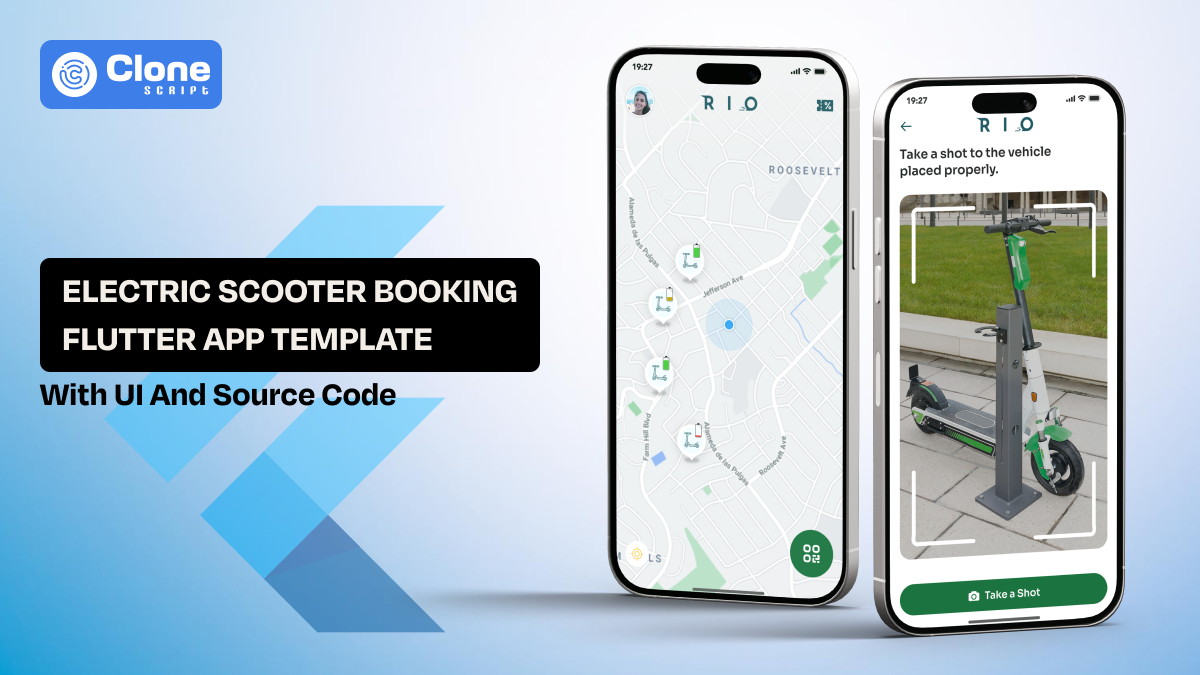
E-Scooter Booking Flutter App Template (With UI and Source Code)
The online electric scooter booking market is operational, competitive, and increasingly data-driven. Cities across Asia, Europe, and North America continue expanding micromobility infrastructure, influenced by the rapid scaling models pioneered by companies like Lime and Bird.
For developers, this shift creates an immediate opportunity. Startups want fast MVP launches. Agencies need structured solutions that reduce build time. Clients expect real-time tracking, smart pricing, and seamless payments from day one.
Building an electric scooter rental system from scratch can take months. We know the fact.
A production-ready Flutter app template with source code reduces that timeline. Instead of assembling authentication, booking logic, GPS tracking, and admin dashboards piece by piece, you start with a structured foundation designed specifically for micromobility platforms.
This guide explains how an online electric scooter booking Flutter template accelerates app development, what technical modules matter most, and how you can deploy faster without compromising scalability.
Why Developers Are Choosing Templates Over Custom Builds in 2026
Custom development remains valuable for complex enterprise ecosystems. However, in the online electric scooter booking segment, execution speed directly impacts funding, partnerships, and city-level approvals. Mobility startups cannot afford prolonged development cycles while competitors deploy fleets and capture user density.

Here are the reasons that developers are picking the templates in Flutter.
-
Reduced Development Timeline
The custom mobile app development timeline can be extended. A complete scooter rental platform is not a simple mobile app. It requires a synchronized system consisting of:
-
User application
-
Admin dashboard
-
Fleet management panel
-
Real-time ride tracking
-
Push notification services
-
Structured database architecture
Building this stack from the first step typically consumes 12–16 weeks, including QA and iteration.
A UI design and source-code electric scooter booking app template reduces this to 4–6 weeks, even after branding, front-end API configuration, and testing. That acceleration can determine whether a startup secures early market traction.
-
Flutter’s Cross-Platform Advantage
Flutter works with a unified codebase for Android and iOS, minimizing duplication. Mobility app developers benefit from faster UI iteration, consistent rendering performance, and simplified long-term maintenance. For agencies handling multiple mobility projects, this architectural consistency significantly lowers operational complexity.
-
Lower Burn Rate for Startups
Micromobility ventures allocate substantial capital toward hardware procurement, IoT systems, and regulatory compliance. By adopting a white-label scooter booking template, they avoid costly architectural trial-and-error. The result is faster deployment, reduced engineering expense, and extended financial runway.
These three reasons recommend using the template instead of a manual development workflow.
Modules Inside This Online Electric Scooter Booking App
A scalable scooter booking platform is built on tightly connected modules. Each component must communicate in real time to manage rides, fleet availability, and payments without failure. A Flutter template pre-defines these modules to prevent architectural gaps during development.

-
User Application (Flutter)
The rider app is the primary interaction layer. It must remain intuitive while handling dynamic backend events.
The core capabilities include:
-
Secure OTP-based authentication
-
GPS-enabled scooter discovery
-
Live availability status
-
Instant booking confirmation
-
Ride timer with automated fare calculation
-
Integrated digital wallet and payment gateway
-
Push notifications for ride updates.
The ride lifecycle remains as follows.
Search → Reserve → Unlock → Ride → End
The payment is managed through synchronized API calls. Proper state management prevents duplicate bookings and pricing inconsistencies.
-
Admin Dashboard
The admin panel controls the entire fleet ecosystem.
Administrative functions include:
-
Fleet onboarding and scooter registration
-
Real-time ride monitoring
-
Dynamic pricing adjustments
-
Promo code management
-
Revenue and ride analytics
Operational visibility ensures smoother city-level scaling.
-
Fleet Operator Controls
For larger deployments, a separate operator interface allows:
-
Maintenance scheduling
-
Battery status updates
-
Zone-based scooter allocation
This modular design separation improves workflow clarity and supports multi-city expansion without back-end restructuring.
Technical Stack & Architecture Overview in Scooter Booking App (Built for 2026 Scalability)
In 2026, building a scooter booking platform with scalability, real-time synchronization, IoT integration, and cloud-native architecture is mandatory. It is no longer just about app screens and APIs.

A responsive Flutter template must reflect this evolution.
-
Front-end Architecture (Flutter 3+)
Modern templates are structured using:
-
Clean Architecture pattern
-
Modular folder hierarchy
-
Robust state management (Bloc / Riverpod)
-
API abstraction layers
Flutter 3+ ensures improved rendering performance, smoother animations, and stronger web support. For scooter booking apps, where map rendering and ride timers must update continuously, UI efficiency directly impacts user experience.
A single codebase supports Android and iOS, reducing long-term technical debt.
-
Back-End Design
A scalable back-end development typically includes RESTful or GraphQL APIs, role-based access control, JWT-based authentication, and ride lifecycle state management.
The ride lifecycle must prevent race conditions during booking or unlocking. Proper transaction handling ensures that two users cannot reserve the same scooter simultaneously.
Modern deployments often use containerized environments (Docker-based) for easier scaling.
-
Real-Time Communication Layer
Real-time functionality is critical for live scooter availability, ride start or end triggers, location updates, and admin monitoring. WebSockets or Firebase real-time services are commonly used to synchronize status instantly across users and admin panels.
-
Database Architecture
Optimized schema design includes geo-indexing for location queries, ride history logs, payment records, and fleet status flags. As fleets scale into thousands of scooters, poorly structured databases become bottlenecks. A well-designed template anticipates high-volume writes and concurrent reads.
-
Cloud & Deployment Readiness
Modern electric scooter booking systems are typically deployed on AWS, Google Cloud, and DigitalOcean. Infrastructure should support auto-scaling CDN integration, secure SSL configuration, and automated backups. This ensures the platform remains stable during peak ride hours.
A technically correct Flutter template for scooter rental is not just visually complete. It is engineered for load, expansion, and long-term maintenance. That distinction separates hobby projects from production-grade mobility platforms.
How This Template Reduces Development Cost for Agencies
For mobile app development agencies building mobility platforms, margins depend on delivery efficiency. In the online electric scooter booking, clients expect advanced functionality without enterprise-level timelines. A structured Flutter template directly improves cost control.

-
Eliminates Repetitive Engineering Work
Custom builds require teams to repeatedly develop:
-
Authentication systems
-
Ride lifecycle logic
-
Payment gateway integration
-
Admin role management
-
Fleet tracking APIs
These components are foundational, not differentiators. A ready-made iOS and Android app template already includes this logic, allowing developers to focus on customization rather than reconstruction.
-
Shorter Billing Cycles, Faster Client Approval
When development stretches over 3–4 months, project risk increases in these conditions:
-
Requirement changes
-
Budget renegotiation
-
Stakeholder fatigue
Reducing implementation to 4–6 weeks keeps momentum strong. Agencies can present working demos earlier, accelerating approval and milestone payments.
-
Lower QA and Debugging Overhead
Mobility platforms involve complex edge cases, such as:
-
Simultaneous booking attempts
-
Payment failures mid-ride
-
Network interruption during unlock
A tested template minimizes these instability points. Fewer unpredictable bugs mean lower QA hours and reduced post-launch firefighting.
-
Improved Resource Allocation
Instead of assigning senior back-end developers to rebuild common modules, agencies can:
-
Allocate resources to performance optimization
-
Focus on IoT integration.
-
Develop value-added features
This strategic reallocation improves profitability without compromising quality.
In practical terms, using a structured Flutter template converts high-risk, long-cycle projects into predictable, scalable delivery models. For agencies operating in competitive markets, operational efficiency becomes a significant advantage.
E-scooter Ride Booking App Revenue Models: You Can Implement With The App
The booking platform must support flexible monetization logic. Revenue configuration should not require back-end restructuring. A well-designed Flutter template allows pricing models to be adjusted from the admin layer.

Below are monetization models relevant in 2026 mobility markets.
-
Per-Minute Rental Model
This remains the dominant pricing strategy in micromobility. A typical structure is a fixed unlock fee, a per-minute usage charge, and an optional pause fee.
Admin can configure the base rate and dynamic pricing during peak hours. Surge logic can be applied city-wise without code modification.
-
Subscription-Based Access
Urban commuters prefer predictable costs. You can implement a weekly unlimited ride pass, a monthly commuter subscription, and discounted ride bundles. Subscription logic improves recurring revenue and increases retention.
-
Pay-Per-Zone Pricing
Different areas may require different pricing. Here are the examples: higher rates in business districts, lower rates in residential zones, and special event surge pricing. Geo-based pricing improves profitability while maintaining operational flexibility.
-
Franchise or Multi-City Model
The template can support multi-operator expansion: separate fleet under city-level admins, centralized super admin control, and revenue tracking per region. This model is useful for scaling into multiple cities without rebuilding the system.
-
Commission-Based Aggregator Model
If external fleet owners join your platform, charge commission per ride, provide operator dashboard access, and manage payouts through the admin. This structure transforms the app into a mobility marketplace.
A robust Flutter template ensures pricing logic remains configurable, scalable, and adaptable to evolving business models without deep redevelopment.
Customization Possibilities for Client-Specific Requirements
Every city operates differently. Regulations vary, fleet size differs, and user behavior changes by region. A production-ready online electric scooter booking Flutter template must therefore be modular and extensible, not rigid.
Below are practical customization paths relevant to real mobility deployments.
-
Multi-Vehicle Support (Scooters + EV Bikes)
Many operators expand beyond scooters into electric bicycles, electric mopeds, and low-speed EV bikes.
You can extend the database schema with a vehicle-type attribute and configure pricing rules per category. The UI can dynamically render vehicle-specific information such as battery range or speed limit.
-
Geofencing & No-Parking Zones
City authorities often require operational restrictions. Customization can include geo-boundary enforcement, auto ride termination outside the service zone, and restricted parking areas. Geospatial APIs enable automatic validation before ride completion.
-
KYC & Regulatory Compliance
Some regions mandate identity verification before unlocking vehicles. Possible integrations: document upload verification, face match validation, and age restriction enforcement. This protects operators from misuse and ensures compliance.
-
QR Code-Based Unlocking
Instead of selecting a scooter manually, users scan a QR code attached to the vehicle. The backend validates the scooter ID and initiates the ride status change. This reduces selection errors and accelerates ride initiation.
-
IoT & Hardware Integration
Modern fleets use IoT modules for real-time GPS tracking, battery monitoring, and remote lock/unlock commands.
Back-end endpoints must support device-level authentication and continuous telemetry functionality. A well-structured template anticipates this integration layer.
-
Advanced Analytics & Reporting
Operators increasingly demand ride heatmaps, revenue forecasting, fleet utilization ratios, and downtime analysis. These can be built using structured ride logs already present in the system.
Online Scooter Booking App Deployment Roadmap – From Purchase to Launch
A structured deployment plan ensures your e-scooter booking app moves from source code to production without instability. Below is a practical roadmap aligned with modern Flutter-based mobility systems.

-
Local Environment Setup
Begin by configuring the Flutter SDK (latest stable version), back-end runtime (Node.js / Laravel / relevant stack), and database (MySQL / PostgreSQL). Run the application locally to verify API connectivity and ride lifecycle logic before staging deployment.
-
API & Service Configuration
Update production credentials: payment gateway keys (Razorpay / Stripe), Google Maps API, Firebase Cloud Messaging, and SMS gateway for OTP. Store keys securely using environment variables. Avoid hardcoding sensitive data.
-
Cloud Deployment
Deploy back-end to a scalable server, such as AWS EC2, DigitalOcean Droplets, and Google Cloud VM. Then, enable the SSL certificate, Firewall rules, and automated database backups. Ensure CORS configuration matches mobile app endpoints.
-
App Build & Testing
Generate Android release build (AAB)and iOS production build. Conduct structured testing for simultaneous booking attempts, payment failure scenarios, ride pause or resume cases, and weak network behavior. Stress testing prevents production conflicts.
-
Launch & Monitoring
After publishing to app stores, monitor server logs, track API response time, validate payment settlement, and observe ride concurrency. Initial monitoring during the first 7–14 days is critical for system stability.
Conclusion
The online electric scooter booking market requires fast execution, reliable architecture, and scalable infrastructure to compete effectively. Developing a scooter rental platform is not easy. A production-ready electric scooter booking Flutter app template with UI and source code significantly reduces this burden by offering structured modules, configurable pricing models, and cross-platform deployment capability.