BTC - Bitcoin
 USDTERC20 - USDT ERC20
 ETH - Ethereum
 BNB - Binance
 BCH - Bitcoin Cash
 DOGE - Dogecoin
 TRX - TRON
 USDTTRC20 - USD TRC20
 LTC - LiteCoin

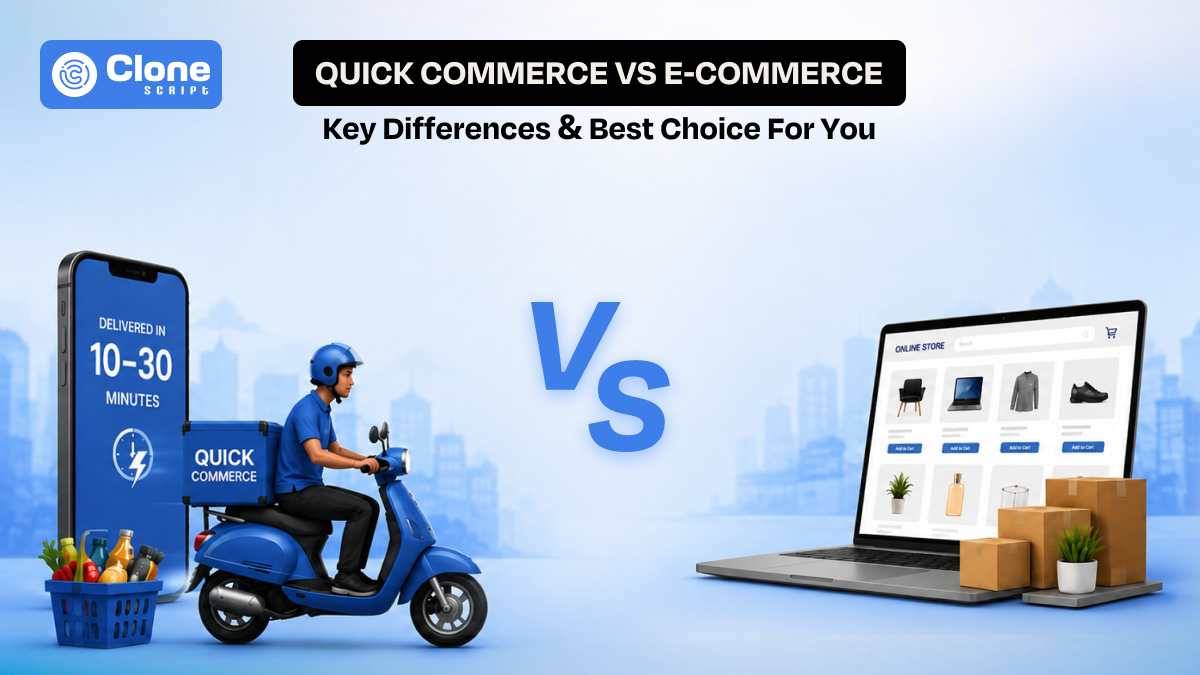
Quick Commerce Vs E-commerce: What Works Best for Your New Business
Business operational design is the main culprit that creates a gap between a profitable brand and a cash-burning one. Marketing is not only responsible.
Let’s be straightforward: Quick commerce and traditional e-commerce may look similar on the surface, but they run on completely different economics.
Over the past few years, consumer expectations have shifted sharply. In urban markets, delivery within 10–30 minutes is becoming routine for essentials. At the same time, standard e-commerce continues to dominate categories like electronics, fashion, and niche D2C products, where purchase decisions are slower and basket sizes are larger.
This creates a critical decision point for business owners:
Do you optimize for speed and frequency, or scale and margin?
Choosing the right marketplace business model can quietly destroy profitability through logistics costs, inventory inefficiencies, and customer acquisition spend. This guide explains both models with real operational insight so you can make a decision based on numbers, not trends.
Let’s start from the basics.
What Is Quick Commerce (Q-Commerce)?
Quick commerce is built on a simple promise: deliver essential products in under 30 minutes. But operationally, it’s one of the most complex retail models to execute.
Instead of relying on large centralized warehouses, quick commerce depends on dark stores. These stores are small, hyperlocal fulfillment centers placed within 2–5 km of high-demand areas. These stores stock a limited range of fast-moving items and are optimized for rapid picking and dispatch.

How It Works in Practice
-
Orders are placed through a mobile app
-
Inventory is sourced from the nearest dark store
-
Delivery partners complete the last-mile delivery within minutes
This model succeeds on high-order frequency, not high-order value.
Real-World Data Points
-
Average order value (AOV) in quick commerce is typically $10–$20 in the U.S., Canada, and the American countries, while in India, the ₹200–₹600 range is usually found.
-
Delivery costs per order can range between $5 and $10, depending on distance and demand density. In India, the delivery price may be available for ₹50–₹ 100.
-
To remain viable, platforms rely on high repeat purchases (3–5 orders per user per week)
Where It Performs Best
Quick commerce works exceptionally well in categories where:
-
Urgency is high (groceries, medicines, daily essentials)
-
Brand loyalty is low (users prioritize speed over brand preference)
-
Purchase decisions are impulsive
Operational Reality Most Businesses Miss
The biggest challenge in this commerce model is not delivery. It’s inventory accuracy and turnover.
-
Stockouts lead to immediate lost sales
-
Overstocking leads to wastage, especially in perishables
-
Real-time inventory sync is mandatory, not optional
This is why many quick commerce startups struggle despite strong demand. The model rewards execution precision, not just scale.
What Is Traditional E-commerce?
E-commerce operates on a fundamentally different principle: optimize for selection, not speed.
This model doesn’t require starting a hyperlocal business to fulfill infrastructure. Centralized warehouses or third-party (3PL) logistics networks can work. Referring to the delivery timelines typically range from 1 to 5 days, depending on location and shipping method.

This model allows businesses to:
-
Offer a broader product catalog
-
Maintain better inventory control
-
Optimize logistics costs through bulk shipping
How It Works in Practice
-
Customers browse and compare products
-
Orders are processed through centralized systems like an e-commerce website or app
-
Products are shipped via logistics partners
Unlike quick commerce, e-commerce is driven by planned purchases, not urgency.
Real-World Data Points
-
Average order value is significantly higher, often ₹1,000–₹5,000+ in India, depending on category. For the U.S., the latest e-commerce AOV reported with the value of $183.37E-commerce business model presented with its mechanism.
-
Delivery cost per order is lower as a percentage of the order value.
-
Gross margins are typically 20–40% higher than those of quick commerce, especially in non-grocery categories.
Where It Performs Best
E-commerce is the stronger model when:
-
Products require consideration before purchase (electronics, fashion, furniture)
-
Customers compare features, reviews, and pricing
-
Businesses rely on higher margins per order instead of frequency
Operational Advantage
E-commerce businesses benefit from:
-
Predictable demand cycles
-
Lower last-mile pressure
-
Scalable logistics through aggregation
However, the trade-off is clear: slower delivery means higher competition and lower urgency-driven conversions.
Still unsure which model fits your business? Let’s break it down further.
Quick Commerce vs E-commerce: Differences That Impact Your Business
At a strategic level, the difference between these models is how revenue and costs behave at scale.
| Factor | Quick Commerce | E-commerce |
|---|---|---|
| Delivery Time | 10–30 minutes | 1–5 days |
| Average Order Value | Low (₹300–₹600) | High (₹1,000+) |
| Customer Behavior | Impulse-driven | Research-driven |
| Logistics Cost | High per order | Optimized, lower per order |
| Inventory Model | Distributed (dark stores) | Centralized warehouses |
| Scalability | Operationally complex | Easier to scale |
| Profit Margins | Thin, volume-dependent | Stronger, margin-driven |
The Real Business Impact
-
Quick commerce wins on convenience but loses on cost efficiency.
-
E-commerce wins on margins but competes heavily on acquisition and pricing.
For example:
-
A grocery quick commerce business may process 5–6 orders per user weekly, but with thin margins per order. This is a prime example of how hyperlocal business ideas are moving forward (the q-commerce is a part of the segment).
-
A D2C e-commerce brand may get 1–2 orders per month per user, but with significantly higher profitability per transaction.
What This Means for You
If your business depends on:
-
Repeat, low-value purchases, then quick commerce fits better.
-
Higher margins and lower frequency go with e-commerce, which is more sustainable.
The key is aligning your model with customer buying behavior, not market hype.
Online Commerce Business Model: The Reality
The real difference shows up in cost structure, infrastructure load, and execution compromise, and that’s where most businesses miscalculate.

1. Unit Economics Breakdown
First, we have to understand CAC (customer acquisition cost) and LTV (life-time value).
Quick commerce spends aggressively to acquire users, but recovery depends on repeat behavior.
-
Quick Commerce
Here, the CAC remains ₹300–₹800 ($4–$10) per user. Other side, LTV depends on weekly ordering frequency. It breaks even only if users order 10–15 times/month.
If frequency drops, the acquisition cost is never recovered.
-
E-commerce
In e-commerce, the CAC range is ₹500–₹1,500 ($6–$18), depending on category. But, higher order value allows recovery in 1–2 purchases. LTV improves through upselling and retention campaigns.
Quick commerce is fragile without retention. E-commerce has more room to recover from mistakes.
2. Delivery Cost Per Order
Delivery is where the biggest gap appears between Q-commerce and E-commerce.
-
Quick Commerce
The average delivery charge per order is around ₹60–₹100 ($0.75–$1.25). Cost is fixed regardless of cart size, and with it high dependency on the delivery density required.
Even a small drop in order volume increases per-order cost immediately.
-
E-commerce
Per shipment delivery charge can be ₹80–₹150 ($1–$2). Because it spread across larger orders. Also, orders are optimized through batching and logistics partners.
Quick commerce absorbs delivery as a direct hit. E-commerce distributes it across revenue.
3. Basket Size Impact
Basket size determines whether your margins survive.
-
Quick Commerce
In Q-commerce, the AOV range is ₹300–₹600 ($4–$8) and is limited by urgency-driven buying. There is no real scope for upselling.
-
E-commerce
The average order value for e-commerce is ₹1,000–₹5,000+ ($12–$60+). This cost increased through bundles, cross-sells, and product recommendations.
E-commerce gives you control over revenue per order. Quick commerce relies on frequency, not expansion.
4. Infrastructure Requirements
The debate has to start with dark stores vs centralized warehouses.
Infrastructure defines your fixed cost and scalability.
-
Q-commerce (Dark Stores)
Its setup cost per store is usually ₹10–₹25 lakh ($12,000–$30,000) with a coverage radius of 2–5 km. Quick commerce requires multiple locations for city-wide presence.
-
E-commerce (Warehouses)
Central warehouse setup requires ₹20–₹50 lakh ($25,000–$60,000) and can serve multiple cities from fewer locations. E-commerce will be easily expandable through 3PL partners.
Note that Quick Commerce scales through geographic expansion. E-commerce scales through volume and systems.
5. Last-Mile Fleet Dependency
Delivery expectations directly affect operational ability.
-
Quick Commerce
This commerce model requires a dedicated rider network, which can be complex for startups. The order delivery window time is 10–30 minutes, and if an idle rider exists, the direct cost loss has to be borne. Also, surging demand can turn into a service failure risk.
-
E-commerce
In e-commerce, you have to depend on logistics providers for outsourcing, and the time frame for delivery takes 1-5 days. There is no need to manage the fleet directly.
Quick commerce is a logistics-heavy operation. E-commerce reduces that burden significantly.
6. Operational Complexity
Real-time inventory syncing is becoming important.
Inventory errors in quick commerce are immediately visible to users.
-
Quick Commerce
For Quick Commerce, inventory requires real-time sync across the mobile app, store, and delivery system. Even a 2–3 minute delay can cause order failures.
-
E-commerce
Inventory updates can be delayed or buffered, and systems tolerate minor mismatches. E-commerce reduces real-time operational pressure compared to quick commerce.
7. Demand Forecasting Challenges
Demand behavior is fundamentally different, and there’s no direct control a business can have.
-
Quick Commerce
First of all, in this model, an hourly demand difference works. It is usually influenced by weather, time of day, and local demand spikes. If you overstock ready to face such wastage, and for understock cause instant lost sales.
-
E-commerce
In an e-commerce business, you have an idea about predictable demand cycles, which means it's easier to plan using historical data. But there is a lower risk for inventory loss.
Quick commerce operates in real-time volatility. E-commerce operates on predictable trends.
Strategic Takeaway
If your business cannot:
-
Drive repeat purchases consistently
-
Handle operational intensity
-
Absorb early-stage inefficiencies
Then, quick commerce becomes risky very quickly.
E-commerce gives you more control, more flexibility, and a clearer path to profitability.
Conclusion
There’s no universal winner here: only alignment with your business reality. The right model depends on three factors: product type, geography, and capital.
If your goal is speed and frequency, choose quick commerce. If you prioritize margins and scalability, e-commerce is the more sustainable path.
FAQs
-
Where does quick commerce fail as a business model?
Quick commerce fails in low-density cities, high-return categories, and price-sensitive markets. Because here delivery costs rise, margins shrink, and customers switch platforms instantly.
-
Why is quick commerce not suitable for every location?
Quick commerce depends on dense urban demand. In smaller cities, low order volume increases delivery costs, making the model operationally unsustainable.
-
Which product categories should avoid quick commerce?
Products with high return rates, large sizes, or research-driven buying, like electronics, furniture, and fashion, don’t perform well in quick commerce.
-
Which business categories work best for quick commerce vs e-commerce?
Quick commerce fits groceries, medicines, and essentials. E-commerce works better for electronics, fashion, and luxury products, where customers prefer comparison and higher-value purchases.
-
Why is category selection critical in choosing the right model?
Each category has different buying behavior. Urgent, repeat purchases favor quick commerce, and when considered high-value products, perform better in e-commerce.
-
What is the best way to start a new online commerce business?
Start with e-commerce to validate demand, optimize pricing, and build margins before investing in the operational complexity of quick commerce.
-
When should a business expand into quick commerce?
Move to quick commerce only after identifying fast-moving products with consistent demand and repeat purchase behavior from your e-commerce data.
-
Why should businesses avoid launching quick commerce initially?
Launching quick commerce early increases operational risk, costs, and complexity without validated demand, often leading to unsustainable burn rates.
-
How can a hybrid model improve business performance?
A hybrid model uses e-commerce for margins and catalog depth, and quick commerce handles high-frequency products. The intent is to improve both revenue stability and customer retention.
-
What is the biggest strategic mistake businesses make in this space?
Choosing a model based on trends instead of product behavior, demand density, and operational capacity leads to poor scalability and margin loss.