BTC - Bitcoin
 USDTERC20 - USDT ERC20
 ETH - Ethereum
 BNB - Binance
 BCH - Bitcoin Cash
 DOGE - Dogecoin
 TRX - TRON
 USDTTRC20 - USD TRC20
 LTC - LiteCoin

Develop a Cosmetic E-commerce App Like Sephora & Nykaa Using a Clone Script (Step-by-Step Guide for Developers)
Sephora and Nykaa are well-known e-commerce platforms for cosmetics, haircare, and personal beauty solutions. With advanced features and a unified shopping experience, is a two key aspects of the Sephora and Nykaa app. Beauty startups also want something like that. They approach an app development agency with a 4 to nearly 5 figure budget. That’s where a clone script solution becomes the right choice for them.
It creates win situation for both sides. First, developers are not involved in repetitive tasks like UI design and code checks, which saves time and results in faster deployment. Second, clients got the functional mobile app in the proposed budget. So, if you’re a development agency or an e-commerce developer, this guide is helpful for you.
Sephora vs Nykaa: What Top Cosmetic Apps Do Well (and What Developers Can Reuse Fast)
Not a single new cosmetic brand app looks like a replica of Nykaa and Sephora. They must fill the gaps and earn the USP that customers are searching for. Your job is to identify key things, like which parts of these apps create value immediately and which do not.
After seeing both apps and using them, we identify the following.
-
Sephora: Experience First, Catalog Second
Sephora’s app focuses heavily on decision support. Users are unsure what to buy, so the app reduces hesitation through:
-
Guided product discovery
-
Visual confidence via virtual try-on
-
Strong emphasis on reviews and usage tips
Is a custom AI system required for the client’s app? No. Keep focus on structured product data, consistent tagging (skin type, concern, shade), and UI patterns that surface the right product quickly. Even basic recommendation logic, when paired with clean UX, delivers measurable results.
-
Nykaa: Commerce at Scale with Content as a Layer
Nykaa approaches the problem differently. It assumes high user intent and optimizes for the following:
-
Large product catalogs
-
Aggressive filtering and sorting
-
Content-driven trust (blogs, influencers, tutorials)
We analyze the Nykaa app and find that it demonstrates the importance of back-end efficiency. Whether you talk about the product search speed, the filter accuracy, or inventory synchronization, they outclass the performance.
Now, let’s see how the beauty and personal care brand operates in a real-world for generating revenue.
Business Models for Beauty, Skincare & Haircare E-commerce Apps
The business model is related to business decisions and a technical constraint. Each model changes how you design the database, APIs, admin panels, and even the checkout flow. Below are the most common models in beauty and personal care.
-
Direct-to-Consumer (D2C) Sales Model
The D2C model is the fastest and most budget-friendly option to launch. A single brand sells its products directly to customers through the app.
Thinking as a developer, implementing this model on the app is simpler because:
-
There is one seller, one inventory source.
-
No vendor onboarding or commission logic is required.
-
Admin roles and permissions stay minimal.
For a successful integration of the D2C sales model, the technical requirements are:
-
Product and variant management (shades, sizes)
-
Inventory tracking
-
Orders, payments, and basic analytics
This revenue model is useful only for newal introduced cosmetic brand to test the market launch. It allows developers to deliver a stable MVP and keep the back-end clean, making future expansion easier.
Developer insight:
If the client’s roadmap includes future marketplace features, design the database with extensibility in mind, but do not build vendor logic upfront. Premature complexity slows project delivery.
-
Marketplace Model
Apart from the D2C direct revenue generation, some enterprise-graded e-commerce brands like to go with a marketplace model, just like Nykaa. Beauty brands list their products on the platform, and in the same end the admins earn the commission on every sale generated. While this model is attractive from a business angle, it significantly increases development scope.
The e-commerce marketplace model includes additional technical layers:
-
Vendor registration and approval workflows.
-
Vendor-specific product catalogs.
-
Commission calculation and payout tracking.
-
Role-based access control (admin, vendor, sub-admin).
This model also impacts performance and data integrity. Product searches, filters, and inventory queries now operate across multiple sellers. That means it requires careful indexing and query optimization at a higher level.
For tight budgets, developers should recommend:
-
Launching with limited vendors
-
Restricting vendor-level customization initially
-
Using predefined commission rules instead of dynamic pricing logic
Developer insight:
During the marketplace app development, we also faced the issue that early-adopting vendor tools were worthless. If timelines are tight, prioritize buyer experience first and release vendor dashboards in phases.
-
Subscription-Based Model
First, both models are common. But the new has been introduced: subscription-based. In this model, the beauty brands have the liberty to pay only for what service they use, like listing only exclusive, routine-based products in a certain number. Technically, designing this business model introduces recurring logic, even if the UI remains simple.
To develop this, key considerations include:
-
Recurring payment handling
-
Subscription lifecycle states (active, paused, canceled)
-
Reminder notifications and renewal triggers
-
Inventory forecasting for repeat orders
Subscriptions increase back-end complexity but can be added incrementally. Many developers implement subscriptions after validating one-time purchases, reducing initial risk.
Developer insight:
Avoid hard-coding subscription logic into orders. Treat subscriptions as a separate entity linked to orders. This keeps the system flexible.
-
Hybrid & Omnichannel Models
Some clients want a mix of D2C + Marketplace and Online + Offline store integration for their brand. They prefer a hybrid and omnichannel model.
While it is useful, these models' development demands include:
-
Real-time inventory synchronization
-
Unified user accounts across channels.
-
More complex reporting and analytics
For a first release, developers should strongly advise against full omnichannel builds unless the client already has mature systems in place.
Developer insight:
Omnichannel is an evolution, not an MVP. Build APIs that can integrate later, but don’t prevent launch for it.
Choosing the Right Model Under Constraints
When time and budget are limited, the correct strategy is not choosing the “biggest” model. It’s choosing the most executable one.
|
Business Goal |
Recommended Model |
|---|---|
|
Fast market entry |
D2C |
|
Brand aggregation |
Limited marketplace |
|
Repeat revenue |
D2C + later subscription |
|
Scale later |
Modular D2C foundation |
Which model is perfect for an e-commerce business depends on what you want: sales, brand awareness, or market share adoption.
Core Features of a Beauty & Cosmetic E-commerce App (MVP-First Approach)
Features in the e-commerce app make the user experience memorable, generate leads, and improve conversion. Here, we list some of the common features that have to be integrated.
-
Product Catalog: Structure Matters More Than Size
In cosmetic apps, the catalog is a list of products and the foundation of the entire experience. Poor catalog structure leads to slow filters, confusing navigation, and weak recommendations later.
The catalog should support:
-
Product variants such as shade, size, and formulation
-
Attribute-based tagging (skin type, concern, hair type)
-
Clean relationships between brand, category, and product
We find that developers embed excessive logic into the UI layer, and from there, confusion arises during the project. To avoid such issues, a well-normalized back-end schema reuses the same data across listing pages, search results, recommendations, and promotions without duplication.
Developer tip:
Design the catalog so new attributes can be added without schema rewrites. Beauty products evolve fast, and rigid schemas become liabilities to manage.
-
Advanced Search & Filters: Speed Over Sophistication
Search and filters are where most cosmetic apps don’t help in order conversion. Under tight timelines, developers should prioritize fast, predictable behavior over advanced search intelligence.
Applying the filter system on the app that includes options like:
-
Brand
-
Price range
-
Rating
-
Skin or hair concern
When creating the search system on the app, make sure it accepts spelling variations and partial matches. Don’t include complex ranking logic in the first release. We recommend that you optimize database indexes and cached queries deliver more real-world value than overengineered solutions.
Developer tip:
Make your back-end indexing top-quality; for example, if searching the product on the app takes 5-8 seconds to load, there’s an issue in the server code. Don’t touch the front-end side code.
-
Product Detail Pages: Where Decisions Are Made
Most conversion decisions happen on the product detail page. This screen must answer user questions quickly and clearly.
The following factors affect how much customers perceive the product:
-
High-quality images with optimized loading
-
Clear pricing and availability
-
Ingredient or usage information
-
Ratings and reviews
Avoid clutter here. Overloading this page with banners, popups, or dynamic widgets increases render time and distracts users from the purchase decision.
-
Cart & Checkout: Keep It Predictable
In a personal beauty care app, a shopping cart is a key e-commerce functionality that plays a key role in bottom-of-the-funnel conversion. Intgerating shopping cart page with a properly researched user flow helps to accomplish the goals, like sales.
As we see some D2C apps, the checkout page design is an experimental way, with animations, unnecessary popups, and color combinations used unauthentically. This is not acceptable.
We prefer to a a simple checkout that works every time and is optimized for speed.
You have to fulfill these requirements for it:
-
Persistent cart across sessions
-
Minimal checkout steps
-
Multiple payment methods handled through a stable gateway
-
Clear error handling and order confirmation
You should also assume interruptions, network drops, app backgrounding, and payment retries and handle them properly.
Developer tip:
Build checkout as a state-driven flow. Stateless checkout logic leads to duplicate orders and payment mismatches.
-
User Accounts: Lightweight but Useful
In early-stage cosmetic apps, user accounts should support convenience, not complexity. Do not play with more UI design and advanced back-end logic for this feature.
When integrating the user account feature, it should support these factors:
-
Login and registration
-
Order history
-
Saved addresses
-
Basic preferences
Don’t make a hurry to launch advanced profile systems, loyalty tiers, and social integrations. It can come later. For MVP builds, focus on reliability and data integrity.
-
Admin Panel: Often Ignored, Always Important
Whether the client approaches you with a direct-to-customer sales model or subscription model, the admin tools have to support it. Otherwise, it's tough for them to manage the app.
A practical admin panel should allow clients to:
-
Product and inventory management
-
Order tracking and status updates
-
Price and offer control
-
Basic reporting
Developers should treat the admin panel as a core feature, not an afterthought. A clean admin system reduces support requests and future rework.
Advanced Features for Modern Beauty & Skincare Apps
Once the core e-commerce flow is live and stable, clients usually shift their focus from “launching fast” to “standing out.” This is where advanced features are introduced.
-
AR Virtual Try-On for Makeup & Cosmetic Products
AR (Augmented Reality) try-on is often the first advanced feature clients ask for. It reduces hesitation and improves conversion, especially for color-based products like lipstick or foundation.
To integrate this advanced technology to app, you have to work with the following:
-
Heavy client-side processing
-
Device compatibility challenges
-
Performance constraints on lower-end phones
While managing cost and risk together, this approach works well:
-
Start with limited product categories (e.g., lipsticks only) to check if everything works properly.
-
Use third-party AR SDKs instead of custom computer vision.
-
Keep AR as an optional layer, not a preventing dependency.
Developer insight:
Never join AR logic tightly with core product flows. If AR fails or is unsupported on a device, the purchase flow must still work uninterruptedly.
-
AI-Based Skincare & Haircare Recommendations
AI in web development revolutionizes the user experience, especially for online shopping. From day one on, don’t add the advanced personalization at full scale. Start with the rule-based logic, then identify the core strength and work on it to tackle the evolving systems.
We recommend the following approaches for early-stage development:
-
Tag-based suggestions should appear (skin type, concern, usage).
-
“Frequently bought together” logic through past product search and order for up-selling.
-
Recently viewed and popular items related to products for cross-selling.
As data grows and users are familiar with using it, developers can introduce:
-
Collaborative filtering models
-
User similarity scoring
-
Behavior-driven recommendation APIs
Developer insight:
Treating recommendation engines as separate services works smart for development. There is a lower chance of risking the core commerce stability and experimenting with the feature.
-
Reviews, Ratings & Influencer Content
Social proof plays an important role in beauty product purchases. However, poorly implemented content systems cause performance issues.
To implement the review section on the app, know these best practices:
-
Paginate and lazy-load reviews that keep app speed optimized.
-
Cache aggregate ratings and present them in a summarized overview.
-
Separate influencer content from transactional APIs to maintain trust in the app and reduce chances of manipulation.
We recommend that you avoid pulling large content payloads into product listing APIs. Keep commerce and content loosely joined.
-
Notifications & Engagement Features
Once users start ordering, engagement features help retain them. Notifications are working as the marketing executive for brands.
In an e-commerce app, notifications help in the:
-
Sending order status notifications to customers (confirmed, in transit, and delivered)
-
Back-in-stock alerts keep conversion aligned and influence to make preferred action.
-
Price drop reminders invite customers to check the product for purchase.
These features depend on event-driven architecture. Message queues and background workers are preferable to synchronous processing.
Developer insight:
Notifications should not be too promotional. Duplicate messages affect trust and increase support tickets. Create the messaging system in the app properly.
We can say that beauty apps scale successfully when developers resist the urge to “build everything,” and instead layer features over a stable foundation.
Step-by-Step Development Process for a Beauty E-commerce App
Developers who follow a structured, phased approach deliver faster, avoid rework, and keep costs predictable. We insist on building the e-commerce app for beauty brands through these steps.
Step 1: Planning & Feature Finalization (Define the Real MVP)
The first step is to research what the client wants. For example, they need only selling app for their own products or want to create a marketplace.
Then, decide the features to be included in the app. Start by separating it:
-
Must-have features (catalog, search, cart, checkout, admin)
-
Nice-to-have features (AR, advanced AI, loyalty, social feeds)
Also, ask the client to select a platform where the app goes to live, including iOS, Android, and Web. The monetization method has to be decided here to make the related functionality.
Every feature added here has a direct cost impact. As a developer, your responsibility is to translate business ambition into a realistic build plan.
Step 2: Data Modeling & Architecture Design
Before UI or APIs, design the data layer. Cosmetic apps do not work well when product data is poorly structured. It affects the overall user experience. You have to key entities to define here:
-
Products and variants (shade, size, formulation)
-
Categories and attributes
-
Users and orders
-
Inventory and pricing
We prefer to design for extensibility, but build for current needs. Overworking the schema delays development and adds risk.
Step 3: UI/UX Design for Beauty Platforms
App UI/UX design should focus on clarity and speed, not decoration. This is the third step. As you check the overall app flow of Nykaa and Sephora, you notice the key things that can be a USP. Our recommended approach includes:
-
Create low-fidelity wireframes first, then go for a mockup and a prototype.
-
Validate core user flows (browse → product → cart → checkout). Do not be fancy.
-
Move to high-fidelity UI only after flow approval and making corrections.
For developers, early wireframes reduce rework and prevent mismatches between design and technical feasibility.
Step 4: Front-end Development (Build What Users Touch First)
Mobile app front-end work should begin once core APIs are planned, not completed. As it relates to design and code, the compromise to anyone costs the overall project.
In this step, you have to consider these things:
-
Are product listing and detail pages easy to load and fetch?
-
Search and filters are working properly, even though spelling mistakes happen frequently.
-
Cart and checkout flows are optimized for UX, but still has a issue.
-
Account screens are easy to access, but added security interrupts them.
Avoid hard-coding values or business logic into the UI. Keep the front-end API-driven so changes don’t require redeployment.
Step 5: Back-end & API Development
After the front-end development, back-end work starts to support the design and functionality through logic-based coding. In this step, developers have to fulfill these key responsibilities:
-
Deploy product, order, and user APIs securely over the networks.
-
Integrate authentication and authorization with the possible option.
-
Payment gateway integration to accept and process the online payments for both customers and vendors.
-
Admin and operational APIs are deployed in a working condition.
Back-end stability matters more than speed. Cosmetic apps see traffic spikes during promotions, and weak APIs do not optimize for it.
Step 6: Admin Panel & Operations Tools
The sixth step in beauty app development is to add the admin panel and supportive tools that help admins manage the platform with ease. Minimum admin capabilities include:
-
Product and inventory management
-
Order processing and status updates
-
Pricing and offer control
Without these tools, clients become dependent on developers for daily operations, leading to frustration and post-launch issues.
Step 7: Quality Assurance & Testing
This step is very important as it is related to the rework or approval for the deployment. QA & Testing should start early, not at the end. Here are essential testing layers to know:
-
Functional testing of purchase flows
-
Edge cases (payment failures, retries)
-
Load testing for peak traffic
-
Basic security checks
App testing executives are using automation to identify vulnerabilities in code and bugs in the functionality that expose further. Once everything is resolved in the design and development phase, the quality assurance is stated again.
Step 8: Deployment & Launch
The app is now ready to go live on the web or Google Play Store for Android and iOS versions on the App Store. A controlled launch is making a task optimized for developers to hand over the functional app to the client. We recommend the best practices when deploying the app:
-
Use staging and production environments.
-
Monitor logs and error rates closely.
-
Prepare rollback plans.
-
List the app on the Play Store and App Store.
Avoid launching with experimental features enabled. Stability beats innovation on day one.
Step 9: Post-Launch Monitoring & Iteration
Launching the app is not the finish line. The real work starts now. After releasing the app on the Google Play Store or App Store, make sure to follow:
-
Track user behavior and drop-off points
-
Collect real usage data.
-
Prioritize features based on evidence, not assumptions
This is the stage where AR, AI, subscriptions, and loyalty features make sense, backed by real data.
You already know how to implement the features, and completing the app development cycle takes a minimum of 3-4 months with a custom solution. But with a Flutter-ready app, you’re 4 steps ahead.
Queen Beauty Care App: A Ready-Made E-commerce Clone Script Solution for Beauty Businesses
The Queen Beauty Care App is a Flutter-based mobile e-commerce solution optimized for development to launch a full-featured beauty shopping app quickly. It combines essential commerce functionality with a customizable UI and Firebase back-end starter structure to accelerate development and reduce time-to-market.
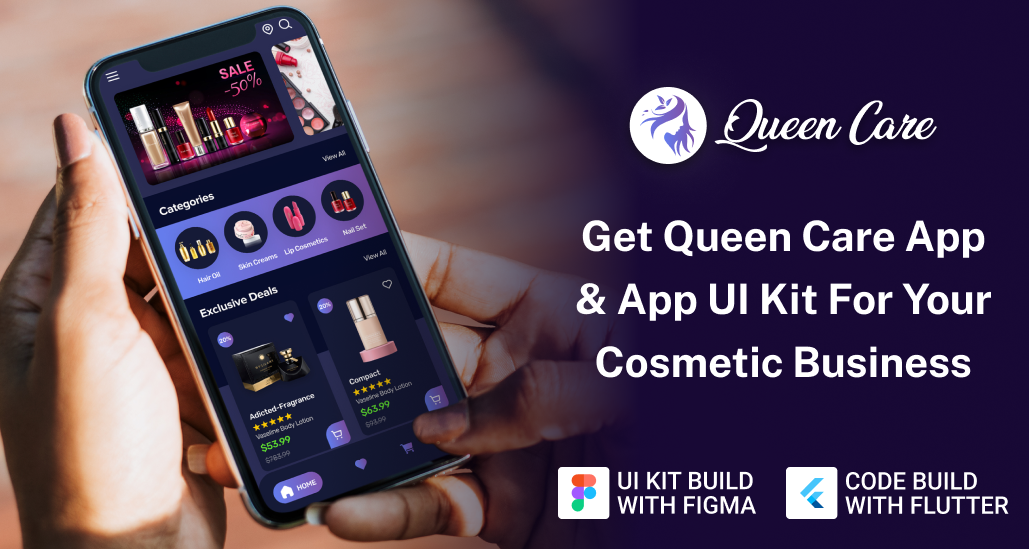
What the Script Contains?
-
A Flutter source code package ready to build for Android and iOS, including UI screens for browsing and purchasing cosmetics.
-
A Firebase back-end with user authentication, product data storage, and basic admin support.
-
Shopping features such as search, filters, wishlist, cart, checkout, multiple payment options, and order tracking.
-
Pre-designed Figma UI templates for quick branding and visual customization.
-
Responsive layouts and interaction patterns suited for beauty shoppers.
How Developers Can Use It?
-
Accelerate MVP delivery by using the clone’s pre-built commerce flows instead of building core features from scratch.
-
Customize branding, UI components, and feature extensions to match client requirements while preserving the tested foundation.
-
Integrate additional services such as third-party payment gateways, analytics, or push notifications without rearchitecting the base system.
-
Focus effort on unique differentiators (loyalty programs, advanced personalization, AR modules) rather than basic e-commerce plumbing.
-
Deploy faster and iterate based on real user feedback, reducing risk and cost compared to a full custom build.