BTC - Bitcoin
 USDTERC20 - USDT ERC20
 ETH - Ethereum
 BNB - Binance
 BCH - Bitcoin Cash
 DOGE - Dogecoin
 TRX - TRON
 USDTTRC20 - USD TRC20
 LTC - LiteCoin

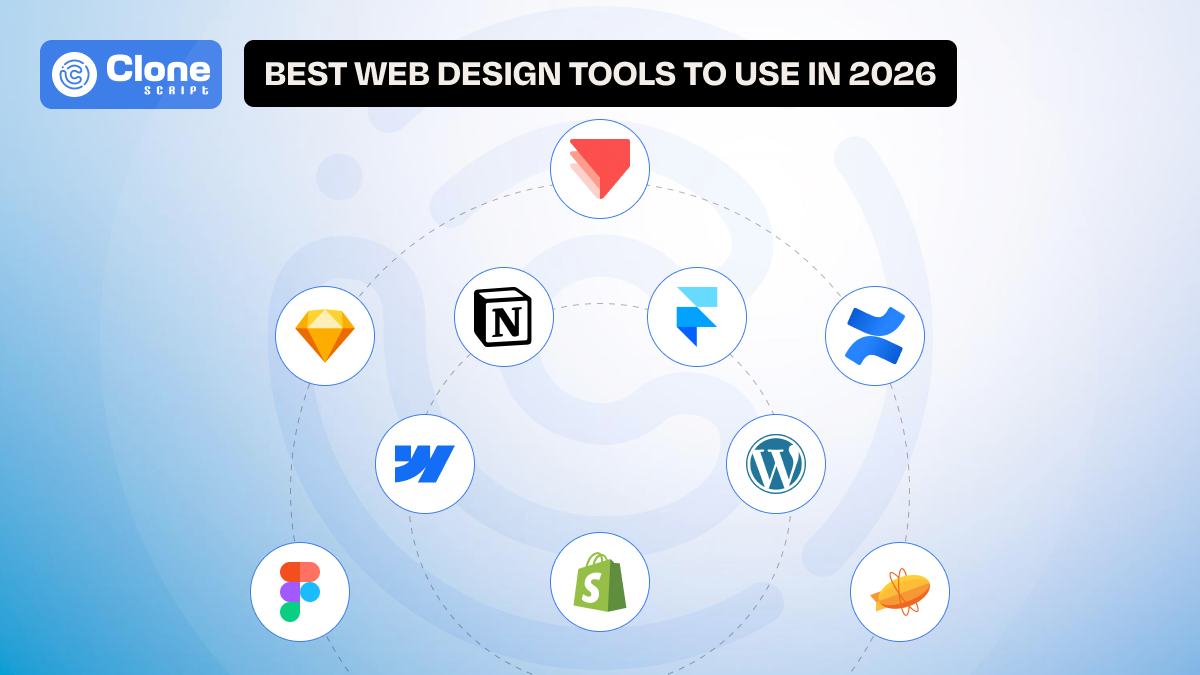
Best Web Design Tools to Use in 2026: Figma, Webflow, Sketch & More
By 2026, a web designer's work will not only include visual creativity but will also require the ability to work across systems, workflows, collaboration models, and production constraints. The types of tools you use will have a direct impact on your ability to ship quickly and accurately convert your designs to code, and on your ability to grow as a team make design decisions across your products.
This article will review what we believe to be the best tools available to a web designer for use in 2026, based on how experienced designers, agencies, and product teams are actually working in production environments; therefore, functionality of the tools will have priority over novelties, as well as the ability to efficiently adopt or implement them and the ability to last long-term.
If you are a professional designer and are looking for tools that are going to hold up to real clients, this is the guide for you.
How Professional Web Designers Evaluate Tools in 2026
In web UI and UX design, designers with a lot of experience do not continue to select only by the popularity of a tool. On established teams, the operation of a specific tool is much more important than its previous value to the company. When evaluating tools for professional use, designers use these criteria:
-
Scalability of the design system across several projects.
-
Quality of the designer/developer/stakeholder collaboration.
-
Handoff friction reduction.
-
Production readiness of the delivered items.
-
Longevity of the tool and ecosystem support.
The tools that are found lacking in any of those areas are the first to be discarded from a team of professionals’ stacked toolbox.
Design & UI Tools: The Foundation of Modern Web Design
Web projects depend upon design and UI tools to establish layout logic, spacing rules, how components work, and how consistent everything is visually. By 2026, tools will also act as system management platforms instead of simply being a place to draw.
-
Figma: Industry Standard for Professional UI Design
Figma will continue to be the industry standard for the majority of professional UI design due to its providing a solution to what legacy design tools have yet to solve, which is real-time collaboration at scale.
Professional teams rely on Figma for:
-
Centralized design systems with libraries share.
-
Component variants and tokens to maintain consistency.
-
Real-time collaboration on design across departments.
-
Integration of prototyping and hand-off to developers.
Figma's browser-based architecture solved all of the version control chaos, allowing large teams to work from one source of truth.
Best designed for the following: Product teams, Saas companies, agencies, and distributed teams.
-
Sketch: Precision Tool for macOS-Centric Workflows
Many UI designers continue to use Sketch within their workflow because they find that Sketch has a native experience and a lighter-weight footprint than Figma, which works primarily on the web.
While Sketch does not have the same level of collaboration that Figma provides, it is still a good tool for designing layouts that require the design owner to have access to their design files and to only make changes to designs when required.
Key principal component analysis in Sketch includes:
-
Vector file creation and editing
-
Mature plugin ecosystem
-
File-based workflows
Most suitable for: A single designer or a small team working on macOS only.
Design & UI Tools Comparison
|
Tool |
Collaboration |
Design Systems |
Platform |
Pricing |
Professional Use Case |
|---|---|---|---|---|---|
|
Figma |
Real-time |
Advanced |
Web + Desktop |
Starts from $3/month |
Teams, agencies, SaaS |
|
Sketch |
Limited |
Strong |
macOS |
Starts from €11/month |
Solo designers |
Prototyping & Interaction Tools: Validating UX Before Development
In the professional web design workflow, prototyping is a requirement, not an option. Validating the interactions you create before starting development will save you time and money by avoiding costly repeat work after development has begun. And in 2026, teams that regularly bypass this step will lose a significant amount of both budget and time.
Here is the tool list to consider.
-
Figma Prototype: Fast, Integrated Interaction Testing
Figma's integrated prototyping tool is the most popular method of validating interactions at an early stage of design. With Figma's prototyping, web designers can simulate end-to-end user flows directly in their design files without the need to switch between programs.
Figma's integrated prototyping tool works particularly well in the following scenarios:
-
Reviewing with stakeholders
-
Testing with basic users
-
Validating user flows
Although Figma's integrated prototyping does not provide advanced functionality such as logic, it provides a fast and efficient way to validate the majority of the user experience design from a professional standpoint.
-
Framer: High-Fidelity, Production-Like Prototyping
Framer has become a valuable resource for designers looking for code quality at the user interface level, without having to dive deep into code development.
Framer is used by many professional teams to create:
-
Advanced animations and transitions
-
Realistic behavior of components
-
Heavy on interactions, marketing, and SaaS pages
When the quality of the user experience will significantly impact conversion rates or affect how a product is perceived, Framer is an incredibly useful tool to use.
-
ProtoPie: Advanced Interaction and Logic Simulation
ProtoPie has been created specifically to simulate the interaction of complex user experiences (UX) that use gesture-based inputs, variables, and conditional logic to produce the overall interaction experience, such as:
-
Experimental interfaces
-
Complex user flows
-
Hardware or device interactions
ProtoPie can also be utilized as an advanced validation tool in the event that your design or concept is distinctly different than the final product.
Prototyping Tools Comparison
|
Tool |
Fidelity |
Interaction Complexity |
Code-Based |
Pricing |
Ideal Use |
|---|---|---|---|---|---|
|
Figma Prototype |
Medium |
Basic–Moderate |
No |
Include in Figma subscription |
Fast validation |
|
Framer |
High |
Advanced |
Yes |
$5/month |
Interactive web UX |
|
ProtoPie |
Very High |
Complex |
No |
$25/month |
Advanced UX logic |
Collaboration & Handoff Tools (Design-to-Dev)
One of the major pitfalls of web projects is the transfer of responsibilities between designers and developers. Designers are often forced to rely on third-party tools for interpreting the designer's intent.
In 2026, multi-disciplined teams utilizing Figma’s Dev Mode will be enabled to effectively transfer the design to the development phase of a project through improved visual references.
-
Figma Dev Mode: Modern Design-to-Dev Workflow
Through the use of descriptive modes, Figma Dev Mode is designed to help developers correctly understand and interpret design intents as they develop web application interfaces with less opportunity for misinterpretation.
Its key features are:
-
The direct inspection of the design without requiring static images.
-
The use of CSS-ready values, which removes a significant amount of the manual translation process.
-
Developers to have access to the most current version of the design being developed.
-
Provides less reliance on excessive documentation and files during the transfer process.
-
An increased degree of designer/developer alignment will reduce the number of cycles of work and clarification.
By reducing the amount of guesswork for providing production-quality user interfaces from the original design, utilizing Figma Dev Mode will also reduce the time to get production-quality user interfaces built.
-
Zeplin: Structured Handoff for Traditional Teams
Zeplin offers a well-organised design transfer solution for teams who adhere to published workflows, by gathering relevant specifications, assets, and notes into a centralised location to provide a predictable and controlled output throughout the development process.
Its key features are:
-
Centralised specification makes it clear to developers the exact measurements, assets, and styles they are to use.
-
Version control allows teams to manage updates without causing confusion or having different versions of the same design.
-
The process of managing the assets (icons, images, user interfaces) makes it simple to export the required images/icons at the needed resolutions.
-
Layers of documentation provide clarity when creating regulated or enterprise development environments.
-
Less complexity results in an accurate product coming out of implementation or QA.
Zeplin enables teams with an emphasis on process discipline to consistently provide accurate design transfers, with fewer misunderstandings and reliable results when working on large or complex web design and development projects.
-
Notion and Confluence: Design Knowledge at Scale
Notion and Confluence serve as a centralised knowledge base for teams documenting design systems, UI principles, and UX decisions made regarding their consistency and design quality across large-scale projects.
Its key aspects are as follows:
-
By documenting design systems, teams can ensure that all products have the same UI patterns.
-
UX guidelines create a common understanding of usability standards among designers, developers, and other stakeholders.
-
Rationale for decisions has been written so that they won't be re-debated, and the designs will be maintained.
-
To allow for onboarding and ongoing scalability, cross-functional access provides users with an avenue to access the product.
-
Living documentation is continuously updated in tandem with your products.
Absence of structure to design knowledge tools affects quality over time. Notion & Confluence ensure that you maintain consistency, institutional memory, and long-term productivity within the web designs you create.
Collaboration & Handoff Tools Comparison
|
Tool |
Primary Role |
Developer Access |
Documentation Support |
Pricing |
Ideal Use Case |
|---|---|---|---|---|---|
|
Figma Dev Mode |
Design-to-development handoff |
Direct inspection, CSS-ready values |
Auto-generated specs |
Included in Figma plans |
Fast, accurate implementation for modern product teams |
|
Zeplin |
Structured design handoff |
Specs, assets, style guides |
Centralized documentation |
$13.75/month |
Traditional workflows with controlled approvals |
|
Notion |
Design knowledge management |
Linked references, embeds |
Flexible documentation system |
$10/month |
Maintaining design systems and decision logs |
|
Confluence |
Enterprise documentation |
Deep integrations, permissions |
Versioned documentation |
$5.42/month |
Large teams with formal UX governance |
No-Code/Low-Code Builders (Production Layer)
Website UX designers are more able to create a finished "product" than at any other time, thanks to tools for no-code and low-code, which allow them to create and launch live, real-world websites without complete dependency on developers.
-
Webflow
As a design-led low-code platform, Webflow allows teams to create websites that are capable of production-grade level quality from a UX standpoint, whilst retaining control of semantic HTML markup, CSS, flexibility of content management, and performance standards.
Its key features are:
-
The visual canvas corresponds directly with real CSS and box-model behavior.
-
The built-in content management system supports scalable content architectures and enables seamless integration with other systems.
-
There is the ability to populate advanced interactions and animations without relying on JavaScript.
-
There are proper SEO, performance, and accessibility control features.
-
The ability for designers to ship final products with little ongoing developer assistance.
Webflow is ideal for SaaS-based websites, marketing platforms, and agencies that need fast turnaround times without sacrificing quality, structure, or long-term support capabilities.
-
WordPress (Themes + Gutenberg)
WordPress has undergone an incredible transformation via the introduction of block themes and Gutenberg into a flexible and adequate content platform that utilizes visual editing interfaces, component-based layouts, and enterprise-grade publishing workflows.
Why is it useful?
-
By utilizing a block-based editing interface to create modular web design, reusable layouts.
-
Full site editing separates the content and presentation layer of a website for greater design efficiency.
-
A broad range of plugins for SEO, performance, and security is available.
-
Configuration options work seamlessly with every possible type of system, including custom-built themes and headless setups.
They are best suited for content-heavy websites or those that are primarily driven by editorial content.
-
Shopify
Shopify is a low-code platform built for commerce that provides an ecommerce infrastructure (product management, payment processing, and store performance), as well as allowing for structured customization through themes and layouts based on components.
Here, why is it useful?
-
Ecommerce Infrastructure with Global Payment Processing
-
Optimized conversion and performance theme architecture
-
Extend functionality, i.e., Apps and Plugins, to avoid custom development
-
Natively built-in security, hosting, and compliance
-
Support for headless & composable commerce setups
Shopify is an excellent option when ecommerce website is your primary revenue source, providing speed, reliability, and scalability with less technical complexity for online retailers and growing brands.
-
Framer Sites
Framer Sites fills the gap between design and publishing by enabling designers to take interactive prototypes and turn them into live websites very easily with no friction, while also focusing on speed, animation, and visual storytelling.
Here is the explanation of why this platform is acceptable.
-
It helps to create live pages from design prototypes.
-
The motion-first approach is the best for high-impact landing pages, which can be found on MNCs' websites.
-
It's simple to use a CMS for light-weight content management.
-
The fast hosting is designed for performance and quick deployment.
-
The minimal but purposeful customization options are available.
Framer is perfect for startups, product launches, and campaign sites, where speed, polish, and visual appeal are valued more than complex back-end or content development.
No-Code/Low-Code Builders Comparison
|
Tool |
Design Control |
Code Output Quality |
CMS Capability |
Pricing |
Ideal Use Case |
|---|---|---|---|---|---|
|
Webflow |
High (visual + CSS-level control) |
Clean HTML/CSS |
Advanced CMS |
$14/month |
Marketing sites, SaaS websites, design-led teams |
|
WordPress (Block Themes + Gutenberg) |
Medium–High (theme-based) |
Theme-dependent |
Very strong |
Free (hosting extra) |
Content-heavy sites, blogs, and scalable publishing |
|
Shopify |
Medium (template + sections) |
Optimized for commerce |
Product-focused CMS |
Starts at $39/month |
Ecommerce stores, DTC brands |
|
Framer Sites |
High (design-first) |
Component-based output |
Basic CMS |
Starts around $5/month |
Instant landing pages, interactive marketing sites |
Conclusion
By 2026, the professional web design field will be heavily influenced by strategic tool selection rather than designer whims or fads. Webflow, WordPress, Shopify, and Framer have unique business and technological capabilities; when combined with a sound design system and clear workflow processes, they allow for quicker delivery with consistent quality and longer-term scalability.
The most effective teams view their tools as infrastructure. Then, choose carefully to meet a specific need, use consistently to create a uniform experience, and continually improve as both products and customer needs change over time.