BTC - Bitcoin
 USDTERC20 - USDT ERC20
 ETH - Ethereum
 BNB - Binance
 BCH - Bitcoin Cash
 DOGE - Dogecoin
 TRX - TRON
 USDTTRC20 - USD TRC20
 LTC - LiteCoin

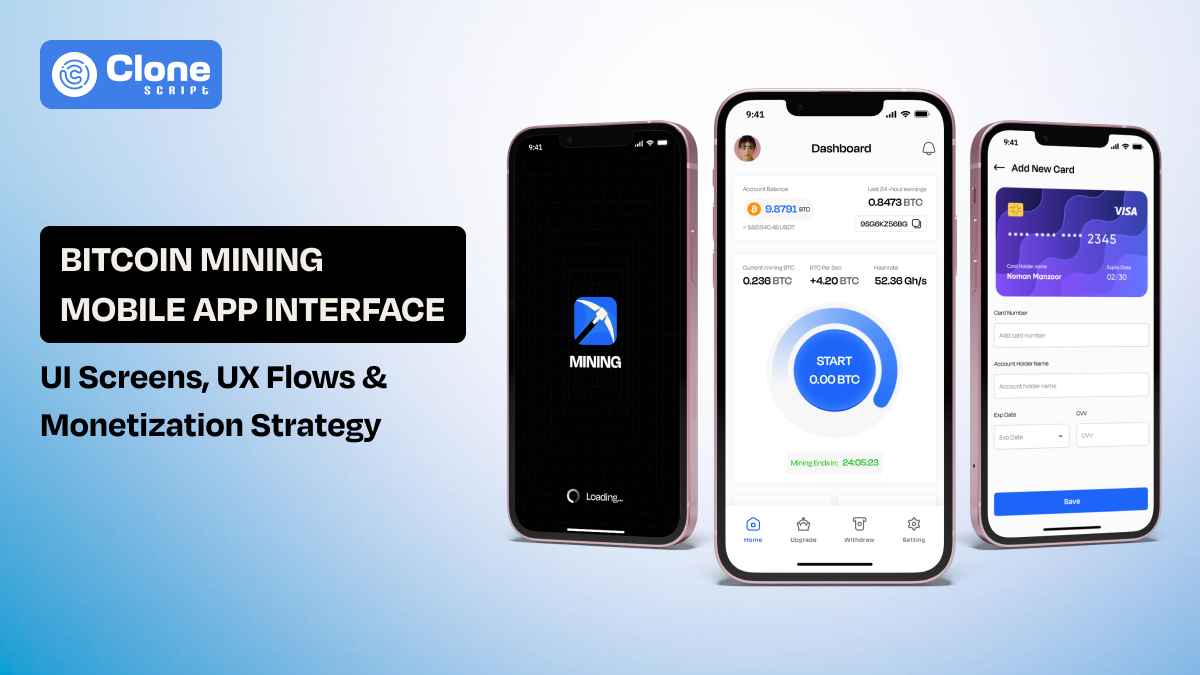
Bitcoin Mining Mobile App Interface: Essential UI Screens, UX Flows & Monetization Strategy
Crypto and Web3 product teams building mining platforms face a structural challenge: translating complex blockchain infrastructure into a mobile experience users can trust and understand.
The bitcoin mining app interface is not just a visual layer. It functions as the platform’s control center, where users track hash rate, monitor real-time earnings, upgrade mining power, and initiate BTC withdrawals.
If the interface architecture is weak, even a technically sound back-end will struggle. Mining apps operate in a high-skepticism environment where users expect transparency, live performance visibility, and seamless financial control. Every screen must reinforce operational credibility.
This guide explains the essential UI screens, UX flows, and monetization structure required to build a scalable bitcoin mining mobile application in 2026.
Why the Bitcoin Mining App Interface Is a Strategic Layer
A bitcoin mining platform is fundamentally a financial system. Users are not interacting casually. They are allocating capital, monitoring returns, and evaluating risk. The interface must therefore function as a transparency engine, not just a navigation framework.
Mining apps process technically dense data: hash rate fluctuations, mining pool distribution, block rewards, transaction confirmations, and subscription-based power allocations. Without structured visualization, this information becomes overwhelming. Poor presentation leads to confusion, distrust, and increased churn.
From a product architecture perspective, the Bitcoin mining app interface performs three critical roles:
-
Trust Signaling
Users need immediate clarity on current mining performance, earnings breakdown, withdrawal eligibility, and network fee structure. Clear data hierarchy and real-time indicators reduce skepticism. On the other hand, delayed updates or vague metrics quickly damage credibility.
-
Revenue Enablement
Most mining platforms rely on subscription-based hash power, cloud mining contracts, referral incentives, and upgrade add-ons. If these monetization paths are buried or poorly structured in the UI, conversion rates drop. The way to upgrade prompts must be contextual rather than intrusive. Plan comparisons must be precise, not promotional.
-
Operational Clarity
Crypto users vary in technical literacy. Some understand blockchain mechanics; others focus only on ROI. The interface must accommodate both groups through progressive disclosure, showing essential data first and advanced analytics on demand.
A strategically designed mining interface reduces the following:
-
Support requests about payouts
-
Confusion around fees
-
Subscription churn
-
Misinterpretation of earnings projections
For Web3 design and development teams, this means interface architecture is not a post-development task. It must be treated as a foundational layer aligned with back-end development logic, financial modeling, and growth strategy.
When executed correctly, the interface becomes a competitive advantage rather than an issue.
Prime UI Screens Every Bitcoin Mining Mobile App Must Include
A scalable bitcoin mining app interface is built on clearly defined functional screens. Each screen must serve a measurable purpose, either operational visibility, financial action, or revenue enablement.
Below are the essential UI components required in a production-grade mining mobile application.
-
Onboarding & Wallet Integration
The onboarding experience determines whether users activate mining or abandon the app. This screen should include:
-
Secure registration (email, mobile, or wallet-based)
-
Wallet connection interface
-
Optional KYC disclosure (if jurisdictionally required)
-
Risk acknowledgment notice
-
Two-factor authentication setup prompt
The objective is speed with clarity. Users should understand what the platform does, how mining rewards are generated, and how earnings will be handled, without being overloaded with technical jargon.
Progress indicators and contextual microcopy improve completion rates.
-
Mining Dashboard (Primary Control Center)
The dashboard is the most critical screen in the Bitcoin mining mobile app UI. It represents platform credibility and must display:
-
Live hash rate
-
Active mining power
-
Mining pool status
-
Hourly and daily earnings
-
Total BTC mined
-
Available withdrawal balance
-
Subscription tier summary
-
Server uptime or operational status
Real-time updates are essential. Static or delayed metrics create suspicion in crypto environments. Design-wise, a card-based modular layout improves readability. Visual hierarchy should prioritize earnings and mining performance over secondary metrics.
-
Mining Control Panel
Users expect a sense of control, even within automated cloud mining systems. The mining screen should allow:
-
Start/Stop mining toggle
-
Plan upgrade access
-
Mining power adjustment (if applicable)
-
Historical performance charts
-
Server or hardware performance indicators
Destructive actions, such as stopping mining, must require confirmation. Preventing accidental interruptions is a UX necessity. Advanced settings should remain accessible but not dominate the primary interface.
-
Earnings & Withdrawal Screen
This screen determines long-term trust and platform reputation. The earnings and withdrawal screen should include:
-
Detailed earnings ledger
-
Daily mining breakdown
-
Withdrawal input field
-
Network fee calculation
-
Minimum withdrawal threshold indicator
-
Blockchain transaction hash
-
Withdrawal status tracking
The earnings breakdown must clearly differentiate:
-
Gross mining rewards
-
Platform commission
-
Network fees
-
Net payout
Providing blockchain references enhances transparency and reduces user anxiety.
-
Referral & Rewards Interface
Mining platforms often depend on referral growth loops. This screen must feel performance-oriented rather than promotional. Include the following:
-
Unique referral link
-
Commission percentage display
-
Total referral earnings
-
Active referral count
-
Tier-based incentive progression
-
Sharing options
Clear visualization of referral earnings strengthens engagement and encourages network-driven growth.
-
Subscription & Mining Power Upgrade Screen
Monetization flows depend heavily on the clarity of this screen. It should present:
-
Mining power tiers
-
Contract duration
-
ROI projection estimator
-
Feature comparison table
-
Auto-renewal management
Projection tools should remain realistic and include disclaimers. Overstated ROI claims undermine credibility.
Side-by-side plan comparisons improve conversion efficiency.
-
Security & Compliance Settings
Security must be visibly embedded in the Bitcoin mining interface. This screen should offer:
-
Two-factor authentication configuration
-
Biometric login toggle
-
Device session management
-
Withdrawal confirmation safeguards
-
Legal disclaimers
-
Risk acknowledgment logs
Security indicators should appear consistently across screens for platform reliability.
When these core screens are structured with clarity and financial transparency, the Bitcoin mining interface becomes an operational system rather than a collection of pages. Each component supports trust, usability, and revenue performance simultaneously.
Next comes how these screens connect through frictionless UX flows that determine user retention and subscription growth.
UX Flows That Define Mining App Performance
Well-structured screens alone are insufficient. In a bitcoin mining platform, flow architecture determines whether users activate subscriptions, trust withdrawals, and continue reinvesting.
Below are the mission-critical flows that shape the mining app's performance.
-
Onboarding to First Mining Activation
This is the most sensitive journey in the app.
Look at this ideal flow.
Signup → Wallet Connection → Plan Selection → Payment → Mining Activation → Dashboard
Key optimization principles:
-
Limit the onboarding to 5–6 screens maximum
-
Display a progress bar to reduce drop-off.
-
Provide contextual tooltips for complex terms like hash rate.
-
Avoid forcing full-feature tours before activation.
The goal is speed-to-first-mining. Users should reach the dashboard quickly and see the mining status confirmed immediately.
A delay between payment and activation must include a real-time loading state, a confirmation message, and a clear next action.
Instant feedback improves perceived system reliability.
-
Mining Performance Monitoring Flow
Users repeatedly return to monitor earnings.
Prefer this core loop:
Open App → Dashboard → Earnings Detail → Back to Dashboard
This loop must be seamless. Avoid deep navigation trees. Mining apps perform best when performance metrics are visible within one tap.
Enhancements include pull-to-refresh functionality, subtle animations on data updates, and a timestamp showing the last synchronization.
Crypto users are sensitive to lag. Visual cues indicating live updates improve trust.
-
Earnings Withdrawal Flow
Withdrawal UX is the strongest credibility signal in a Bitcoin mining app.
Add this optimized flow:
Dashboard → Earnings → Withdraw → Fee Breakdown → Confirm → Blockchain Processing → Success State
Key design requirements:
-
Show network fees before final confirmation
-
Display estimated processing time
-
Provide transaction hash with copy option.
-
Offer push notification for completion.
The confirmation screen must clearly display the requested amount, the deducted fees, and the net transfer amount.
Ambiguous confirmation screens generate support tickets and suspicion.
-
Subscription Upgrade Flow
Mining platforms depend on subscription expansion.
Follow this efficient flow:
Dashboard → Upgrade → Compare Plans → Payment → Confirmation → Updated Mining Power Reflected Instantly
Critical UX components to focus on are:
-
Clear visual comparison table
-
Highlight performance improvement
-
Immediate dashboard update post-purchase
-
Clear renewal date and billing cycle
Users should immediately see higher hash rate and projected earnings adjustments. This instant feedback improves purchase satisfaction.
-
Referral Activation Flow
Referral systems must be frictionless.
For that, follow this flow:
Dashboard → Referral Section → Copy/Share Link → Referral Tracking → Earnings Update
Referral earnings should appear automatically in the dashboard once credited. Delays in referral tracking damage incentive mechanics.
Progress visualization, such as tier milestones, improves engagement without feeling overly gamified.
Designing Data-Heavy Mining Interfaces Without Overload
A bitcoin mining platform processes dense, continuously updating data. A structured visualization is important; otherwise, the interface becomes cognitively exhausting.
-
Prioritize Data Hierarchy
Every metric deserves a different visual weight.
Primary data must always be visible, including active hash rate, total mined BTC, available withdrawal balance, and current subscription tier.
Secondary data is expandable or tabbed, which includes historical mining performance, referral earnings, mining pool distribution, and detailed payout logs.
Organizing metrics by importance reduces cognitive friction. Users should grasp their financial status within seconds of opening the dashboard.
-
Use Modular Card-Based Layouts
Card-based UI systems isolate metrics into digestible sections. These benefits are useful, cleaner visual structure, faster scanning, easier component scaling, and reduced design clutter.
Each card should represent a single concept: earnings, performance, referrals, or subscription. Avoid mixing unrelated metrics in a single block.
This modular approach also simplifies future feature expansion.
-
Implement Progressive Disclosure
Advanced crypto users may want deeper insights, such as mining difficulty changes, pool fee breakdowns, historical block rewards, and ROI analytics.
However, exposing these details by default overwhelms general users.
Progressive disclosure solves this by showing essential data first and revealing advanced analytics through expansion panels or secondary tabs.
This approach supports both novice and advanced users without fragmenting the interface.
-
Visualize Trends, Not Just Numbers
Raw figures lack context. Visual indicators provide perspective. Effective visualization tools include line charts for earnings trends, bar graphs for daily mining performance, circular progress indicators for contract duration, and percentage indicators for referral growth.
Trend visualization allows users to interpret progress over time rather than reacting to isolated figures.
Keep charts minimal. Avoid excessive gridlines, multiple axes, or stacked data that complicates interpretation.
-
Use Real-Time Indicators Thoughtfully
Mining performance often updates dynamically. The interface should communicate synchronization status without distracting users.
These best practices are recommended:
-
Display “Last Updated” timestamp
-
Subtle refresh animation on metric change
-
Non-intrusive loading indicators
-
Auto-refresh with manual override option
Visible synchronization builds confidence that earnings are live rather than simulated.
-
Prevent Metric Misinterpretation
Mining apps must clearly differentiate between estimated earnings, confirmed earnings, pending rewards, and withdrawable balance.
These distinctions must be visually obvious. Using consistent labels and subtle color coding improves comprehension.
Misleading aggregation of projected and confirmed earnings damages trust.
-
Maintain Visual Consistency
Crypto platforms often adopt dark themes to improve usability and align with their brands. However, consistency matters more than aesthetics.
Maintain these aspects: uniform typography hierarchy, consistent spacing system, predictable iconography, and stable navigation placement.
Consistency reduces cognitive load and enhances perceived professionalism.
-
Optimize for Mobile Constraints
Most users monitor mining activity on mobile devices. Therefore, optimizing the design for important metrics must sit within thumb reach, scroll depth should remain reasonable, touch targets must be large enough, and charts must remain legible on smaller screens.
Avoid forcing landscape mode for analytics unless necessary.
-
Plan for Scalability
As mining platforms grow, additional metrics may be introduced, including multi-coin mining, advanced staking integrations, yield-comparison dashboards, and performance benchmarking.
A confusing interface architecture becomes an issue. Designing with modular systems ensures future expansion without redesign.
Monetization Strategy Inside a Bitcoin Mining App
Revenue should feel like a logical extension of platform usage. When monetization mechanics are integrated within dashboards, upgrade paths, and earnings screens, conversion rates improve without damaging trust. Below are the primary revenue models and how they should be implemented inside the interface.
-
Subscription-Based Mining Power
This is the dominant monetization model in cloud mining platforms. The interface requirements: clear hash-rate tiers (e.g., 50 GH/s, 100 GH/s), display of contract duration, ROI projection estimator, auto-renew toggle, visibility of renewal date, and side-by-side plan comparison.
Users must immediately understand:
-
What they are buying
-
For how long
-
What potential output to expect
Clarity increases subscription upgrades and reduces churn.
-
Cloud Mining Contracts
Predefined mining packages simplify decision-making. UI elements should include: a fixed pricing display, a contract validity countdown, an estimated output summary, and an upgrade or extension option. Time-bound contracts encourage urgency while keeping revenue predictable.
-
Referral & Commission Model
Referral programs support user acquisition and retention. The referral interface should show: commission percentage, tier-based bonuses, total referral earnings, active referral count, and withdrawal eligibility. Performance-driven referral dashboards increase engagement without appearing promotional.
-
In-App Mining Boosts
Temporary performance multipliers drive impulse purchases. Effective UI components to prefer: boost duration timer, performance impact simulation, limited-time availability indicator, and clear pricing display. Countdown mechanics create urgency while remaining transparent.
-
Transaction & Withdrawal Fees
Operational sustainability often depends on transaction margins. Before confirmation, clearly display: gross mining reward, platform commission, network (gas) fee, and net payout. Financial transparency is mandatory. Hidden deductions undermine platform credibility.
Launch Faster With a Ready-Made BTC Mining Mobile App UI
Building a mining UI from scratch consumes design cycles and delays deployment. A structured foundation reduces complexity and speeds execution.
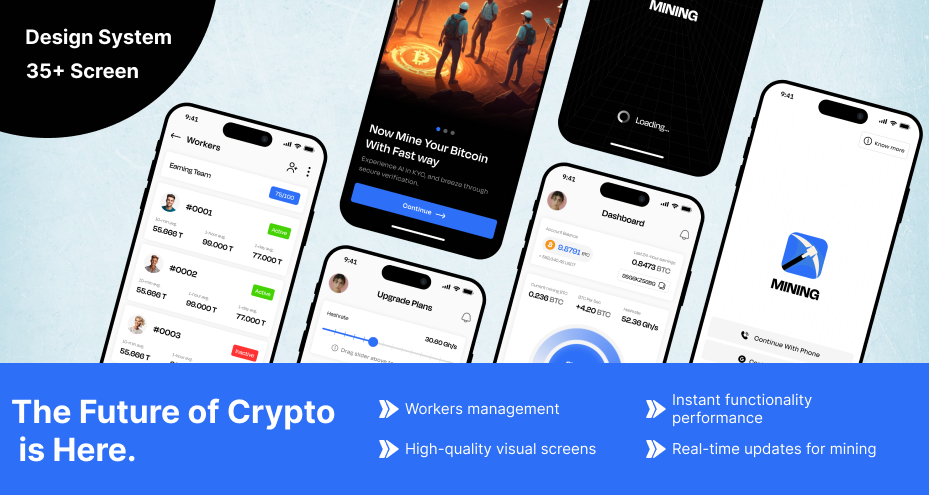
Using a pre-designed solution like the BTC Mining Mobile App Figma UI from AllClone Script. This Figma design provides:
-
Pre-built mining dashboard layouts
-
Structured onboarding and subscription flows
-
Earnings and withdrawal screen templates
-
Dark-mode optimized mobile UI
-
Editable Figma components
-
Developer-ready hierarchy
This approach allows teams to focus on back-end mining logic and blockchain integration rather than interface experimentation.
When speed-to-market matters, advantaging a validated UI framework significantly reduces risk and accelerates MVP delivery.